
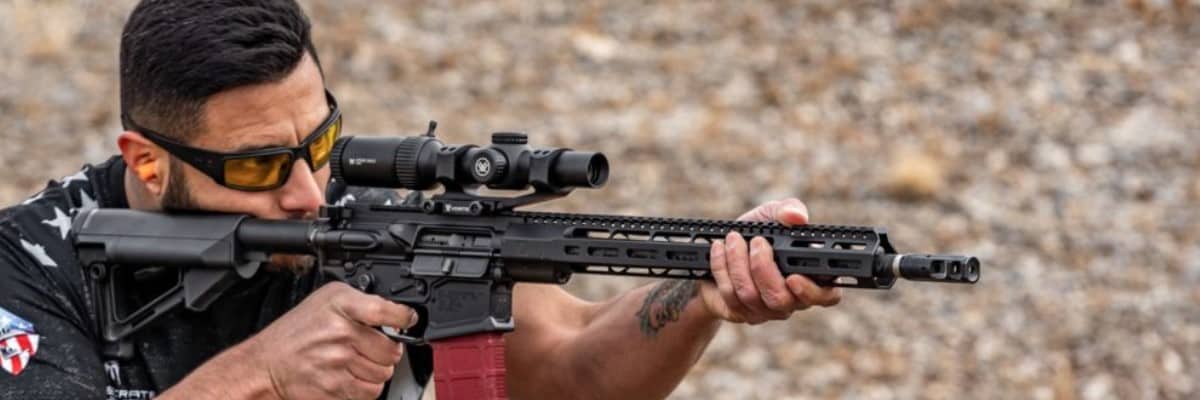
First focal plane glass used to come with a price of admission that put it out of reach for most people building a fighting carbine or a do-it-all AR. You either paid a small fortune for holdovers that worked at every magnification, or you settled for a second focal plane scope whose reticle only told the truth at full power. The Strike Eagle 1-8×24 FFP is Vortex’s answer to that gap, running the EBR-8 MOA reticle in the front plane at a price that normally buys you the SFP version and nothing more.
I wanted to know whether the focal-plane upgrade was the real thing or a marketing checkbox, so I put it on a carbine and ran it hard, close and far, in good light and bad. What I came away with is a scope that delivers the one feature people actually buy an LPVO for, with a couple of honest trade-offs that come with hitting this kind of money. The reticle tracks, the 1x is genuine, and the value is hard to ignore. Two small things keep it from being flawless, and neither one is a dealbreaker for the shooter this is built for.
Vortex Strike Eagle 1-8×24 FFP Review
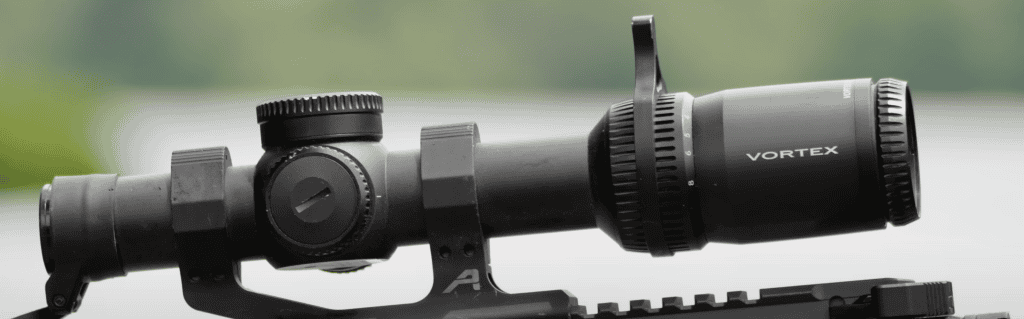
True 1x, and it actually behaves like one
Plenty of optics claim 1x and then give you a faint fishbowl that fights you the moment you try to run both eyes open. This one doesn’t. Dropped to its bottom power, the picture sat flat and natural enough that I cleared a five-target steel array from 7 to 25 yards with both eyes open and never felt that swimming lag where your brain argues with the glass. It tracks like a red dot down low, which is exactly what you want when targets are close and time is short. The throw lever rides in the box, no extra purchase required, and it snaps the magnification from 1x to 8x with a quick flick of the thumb.
The eyebox is where you feel the price. From 1x through roughly 5x it’s generous, forgiving of a sloppy cheek weld and a head that’s slightly off. Run it up toward 8x and the window tightens. It’s not punishing, but if your mount height or stock isn’t dialed, you’ll catch the edge of the picture going dark until you settle behind it. That behavior is normal for an LPVO in this bracket, and worth saying out loud since no spec sheet will warn you.
FFP is the whole reason this version exists
Strip everything else away and this is what you’re paying for. In the front focal plane the reticle grows and shrinks with the magnification, so a hashmark subtends the same true value at any power you choose. Hold on a mark at 4x and the hold is correct. Do it at 6x and it’s still correct. On the second focal plane Strike Eagle those holds only line up at maximum power, which means that whenever you grab the rifle at whatever zoom it happened to be set, you’re estimating. For a scope built to be spun up and down constantly, the front plane is simply the right engineering, and the version in front of me proves you no longer have to spend big to get it.
The glass earns its grade for the tier. It’s bright, neutral in color, and holds detail well across most of the picture. Run it to 8x and pixel-peep a high-contrast edge and you’ll find a little chromatic aberration creeping in at the margins. In live fire I never once noticed it. That’s the kind of flaw that shows up on a bench under scrutiny and vanishes the second you’re shooting something.
The EBR-8 lit up, and where the illumination runs out
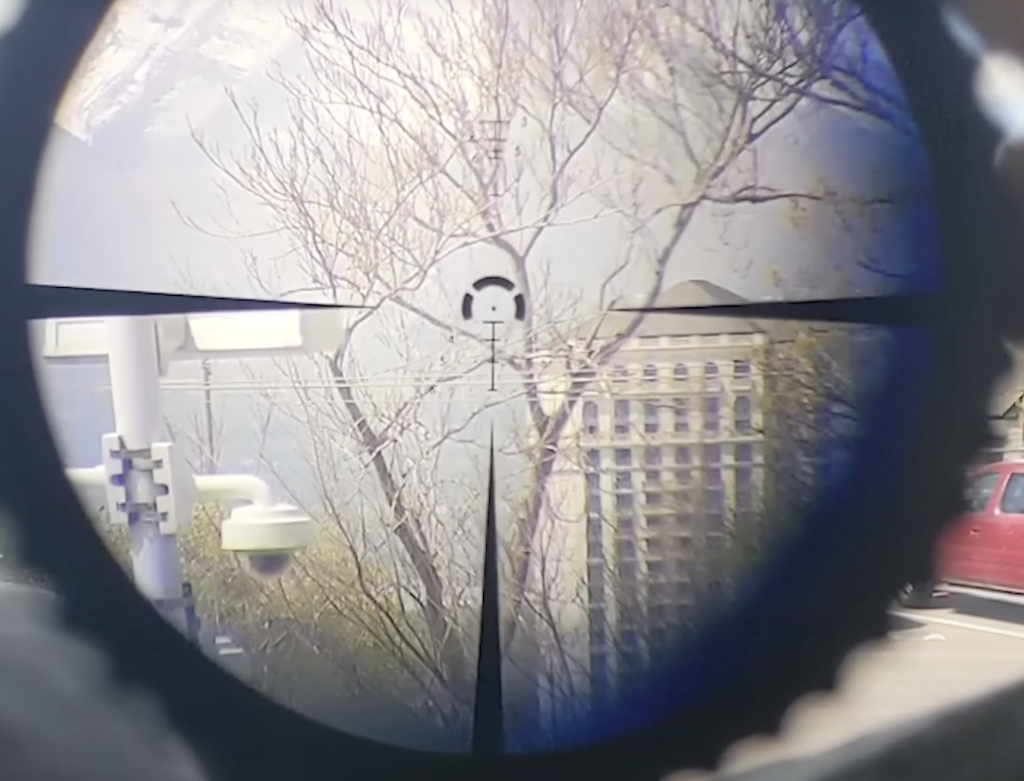
The EBR-8 is a tidy layout: a floating center dot, a horseshoe ring wrapped around it, and a stadia ladder dropping below the cross for holds, calibrated by Vortex for common 5.56 and .308 loads out to several hundred yards. Vortex is honest that it isn’t tuned to any single load, so you confirm your own holds and write them down, which is how you should treat any BDC regardless. Because it’s front plane, the reticle shrinks at 1x, and without illumination that floating dot gets small enough to hunt for against a busy background, which is the opposite of what you want up close. Illumination is the fix, and it mostly works: lit, the center behaves like a red dot at 1x. The limit is brightness. In shade or overcast it pops cleanly. Step into hard, open daylight and the top setting washes out enough to lose some of that red-dot snap. I’d have traded a lot for one brighter notch. The dial also has no off positions between clicks, so you spin it all the way down to kill it.
Set the zero, forget the turrets
The capped, zero-reset turrets fit the mission. This is a hold-over optic, not a dial-for-distance one. You sight in, reset the dials to zero, thread the caps back on, and work the reticle from then on. While I was zeroing I ran the adjustments through their paces, dialed up 20 MOA and back, fired at each stop, and the 1/4 MOA clicks moved true and returned where they started. After that I capped them and never touched them again across the rest of the test, which is exactly the intent. The 145 MOA of travel buried under those caps is far more than this role will ever draw on, but it’s there.
Heavy, and honestly worth it
The body is a single piece of aircraft-grade aluminum on a 30mm tube, nitrogen filled and O-ring sealed. It feels dense and rattle-free in the hand, the controls move with resistance that’s firm without being stiff, and with the throw lever installed the magnification ring won’t drift on its own. The cost of all that FFP hardware shows up on the scale. At 23.9 oz it sits noticeably heavier than the SFP model and most of its competition. On a featherweight build you’ll feel it up top; on a duty-style carbine you won’t think about it. Whether that matters comes down entirely to the rifle you’re hanging it on.
Running It Hard on a 16-Inch 5.56 Carbine, Close Targets to Full Power
An LPVO belongs on a semi-auto carbine, so that’s where this one went: a 16-inch AR-15 in 5.56 NATO, mounted in a one-piece cantilever to pull the eyepiece back into position, ring screws torqued to 18 in-lbs per Vortex’s spec. I fed it Federal American Eagle 55-grain FMJ for the bulk of the shooting, the cheap, common ammo someone buying a scope in this bracket actually runs. There’s no sense validating a carbine optic with match loads nobody feeds a blaster.
The shooting stretched across a few weeks of range trips chosen for variety: bright cloudless afternoons specifically to stress the illumination claim, a couple of flat overcast mornings, and one session that opened in light rain to see whether anything fogged or let water in. Nothing did. I put north of 300 rounds through it, enough to confirm a zero survives a real session and to learn the eyebox by feel instead of by staring at a bench. What I most wanted to settle was whether the front-plane holds genuinely stayed honest as I changed power, so I worked transitions from both-eyes-open 1x drills out to steel at distance, holding on the BDC at assorted magnifications. They held, and that’s the headline. The rest of how I structure these evaluations is laid out in my full testing methodology.
Performance Ratings
Field Test Data
| Test Parameter | Result |
|---|---|
| Zero retention (300+ rounds, 5.56) | Held; no measurable shift across sessions |
| Tracking check (dial 20 MOA up, return to zero) | Moved true, returned to zero, clicks repeatable |
| 1x close drill (5 steel, 7-25 yds, both eyes open) | Fast acquisition; ran like a red dot when lit |
| Front-plane hold consistency (4x, 6x, 8x) | Holds stayed accurate across magnifications |
| Daylight illumination (top setting, open sun) | Washed out; usable but not red-dot bright |
| Weather check (light rain session) | No fogging, no intrusion, glass shed water |
Tested with: 16″ AR-15 (5.56 NATO) | Federal American Eagle 55gr FMJ | one-piece cantilever mount
Pros and Cons
PROS
|
CONS
|
The Shooter This Carbine Optic Was Built For
This lands squarely for the shooter who specifically wants first focal plane on an AR and isn’t ready to spend four figures to get it. Building a carbine for range work, training, or entry-level tactical competition, where you want holds that stay correct at whatever power you’re on, puts you exactly in this scope’s lane, and almost nothing else hits that value mark. It’s also a fair pick for predator and big-game work where you mostly live at lower magnification, since the 1x is fast and the reticle gives usable holds when you reach out.
Steer clear if you’re chasing a featherweight, fast-handling build, because 23.9 oz is a real anchor up top and lighter options exist. It’s also the wrong tool if your shooting happens mostly in bright open ground and you’re banking on a daylight-bright lit center at 1x; the front-plane reticle goes small down low and the illumination won’t fully carry it in hard sun, so a daylight-bright SFP optic or a higher tier suits you better. Same answer for the committed MRAD shooter, since this one ships in MOA only.
Common Questions About the Strike Eagle 1-8×24 FFP
How is the FFP version different from the standard Strike Eagle 1-8×24?
Focal plane is the big one. The FFP reticle scales with magnification, so your holds are correct at any power, not just 8x. It also runs the EBR-8 MOA reticle and weighs more than the SFP model, with a step up in glass and turrets.
Is the illumination bright enough to use like a red dot in daylight?
In shade and overcast it works well at 1x. In hard open sun it washes out and loses snap. If daylight-bright performance is a hard requirement for you, this isn’t the scope to bank on for it.
What reticle does it use, and is it calibrated to my load?
The EBR-8 MOA, with a floating dot, horseshoe ring, and a BDC ladder. Vortex calibrates it for common 5.56 and .308, but not for any single load. Confirm your own holds at the range.
Will it survive hard recoil?
Built from a single block of aircraft-grade aluminum and rated for high recoil and impact. It held zero through my 5.56 testing, and on a standard carbine durability isn’t a worry. It carries Vortex’s lifetime VIP warranty regardless.
Does it come with a mount?
No. Budget for a one-piece cantilever to set eye relief correctly on an AR. It does include the throw lever, flip caps, and a sunshade, which softens that a bit.
Is it offered in MRAD?
Not currently. This one is MOA only. If you run MRAD across your other optics, look at Vortex’s Viper or Razor lines to stay consistent.
Where to Look If This One Misses Your Mark
If the tight 8x eyebox or the weight steers you off, the Primary Arms SLx 1-8×24 FFP with the ACSS reticle is the closest cross-shop. It’s the same value bracket, also front plane, and the ACSS is a more complete ranging-and-holdover system than the EBR-8 if you want to do more than basic BDC work.
If you don’t already own a mount, the Sig Sauer Tango MSR 1-6×24 ships with one in the box, which closes much of the gap since you skip buying a cantilever. You give up 2x of top-end magnification, which matters past mid range, but its illumination and eye relief edge this one out for closer, faster work.
And if you want to stay at 1-8x for similar money but prefer a different reticle feel, the Athlon Argos BTR Gen2 1-8×24 is the other budget front-plane option shooters land on. Cross-shop it on glass and reticle preference, since the core job is the same.
Disclosure
This review reflects my own hands-on testing and honest assessment of the scope. This post may contain affiliate links, and I may earn a small commission if you purchase through them at no extra cost to you. Affiliate relationships do not affect my evaluation, my ratings, or anything I’ve said here.
The Strike Eagle FFP Makes an Easy Case for Itself
If you want true first focal plane on a 1-8x and you’re not willing to spend triple to get there, this is the scope, and it delivers on that pitch cleanly. The reticle upgrade is the whole story: holds that stay correct at every magnification erase the one thing that always made the SFP version a hedge. The 1x is genuine, the glass is good for the tier, it tracked true, and it held zero through everything I asked of it.
It isn’t perfect. The eyebox snugs up at 8x, the illumination won’t punch through open daylight like a true red dot, and it carries some weight. None of those sink it for the shooter it’s built for, the person who wants a capable, do-everything optic on an AR without draining the account. If you need daylight-bright illumination or you’re counting grams on a light build, look elsewhere. For anyone else stepping into front-plane glass for the first time, this is the easiest recommendation in the category. Bolt on a solid cantilever and go shoot.
Mike Fellon is the founder of ScopesReviews and an optics specialist with 15+ years in precision shooting. A former Bass Pro Shops firearms advisor and NRA-certified instructor, he’s hands-tested 200+ rifle scopes across hunting and competition. Based in Dallas, Texas.