
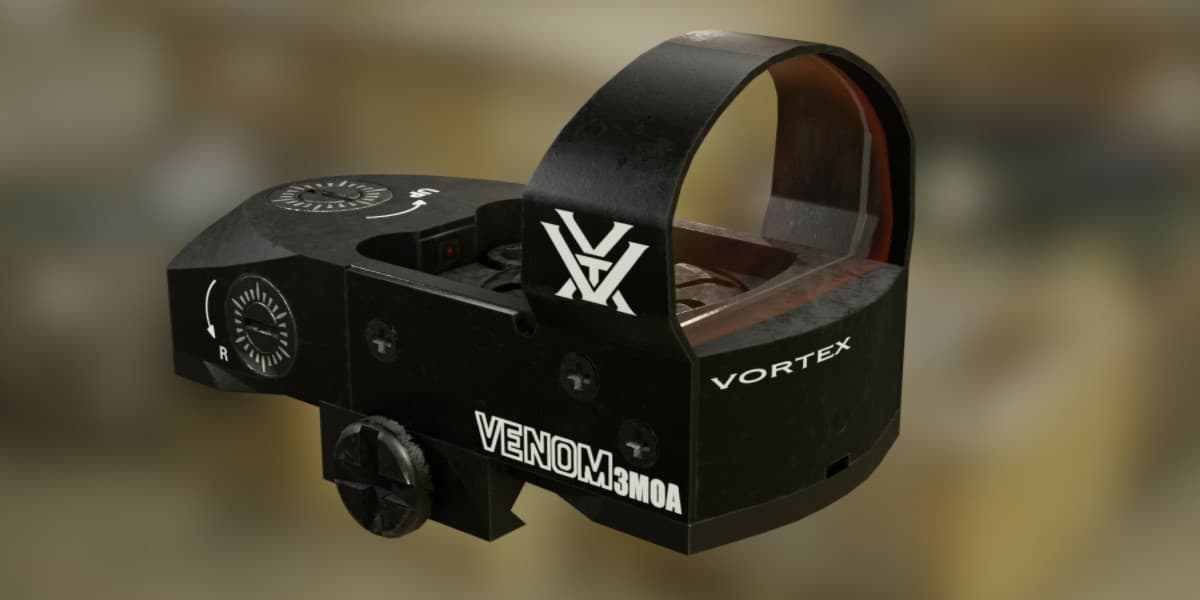
Vortex built the Venom as an open reflex sight that goes wherever you bolt it, and most of the marketing leans on the top-loading battery tray and that wide 26.5mm window. It gets sold hard as a pistol optic, but spend any time around turkey and waterfowl rigs and you’ll notice where a lot of them actually live: on a shotgun rib. That is the version of the Venom I wanted to put through its paces, because a reflex sight on a 12 gauge has to survive abuse that a carry pistol never dishes out.
My questions going in were narrow. Does the open emitter hold up to heavy magnum recoil over a full patterning regimen? Is the top-load battery the genuine convenience Vortex claims, or a gimmick? And how does a 3 MOA dot behave in the bright, open settings where you actually hunt birds? The answers landed somewhere short of dramatic. This is a competent, versatile reflex with one real selling point and a short list of quirks you live with rather than fight. Nothing about it shocked me in either direction, and for this category that is closer to praise than it sounds.
Vortex Venom Review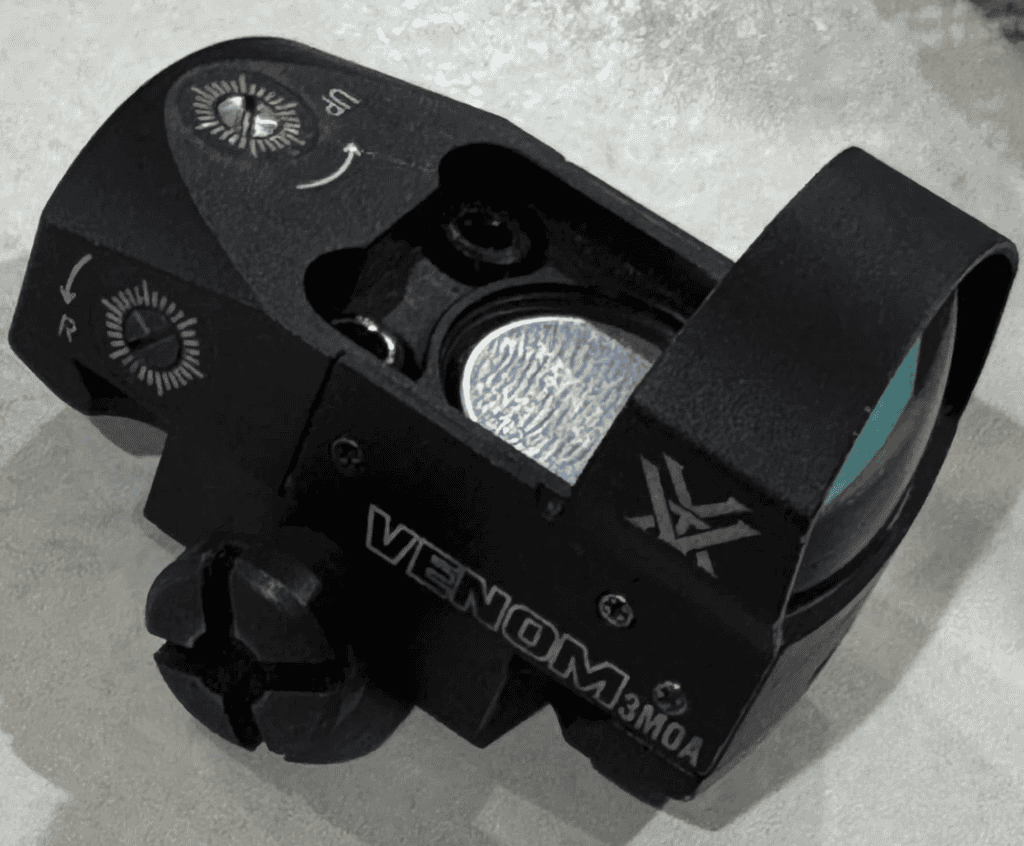
Why a shotgun rib instead of a slide
The Docter and Noblex footprint, the 1.05 oz weight on the 3 MOA model, and that big window all point at a gun where speed and a wide sight picture matter more than a tiny profile. A turkey gun fits that description perfectly. You sit, you call, and when a gobbler commits you have a second or two to put a dense pattern on his head and neck at distance. A reflex with a clean dot and a window you can find fast beats iron beads every time, and the Venom’s window is roomy enough that I never had to hunt for the dot when I shouldered the gun in a hurry.
The top-load tray actually delivers
Halfway through a long patterning day the dot started looking dim even after I bumped the brightness, the classic sign of a tired cell. At the bench I backed out the top tray screw, dropped in a fresh CR1632, and snugged it down, all without breaking the mount or touching the windage and elevation. Sent three more rounds at the pattern board and the center of the pattern sat exactly where it had before the swap. On a Viper, or any sight with a bottom-load battery, that same swap means pulling the optic and re-confirming everything. For a gun zeroed to a specific turkey load, the top tray is not a marketing line; it is the feature that justifies picking this Venom over its stablemate.
The battery cap fights back
That convenience comes with a catch I felt the second time I opened the tray. The cap threaded crooked on me, and the shallow coin slot does not give you much leverage to seat it square. I caught it before I stripped anything, but I understand exactly why this shows up in owner complaints. You learn to start the threads by hand, gently, and let the coin do nothing but the final snug. Treat it like a careless quarter-turn and you will chew up that slot.
A clean dot until you crank it
The 3 MOA dot is the right size for this work, small enough to leave the bird’s head visible at patterning distance, big enough to grab fast in the window. In flat morning light it was crisp. The problem showed up midday in an open field with the sun high, when I ran the brightness up near the top of the 10 manual settings to fight the glare. The dot bloomed into a ragged little starburst, the cauliflower look that astigmatic shooters know well and that the Venom exaggerates at full tilt. Dropping it two clicks tightened it right back into a usable dot. The auto-brightness mode handled most transitions on its own and kept me off the high settings, which is the real fix: let the ambient sensor pick, and the dot stays clean.
The dark-window moment
The quirk that genuinely bit me has nothing to do with recoil or glass. Set up against a tree before legal light one morning, I sat dead still through a slow hour of calling. When a tom finally eased into range and I came up on the gun, the window was black. No shake awake means motionless time does not wake the dot, and on a long static sit you are relying on either having switched it on deliberately or on it not having timed out. The auto-off shuts the sight down after 14 hours, which is fine, but the absence of a motion sensor is the wrong omission for a sight that ends up on so many hunting guns. I thumbed it on, the bird hung up, and I got a second chance, but a turkey hunter cannot count on that. After that morning I made a habit of switching it on the moment I sat down, every time.
What held up
Magnum 3.5-inch loads are violent in a way that surprises people who only shoot rifles, a short brutal slam rather than a push, and that abrupt jolt is what cracks emitters and walks mounts loose. The Venom shrugged it off. Through the whole patterning regimen the dot never flickered under recoil and the pattern center never wandered. A patterning session got rained on for a solid stretch and the sealed, nitrogen-purged housing never fogged or fritzed. For a sub-two-ounce reflex riding one of the harder-kicking platforms in the safe, that durability is the quiet thing the Venom does best.
If you are interested in my other articles have a look at Burris AR-536 review or Sightmark Ultra Shot Plus review.
How I Set Up the Venom for a Heavy-Recoil Turkey Gun
I ran the Venom 3 MOA on a Mossberg 835 Ulti-Mag, fed Winchester Long Beard XR 3.5-inch #5 turkey loads. The 835 is overbored, 3.5-inch chambered, and one of the harder-kicking turkey guns you can buy, which is precisely why I picked it: if the open emitter was going to loosen or fail, this platform would expose it. I mounted the sight on a Picatinny base over the drilled-and-tapped receiver with a low Docter-pattern mount, then confirmed the pattern at 40 yards from a bag before any of the run-and-gun work began.
Here is where the experience behind the review matters. Over the years I have bolted a stack of open-emitter reflexes onto shotgun ribs, and the failure pattern is consistent: it is rarely the glass that quits, it is the emitter housing or the mount giving up under that abrupt magnum slam. I have watched two well-reviewed reflexes start throwing a doubled or smeared dot after a few boxes of heavy loads, and one walk its zero a full pattern-width left over a single afternoon. Knowing that pattern is the whole reason I trust a shotgun verdict on this category, and it is why I weight recoil survival on a 12 gauge far more heavily than I would on a pistol slide. The Venom landing on the right side of that line is not a given; plenty of sights in its tier do not.
Across roughly 180 rounds of mixed 3.5-inch turkey and practice loads, through one rained-on session and a midday glare test, I checked zero after every string and ran cold shouldering drills to time how fast the dot came up. You can read my full testing methodology in the full testing methodology writeup.
Performance Ratings
Field Test Data
Tested on: Mossberg 835 Ulti-Mag | 12 Gauge | Winchester Long Beard XR 3.5″ #5
| Test Parameter | Result |
|---|---|
| Zero retention after magnum strings | No measurable shift after ~180 rounds of 3.5-inch loads; pattern center held at 40 yards |
| Battery swap without re-zero (top tray) | Fresh CR1632 installed at the bench; no point-of-impact shift on follow-up pattern |
| Dot bloom onset | Visible starburst at manual settings 8-10 in bright open field; tightens at 6-7 or on auto |
| Dot stability under recoil | No flicker or doubling during 3.5-inch magnum strings |
| Wet-weather performance | Steady rain during one patterning session; no fogging or function loss (IPX7, nitrogen purged) |
| Static-sit power behavior | Window found dark after a long motionless sit; no shake awake to recover it, only 14-hour auto-off |
Common Questions About the Vortex Venom
Should I get the 3 MOA or 6 MOA Venom?
The 3 MOA is the most popular for a reason: it leaves more of the target visible and works better at distance. Go 6 MOA only if your eyes struggle with the smaller dot or you want the fastest possible pickup up close.
Venom or Viper for a pistol?
For a dedicated handgun, the lower-profile Viper usually fits better. The Venom’s strength is the top-load CR1632 battery, which matters most on a long gun or shotgun where you do not want to pull the optic to swap a cell.
Can the Venom handle shotgun recoil?
Yes. It held zero and dot stability through heavy 3.5-inch magnum turkey loads in my testing, which is harder on an optic than most rifle work.
Why does my dot look fuzzy or like a starburst?
That is usually too much brightness for the conditions, exaggerated if you have astigmatism. Drop a few settings or use the auto-brightness mode and the dot tightens up.
Does it have shake awake?
No. It has auto-off after 14 hours but no motion sensor, so it will not wake on movement. Switch it on deliberately before a long static sit.
Will it fit any optics-ready gun?
It uses the Docter/Noblex footprint, not the RMR pattern. Confirm your slide cut, plate, or mount matches before buying.
If the Bright-Setting Battery Life or Missing Shake Awake Is a Dealbreaker
The Venom’s two real weak points, a thirsty bright end and no motion wake, are exactly where a couple of competitors pull ahead.
If the dark-window problem on a static hunt bothers you as much as it bothered me, look at the Holosun 507C X2. Its Shake Awake wakes the dot the instant you move the gun, which is the single feature the Venom most obviously lacks, and you also get a selectable circle-dot reticle and a far longer battery runtime.
If you want the same top-load convenience but in a slimmer package built specifically for a pistol slide, the Vortex Viper sits lower and tucks into a holster more easily, at the cost of the 3 MOA option and the larger window. It is the better pick if a handgun is the only gun this sight will ever ride.
And if outright durability and battery life on a hard-recoiling gun is the whole point, the Sig Sauer Romeo1Pro brings a tougher reputation and longer runtime, though it gives up the easy top-load battery access that makes the Venom so painless to maintain on a zeroed gun.
You can check read the Vortex Sparc 2 review or EOTech 512 review.
Disclosure
Everything above came from my own range time with this sight. This article may contain affiliate links, and a purchase made through them can earn a commission at no extra cost to you. Those relationships do not influence the evaluation or the ratings above.
The Venom Is a Buy for the Shooter Who Values Easy Maintenance Over a Flawless Dot
The Venom does not try to be the best reflex on the market, and it is not. What it does is cover a lot of ground competently and put one genuinely useful feature, the top-load battery, where it counts. On a hard-kicking turkey gun it held zero through punishing magnum loads, never fogged in the rain, and let me swap a dying cell at the bench without losing my pattern. Those are the things that matter on a gun you maintain across seasons.
The compromises are honest and small: the bright end of the brightness range eats batteries and blooms the dot, and the missing shake awake means you have to remember to turn it on before a long sit. Neither sinks the sight. If you want a versatile, durable mid-tier reflex for a shotgun, carbine, or any gun where painless battery swaps beat the last ounce of dot crispness, buy the 3 MOA Venom and pair it with the auto-brightness mode. If a clean dot at max brightness or a motion-wake sensor is non-negotiable, this is not your sight, and the alternatives above will serve you better.
For more Vortex red dots, check out Vortex Crossfire red dot sight and Vortex Viper red dot sight.
Mike Fellon is the founder of ScopesReviews and an optics specialist with 15+ years in precision shooting. A former Bass Pro Shops firearms advisor and NRA-certified instructor, he’s hands-tested 200+ rifle scopes across hunting and competition. Based in Dallas, Texas.