
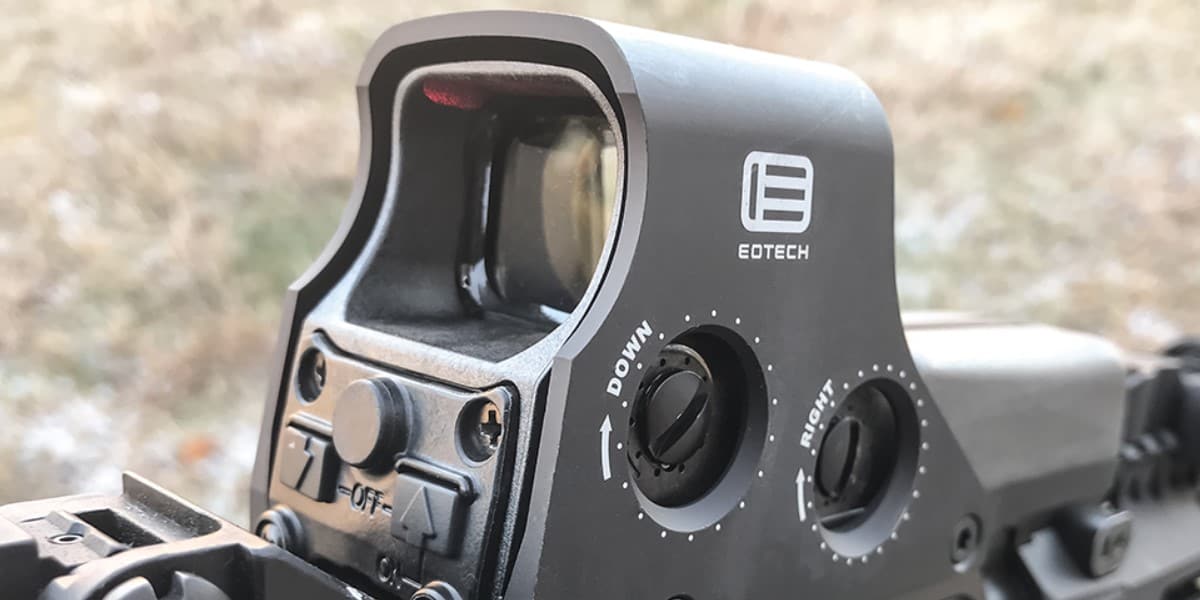
The EOTECH 512 has been around long enough that most shooters have formed an opinion about it without ever mounting one. It is the sight that put holographic technology in the hands of regular carbine shooters, the one that survived a very public thermal drift lawsuit and came out the other side still selling, and the one people keep buying even though the holographic market looks different now than it did a decade ago.
I wanted to run a current-production 512 partly because my last sustained time with one was years ago, and partly because the conversation around it has changed. Holosun’s 510C keeps getting cross-shopped against it despite being LED reflex technology, not holographic. The Vortex UH-1 Gen II arrived as the only other true holographic option on the market. Whether the 512 still earns a recommendation when those alternatives sit next to it on the shelf is a question I wanted to answer with rounds downrange, not spec-sheet comparisons.
What I found is a sight that does its core job about as well as anything I have tested, wrapped in a package that the competition has outgrown.
EOTECH 512 Review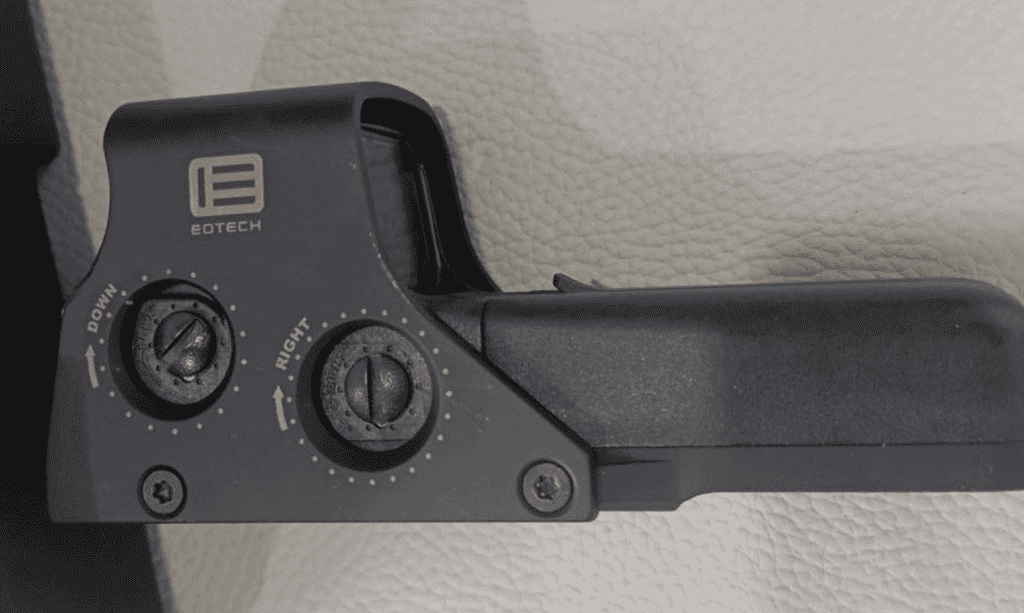
The 68 MOA Ring on a Shot Timer
I started the evaluation with a set of Bill Drills at seven yards: six rounds on an IPSC target from a low ready, running on a par timer. On the first presentation of the morning, I pushed the BCM out and the 68 MOA circle was already framing the A-zone before I had consciously picked up the center dot. The ring handles gross alignment; the 1 MOA dot refines it. By the third run I was clearing six rounds in just over three seconds, and the consistency came from not having to hunt for a tiny aiming point in the window. The ring pulled my eye where it needed to go.
The window at 1.20″ x 0.85″ is not the largest in the holographic category, but both eyes open at CQB distances it was never a limiting factor. The housing frame disappeared when my focus was on the target. The reticle sits on the focal plane in a way that keeps both the ring and the target background sharp simultaneously, which is what holographic projection does differently from a reflected LED. For shooters who have dealt with LED red dots smearing into starbursts through astigmatism, the 512’s laser-projected hologram typically resolves it.
Forty-Five Minutes Face-Up on the Bench
The thermal drift history is the thing people bring up first with any EOTECH, so I tested it directly. After the morning’s speed work, I left the BCM with the 512 mounted face-up on the shooting bench in direct sun. Ambient was reading 97°F on the truck thermometer. Forty-five minutes later I loaded a fresh magazine and fired a five-round group from the bench at 25 yards without adjusting anything.
The group had walked roughly 1.5 MOA to the right. All five rounds were still inside the A-zone of an IPSC target at that distance, so it is not a catastrophic shift. It is measurable and it is real. For a home-defense carbine that lives in a closet at room temperature, thermal drift is irrelevant. For a patrol rifle that sits in a hot trunk through a summer shift, it is worth knowing about. Current-production 512s are meaningfully better than the units that triggered the class action settlement, but thermal sensitivity has not been eliminated from the design.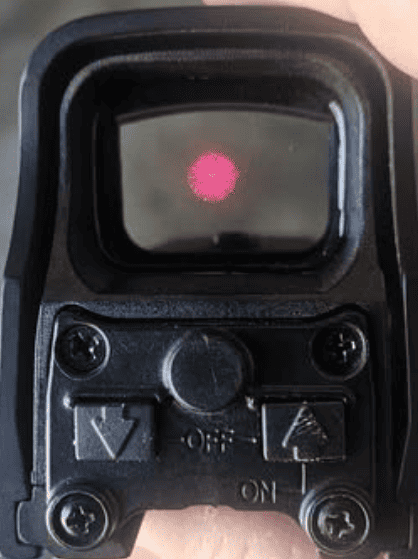
Swapping Uppers With a Knob Mount
During a break I tried moving the 512 from the BCM to a second upper I had along. The knobbed cross-bolt requires loosening by hand, lifting the sight off the rail, setting it on the new upper, and tightening the knob back down. That process took about four minutes, and confirming zero on the new upper added another five. A QD lever on the EXPS series turns the same operation into thirty seconds.
The knob mount itself is secure. I had no issues with movement or loosening during the entire four-hundred-round evaluation, and return to zero after the full removal and reinstall measured within 0.75 MOA. Solid lockup. But the time cost of removing and reinstalling this sight is the clearest everyday gap between the 512 and EOTECH’s own higher-tier models.
Flipping the G33 In at Fifty
I paired the 512 with a G33 magnifier for the last portion of testing, running a 6-inch steel plate at fifty yards. Behind the 3x magnifier, the ring expanded as expected and the 1 MOA center dot stayed clean enough to hold center on the plate without searching. No noticeable vignetting or edge distortion with the G33 seated in its flip-to-side mount at correct eye relief.
The ring-dot reticle makes more sense behind magnification than a single dot does, because the ring gives you a reference frame for the hold while the dot does the precise work. At fifty yards I was ringing the plate on a consistent rhythm, and the 512-plus-G33 combination felt like it genuinely extends this sight past pure CQB distances. If you are considering the 512, budgeting for a magnifier is worth planning for.
Four Hundred Rounds on a BCM Carbine in July Heat
I mounted the 512 on a BCM RECCE-16 in 5.56 NATO, a 16-inch mid-length gas carbine that represents the general-purpose AR this sight is most likely to ride on. Ammunition was Federal American Eagle 55gr FMJ, a standard ball load that keeps variables simple and matches what most shooters actually run at the range. I chose a summer testing window deliberately because thermal behavior is the thing people ask about most with any EOTECH, and I wanted to see it under genuine heat rather than speculate from a spec sheet.
Testing happened at an outdoor range over two sessions totaling around four hundred rounds. Conditions were mid-July: 95 to 97°F ambient, direct sun, no shade over the shooting positions, moderate wind. The first session covered zeroing, speed drills at 7 to 15 yards both eyes open, and an intentional 45-minute thermal soak test at 25 yards. The second session focused on magnifier pairing with a G33 at 50 yards and a sustained-fire string to check for reticle behavior under recoil accumulation.
The thermal test is where category experience matters most. Last summer I ran a Holosun 510C through the same face-up bench soak in comparable heat, and it held dead zero across a two-hour window. The 512 shifted. That difference is a characteristic of holographic projection versus LED reflex technology, and it shows up reliably when ambient temperatures push past 90°F. Having measured it across both platforms is what lets me separate a manageable trade-off from a disqualifying flaw; the 512’s thermal behavior falls in the first category for how most shooters will actually use this sight. The full methodology behind how I structure these evaluations is covered in my full testing methodology.
Performance Ratings
Field Test Data
| Test Parameter | Result |
|---|---|
| Zero Confirmation (25 yds, bench rest) | 5-shot group centered within 0.5 MOA of point of aim |
| Return to Zero After Full Remount | 0.75 MOA rightward shift (knob mount, hand-torqued) |
| Thermal POI Shift (45 min direct sun, 97°F) | 1.5 MOA rightward walk |
| Presentation to First Shot (7 yds, low ready) | 0.85 sec average (10-rep par timer) |
| Target-to-Target Transitions (IPSC at 5-12 yds) | 0.42 sec average split between targets, both eyes open |
| Maximum Usable Brightness in Direct Sun | Setting 18 of 20 adequate at midday |
| Magnifier Pairing (G33, 50 yds, 6″ steel) | Consistent hits; ring and dot clean through 3x with no vignetting |
Tested on: BCM RECCE-16 | 5.56 NATO | Federal American Eagle 55gr FMJ
Common Questions About the EOTECH 512
Did EOTECH fix the thermal drift issue in the 512?
Post-2016 production units are significantly improved. Testing still shows 1 to 2 MOA of shift is possible in sustained heat above 90°F, but it is far less severe than pre-settlement units. For indoor home-defense use at room temperature, thermal drift is a non-issue.
What is the difference between the EOTECH 512 and the XPS2?
The XPS2 is shorter, lighter, uses a single CR123A battery, and has rear-mounted push-button controls. The 512 uses AA batteries and side-mounted buttons. Optical performance and reticle pattern are identical. The XPS2 fits shorter rails and weight-conscious builds better.
Can I use the EOTECH 512 with a magnifier?
Yes. The 512 pairs well with EOTECH’s G33, G43, and G45 flip-to-side magnifiers. The ring-dot reticle stays clean behind magnification, and the Picatinny footprint leaves adequate rail space for a magnifier mount behind it.
Is the EOTECH 512 better than LED red dots for astigmatism?
Generally, yes. The 512 uses a laser-projected hologram rather than a reflected LED, so the starburst or smear effect common with LED red dots is typically reduced or eliminated. Holographic reticles tend to render cleaner for astigmatic eyes.
How does the 512’s battery life compare to LED red dots?
It does not compare favorably. The 512 runs 2,500 hours on lithium AAs at nominal brightness, versus 50,000 or more hours for many LED sights. The trade-off is holographic reticle technology, which requires substantially more power than a simple LED emitter.
Does the EOTECH 512 work with night vision?
No. The 512 has no night-vision-compatible brightness settings. For NV use, EOTECH’s EXPS3 or XPS3 models include dedicated NV brightness levels below the visible spectrum.
If Battery Life or a QD Mount Tops Your List
Holosun HS510C: If the 512’s battery appetite and lack of shake-awake are the sticking points, the 510C runs solar backup with shake-awake and is rated beyond 50,000 hours on battery alone. It is LED reflex technology, not holographic, so the reticle will render differently for astigmatic eyes and lacks the holographic focal-plane projection. But for shooters who prioritize set-and-forget power management over holographic technology, it costs less and runs far longer.
Vortex Razor AMG UH-1 Gen II: The only other true holographic sight in current production. Enclosed-emitter design protects the window, USB-C rechargeable battery eliminates disposable cells, and the EBR-CQB reticle offers holdover references the 512’s circle-dot lacks. Heavier and bulkier than the 512, but if the knob mount’s slow swap time or the disposable-battery dependency stood out during your evaluation, the UH-1 Gen II addresses both with a modern feature set.
EOTECH XPS2-0: Same holographic reticle and optical path in a shorter, lighter chassis with rear push-button controls. Runs a single CR123A battery. If the 512’s 5.6-inch length or the knob mount’s slow install time were the friction points in your decision, the XPS2 solves those while keeping the optical performance identical.
Disclosure
This review may contain affiliate links. If you make a purchase through those links, ScopesReviews earns a small commission at no additional cost to you. Affiliate relationships have no influence on testing procedures or editorial conclusions.
Proven Holographic, Stubborn Package
The EOTECH 512 is a straightforward buy for carbine shooters who have decided they want holographic technology in its simplest, most field-proven form. The 68 MOA ring and 1 MOA center dot is still one of the fastest acquisition reticles I have tested on a carbine. The holographic projection renders cleaner for astigmatic shooters than LED alternatives. The housing has survived two decades of military adoption and a class action lawsuit without losing its core customer base. Those things carry real weight.
The mounting system is slow. Battery life is a fraction of what LED red dots deliver. Thermal shift is measurable in sustained heat. There are no night vision settings. Those are not hidden problems; they are the known trade-offs of choosing the entry-level model from a company that concentrates its feature development in the EXPS line. The 512 has not kept pace with the broader market on convenience features, and it has never tried to.
This sight lives and dies on its holographic reticle. If the ring-dot projection and the proven reliability behind it are what brought you here, the 512 delivers exactly what it has delivered for twenty years. Shooters who need NV capability, a QD mount, or battery life measured in years rather than months should look to the EXPS3 or across the market to the Vortex UH-1 Gen II.
Mike Fellon is the founder of ScopesReviews and an optics specialist with 15+ years in precision shooting. A former Bass Pro Shops firearms advisor and NRA-certified instructor, he’s hands-tested 200+ rifle scopes across hunting and competition. Based in Dallas, Texas.