
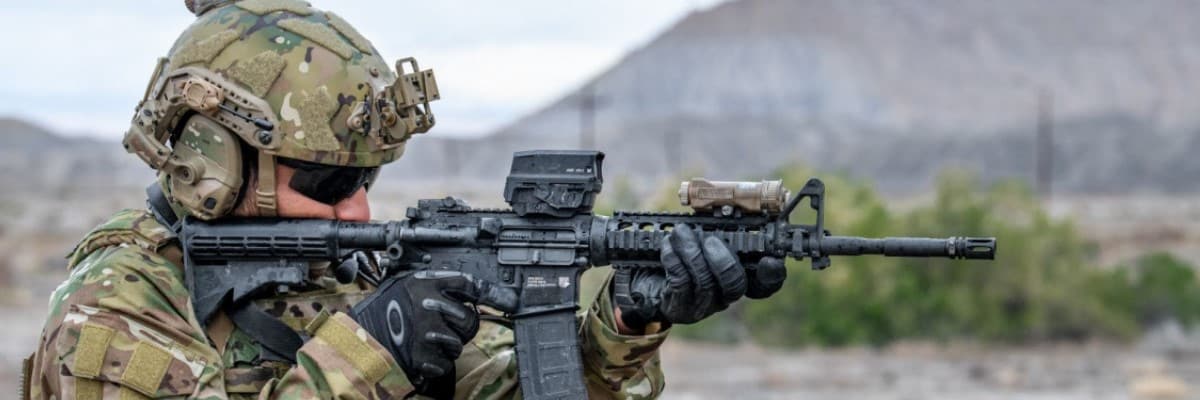
Vortex made the only fully enclosed holographic weapon sight on the market that isn’t an EOTECH, and the Gen II version finally added what the original lacked: dedicated night-vision capability and a reworked button layout. It sits in premium territory, competing head-to-head with EOTECH’s EXPS line, but with a fundamentally different design philosophy. Enclosed aluminum housing instead of an open frame. The EBR-CQB reticle, with its CQB triangle and 65 MOA outer circle, instead of the familiar 68 MOA ring-and-dot.
I put 350 rounds through a Gen II on a Springfield Armory Saint Victor to find out whether the enclosed design and unique reticle justify what they cost in added weight. At 11.6 oz, the UH-1 Gen II is heavier than anything EOTECH offers at this tier, and Vortex is betting that the sealed housing, toolless battery cap, and their VIP lifetime warranty earn that bulk.
Build quality and reticle design both deliver on what Vortex promises. The weight penalty, though, showed up faster than the spec sheet suggests once I started running the gun hard.
Vortex AMG UH-1 Gen II Review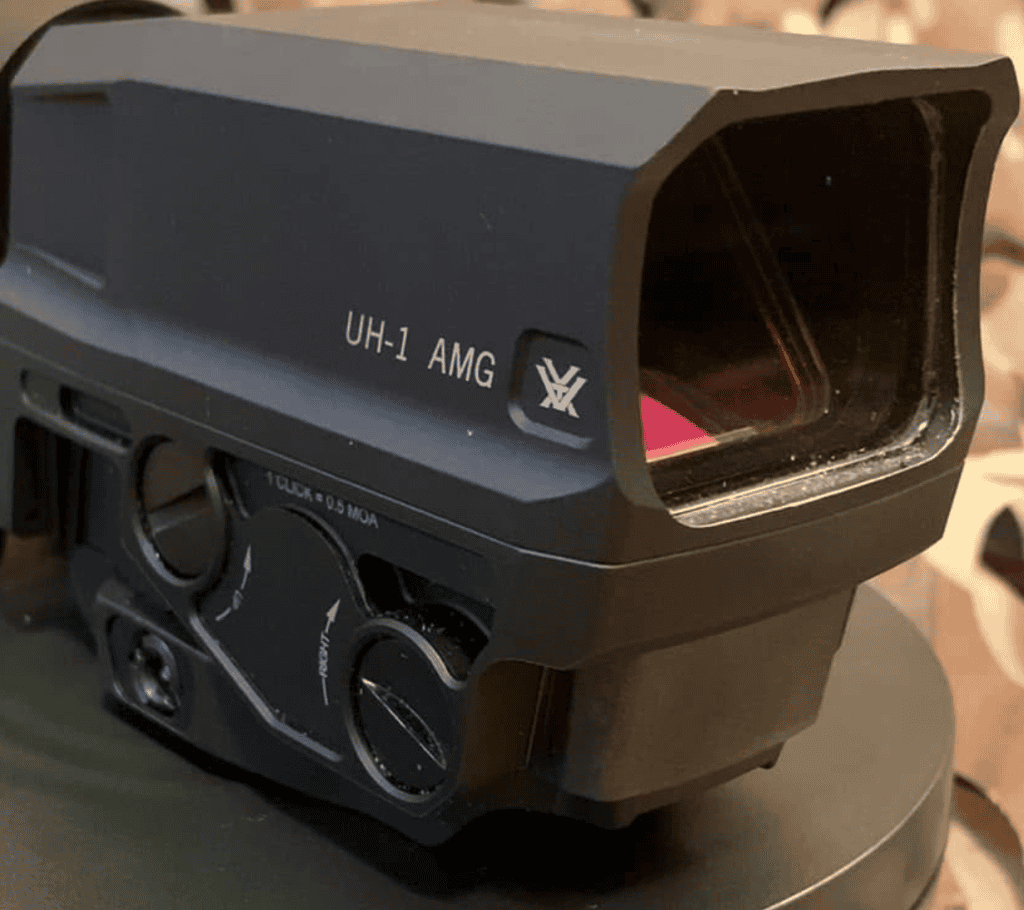
The Reticle That Needs a Second Look
The EBR-CQB reticle is not what your eyes expect if you’ve spent time behind EOTECH holographic sights. The outer 65 MOA circle is familiar enough, but the CQB triangle sitting inside it, pointing down toward the 1 MOA center dot, creates a layered visual that took me three or four presentations before my eye stopped trying to choose between the triangle and the dot. On my first string of controlled pairs at 15 yards, I caught myself settling on the triangle apex instead of the center dot, and my shots walked about two inches high. By the second magazine, my eye had figured out the hierarchy: triangle pulls you in, dot does the work. Once that click happened, the reticle drove fast.
At both-eyes-open speed, the 65 MOA circle functioned the way a ring should on a holographic; it framed the target and let peripheral information through without crowding the sight picture. The enlarged viewing window on the Gen II made both-eyes-open shooting feel less like looking through a porthole, which was my main gripe with the original UH-1 when I ran one briefly a couple of years ago. The holographic projection rendered clean against cluttered backgrounds, bright sky, and the dark interior of a covered firing position. Something that matters for shooters dealing with astigmatism: this is a true holographic reticle, a projected laser hologram, not a lens-reflected LED. A friend who came out to shoot and normally fights starburst on his Sig Romeo5 looked through the UH-1 Gen II and said the reticle was the crispest non-magnified image he’d seen. That tracks with what I’ve observed across holographic sights generally; they tend to render cleaner for astigmatic eyes than LED reflex dots.
11.6 Ounces on a Running Carbine
The weight caught up to me faster than expected. On the Springfield Saint Victor, the UH-1 Gen II pushed the balance point noticeably forward compared to where this carbine usually sits with a lighter optic. During a series of port-to-port transition drills, maybe my sixth or seventh rep, I noticed the muzzle wanting to dip between presentations. Not a dramatic nose-dive; more of a subtle forward pull that cost me about two-tenths on my splits compared to what I’d gotten from the same gun wearing a Holosun 510C the week before. For standing static shooting or from a supported position, the 11.6 oz barely registers. On a gun you’re driving hard between positions, it accumulates.
The enclosed housing is the reason for that weight, and it earns its existence in ways lighter sights cannot. During a simulated cover drill, I pressed the sight into a barricade edge harder than I meant to. The aluminum housing took the contact without a thought; I didn’t flinch. That kind of confidence matters on a duty gun or a home-defense carbine that might get grabbed in the dark and shoved against a doorframe. The QD lever released and reseated cleanly every time, and the lower 1/3 co-witness height put my front sight post in the lower third of the window where it belongs.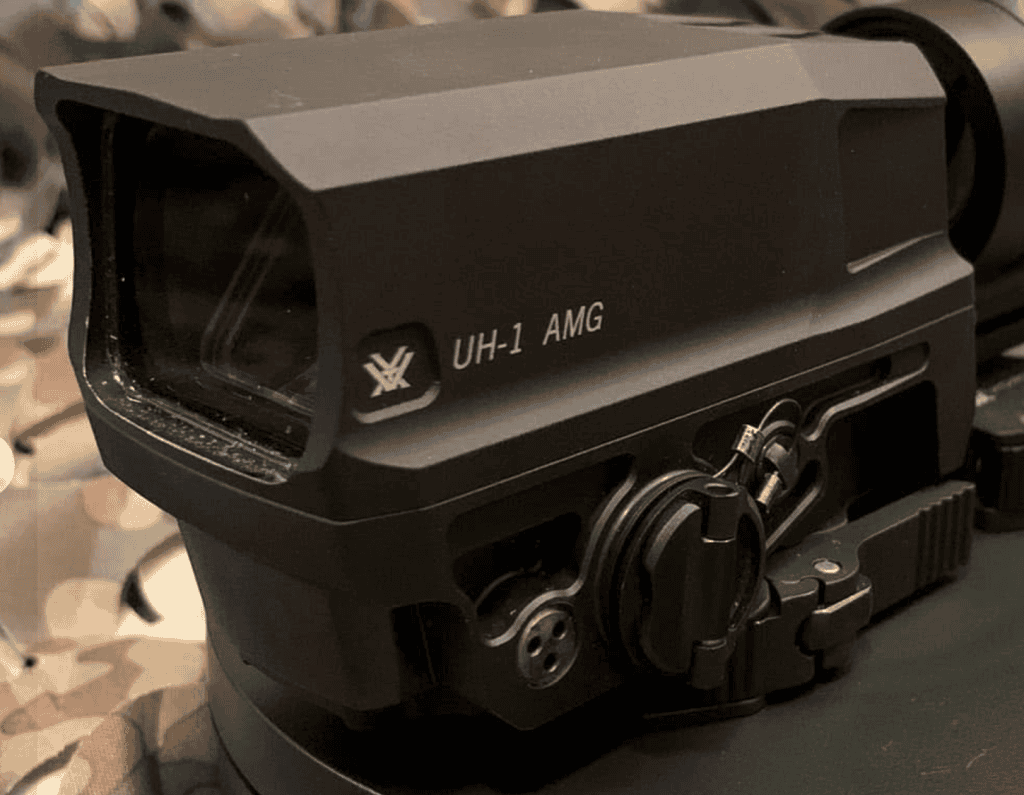
The 14-Hour Auto-Shutoff and What Happens After
Nineteen brightness settings give the Gen II a wide usable range, and the separation between 15 daylight levels and 4 NV settings is one of the clearest improvements over the original. The dedicated NV button on the left side gave immediate recall to the last NV setting I’d used, which means no clicking through 15 daylight levels to reach NV mode when the lights go out. Well executed.
The battery side raised a question I couldn’t fully resolve during my evaluation. I ran the sight on setting 8 for most of my range time, and the CR123A was showing strong after 350 rounds. But over the following two weeks, leaving the sight mounted on the Saint Victor with the auto-shutoff active, the battery indicator dropped faster than I’d expected. I turned the sight off after each session, but the 14-hour auto-shutoff timer means if you forget once, you lose 14 hours of battery life before the sight sleeps. Combined with whatever baseline current draw the electronics maintain when nominally off, my CR123A went from strong to noticeably diminished in about two weeks of sitting. The 1,500-hour rated life is probably achievable with discipline, but holographic sights are hungry by nature, and this one felt like it was on the upper end of that appetite.
The 1/2 MOA per click adjustments had positive, tactile feedback through the turret caps. I zeroed at 50 yards from a bag rest, pulled the sight off the QD mount, remounted, and confirmed zero held within acceptable variation. Three mount-remount cycles showed less than 1 MOA of shift, which is solid for a quality QD system at this tier.
Testing Vortex’s Heaviest Holographic on a Mid-Weight Carbine
I mounted the UH-1 Gen II on a Springfield Armory Saint Victor in 5.56 NATO, a 16-inch carbine that represents what most buyers will actually pair this sight with. The Saint Victor runs about 6.9 pounds empty; adding 11.6 oz of enclosed holographic to the top rail pushed total weight past where some shooters run a magnified setup. That balance shift was something I specifically wanted to feel through sustained work, not just a few magazines off a bench. I fed PMC Bronze 55gr FMJ consistently through the evaluation, roughly 350 rounds across two range sessions.
Both sessions were outdoors at a flat, open range with covered firing positions and open bays for movement work. Weather was cooperative: clear skies, mid-60s in the morning climbing to low 80s by afternoon, enough direct sunlight to push the daylight brightness into its upper settings. I zeroed at 50 yards from a bag rest, confirmed with a five-round group, and then moved to practical drills from standing, low ready, and behind improvised cover.
Having handled holographic sights across the EOTECH XPS, EXPS, and 512 lines over the past decade, I keep coming back to the same observation: the housing design tells you more about what a holographic will actually feel like on a gun than any spec in the table. Open-frame sights trade protection for peripheral vision and light weight. Enclosed sights trade weight for confidence under abuse. The UH-1 Gen II is the most fully committed enclosed holographic I’ve tested, and this evaluation was built around understanding where that commitment pays off and where it costs you. The full breakdown of how I structure these evaluations is available in my full testing methodology.
Performance Ratings
Field Test Data
| Test Parameter | Result |
|---|---|
| Zero Confirmation (50 yards, 5-round group, bagged rest) | 1.1 MOA group centered on point of aim |
| Return to Zero After QD Remount (3 cycles) | Less than 1 MOA shift across all three mount/remount cycles |
| Transition Speed (port-to-port, 7 yards, standing) | 0.18 to 0.22 sec splits; average 0.20 sec |
| Battery Indicator After 350 Rounds (setting 8) | Full strength; no visible drop |
| Battery Indicator After 2 Weeks Mounted (auto-shutoff active) | Dropped to approximately 60% indicated |
| Reticle Visibility in Direct Afternoon Sun (setting 15) | Clearly visible and sharp at maximum daylight brightness |
| QD Lever Lock/Release Cycles (20 cycles) | Consistent lockup with no detectable play throughout |
Tested on: Springfield Armory Saint Victor | 5.56 NATO | PMC Bronze 55gr FMJ
Pros and Cons
PROS
|
CONS
|
Who Should Mount the UH-1 Gen II, and Who Should Look Elsewhere
Home-defense and duty carbine shooters get the most from this sight. If the gun lives in a rack or a case and gets grabbed when it matters, the weight penalty is irrelevant and the enclosed housing becomes a genuine asset. The NV capability and dedicated NV button make it a serious option for shooters running night-vision setups on a defensive AR. The Vortex VIP warranty adds long-term confidence that matters for a sight you’re counting on.
Shooters who’ve been frustrated by astigmatism on LED red dots should have this on their list. The holographic projection was noticeably cleaner for an astigmatic shooter I tested with, and that alone might justify the enclosed design’s extra ounces for someone who has struggled to find a non-magnified optic that looks right to their eyes.
Competition and extended-carry shooters should think carefully. If you’re running a carbine on a shot timer in 3-gun or carrying a patrol rifle for hours, those 11.6 ounces cost measurable speed on transitions and add fatigue over time. A lighter EOTECH EXPS or a quality enclosed red dot will serve you better in that role.
Shooters committed to EOTECH’s reticle language may find the EBR-CQB’s triangle element disorienting at first. It is a different visual grammar, and if your muscle memory is built around the 68 MOA ring-and-dot, the transition period is real.
Disclosure
Some links in this review are affiliate links, meaning ScopesReviews may earn a small commission if you purchase through them at no extra cost to you. These affiliate relationships have no influence on our testing, ratings, or recommendations. Every opinion in this review reflects hands-on evaluation of the Vortex AMG UH-1 Gen II under the conditions described above.
Worth the Weight for the Right Carbine
The Vortex AMG UH-1 Gen II does exactly what Vortex designed it to do: deliver a fully enclosed, NV-capable holographic sight that isn’t an EOTECH. The build quality is genuine. The EBR-CQB reticle, once your eye sorts the triangle from the dot, drives fast and renders clean. The QD mount returns to zero. The VIP warranty means you will never pay to replace it.
The cost is weight, and the cost is battery vigilance. At 11.6 oz, this is a heavy non-magnified optic, and it changes how a mid-weight carbine handles under speed. The battery situation requires more attention than a set-and-forget LED red dot, and the 14-hour auto-shutoff is insurance, not a substitute for turning the sight off yourself.
For a duty carbine, a home-defense gun, or any AR that stays ready rather than rides all day, the UH-1 Gen II earns its place. It is the best enclosed holographic alternative to EOTECH on the market, and for the shooter who specifically wants that combination of protection, reticle design, and lifetime warranty, nothing else fills the slot. Buy it for the gun that needs armor. Skip it for the gun that needs to stay light.
Mike Fellon is the founder of ScopesReviews and an optics specialist with 15+ years in precision shooting. A former Bass Pro Shops firearms advisor and NRA-certified instructor, he’s hands-tested 200+ rifle scopes across hunting and competition. Based in Dallas, Texas.