
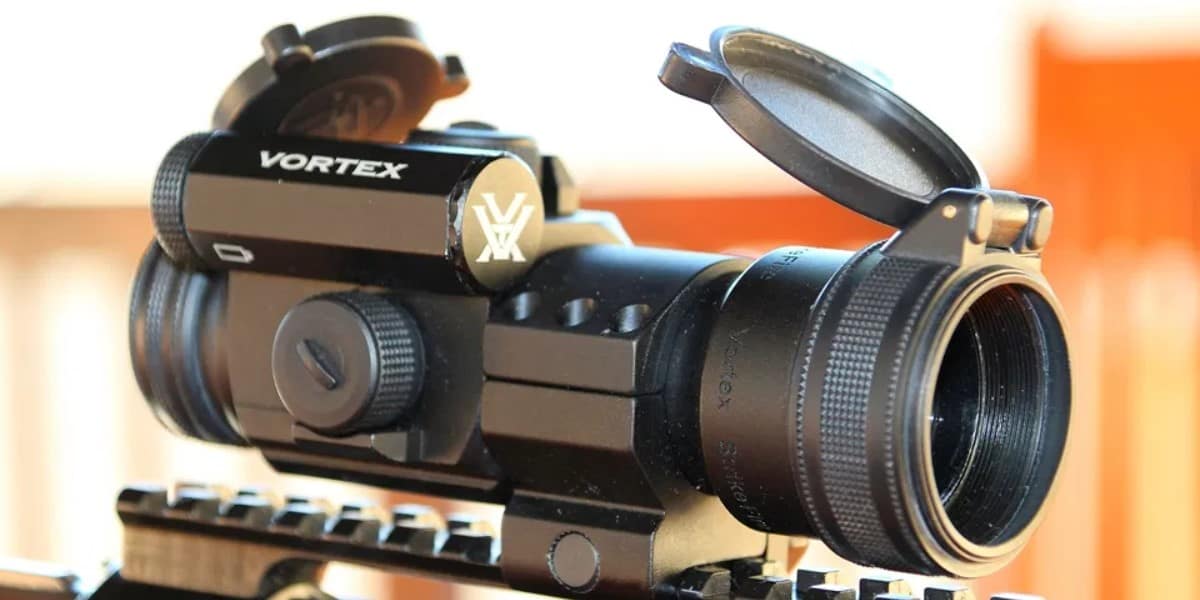
The StrikeFire II has been in Vortex’s lineup for over a decade. The red dot market moved toward compact enclosed emitters, shake-awake sensors, and solar backup panels in that time; this 30mm tube dot hasn’t changed. It still ships with a cantilever mount, still runs a CR2 battery, still lacks motion activation. And it still sells.
That persistence is what made me pick it up. The spec sheet reads like a time capsule: 4 MOA dot, 10 brightness settings, 12-hour auto-off instead of shake awake, and a total weight north of 12 ounces with the mount. None of that should be competitive anymore. But entry-level AR builds keep showing up with StrikeFire IIs bolted on top, and forums are full of five-year-old posts from owners who never bothered to upgrade.
I ran one on an M&P 15 Sport II through 400 rounds of PMC Bronze to find out whether this optic earns its staying power or just survives on brand loyalty and warranty goodwill. The answer turned out simpler than I expected: the StrikeFire II does fewer things than its competitors, does them without incident, and the things it skips are the things that break on cheaper optics anyway.
Vortex StrikeFire II Review
Fifty Thousand Hours and a Catch
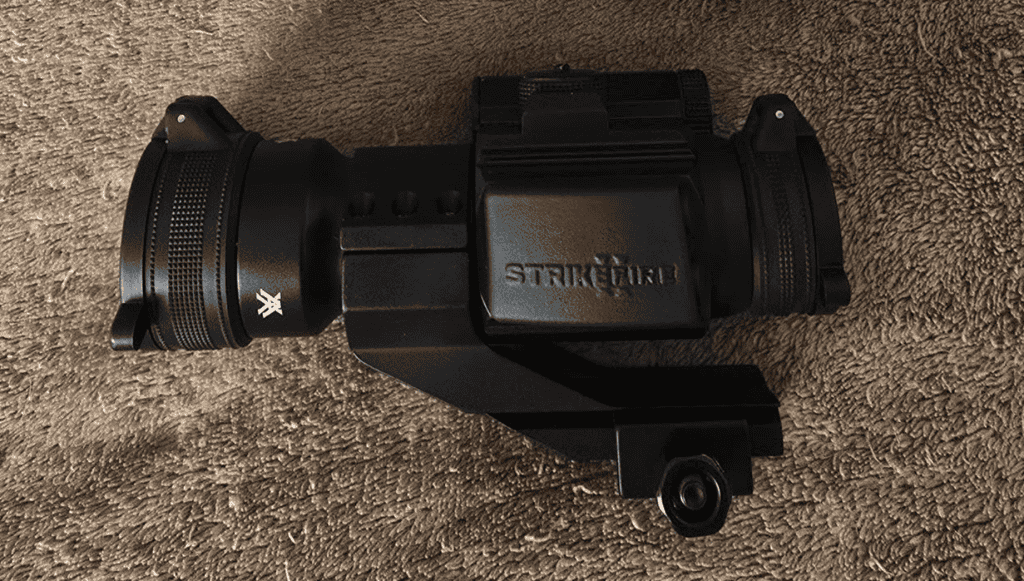
The CR2 battery and the 50,000-hour rating are genuine selling points on paper, and in practice the optic never dimmed or flickered across four range sessions. But the lack of shake awake created a problem I should have anticipated and didn’t.
End of my second session, I had been loading magazines on the bench for maybe fifteen minutes. Picked the carbine up, brought it to my shoulder, and the window was dark. The 12-hour auto-off had not triggered; I had accidentally bumped the brightness dial while setting the rifle down, clicking it past the off detent. The dial has no hard stop between the lowest brightness setting and off, so any incidental contact with the knob while the rifle sits in a rack or leans against a bench can kill the dot without warning. I stood there spinning the dial back up while two other shooters on the line were already running their strings.
That is not a defect. It is a design choice from an era before motion activation, and once I learned the quirk I checked the dial before every pickup. But it is the kind of inconvenience that shake awake eliminates entirely, and it is the clearest sign that this optic’s feature set belongs to an older generation of red dots.
If you want to read more about other Vortex red dot scopes have a look at my full Vortex Viper review or Vortex Venom review.
The Weight You Feel by the Third String
I felt the weight on the first drill. Holding the M&P 15 at the low ready between strings, the muzzle kept dipping forward. At 12.8 ounces with the cantilever mount, the StrikeFire II adds meaningful mass ahead of the receiver. During a timed transition drill, moving between three steel plates at 15, 25, and 40 yards, the rifle felt slow coming off each target. Not unusable, not even bad. Just heavier than the last few dots I had run on that same upper, and enough to notice during the third and fourth strings once fatigue crept in.
The trade-off for that weight is a genuinely solid housing. The 30mm aluminum tube caught a sharp knock against a barricade post during one drill; I inspected afterward expecting a gouge and found the anodizing scuffed but the tube undented and zero untouched. That kind of construction is what the weight buys, and for a dot that lives on a home-defense carbine rather than a patrol rifle that gets carried through a twelve-hour shift, the exchange makes sense.
4 MOA at Fifteen Yards and at a Hundred
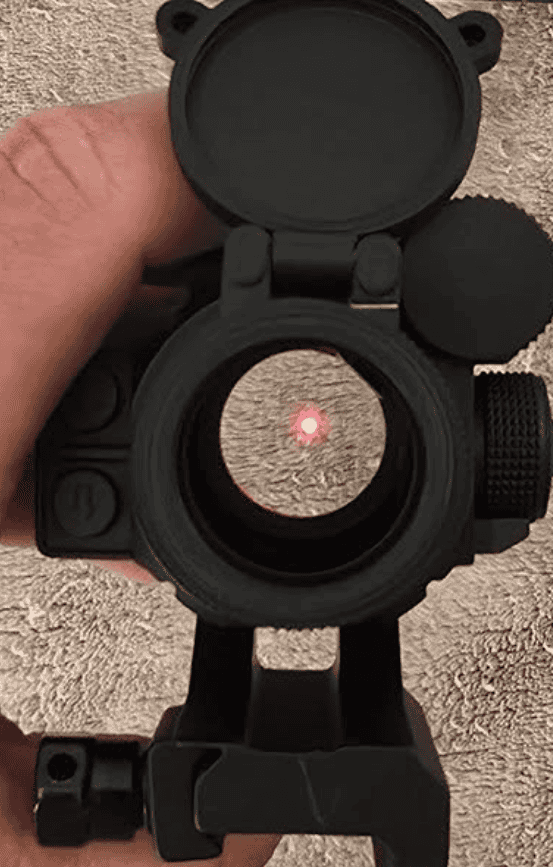
Third session out, I set up a steel silhouette at 100 yards to see how the dot handled distance. At that range, the 4 MOA dot covered roughly 4 inches of the target. Holding center mass, I could ring the plate consistently, but I could not isolate the head zone; the dot swallowed it. Back at 25 and 50, the story reversed. Running a Bill Drill variation on an 8-inch plate at 15 yards, the 4 MOA circle picked up immediately on presentation and I was posting first hits in the low 1.1-second range from the low ready. The size that hurts precision at distance is the size that makes the dot jump into your vision up close.
For the carbine work this optic was built for, inside 50 yards, that balance lands correctly. The lens is clear enough to see the dot edge without significant bloom in daylight (settings 6 through 8 handled midday sun), and the two lowest NV-compatible settings held a tight, dim dot when I checked them at dusk. Shooters with astigmatism should know the 4 MOA dot will bloom more noticeably than a 2 MOA alternative; the tube design helps contain it somewhat, but it does not eliminate the issue.
Rain on the Objective, a Coin for the Turrets
The enclosed 30mm tube sheds the vulnerability that open reflex sights carry. Debris, rain, and direct sunlight have fewer paths to the emitter. On a drizzly morning during the fourth session, water beaded on the objective lens but never reached the emitter or caused the dot to flare. An open reflex in the same conditions would have needed wiping every few minutes.
Adjustments are where the StrikeFire II feels its age most plainly. The 1/2 MOA turrets sit under caps and require a coin or flathead to turn. Zeroing took longer than it should have; I spent ten minutes at the bench looking for a quarter before remembering I had stashed one in my range bag specifically for optics like this. Once set, zero held across all four sessions without any drift I could measure at 50 yards off a rest.
Why a Sport II and 400 Rounds of Ball Ammo Tell the StrikeFire II’s Real Story
I mounted the StrikeFire II on a Smith & Wesson M&P 15 Sport II using the included cantilever ring mount in lower 1/3 co-witness. The Sport II is one of the most common entry-level ARs on the market, which makes it the honest test platform: most StrikeFire II buyers are putting this dot on exactly this kind of rifle. Ammunition was PMC Bronze 55gr FMJ, 400 rounds across four sessions over three weeks in conditions ranging from clear midday heat (low 90s) to an overcast morning with light rain in the upper 60s.
Three questions drove the evaluation: does the dot hold zero through sustained fire and rough handling on a direct-impingement gas gun, does the 4 MOA reticle limit the carbine’s practical capability inside its intended range, and does the lack of shake awake create real problems or only theoretical ones. I have run tube-style red dots from Vortex, Primary Arms, Sig, Bushnell, and Holosun through this same kind of evaluation on various AR builds over the past several years. Across that volume, the line between a reliable entry-level tube dot and a fragile one shows up in two specific places: whether zero drifts after thermal cycling through a long afternoon session, and whether the emitter survives getting knocked around during transport and barricade work. The StrikeFire II passed both without incident, landing in the same reliability band as tube dots selling for noticeably more, though not distinguishing itself within its own tier on any other axis.
The full process behind these evaluations follows my full testing methodology, adapted here for a red dot’s shorter engagement distances and the M&P 15’s recoil profile.
Performance Ratings
Field Test Data
| Test Parameter | Result |
|---|---|
| Zero Confirmation (50 yards, from rest) | Held within 0.5 MOA across 4 sessions, 400 rounds total |
| Return-to-Zero After Remount | Shifted less than 1 MOA after removing and reinstalling cantilever mount |
| Dot Visibility in Direct Sunlight | Clean edges on settings 7-8; minimal bloom through setting 10 |
| First Hit from Low Ready (15 yds, 8″ plate) | 1.08s average over 10 reps |
| 5-Shot Group at 50 Yards (from bags) | 2.1″ average across three groups |
| Battery Status After 400 Rounds | No measurable voltage drop from initial reading |
| Impact Resistance (barricade contact) | Zero maintained; anodizing scuffed, no structural deformation |
Tested on: Smith & Wesson M&P 15 Sport II | 5.56 NATO | PMC Bronze 55gr FMJ
Pros and Cons
PROS
|
CONS
|
If the Weight or the Missing Motion Sensor Push You Away
Sig Sauer Romeo 5: If the lack of shake awake is the sticking point, the Romeo 5 solves it directly. MOTAC motion activation turns the dot on when you pick the rifle up and off when you set it down. It is also considerably lighter at roughly 5 ounces without a mount. The trade-off is a shorter warranty (5 years on electronics versus Vortex’s unlimited lifetime coverage) and a smaller 20mm objective lens. For a carbine that gets picked up and put down frequently, the Romeo 5 eliminates the StrikeFire II’s most noticeable daily-use weakness.
Vortex SPARC AR: Staying inside Vortex’s warranty ecosystem but wanting a lower, lighter package, the SPARC AR drops significant weight and sits closer to the bore. It sacrifices the StrikeFire II’s 50,000-hour battery life (AAA cell, roughly 5,000 hours) and night-vision compatibility, but for a daytime range and home-defense carbine, it is the more current design from the same manufacturer.
Primary Arms SLx MD-25: For shooters who found the 4 MOA dot too coarse at distance, the SLx MD-25 with its ACSS CQB reticle offers a 2 MOA center dot inside a 65 MOA ring, giving both precision and a speed frame. Similar weight class, similar tier, but a reticle system built for shooters who want to push past 100 yards without losing close-range speed.
Disclosure
Some links in this review are affiliate links. Purchases made through them may earn ScopesReviews a small commission at no extra cost to you. These relationships have no effect on how the optic is tested, scored, or recommended.
The StrikeFire II Earns Its Shelf Life on Reliability, Not Innovation
The StrikeFire II is not the red dot I would pick if I were building a carbine from scratch today. Lighter options with smarter power management exist in the same tier. But if someone handed me a bone-stock M&P 15 and told me to put a dot on it that would hold zero, survive getting knocked around, and keep working for years without attention, the StrikeFire II would make a short list.
It does not compete on features. No shake awake, no solar backup, no tool-less turrets. What it offers instead is a 30mm tube that shrugs off contact, a dot that stays where you zero it, a battery measured in years rather than months, and a warranty that covers whatever you manage to do to it. For a home-defense carbine or a truck gun that sits in a case between range trips, those are the things that matter most, and the StrikeFire II delivers them without complication.
Skip it if you need a light setup for a patrol or competition carbine, or if you want to work steel past 100 yards with any precision. Buy it if you want a dot you can mount, zero, and stop thinking about. The Vortex VIP warranty alone turns the entry-level cost into a long-term commitment from the manufacturer, and on this optic, that commitment is backed by hardware that holds up its end.
For more articles about red dot and holographic scopes see my reviews on Vortex Razor AMG UH-1 or Burris FastFire 3.
Mike Fellon is the founder of ScopesReviews and an optics specialist with 15+ years in precision shooting. A former Bass Pro Shops firearms advisor and NRA-certified instructor, he’s hands-tested 200+ rifle scopes across hunting and competition. Based in Dallas, Texas.