
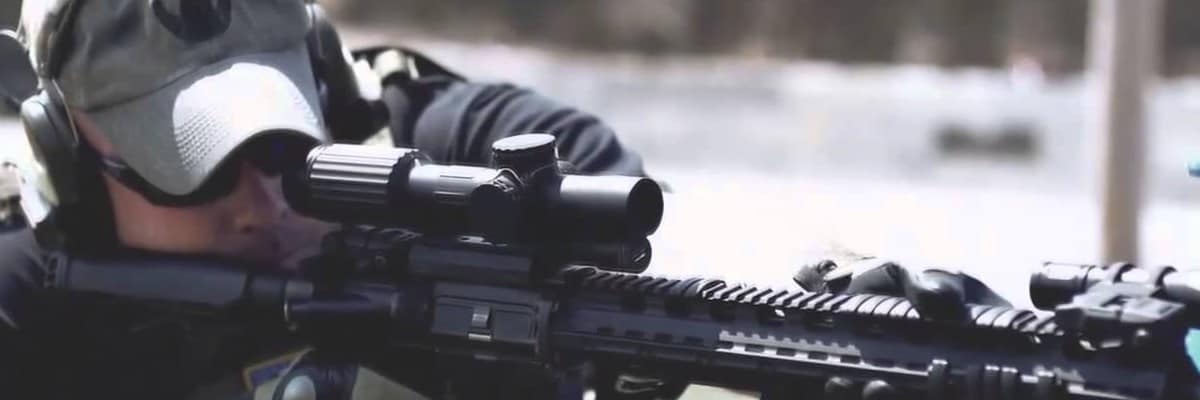
Trijicon built the VCOG 1-6x24mm for military and duty use, and the design decisions read that way before you ever look through it: a housing forged from 7075 aluminum, a mount machined into the body instead of bolted on, and a single AA battery driving the illumination. This is the optic that established Trijicon in the LPVO category, and its 1-8×28 descendant went on to win a Marine Corps contract. That lineage is exactly why I wanted to test the original. Premium LPVOs have gotten lighter and cheaper every year, and the VCOG has done neither. So the question I carried to the range was whether a civilian shooter gets anything real for the weight and the tier, or whether this scope only makes sense on a government purchase order.
After six weeks and roughly 900 rounds on an AR carbine, my answer is that the VCOG delivers something most LPVOs only gesture at: it removes the optic from your list of things that can fail. Whether that trade is worth 23.2 oz depends on how honest you are about what your rifle is for, and I’ll be specific about that below.
Trijicon VCOG 1-6x24mm Review
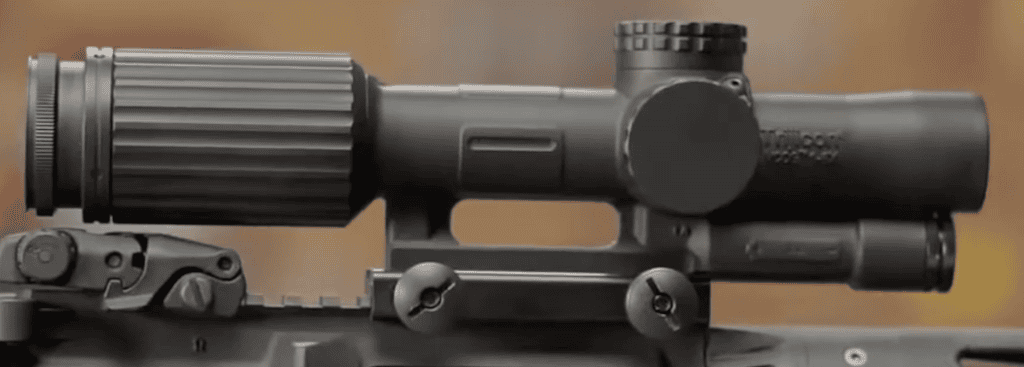
Mounting Took Ten Minutes and Then Stopped Being a Topic
Because the mount is forged into the housing, setup was the shortest of any scope I’ve tested this year. No rings, no lapping, no torque sequence across four caps. I set the thumb screws to spec on the carbine’s top rail, zeroed at 50 yards in eight rounds, and confirmed the offset at 200. That was the last time I touched the turrets for six weeks. The caps went back on and the scope became, functionally, a fixed part of the rifle. On most optics I recheck mounting hardware around the 300-round mark out of habit. I did it here too, and every screw sat exactly where I’d left it.
Glass and a Circle You Can Fight With at 1x
The image is bright, flat, and stays sharp to the edges, which matters more on an LPVO than people admit because at 1x you’re using the whole field, not the center. True 1x is close enough here that both-eyes-open work felt like running a red dot with a slightly heavier frame around it. The segmented circle is the reason that works. First focal plane reticles usually shrink into uselessness at 1x, and Trijicon’s answer was to make the low-magnification element a big broken circle instead of a fine crosshair. On the second range session I ran a timer on paired targets at 15 yards, and my transitions with the illumination on setting 4 were within a tenth of a second of what I shoot with the micro dot on my other carbine. I did not expect that from a scope this substantial.
Dial the fin up to 6x and the circle grows out of your way while the center crosshair and its drop references become usable for real work at distance. Because the reticle is first focal plane, those references hold true at every magnification, so there’s no mental arithmetic about which power you’re on. The illumination stayed visible against sunlit dirt at midday on the top settings, though against a bright white steel plate it washed toward faint. The etched reticle is bold enough that I twice caught myself shooting drills with the illumination off and not noticing until I went to adjust it.
The Barricade Fall I Didn’t Schedule
Week four, I had the carbine propped against a plywood barricade while I pasted targets, and a gust tipped it over onto the gravel apron, optic-side down. The sound was ugly. The VCOG took a visible scuff across the illumination knob shroud and nothing else. I shot a five-round group at 100 yards immediately after, and it printed inside the same 1.1″ cluster the rifle had been producing all month, centered where it should be. I have watched a mid-tier LPVO lose its zero from less than that, and I went into this test half expecting to eventually find the limit of Trijicon’s forged-housing marketing. Four hundred more rounds after the fall, the limit never showed up.
Half MOA Clicks Tell You What This Scope Thinks of Dialing
The turrets are capped, the clicks are 1/2 MOA, and the 90 MOA adjustment range exists to get you zeroed, not to be dialed against. At 600 yards on a windy afternoon I tried treating it like a precision scope anyway, pulling the caps and dialing for a string on steel. The clicks are positive and they tracked back to zero when I returned, but the coarse value means you’re always splitting a click somewhere. Twenty minutes in I gave up, recapped them, and just used the reticle holds, which is transparently what the designers intended. If your idea of an LPVO involves regular dialing, this scope will argue with you every session.
Where 23.2 Ounces Shows Up
The weight is real and it never becomes invisible. On a bench or shooting supported, you forget it. During the third hour of a carbine drill session in July heat, with the rifle up and moving between positions, my support arm knew exactly which upper I’d brought. The mass rides high and forward of the receiver, and offhand strings at 6x wobbled sooner than they do under my lighter LPVO setup. Fixed parallax also means targets inside 15 yards go slightly soft at 6x, which cost me nothing in practice because nobody is at 6x that close. Neither issue is a defect. Both are the bill for the housing that shrugged off the gravel.
How a Duty-Grade LPVO Got Tested: 900 Rounds on a 5.56 Carbine
The rifle was a Daniel Defense DDM4 V7 in 5.56 NATO, fed Black Hills 77gr OTM for everything from zeroing to the 600-yard steel work. I picked that pairing deliberately: the VCOG was designed around a fighting carbine, and a duty-grade 16″ AR shooting a heavy match load is the honest version of its intended platform, not a stand-in. Testing ran six weeks of Texas summer, mostly on a flat range with steel from 200 to 600 yards, split between magnified distance work and high-volume drills at 25 yards and in. Round count landed near 900. Zero was confirmed at the start of every session, and I ran a tall-target check after the barricade fall described above.
My skepticism going in came from two-gun matches, where LPVOs fail in front of you in ways range testing hides. I watched a shooter on my squad lose his dot mid-stage when a mid-tier LPVO’s illumination module quit, and another rezero at lunch after a hard barricade transition walked his group four inches. Those failures are the specific problems the VCOG’s forged housing, integrated mount, and AA battery exist to answer, so my testing leaned hard on the abuse those matches taught me to simulate: loaded transitions against barricades, the rifle dumped into position instead of placed, illumination left on for entire sessions. The full process I run every optic through is in my full testing methodology, but this one got the rough end of it on purpose.
Performance Ratings
Field Test Data
| Test Parameter | Result |
|---|---|
| Zero retention (900 rounds, 6 weeks) | No measurable shift; verified at each session |
| Zero after uncontrolled fall onto gravel | 5-round group at 100 yds printed 1.1″, point of impact unchanged |
| Best 5-round group, 100 yds (bipod, rear bag) | 1.0″ with 77gr OTM |
| Target transitions at 1x, 15 yds (shot timer, paired targets) | Avg 0.08s slower than micro red dot baseline |
| First-round steel hits, 600 yds, reticle holds | 7 of 10 in a 10-12 mph crosswind |
| Return to zero after dialing test | Returned exactly; confirmed on paper at 100 yds |
| Illumination endurance | Left on setting 4 across all sessions; no dimming on the original AA |
Tested with: Daniel Defense DDM4 V7 | 5.56 NATO | Black Hills 77gr OTM
Whose Rifle Actually Justifies a VCOG
Buy this scope if your rifle is a working gun. Patrol carbines, agency rifles, a serious home-defense AR, or any rifle whose optic must survive being dropped, banged through doorways, and left in a hot truck deserves this optic. The VCOG’s entire cost structure pays for the scenario where the rifle hits the ground and still shoots to zero, and my testing says that money is honestly spent. The AA battery is part of that same logic: when the illumination matters most, you can feed it from any gas station on earth.
It also fits the shooter consolidating a red dot and a magnifier into one optic without giving up speed. The segmented circle at true 1x is the fastest FFP low-power reticle I’ve run, and my timer data backs that up.
Skip it if you’re building light. A backcountry or competition rifle where every ounce is audited will resent this optic every time you pick it up; the category is full of LPVOs a half pound lighter that shoot beautifully on square ranges. Skip it too if you dial. The capped 1/2 MOA turrets make the VCOG a hold-over instrument, full stop, and a shooter who wants to spin elevation for precise distance work should be shopping a different class of scope entirely.
Common Questions About the Trijicon VCOG 1-6x24mm
Does the VCOG work if the battery dies?
Yes. The illumination is LED-driven, but the reticle itself is etched glass, so a dead AA leaves you with a fully usable black segmented circle and crosshair at every magnification. You lose speed in dim light, not function.
Do I need to buy rings or a mount separately?
No. The mount is machined into the forged housing and clamps directly to a Picatinny rail with thumb screws. That’s a real saving in both cost and failure points, since quality LPVO mounts are expensive and are themselves a common source of zero problems.
Should I get the 1-6×24 or the newer VCOG 1-8×28?
The 1-8×28 adds top-end magnification and a larger objective but costs more and gives up nothing in toughness. For carbine distances inside 600 yards, the 1-6×24 does everything the 1-8 does. Buy the 1-8 only if you genuinely shoot past that.
Is 23.2 oz workable on a duty carbine?
Workable, yes; invisible, no. On a 16″ AR the total package stays maneuverable, but the mass rides high and forward and you notice it during long sessions. Shooters running lights and lasers should weigh the whole upper before committing.
Will it hold zero on harder-recoiling rifles than 5.56?
Trijicon rates the VCOG for hard use and offers BDC variants for 7.62 NATO and .300 Blackout, and its construction gives no reason for concern on those platforms. My zero-retention testing was on 5.56, where it was flawless across 900 rounds.
Disclosure
This review may contain affiliate links, which means ScopesReviews may earn a small commission if you purchase through them, at no additional cost to you. Affiliate relationships never influence my testing process or conclusions; the 900 rounds behind this review happened the same way whether you buy the scope or not.
A Tool You Buy Once and Stop Thinking About
My verdict on the VCOG 1-6x24mm commits: for a rifle that has to work when it’s been treated badly, buy it. The glass is excellent, the segmented circle makes true 1x genuinely fast, the integrated mount deletes an entire category of failure, and six weeks of deliberate abuse never moved the zero. Most premium optics earn their tier with refinement. This one earns it with certainty, and after watching it shoot a clean group thirty seconds after bouncing off gravel, I believe the certainty is real.
The weight is the price of admission and I won’t minimize it; 23.2 oz changes how a carbine carries, and the capped 1/2 MOA turrets rule out precision dialing. But those aren’t flaws to weigh against the strengths. They’re the same design speaking. Trijicon decided every gram and every feature would serve the rifle that gets dropped, and the shooters who need that rifle will find nothing else in the category does the job with this much margin. Everyone else already knows they wanted a lighter scope, and that’s fine. This one wasn’t built for them.
Mike Fellon is the founder of ScopesReviews and an optics specialist with 15+ years in precision shooting. A former Bass Pro Shops firearms advisor and NRA-certified instructor, he’s hands-tested 200+ rifle scopes across hunting and competition. Based in Dallas, Texas.