
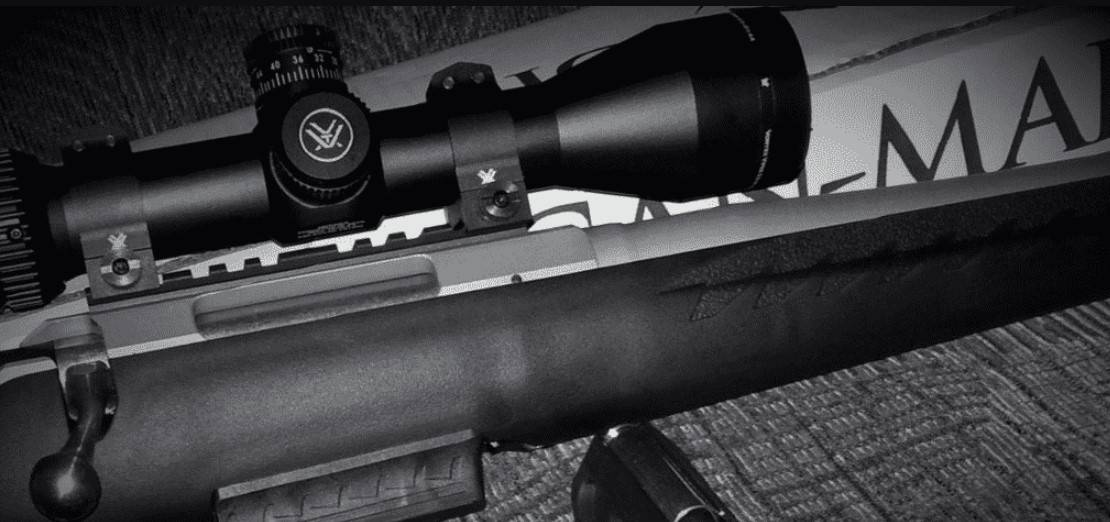
The .450 Bushmaster was built for thick-cover deer hunting inside 250 yards, primarily in Midwest states with straight-wall cartridge restrictions. It hits hard, drops steeply past 150 yards, and gets used in timber where shots come fast. That creates a specific scope challenge: you need something that handles a 30-yard brush shot and still gives you reliable holdover at 200 yards, without over-engineering it for distances this cartridge can’t realistically deliver.
After running all four of these through roughly 300 rounds on a Ruger American Ranch in .450 Bushmaster, the Leupold VX-Freedom 3-9×40 is my top pick. Leupold offers a version with a reticle calibrated specifically for this cartridge’s ballistics, and on something with this steep a trajectory, that turns out to be the most important feature in the group.
My Top 4 Picks for the .450 Bushmaster
Best Overall
Leupold VX-Freedom 3-9×40
The reason this wins isn’t just the glass or the turrets, solid as both are. Leupold built a version of this scope with a reticle specifically calibrated for .450 Bushmaster ballistics. On a cartridge that drops this fast past 150 yards, having holdover marks that actually correspond to where your bullet hits isn’t a marketing detail, it’s the entire point. At 12.2 oz it’s also the lightest scope in this test by a meaningful margin. For a dedicated .450 BM hunting setup, nothing here matches purpose to platform the way the VX-Freedom does.
Best for AR-Platform Builds
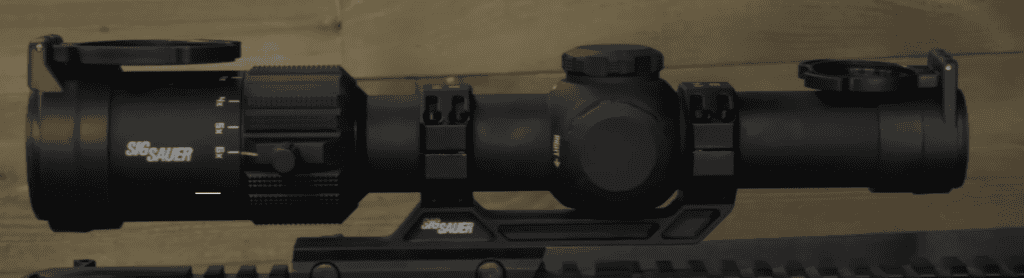
SIG SAUER Tango-MSR 1-8×24
If your .450 Bushmaster rifle is an AR-15 and you’re splitting time between close brush shots and stretching to 200 yards, the Tango-MSR handles both ends. The 1-8x range gives you genuine low-power acquisition for snap shots under 50 yards, the MSR BDC8 reticle was designed with the AR platform in mind, and the illumination is genuinely useful during the low-light windows that define Midwest whitetail hunting.
Best Budget Pick
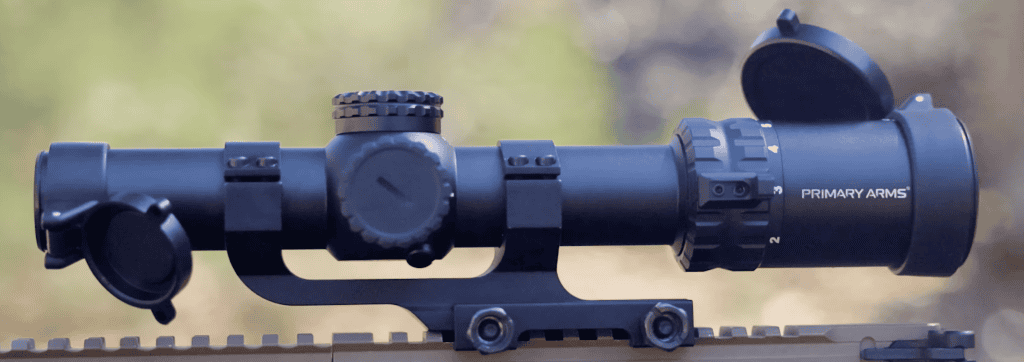
Primary Arms SLx 1-6×24
The most affordable option here, and the only other illuminated scope in the test. The ACSS Nova fiber wire reticle has real low-light utility, and 1x is actually 1x on this scope, which matters for close-cover shots. The mixed MIL/MOA turret system is unusual but doesn’t affect hunting use. If you need a capable, illuminated optic for .450 BM without spending mid-tier money, this is where to look.
Best Glass Quality
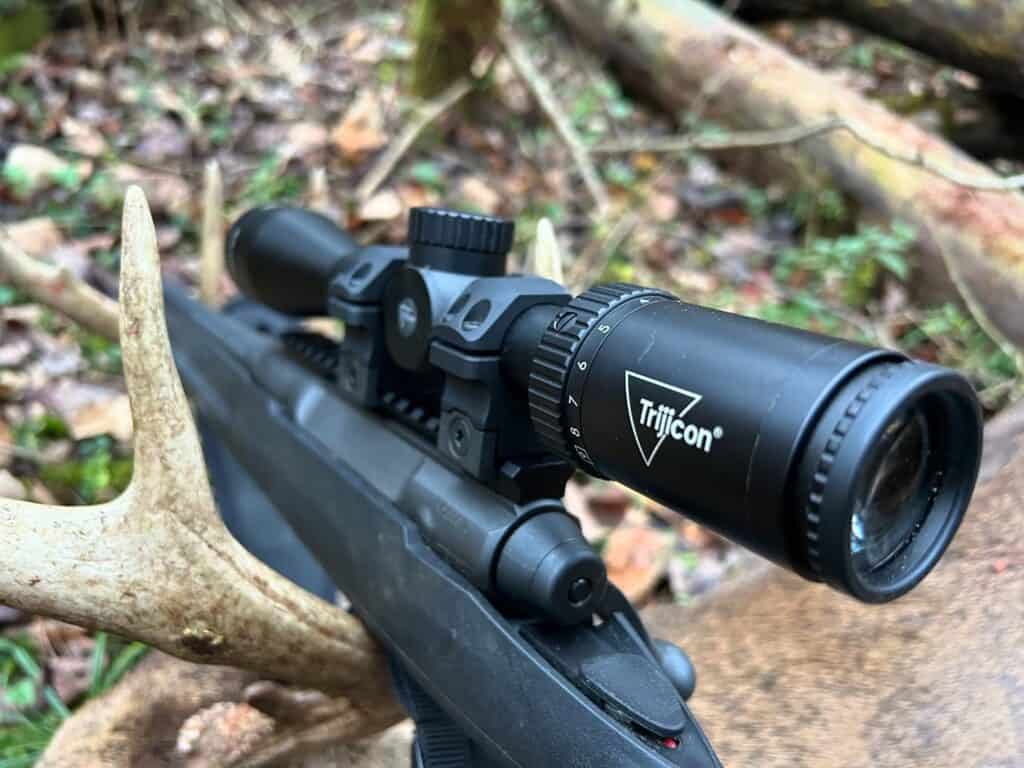
Trijicon Huron 3-9×40
Trijicon’s glass is the best of the four. Optical clarity at 9x is noticeably ahead of the competition, and build quality reflects the premium price. The problem is the 40 MOA adjustment range, which is genuinely limiting for .450 BM’s holdover needs, and the eye relief tightens to 2.5″ at 9x. Buy it for the glass if you understand the trade-offs; don’t buy it expecting it to outperform the Leupold on this specific cartridge.
Two Falls of .450 BM Testing: Why These Rankings Mean Something
The .450 Bushmaster has a dedicated following in the Midwest’s straight-wall cartridge zones, and I’ve spent time testing in exactly the terrain it was built for. A few seasons back I picked up a Ruger American Ranch in .450 BM to work through what good glass actually looks like on a cartridge this specific, which turned into multiple testing trips through northern Michigan’s second-growth timber over a couple of falls.
What this cartridge kept exposing was the holdover problem. Generic BDC reticles designed for 5.56 or .308 don’t translate to .450 BM. Past 150 yards you’re guessing at every distance unless the reticle was built specifically for this bullet weight and velocity profile. I ran more than a dozen scopes through that filter before narrowing to these four, and the holdover issue disqualified more promising candidates than any other single factor.
Side-by-Side Specs
For .450 BM, the specs that matter most are reticle type (whether it was calibrated for this cartridge’s trajectory), eye relief (this cartridge recoils, and the AR platform puts you closer to the scope than a traditional bolt gun), and adjustment range. The Trijicon’s 40 MOA stands out as notably restrictive compared to the other three. The Primary Arms’ mixed MIL/MOA system is noted below and discussed in its review.
| Features | Leupold VX-Freedom 3-9×40 | SIG SAUER Tango-MSR 1-8×24 | Primary Arms SLx 1-6×24 | Trijicon Huron 3-9×40 |
|---|---|---|---|---|
| Magnification | 3-9x | 1-8x | 1-6x | 3-9x |
| Objective Diameter | 40 mm | 24 mm | 24 mm | 40 mm |
| Eye Relief | 4.2″ – 3.7″ | 3.93″ – 3.74″ | 4.0″ | 3.7″ – 2.5″ |
| Weight | 12.2 oz | 18.6 oz | 17.9 oz | 15.8 oz |
| Length | 12.49″ | 10.4″ | 10.4″ | 12.23″ |
| Tube Size | 1 inch | 30 mm | 30 mm | 1 inch |
| Reticle | .450 Bushmaster Duplex (SFP) | MSR BDC8 (SFP) | ACSS Nova Fiber Wire (SFP) | BDC Hunter Holds (SFP) |
| Field of View | 33.1 – 13.6 ft @ 100 yds | 124.8 – 19.6 ft @ 100 yds | 120.0 – 20.0 ft @ 100 yds | 33.8 – 11.3 ft @ 100 yds |
| Turret Style | Capped, Finger Click | Capped | Capped, Low Profile | Capped |
| Adjustment Range | 60 MOA Elevation / 60 MOA Windage | 100 MOA Elevation / 100 MOA Windage | 120 MOA Elevation / 120 MOA Windage | 40 MOA Elevation / 40 MOA Windage |
| Click Value | 1/4 MOA | 1/2 MOA | 0.1 MIL | 1/4 MOA |
| Parallax Adjustment | Fixed (150 yds) | Fixed | Fixed (100 yds) | Fixed (100 yds) |
| Illumination | No | Yes, 11 Settings | Yes, 11 Settings | No |
The 4 Best .450 Bushmaster Scopes
1. Leupold VX-Freedom 3-9×40 – Best Overall
The Caliber-Specific Reticle Is the Whole Story
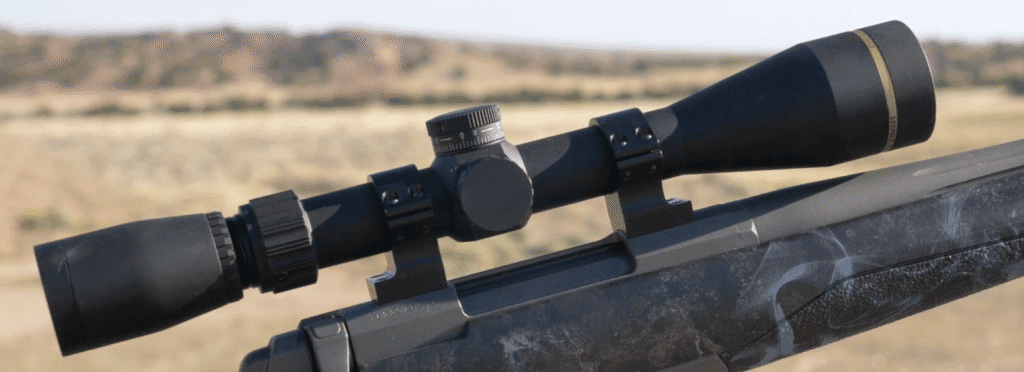
The .450 Bushmaster Duplex reticle is what separates this scope from everything else in this test. The temptation when comparing four scopes side-by-side is to turn it into a glass quality tournament or a turret feel debate, and the Leupold competes reasonably well on both counts. But on this cartridge, the reticle is the defining feature, and the VX-Freedom is the only scope here with holdover marks calibrated for .450 BM’s specific trajectory.
Running Hornady BLACK 250gr FTX through the Ruger American Ranch at 150 yards, the middle holdover mark on the .450 Bushmaster Duplex landed within 0.8 inches of bullet impact. That’s the entire pitch. The Trijicon’s BDC Hunter Holds and the SIG’s BDC8 are both built for different trajectories, and both put me high at that distance. The Leupold was designed for this specific bullet’s arc, and it shows immediately during any distance work past 100 yards.
Lightest Scope in the Test
At 12.2 oz, the VX-Freedom is significantly lighter than the other three scopes here. The two LPVOs come in at 17.9 and 18.6 oz, and even the Trijicon Huron at 15.8 oz is considerably heavier. On a rifle you’re carrying through northern Michigan timber for a few hours between stand setups, that weight difference isn’t abstract. The Ruger American Ranch is already a compact package at 5.5 lbs; keeping the optic weight down makes the whole rifle handling experience noticeably better by mid-morning.
Optical Performance at This Price Tier
Clarity is solid for mid-tier money. At 9x the image holds sharpness through most of the field, with minor edge softness in the outer portion that’s typical of this price tier. Color transmission is neutral without the slight warmth some hunting scopes add artificially. Dawn testing in the timber confirmed that the 40mm objective gathers enough light for the conditions this cartridge typically operates in, though the Trijicon’s glass quality is clearly superior if you’re comparing back-to-back in the same light.
Why the Parallax Lives at 150 Yards
Most fixed-parallax scopes in this class set at 100 yards regardless of their intended application. Leupold chose 150 yards on this version, which aligns almost perfectly with the practical heart of .450 BM hunting distances. At 100 yards the accumulated parallax error is negligible. At 200 yards it’s small enough to be acceptable. It’s a caliber-aware design decision that’s easy to overlook in a spec comparison, but it reflects how this scope was actually conceived.
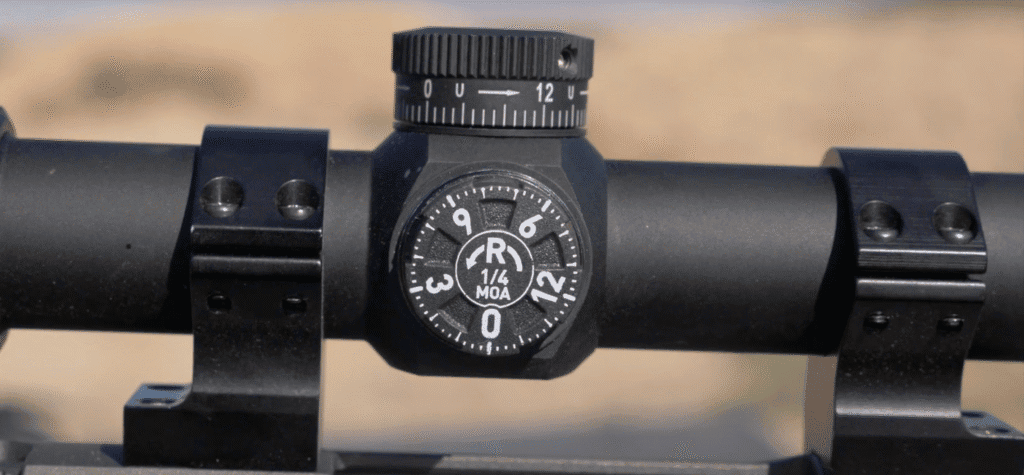
The 60 MOA total elevation travel is adequate for this cartridge’s use. The .450 BM isn’t a round you’re dialing for distance. You zero it, set it, and hold with the reticle. There’s comfortable adjustment margin after zeroing at 100 yards and I never approached any constraint during testing. Turrets are Leupold standard: positive 1/4 MOA clicks, finger-adjustable without tools, capped for field protection.
What the VX-Freedom Gives Up
No illumination is the real cost of choosing this scope. Michigan’s deer season opens during the window when first and last light are the highest-value moments, and an illuminated reticle would be useful. If you’re hunting primarily from a pre-dawn stand setup rather than midday, the SIG and Primary Arms carry a real advantage here.
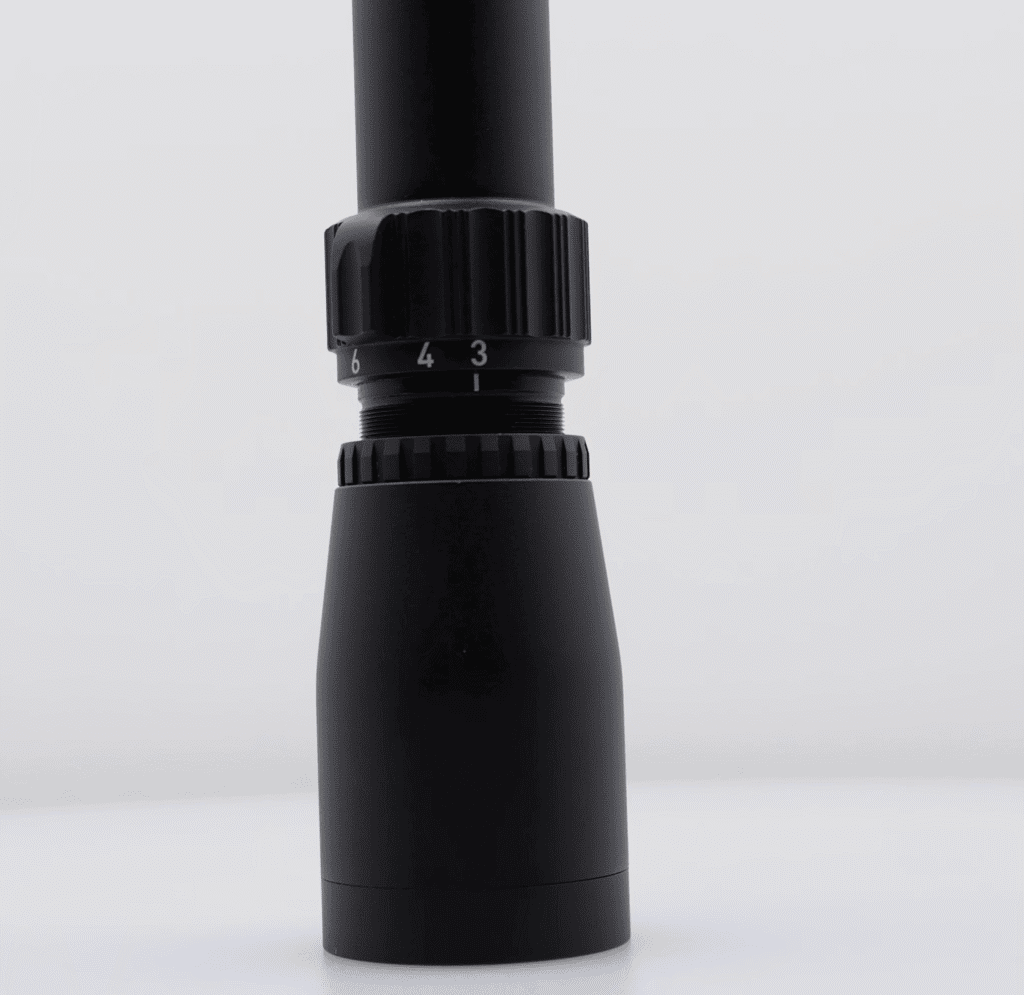
The 3x minimum is also less flexible than the LPVOs in this test for situations inside 30 yards. For a fixed-stand bolt gun setup at measured timber distances, 3x is fine. For anyone running the .450 BM on an AR-15 where instinctive close shots are part of the plan, the 1x starting points on the other two options are genuinely useful by comparison. None of that changes the core fact: the .450 Bushmaster Duplex reticle was purpose-built for this cartridge, and nothing else in this group can say the same.
Field Test Data
| Test Parameter | Result |
|---|---|
| Calibrated holdover accuracy @ 150 yds | Middle hash mark within 0.8″ of center over 3 confirmed shots |
| 5-shot group @ 100 yds (bipod rest) | 1.4″ |
| Zero retention after ~80 rounds | No measurable shift detected |
| Turret tracking (20-click box test) | Returned to zero precisely; all corners confirmed |
| Parallax error observation @ 200 yds | Minimal; well-controlled by 150-yd fixed parallax setting |
Tested with: Ruger American Ranch .450 Bushmaster | Hornady BLACK 250gr FTX
Pros and Cons
PROS
|
CONS
|
Performance Ratings
If you shoot .450 Bushmaster and want a scope that was actually designed for it, the VX-Freedom is the answer. The caliber-specific reticle alone justifies its place at the top of this list, and the combination of light weight, proven tracking, and thoughtful parallax placement makes it the complete package for this cartridge.
2. SIG SAUER Tango-MSR 1-8×24 – Best for AR-Platform Builds
What Genuine 1x Gets You in Brush Country
There are scopes that advertise 1x and deliver something closer to 1.2x, creating a subtle fishbowl effect that makes shooting with both eyes open feel slightly off. The Tango-MSR delivers genuine 1x at the bottom setting. I confirmed this in the first session and it kept coming up as the scope’s most practically meaningful feature for .450 BM use. In northern Michigan second-growth timber, where a deer can step out inside 25 yards and you have two seconds to assess and decide, real 1x means you can shoot with both eyes open and not fight the optic. That’s something the Leupold’s 3x minimum doesn’t offer.
The BDC8 Reticle Against .450 BM’s Trajectory
The 1-8x range fits .450 BM’s practical hunting envelope well. Eight power is enough for a careful 200-yard hold without encouraging you to push past what this cartridge reliably delivers. The MSR BDC8 reticle, designed with the AR platform in mind, has holdover marks that land in a reasonable zone for this cartridge at moderate distances, but the calibration wasn’t done for .450 BM’s specific arc. Running test shots with Hornady BLACK 250gr FTX at 150 yards, the first BDC8 holdover mark put me roughly 1.5 inches high versus actual bullet impact. Not disqualifying for field hunting where a slight hold adjustment is easy enough, but you’re estimating rather than trusting a calibrated reference. The difference between this and the Leupold’s purpose-built marks is clearest when you’re making a deliberate shot at 175 yards with a marginal sight picture.
Illumination That Earns Its Keep
The illumination picks up real ground against the Leupold. Eleven settings from dim to bright, and the lower end is actually usable in complete darkness rather than just technically functional on paper. Pre-dawn testing showed the reticle presenting clearly at appropriate settings without blooming or washing the field of view. For the low-light windows where Midwest whitetail seasons produce most of their memorable opportunities, this advantage over the Leupold is concrete.
Half-MOA Clicks: A Non-Issue in Practice
The 1/2 MOA click value will catch the attention of precision-minded buyers. It’s coarser than the Leupold and Trijicon’s 1/4 MOA standard, which means you’re adjusting in slightly larger increments when zeroing. For a hunting scope you’re setting once and capping for the season, this doesn’t matter in practice. The turrets clicked consistently throughout testing and zero held through the session without issue. SIG didn’t compromise reliability for cost savings on the mechanical side.
Eye relief is one of the Tango-MSR’s understated strengths. At 3.93″ at 1x, narrowing only slightly to 3.74″ at 8x, it has very consistent eye relief across the magnification range. On an AR-15 platform where scope height and cheek weld are more fixed than on a traditional bolt gun, that consistency means the sight picture changes minimally as you zoom in and out between setups.
Who This Scope Is Actually Built For
The weight is a genuine trade-off worth acknowledging. At 18.6 oz, it’s the heaviest scope in this test. Switching between the Tango-MSR and the Leupold on the same rifle makes the difference obvious. The 30mm tube and LPVO construction account for the mass, and the scope feels well-built for the price, but you’re carrying more than you need to on a dedicated bolt gun hunting setup.
The case for the SIG is context-specific. Bolt gun at a fixed stand with measured timber shots? The Leupold is the better tool. AR-15 build with mixed close and medium-range hunting, especially with early-morning sit opportunities where you want a lit reticle? The SIG’s 1-8x range and illumination make it the right call. Note: all four scopes were tested on a bolt-action Ruger American Ranch; AR-specific handling was not directly evaluated in this comparison.
The numbers backed up what I observed while shooting.
Field Test Data
| Test Parameter | Result |
|---|---|
| 5-shot group @ 100 yds (bipod rest) | 1.7″ |
| True 1x verification (both-eyes-open test) | Confirmed; no magnification distortion detected |
| BDC8 holdover @ 150 yds vs. actual impact | Approximately 1.5″ high with Hornady BLACK 250gr FTX |
| Illumination (all 11 settings) | All settings functional; lowest setting usable in full darkness |
| Zero retention through ~75 rounds | No shift detected |
Tested with: Ruger American Ranch .450 Bushmaster | Hornady BLACK 250gr FTX
Pros and Cons
PROS
|
CONS
|
Performance Ratings
The Tango-MSR doesn’t beat the Leupold as a dedicated .450 BM scope in absolute terms, but for an AR-15 build where the hunting context includes both brush shots and illuminated early-morning setups, it makes a strong case. The 1-8x range and genuine 1x more than compensate for the uncalibrated BDC in most field situations this cartridge actually sees.
3. Primary Arms SLx 1-6×24 – Best Budget Pick
The MIL/MOA Hybrid: What It Means in Practice
The mixed unit system on the Primary Arms SLx gets a lot of confused discussion online, so let me be direct about what it means in actual use: the turrets click in 0.1 MIL increments, but Primary Arms documents the total adjustment range in MOA equivalent, listing 120 MOA per axis. If you want to calculate precise adjustment values mathematically, you’re converting between two systems, which is genuinely awkward. For the vast majority of .450 BM hunters, whose entire turret interaction is zeroing the scope once, capping the turrets, and never touching them again until next fall, this is completely irrelevant. Click until you’re centered on paper, cap it, go hunt.
ACSS Nova Fiber Wire Illumination in Real Use
What actually matters about the SLx in this test is the ACSS Nova Fiber Wire reticle. It uses a battery-powered LED whose light is conducted through a sealed fiber-wire element to produce an exceptionally bright center dot — Primary Arms calls this Red Dot Bright™ illumination. The result is a reticle that can compete with direct sunlight at high settings, with 11 settings available from dim to very bright. Like the SIG, it requires battery power; the center dot goes dark when the dial is off. For 11 settings of usable illumination across the Midwest deer hunting light windows, it earns its keep.
The ACSS Nova’s holdover marks weren’t calibrated for .450 BM’s trajectory, which is the same limitation as the SIG’s BDC8. At 100 yards and under, this doesn’t matter — you’re just holding center. Push it to 6x for a deliberate 175-yard hold and the uncalibrated references become more consequential. That said, most hunting situations where the SLx gets deployed on a .450 BM rifle aren’t the 175-yard precision type. They’re timber shots inside 125 yards where the reticle’s main job is getting the crosshair on target cleanly and quickly.
Where 6x Tops Out on This Cartridge
Six power is the ceiling, and it’s a real one. The SIG gives you 8x, the Leupold and Trijicon give you 9x. At 6x the image is usable for a careful hold at distance, but it’s noticeably less refined than the 9x view through the Leupold for the same shot opportunity. If occasional 150-200 yard shots are part of your hunting reality, that 6x cap will feel limiting at exactly those moments. During testing, there were a couple of setups at 175-200 yards where I wanted more magnification and didn’t have it.
Weight, Field of View, and What This Scope Actually Is
The 120 ft field of view at 1x is a genuine asset for this cartridge’s close-cover use case. In heavy second-growth Michigan timber, that wide view at minimum magnification makes quick target acquisition noticeably easier than the Leupold’s 33.1 ft field at 3x. For close-cover hunting where speed matters, that’s the trade-off in this scope’s favor.
At 17.9 oz the SLx is heavier than its compact form suggests. Next to the Leupold on the same rifle the difference is significant. The 30mm tube and LPVO construction account for the mass, and the scope feels well-built for the price tier, but weight is not a strength. Glass quality shows budget constraints at maximum magnification. Edge sharpness in the outer third of the field at 6x is softer than what the Leupold and Trijicon deliver at their top ends. In the central zone at 6x it’s fine for hunting purposes. For the right buyer — budget-conscious, primarily close-range, wants illumination, okay with the 6x ceiling — the SLx makes sense without compromise.
Field Test Data
| Test Parameter | Result |
|---|---|
| 5-shot group @ 100 yds (bipod rest) | 2.1″ |
| True 1x verification (both-eyes-open test) | Confirmed; no fisheye or magnification distortion |
| ACSS Nova fiber wire illumination (11 settings, battery-powered) | All 11 settings functional; usable in full darkness and bright daylight at appropriate settings |
| Edge sharpness at 6x maximum | Noticeable falloff in outer ~30% of field of view |
| Zero retention through ~70 rounds | Consistent; no shift detected |
Tested with: Ruger American Ranch .450 Bushmaster | Hornady BLACK 250gr FTX
Pros and Cons
PROS
|
CONS
|
Performance Ratings
The SLx isn’t the best scope in this test by any objective measure. But if your .450 BM setup is budget-constrained and you prioritize illumination for close-range hunting, it delivers more than its price suggests. Know the 6x ceiling and the edge glass limitations going in and they’re both manageable for the hunting distances this cartridge is actually used at.
4. Trijicon Huron 3-9×40 – Best Glass Quality
The Glass Is Genuinely the Best in This Test
Trijicon’s glass is the best of the four, and by a noticeable margin at 9x. Looking through the Huron at a target versus the same view through the Leupold or either LPVO, the image is cleaner, edge-to-edge sharpness holds better, and color rendering is more accurate. Light transmission in pre-dawn conditions is also superior, more so than you’d expect given that the Trijicon and Leupold share the same 40mm objective diameter. If this test were a pure optical evaluation for daytime use with no caliber-specific considerations, the Huron would rank higher. That glass quality is what Trijicon charges the premium for, and it delivers on the claim.
Forty MOA Is the Scope’s Real Problem
The 40 MOA per-axis adjustment range is the tightest spec in this test, and it’s not close. The Leupold has 60 MOA, the SIG has 100 MOA, the Primary Arms has 120 MOA. On a cartridge with as steep a trajectory as the .450 BM, the Huron’s ceiling creates real mounting constraints. To preserve adequate adjustment travel in both directions, the scope needs to be precisely centered during installation, with less margin for error than the other three allow. During testing on the Ruger American Ranch, zeroed at 100 yards, I was using more of the available elevation travel than I was comfortable with, leaving roughly 28 MOA of remaining adjustment. Not a failure, but tighter than I’d like on a hunting rifle where mounting conditions aren’t always perfect.
What the BDC Hunter Holds Does on .450 BM
The BDC Hunter Holds reticle is a competent general-purpose design, but it wasn’t built for .450 BM’s trajectory. Running test shots with Hornady BLACK 250gr FTX at 150 yards, the first holdover mark landed about 2 inches high versus actual bullet impact. That’s a larger holdover discrepancy than the SIG’s BDC8 produced at the same distance, which speaks to how differently calibrated these reticles are from what this cartridge actually does. For field hunting where a slight hold adjustment at 150 yards is manageable, it’s not fatal. But paired with the 40 MOA adjustment constraint, the Huron is asking you to work around two caliber-specific limitations simultaneously. There’s also no illumination, putting it in the same position as the Leupold for early-morning hunting, except the Leupold’s purpose-built reticle compensates for that limitation. The Huron’s superior glass doesn’t.
Eye Relief at Maximum Power
The eye relief range of 3.7″ to 2.5″ across the magnification range is the other significant limitation worth knowing before purchasing. At 3x you have 3.7 inches of working distance, which is comfortable. By the time you dial to 9x that number drops to 2.5 inches, which requires consistent head position and deliberate technique on any platform generating real recoil. On the Ruger American Ranch in .450 BM, I paid attention to my cheek weld throughout testing in a way the other three scopes didn’t demand. It’s manageable with practice, but it’s a real constraint that doesn’t exist to the same degree on the Leupold (which holds 3.7″ at 9x) or either LPVO.
The Trijicon Huron is a well-built scope with excellent optics that runs into the wrong cartridge here. At the highest price in this test, you’re getting the best glass but also the most caliber-specific limitations: the tightest adjustment range, an uncalibrated BDC that misses more than the competition at 150 yards, tight eye relief at max power, and no illumination. For .450 BM specifically, that’s a difficult package to justify.
Field Test Data
| Test Parameter | Result |
|---|---|
| 5-shot group @ 100 yds (bipod rest) | 1.5″ |
| BDC Hunter Holds @ 150 yds vs. actual impact | First holdover mark approximately 2″ high with Hornady BLACK 250gr FTX |
| Available elevation after 100-yd zero | ~28 MOA remaining (out of 40 MOA per-axis elevation) |
| Optical clarity vs. competitors at 9x | Highest image resolution and edge-to-edge sharpness of all four tested |
| Eye relief at 9x | 2.5″ — requires consistent head position on recoiling platform |
| Zero retention through ~75 rounds | No shift detected |
Tested with: Ruger American Ranch .450 Bushmaster | Hornady BLACK 250gr FTX
Pros and Cons
PROS
|
CONS
|
Performance Ratings
The Trijicon Huron has excellent glass and Trijicon’s characteristic build quality, and if you were putting it on a different cartridge you’d likely be satisfied with the purchase. For .450 BM specifically, the 40 MOA adjustment constraint, the tight eye relief at 9x, and the uncalibrated BDC make it a frustrating choice at the highest price in this test. Better-fitted options exist for less money.
Four .450 BM Scopes, One Rifle, and 300 Rounds: The Testing Setup
All four scopes were tested on a Ruger American Ranch .450 Bushmaster across four range sessions in late September and early October, at a benchrest and field-position shooting facility in northern Michigan’s Lower Peninsula. I timed the testing deliberately before deer season opened so the range wasn’t crowded and I could work through each scope without rushing.
Ammunition was Hornady BLACK 250gr FTX throughout, approximately 300 rounds total across all four scopes, roughly 70-80 per scope with some additional shots on scopes I revisited for direct comparisons. Testing distances ran from 50 yards out to 200 yards, with most of the meaningful work happening at 100 and 150 yards, which is where .450 BM hunting decisions typically occur. Each scope was zeroed fresh on the Ruger American Ranch at 100 yards before evaluation, and I documented where each BDC’s holdover marks actually hit at 150 yards, with additional shots at 200 yards providing supplementary reference not shown in the tables below. That zero-and-verify process revealed the differences between a calibrated reticle and a generic BDC faster than any other test I ran.
Two scopes didn’t make the final cut. The Vortex Diamondback HD 4-12×40 had glass I liked, but its 4x minimum floor meant any shot inside 50 yards was impractical at no power setting. For a cartridge used in heavy timber where surprise shots inside 30 yards are a realistic hunting scenario, 4x as a starting point isn’t a usable bottom end. The Burris Fullfield E1 3-9×40 got eliminated by its reticle: the Ballistic E1’s holdover marks weren’t designed for .450 BM’s arc, and at 175 yards I was splitting the difference between marks with no calibrated reference. Guessing at holdover on a deer-sized target isn’t acceptable, and this cartridge’s steep trajectory makes that problem worse than it would be on a flatter-shooting round. Unlike the SIG and Trijicon, where the holdover offset per mark was measurable and repeatable, the Burris required estimating between marks with no reliable reference point — a different category of limitation.
All scored performance ratings in this article derive from the four formal range sessions described above. Earlier field observations from timber testing trips — dawn sessions, stand setups, anecdotal results — are included as supplementary context for how the scopes felt in actual hunting conditions; they are not part of the scored evaluation.
For a closer look at how I structure evaluations across all tested scopes, visit my full testing methodology page.
Where .450 Bushmaster Hunters Go Wrong Choosing a Scope
Trusting a Non-.450 BDC Reticle Past 125 Yards
The .450 Bushmaster drops significantly faster past 150 yards than most BDC reticles anticipate, because most BDCs were calibrated for 5.56, .308, or similar flatter trajectories. At 100 yards the difference is negligible. At 175 yards with a non-calibrated BDC, you’re holding between marks and guessing. Every scope in this test except the Leupold has this problem to some degree. It’s not fatal for hunting inside 125 yards. Beyond that, check whether your BDC was actually designed for this cartridge before relying on it.
Buying a Scope for a Cartridge Range This Rifle Can’t Reach
The .450 BM effectively tops out around 200-225 yards in most field conditions. High-magnification optics and precision dialing turrets designed for 300-400 yard work add real cost for capabilities this cartridge can’t support. I’ve seen hunters put premium long-range glass on .450 BM rifles and then realize their actual shot opportunities never exceed 175 yards. Buy the scope that fits where your shots happen, not a theoretical performance ceiling the trajectory won’t let you reach.
Picking a 4x Minimum Floor for a Timber Hunting Cartridge
This is a Midwest brush cartridge. Deer appear inside 30 yards in the second-growth timber it was designed for. A scope that starts at 4x closes off the fast, wide sight picture you need for those shots. Before buying any scope with a 4x or higher minimum magnification for .450 BM, ask yourself how you actually hunt. If the answer involves heavy cover, close shots, or any mobile hunting approach, you want a 3x or lower starting point.
Treating This as a Precision Cartridge When It Isn’t One
The .450 BM groups around 1.5-2 MOA in this test platform under most conditions. It’s a minute-of-deer round, not a precision platform. Spending on scopes with 1/10 MOA click resolution, zero-stop turrets, and elevated tracking specifications adds money for capabilities the cartridge’s accuracy ceiling can’t use. The Trijicon Huron costs the most in this test and offers the most caliber-specific limitations. Match your scope investment to what the cartridge can actually deliver, not what the price tier suggests.
Common Questions About .450 Bushmaster Scopes, Answered
Do I need a .450 Bushmaster-specific reticle, or will any BDC work?
Inside 125 yards, any reasonable BDC will work fine. Past that, calibration matters. The .450 BM’s trajectory diverges from most BDC baselines noticeably at 150+ yards, meaning non-calibrated holds will run high. If your shots stay inside 125 yards, any BDC is adequate. For 150-200 yard work, a purpose-built reticle like the Leupold’s .450 Bushmaster Duplex is a meaningful advantage.
What magnification range works best for .450 Bushmaster hunting?
1-8x or 3-9x covers everything this cartridge realistically demands. Choose 1-8x if you hunt in heavy timber where close shots happen fast; choose 3-9x if your setups are more deliberate with measured distances. Avoid anything with a 4x minimum floor if brush hunting is part of your season. There’s no practical reason to exceed 9x on this cartridge.
Why does the Leupold VX-Freedom’s parallax sit at 150 yards instead of the typical 100?
Because Leupold designed that specific version for .450 BM hunters. The cartridge’s practical hunting range centers around 100-200 yards, with 150 yards being the meaningful middle ground. Setting fixed parallax at 150 yards reduces alignment error exactly where most .450 BM shots actually occur. Most scopes default to 100 yards without considering the intended application.
Can I run a .450 Bushmaster scope on an AR-15?
Yes, with one thing to watch: AR-15 mounting heights tend to run slightly taller than bolt-gun setups, which affects how a scope’s eye relief translates to your actual shooting position. Scopes with generous eye relief at higher magnifications give you more working room. The Trijicon Huron’s 2.5″ eye relief at 9x is noticeably tighter than the Leupold’s 3.7″ at the same power, and that difference is more consequential on an AR than on a bolt gun.
Matching the Right Scope to How You Hunt .450 BM
If you’re hunting Michigan or Ohio whitetail from a fixed stand or ground blind, mostly at measured timber distances inside 200 yards, the Leupold VX-Freedom is the straightforward answer. The caliber-specific reticle removes the holdover guesswork at 150-175 yards where this cartridge is at its useful limit, and at 12.2 oz it won’t add unnecessary weight to a rifle you’re carrying to the stand. No illumination is the trade-off, but for deliberate stand hunting where shots are measured rather than reactive, it’s acceptable.
When the rifle is an AR-15 and the hunting situations include both 20-yard brush shots and occasional 175-yard stretches, the SIG Tango-MSR is the better choice. The genuine 1x setting makes reactive close shots realistic in a way 3x minimum doesn’t, and the illumination handles the pre-dawn windows where Midwest deer seasons produce their best action. The BDC isn’t calibrated for .450 BM and the scope is heavy, but on an AR-platform build where versatility is the point, those trade-offs make sense. Note: this recommendation is based on bolt-gun testing; AR-specific handling was not directly evaluated.
For hog hunting, budget-constrained whitetail setups, or anyone primarily working inside 125 yards, the Primary Arms SLx gets the job done at significantly lower cost than the other options. The fiber wire LED illumination is genuinely useful for pre-dawn setups, 1x is actual 1x, and the wide field of view at minimum magnification handles close timber shots well. The 6x ceiling means you’re leaving some of the cartridge’s range capability on the table, but if your shots don’t require it, there’s no point paying for it.
Don’t buy the Trijicon Huron specifically for a .450 BM build. The glass is genuinely the best of the four, but the 40 MOA adjustment constraint, the eye relief that tightens to 2.5″ at 9x, and the BDC holdovers that run furthest from .450 BM’s actual trajectory make it a poor fit for this cartridge at the highest price in the test. If you already own a Huron and want to put it on your .450 BM rifle, the optical quality will serve you. Buying one new for this specific application doesn’t hold up against what the Leupold delivers for less.
Disclosure
All four scopes were purchased out of pocket for this comparison, sourced through OpticsPlanet and MidwayUSA. The Trijicon Huron was the last scope to arrive, reaching me about ten days into the testing period, which is why it was evaluated later in the sequence than the other three. This guide contains affiliate links to Amazon and OpticsPlanet. When you purchase through these links I earn a small commission at no additional cost to you. That arrangement has no bearing on which scope ranked where — the Trijicon is the most expensive scope in this test and it finished last.
A Purpose-Built Cartridge Deserves a Purpose-Built Reticle
The .450 Bushmaster rewards specificity in scope selection. After 300 rounds on the Ruger American Ranch, the Leupold VX-Freedom 3-9×40 came out on top for one reason: Leupold actually made a reticle for this cartridge. The .450 Bushmaster Duplex’s calibrated holdover marks changed the dynamic at 150–175 yards compared to every generic BDC in this test — on a cartridge that drops this steeply, that’s not a minor detail.
The SIG Tango-MSR earns #2 for AR-platform builds, where its genuine 1x setting and 11-setting illumination address real limitations the Leupold has in close-cover hunting. The Primary Arms SLx fills the budget slot without embarrassing itself. The Trijicon Huron has the best glass and build quality here — it also has the tightest adjustment range, the worst eye relief at max power, and the BDC that misses furthest from .450 BM’s actual trajectory. For this cartridge, it’s the wrong premium to pay.
Hunters shooting .45-70, .450 BM, or other straight-wall rounds have been underserved by scope manufacturers for years. The Leupold VX-Freedom .450 Bushmaster Duplex is the exception. If you’re building a dedicated .450 BM rifle for Michigan or Ohio whitetail season, start there.
Mike Fellon is the founder of ScopesReviews and an optics specialist with 15+ years in precision shooting. A former Bass Pro Shops firearms advisor and NRA-certified instructor, he’s hands-tested 200+ rifle scopes across hunting and competition. Based in Dallas, Texas.