
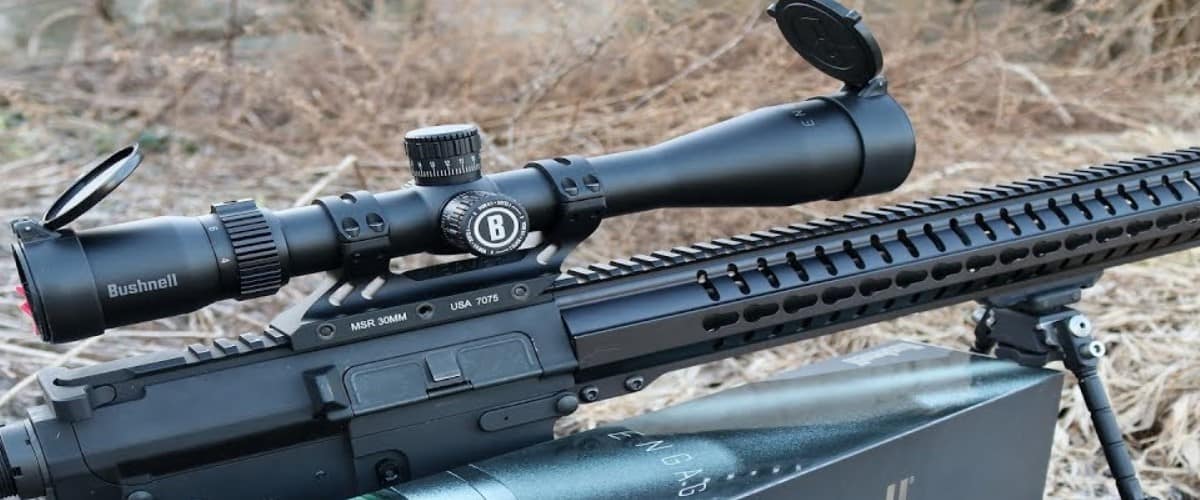
Bushnell built the Engage line to sit between the bargain rack and the optics that cost real money, and the 4-16×44 is the configuration most shooters in that hunt-and-range middle actually reach for. It carries a 30 mm tube, a Deploy MOA reticle in the second focal plane, and exposed locking turrets that reset to zero without a tool. On paper that feature set reads like it belongs a tier above where Bushnell prices it, and that gap is what put the scope on my bench. The money always gets saved somewhere on a mid-tier optic, and I wanted to find where.
I ran it through a couple of months of range work and a string of early sessions on a .308 bolt gun, dialing it, glassing with it, and doing my best to knock its zero loose. Here is where I landed after living with it: the Engage does almost everything its tier has no business doing well, and the single place it gives ground is not where the spec sheet would point you. The glass holds, the turrets track, and the reticle is the one thing to study hard before you buy. How much that last point matters comes down to when and where you actually shoot.
Bushnell Engage 4-16×44 Review
The parallax dial fought me for the first session
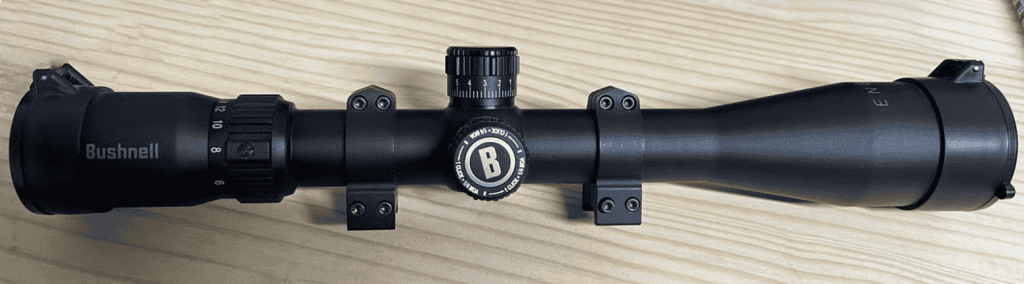
Out of the box the side focus dial was stiff enough that I checked twice to make sure I wasn’t forcing it past a stop. Bushnell’s complaint forums had warned me this was common on Engage samples, so I wasn’t shocked, but it’s the kind of thing that makes you wonder what else is tight. I spent the first bench session working it back and forth between 25 yards and the far berm, and by the end of that afternoon it had loosened into something I’d call firm rather than stubborn. The magnification ring did the same, just less dramatically. Nothing broke in, nothing fell out of spec; it was a coating-and-grease stiffness that wore off with use. I’d still rather a scope not arrive needing a break-in lap around the parking lot, but I’ve handled enough optics in this class to know it’s cosmetic, not mechanical.
Where 16x of magnification actually earns it
The glass is the pleasant part of this scope. At the bottom of the range the picture is bright and flat across most of the field, and pushing to the top of the magnification band the image stays usable rather than collapsing into the mush you get from cheaper variables when you wind them out. On a still morning I had it parked at full power reading a paper target at distance and the mirage came through cleanly enough that I was timing my shots to the boil, which is not something I expected to be doing with a scope priced where this one sits. Edge sharpness softens in the last bit of the field, and the 44 mm objective is honest about its limits when the sun drops, but in good light the Engage gives you more resolution than the tier usually hands over. The EXO Barrier coating shed a light drizzle one afternoon without me reaching for a lens cloth, which is a small thing until it’s the difference between taking a shot and wiping glass.
Counting clicks I could actually trust
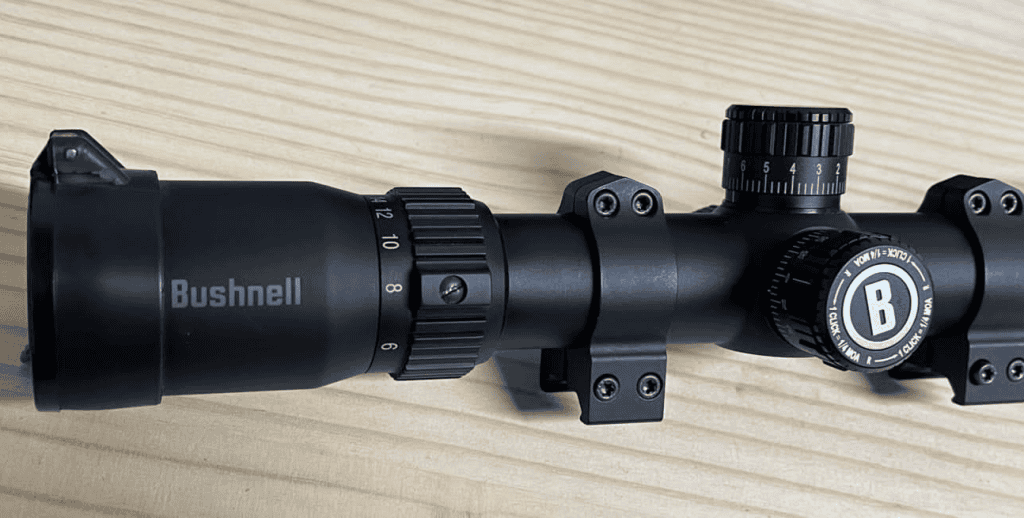
I came into this expecting the turrets to be the corner Bushnell cut, and they’re the opposite. The clicks are tactile and audible, spaced cleanly enough at quarter-MOA that I never had to second-guess a count, and the tool-less zero reset is the real convenience: confirm your zero, lift, set the dial to zero, done. I ran a deliberate box on a flat afternoon, dialing the elevation up, walking the windage across, coming back down and back in, and the point of impact landed where the math said it should every corner of the square. Then I spent the better part of a session just cycling the elevation through most of its travel and returning to zero over and over to see if it would drift, and it held. The honest gap here is the lack of a zero stop. With 50 MOA of elevation on tap you’ve got room to get lost in the dark under the dial, and you’ll be counting revolutions instead of feeling a hard return. For a scope that mostly lives between a hunting zero and a couple of dialed holds, I didn’t miss it much. If you’re the type who dials aggressively and often, you’ll feel its absence.
The morning the crosshair vanished
The reticle is what defined the scope for me. One gray dawn I had the rifle up on a treeline waiting for legal light, glassing a brushy field edge where a deer-colored animal would blend, and the Deploy MOA’s fine crosshair simply dissolved into the background. The center is busy with hashmarks and the lines themselves are hair-thin, which is a gift on a bright paper target at full magnification where you want precision, and a liability against dark cover in the last twenty minutes before shooting light. There’s no illumination to rescue it. I found myself dropping magnification to thicken the visual weight of the wires, which helped a little, but a thin black reticle on a dark background is a thin black reticle. As a second-focal-plane design the subtensions only hold true at the top of the magnification band, so the holdover hashes are a bench-and-bright-light tool, not a quick-snap brush aid. None of this is a defect. It’s a design that was drawn for daylight precision, and it’s excellent at that. It just asks you to be honest about the light you hunt in.
How I Put the Engage Through Range and Field Light
I mounted the Engage on a Ruger American Predator in .308 Winchester, a pairing I picked on purpose: this is a mid-tier scope, and a working bolt gun in a deer-and-target caliber is exactly the rifle a real buyer hangs it on. Mismatching it with a premium custom rig would have told me nothing useful about how it performs for the person actually shopping it. I fed it Federal Gold Medal 168-grain Sierra MatchKing for everything, so group data and tracking checks came off one consistent load.
Testing ran across a couple of months on a flat range with steel and paper out to distance, plus a handful of pre-dawn sessions sitting a field edge specifically to push the reticle in failing light. Round count landed in the low couple hundred, enough to confirm zero held through repeated dialing and recoil cycles. I confirmed zero cold each session and ran a box test for tracking rather than trusting a single string.
The reticle question is where my background actually mattered here. Five years selling optics over a counter taught me that buyers cross-shopping scopes in this class fixate on magnification and glass and almost never ask the one question that bites them later, which is whether they can see the reticle when the animal is finally standing there in low light. I watched that exact mistake play out with customers more times than I can count, so when I test a thin unilluminated hunting reticle I go looking for the failure point on purpose instead of grading it on a bright paper target and calling it done. That’s the lens I brought to the dawn sessions, and it’s why the reticle gets the scrutiny it does in this review. My full testing methodology covers how I structure these evaluations across optic types.
Performance Ratings
Field Test Data
| Test Parameter | Result |
|---|---|
| Best 5-shot group @ 100 yds (bipod, rear bag) | 0.9″ |
| Average 5-shot group @ 100 yds | 1.1″ |
| Box test tracking (dial up, across, back) | Returned true to each corner, no offset |
| Return to zero after repeated dialing cycles | Held zero, no measurable drift |
| Point-of-impact shift across 4x to 16x | None observed |
| Usable reticle window at dawn (against treeline) | Crosshair lost roughly 20 min before legal light closed |
Tested with: Ruger American Predator | .308 Winchester | Federal Gold Medal 168gr Sierra MatchKing
Pros and Cons
PROS
|
CONS
|
Who Should Hang This Scope on a Rifle
The Engage 4-16×44 makes the most sense for the daylight target shooter and the deliberate hunter who values precise daytime aiming and an occasional dialed hold over snap-shooting in the gloom. If you spend your time on paper and steel, ringing distant gongs in good light, the thin reticle is an asset and the honest tracking is the whole point. The same goes for the hunter who sits a field or glasses open country in usable light and takes measured shots. The tool-less zero reset rewards anyone who likes to confirm a zero and move on without digging for an Allen key.
It’s the wrong scope for the low-light specialist. If your shots come in the last fifteen minutes of legal light, in timber, or against dark-bodied game blending into cover, that fine black crosshair with no illumination will fight you exactly when you need it most. Thick-brush hunters who want a bold, fast reticle and snap acquisition should look elsewhere. And if you dial heavily and often across full revolutions, the missing zero stop will nag at you. Match the Engage to bright-light precision and it overdelivers; ask it to work in the dark and it shows you where Bushnell drew the line.
Disclosure
Everything above comes from time I personally spent behind this scope. This article may contain affiliate links, and ScopesReviews may earn a commission if you purchase through them at no additional cost to you. Those affiliate relationships do not influence the evaluation or the ratings above.
A Daylight Workhorse Worth Owning With Eyes Open
The Bushnell Engage 4-16×44 is an easy scope to recommend and a simple one to recommend correctly. It delivers glass and tracking that genuinely outrun its price tier, with locking zero-reset turrets that feel like they wandered down from a more expensive lineup. Nothing about the way it holds zero or moves the point of impact gave me pause across a couple of months of shooting.
The reticle is the whole conversation. Bushnell drew the Deploy MOA for daylight precision, and it’s excellent at that, but the fine wires and the lack of illumination mean it surrenders the last twenty minutes of shooting light to anything with a thicker or lit reticle. That’s not a flaw so much as a defined lane. Buy this scope for range work, target shooting, and hunting in honest light, and it overdelivers without drama. If your shots live in the gloom, spend your money where the reticle glows instead. For everyone shooting in real light, this one earns its place.
Mike Fellon is the founder of ScopesReviews and an optics specialist with 15+ years in precision shooting. A former Bass Pro Shops firearms advisor and NRA-certified instructor, he’s hands-tested 200+ rifle scopes across hunting and competition. Based in Dallas, Texas.