
The $500 mark sits at one of the more interesting points in the rifle scope market right now. Ten years ago this budget got you a basic 3-9x with capped turrets and a duplex reticle. Today the same money buys features that used to require twice the cash: first focal plane reticles, zero stops, locking turrets, illuminated glass. The trouble is that not every scope wearing those features executes them well, and the gap between paper specs and field reliability widens as manufacturers race to stuff more checkboxes into this tier.
I tested seven scopes that come up constantly in this conversation and selected four for final review. If I had to choose just one that would be the Arken.
My Top 4 Picks Under $500
Best Overall
Arken Optics SH-4J GEN2 6-24×50
The Arken delivers a feature set that mirrors scopes priced well above this ceiling. The 34mm tube, FFP reticle, AZS zero stop, illuminated reticle, and 108 MOA of elevation travel aren’t just checkboxes here. They actually work. Nothing else in this test gives you this much real capability for the money.
Best All-Around Value
Vortex Diamondback Tactical 4-16×44
This one earns its spot through versatility. It’s almost a pound lighter than the Arken, the EBR-2C FFP reticle is genuinely useful at hunting and target distances, and the Vortex VIP warranty stands behind it. If your shooting splits between deer woods and the bench, this is the easier scope to live with.
Best Illuminated Reticle Execution
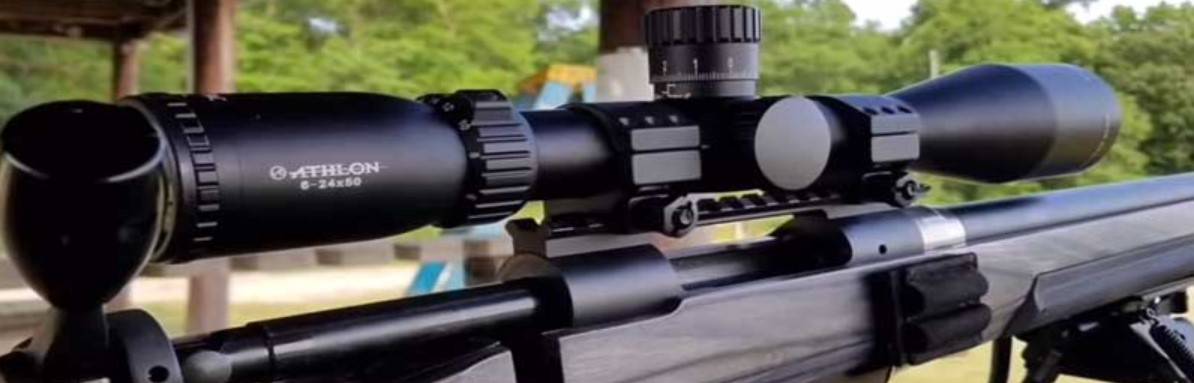
Athlon Argos BTR GEN2 6-24×50
The Argos sits in similar territory to the Arken on paper, but Athlon’s etched-glass illuminated reticle is sharper and brighter than several scopes I tested. You’re paying for execution on the reticle and turret feel. You give up some tube diameter and total elevation travel against the Arken to get there.
Best Pure Hunting Scope
Leupold VX-Freedom 3-9x40mm
This is the cleanest, lightest, simplest scope in this group. The glass punches above its weight in low light, the build is Leupold-bombproof, and the lifetime warranty isn’t a marketing line. The trade-off is real: no FFP, no exposed turrets, no parallax adjustment, no illumination. It’s a hunting scope and nothing else.
Where My Sub-$500 Calls Come From
The under-$500 tier has shifted more than any other price point I’ve tracked since starting ScopesReviews in 2017. Back then this budget meant accepting compromises today’s buyers don’t have to make. Brands like Arken and Athlon walked into this tier with feature sets that used to require $800 or more. Plenty of cheaper options arrived with the same checkbox features but none of the build quality to back them up. Sorting one from the other is the whole job at this price.
The Primary Arms SLx, Hawke Vantage, and Sig Whiskey3 I tested alongside these four (and ultimately set aside) all looked competitive on a comparison chart. Each had specs that should have put it in the running. The reasons each got cut were specific to what buyers spending close to $500 should actually expect. That’s the tier this guide covers, and it’s where most of my hands-on time has gone over the past few years.
Side-by-Side Specs
A quick note before you scan the table: at this price tier the specs that actually matter are tube diameter (it influences total elevation travel), reticle plane (FFP vs SFP changes how you use the scope), parallax adjustment, and whether the turrets are exposed and reset to zero. Magnification and objective size matter less than people think. Look for those four things first.
| Features | Arken Optics SH-4J GEN2 6-24×50 | Vortex Diamondback Tactical 4-16×44 | Athlon Argos BTR GEN2 6-24×50 | Leupold VX-Freedom 3-9x40mm |
|---|---|---|---|---|
| Magnification | 6-24x | 4-16x | 6-24x | 3-9x |
| Objective Diameter | 50mm | 44mm | 50mm | 40mm |
| Eye Relief | ~3.5″ | 3.8″ | 3.3″ | 4.2″ – 3.7″ |
| Weight | 36.6 oz | 23.1 oz | 30.3 oz | 12.2 oz |
| Length | 14.1″ | 14.1″ | 14.1″ | 12.39″ |
| Tube Size | 34mm | 30mm | 30mm | 1 inch |
| Reticle | VPR (FFP) | EBR-2C MOA | APLR2 MOA | Duplex (SFP) |
| Field of View | 20.88 – 5.22 ft @ 100 yds | 26.9 – 6.7 ft @ 100 yds | 16.7 – 4.5 ft @ 100 yds | 33.1 – 13.6 ft @ 100 yds |
| Turret Style | Exposed, AZS Zero Stop | Exposed Tactical | Exposed, Precision Zero Stop | Capped |
| Adjustment Range | 108 MOA Elevation / 34 MOA Windage | 85 MOA Elevation / 85 MOA Windage | 60 MOA Elevation / 60 MOA Windage | 60 MOA Elevation / 60 MOA Windage |
| Click Value | 1/4 MOA | 1/4 MOA | 1/4 MOA | 1/4 MOA |
| Parallax Adjustment | Side, 25 yds to ∞ | 20 yds to ∞ | Side, 10 yds to ∞ | Fixed 150 yds |
| Illumination | Yes, Red | No | Yes, Red (Etched Glass) | No |
The 4 Best Rifle Scopes Under $500
1. Arken Optics SH-4J GEN2 6-24×50 – Best Overall
First Time I Picked It Up Off the Bench
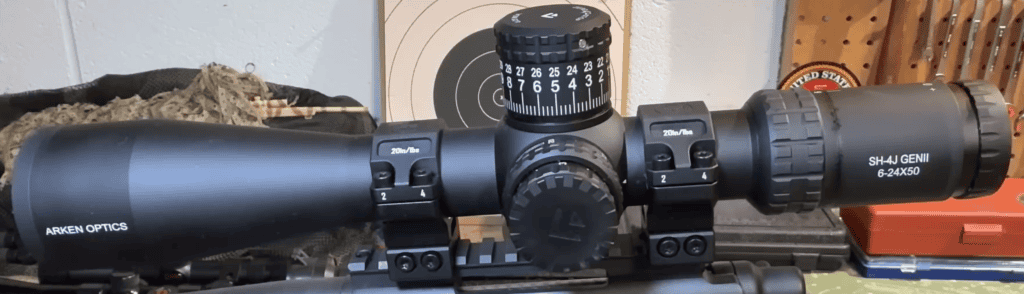
I unboxed the SH-4J expecting a scope that looked the part of its price tag. Instead I got something that felt like Arken had quietly raided a Nightforce parts bin. The turret housings are massive, the elevation and windage knobs have real heft to them, and the 34mm tube makes the Vortex sitting next to it on the bench look almost compact. Picking up the Arken first and the Athlon second telegraphs the difference instantly: same magnification range, same price neighborhood, dramatically different build under hand.
Where the Japanese Glass Held Up and Where It Didn’t
The Japanese ELD glass is the headline upgrade Arken built into the GEN2, and it shows. Through about 16x the image is sharp center-to-edge with a contrast level I don’t normally associate with anything under $500. Past 18x things soften a bit at the edges and chromatic aberration starts showing up on high-contrast targets, but the center stays crisp enough for serious work. Not many scopes in this tier let you do real shooting at 22-24x. This one comes close. The 50mm objective pulls in respectable light at dawn and dusk, and the side parallax dialed in cleanly even at 100 yards on top magnification, which is a place a lot of cheaper scopes start to fight you.
The VPR Reticle and What That Floating Dot Does for You
I tested the VPR MOA variant. There’s a floating dot at center with the inner stadia extending outward, and the design photographs busier than it actually shoots. At low power the dot lets you get on target fast without the FFP markings looking like hash soup. Crank up to 18-24x and the subtensions become useful for holdovers without crowding the target picture. Illumination is red-only off a CR2032 battery, and the rheostat has enough usable settings that I never needed the brightest one outside of bright midday work.
20 MOA Per Revolution Took Some Getting Used To
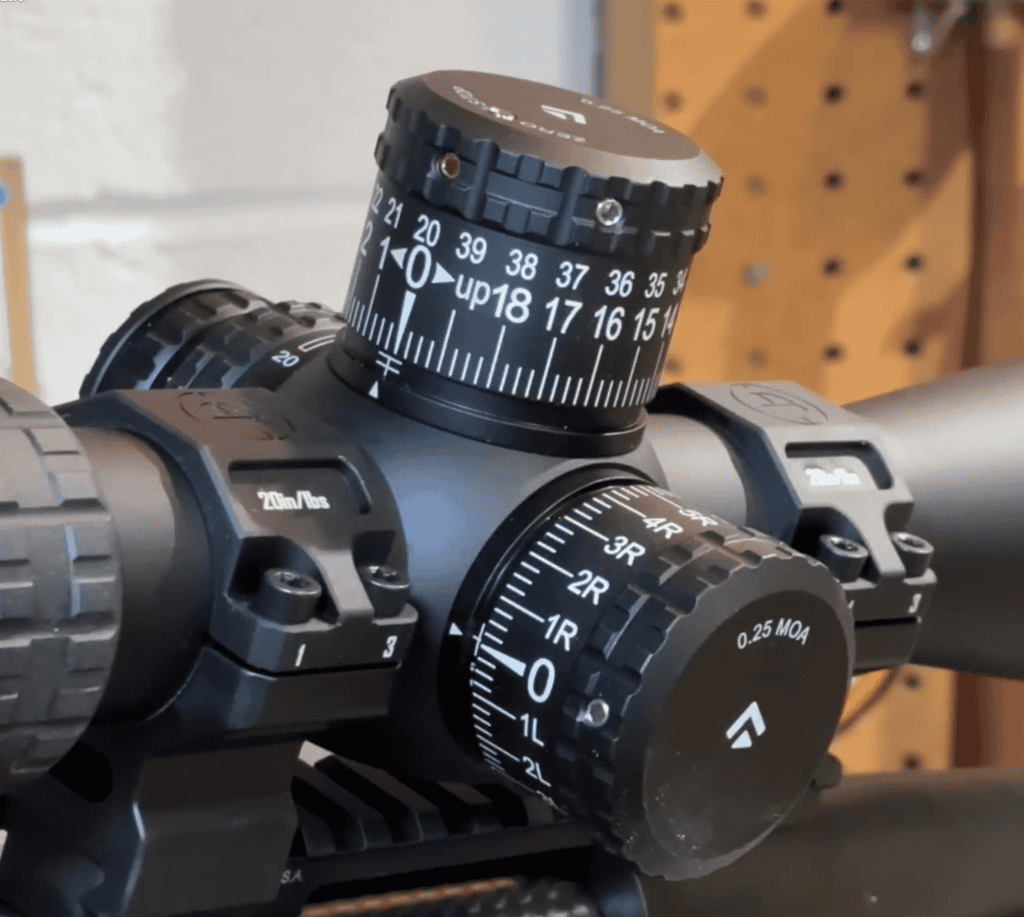
If you’ve never run a 20 MOA per revolution turret, plan on a couple range trips to recalibrate. I’m used to scopes that give you 10 to 15 MOA per turn, and the first time I dialed up for a far target on the Arken I caught myself over-rotating by a full revolution. Once it clicks, the system has a real advantage: you almost never need a second revolution for typical mid-distance precision work, so the zero stop isn’t fighting against a rotation indicator. The AZS zero stop itself is mechanical and tactile. You can dial back blind from any elevation setting and feel it slam home at zero.
The 34 MOA Windage Number Almost Nobody Mentions
I ran two box tests on consecutive range trips, once with the scope freshly mounted and once after 80-plus rounds had cycled through it. Both passed clean. Return to zero was within 0.25 MOA. Tracking was square. The one spec almost nobody flags on this scope is the asymmetric adjustment range. The Arken gives you 108 MOA of elevation, which is more than you’ll ever need at this tier, but only 34 MOA total windage. That’s less than half what the Vortex offers. For most precision shooting in still or moderate air, 34 MOA is plenty. If you live somewhere with serious crosswinds or your shooting reaches extreme distances where wind dial becomes a primary input, this is the one number worth thinking about before you buy.
Here’s how the numbers shook out across the sessions.
Field Test Data
| Test Parameter | Result |
|---|---|
| Box Test (10 MOA square, 100 yds) | Passed both runs, returned to zero within 0.25 MOA |
| 5-Shot Group Average (100 yds, bipod) | 0.85 MOA across 4 groups |
| Tracking Verification at 20 MOA Elevation | Accurate within measurement tolerance |
| Eyebox Forgiveness at 24x | Moderate, requires deliberate head position |
| Usable Illumination Settings (varied light) | 6 of 11 practical across daylight conditions |
Tested with: Ruger American Predator 6.5 Creedmoor | Hornady Match 140gr ELD Match
Pros and Cons
PROS
|
CONS
|
Performance Ratings
The Arken SH-4J GEN2 is the rare sub-$500 scope where the spec sheet actually matches what you get on the rifle. It earned Best Overall because no other scope in this test combines this level of glass, build quality, and turret execution for the money. If the weight or limited windage bothers you, the Vortex is the next call. Otherwise, this is the scope to beat under $500.
2. Vortex Diamondback Tactical 4-16×44 – Best All-Around Value
Where the Vortex Saved Me Almost a Pound and a Lot of Hassle
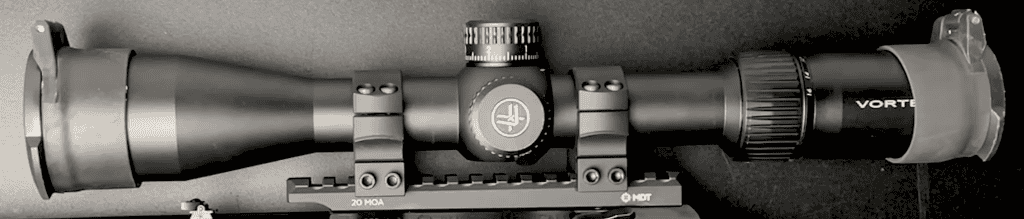
The Diamondback Tactical came out of the box feeling like the rational counterpoint to the Arken sitting next to it. Noticeably lighter, more compact through the turret housing, and the 30mm tube takes a much wider range of common rings without thinking about it. Both scopes target the same buyer in some ways, but you carry them differently. The Vortex is the one I’d put on a rifle I actually planned to hike with, and I spent a lot of testing days with this scope where I didn’t want the extra heft of a 36-ounce optic on top of a 7-pound rifle.
Glass That Earns Its Keep
XD is Vortex’s mid-tier glass, and it punches a little above what I expected at this price. Through about 12x the image is clean, contrast holds well, and chromatic aberration stays minimal even on high-contrast edges. At 16x there’s some softening near the field-of-view margins, but nothing that affected practical shooting. The 44mm objective gathers a respectable amount of light for dawn and dusk work, though it can’t match the 50mm objectives on the Arken and Athlon for raw light gathering. Side parallax tunes cleanly from about 20 yards out to infinity, which made closer-range steel work surprisingly fun on a centerfire setup.
EBR-2C: Useful, with a Caveat
The EBR-2C is where I have mixed feelings. It’s a Christmas-tree style holdover reticle with hash marks every 2 MOA on the MOA variant I tested, and below the horizontal stadia you get a descending grid for combined elevation and wind holds. As a precision reticle for known-distance work, it’s excellent. The hash subtensions are clean, the floating crosshair gives you a precise aiming point, and the FFP design keeps your holdovers true through the magnification range. Where it gets noisier is the numbered references along the vertical and horizontal stadia. Useful when you need them, visually busy when you don’t. The EBR-2C never bothered me in practice, but I can see why some shooters find it a bit cluttered.
Zero Reset Without a Zero Stop
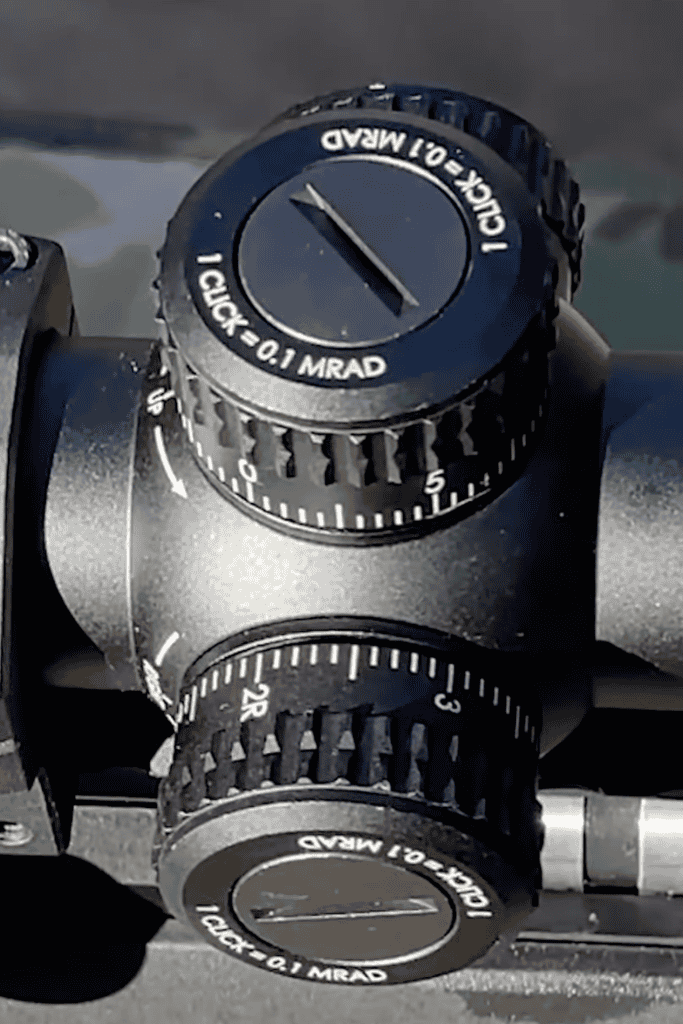
The turrets are exposed tactical-style with a coin-slot screw for zero reset. There’s no true zero stop here, which is the most notable feature gap against the Arken and Athlon. For typical hunting and most range work this almost never matters. If you’re dialing for distance work where you need to come back to a known reference blind, you’ll feel its absence. Clicks are positive and audible with a slightly lighter feel than the Athlon’s, and tracking proved consistent across my box test and a tall-target verification at 100 yards.
What That VIP Warranty Actually Buys You
I want to mention the VIP warranty separately because at this price it’s a real part of the value proposition. No questions, no receipt requirements, no original-owner restrictions, no warranty card. Damage your scope ten years from now in any circumstance and Vortex fixes or replaces it. The lifetime warranties from Arken, Athlon, and Leupold are all good, but none of them match the breadth of Vortex’s day-to-day coverage. For a buyer at this tier who can’t easily absorb the cost of a replacement, that policy quietly underwrites a chunk of what you’re paying for.
Field Test Data
| Test Parameter | Result |
|---|---|
| Box Test (20 MOA square, 100 yds) | Passed, returned to zero within 0.25 MOA |
| 5-Shot Group Average (100 yds, bipod) | 0.92 MOA across 4 groups |
| Weight Savings vs Arken | 13.5 oz lighter (significant for field carry) |
| Eye Relief Consistency Across Magnification | Stable 3.8″ throughout the zoom range |
| Edge Clarity at 16x | Slight softening at margins, center stays crisp |
| Turret Tactile Feedback | Clean clicks, lighter than Athlon’s, no mush |
Tested with: Ruger American Predator 6.5 Creedmoor | Hornady Match 140gr ELD Match
Pros and Cons
PROS
|
CONS
|
Performance Ratings
The Diamondback Tactical is the scope I’d buy if I wanted one optic that handled both hunting and target work without making either feel like a compromise. It loses to the Arken on outright capability and feature set, but the lighter weight, better eye relief, and that warranty close most of the gap. For a lot of buyers, especially anyone whose rifle moves between the stand and the bench, it’s actually the smarter pick.
3. Athlon Argos BTR GEN2 6-24×50 – Best Illuminated Reticle Execution
How the Athlon Shows Up Against the Arken on Paper
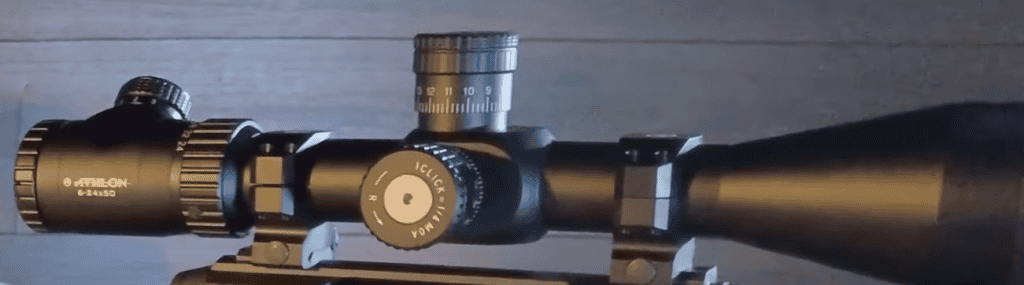
The Athlon Argos BTR GEN2 is the scope that makes the Arken look less like an outlier and more like the leading edge of a real trend at this price tier. Same 6-24x magnification, same 50mm objective, same etched-glass FFP illuminated reticle, same precision-style feature set. Side by side they tell you what’s possible under $500 right now. The differences between them are smaller than I expected and more meaningful than I would have guessed.
The Etched-Glass Illumination Difference
I tested the APLR2 MOA variant. The reticle is a clean Christmas-tree design with finely-marked hash subdivisions across the main stadia and a descending holdover grid that stays useful through the magnification range. Illumination is what separates this reticle from anything else in the test. Athlon etches the illuminated elements directly into the glass rather than relying on a fiber-optic system, and the result is a center cross and inner reticle that light up evenly without bleeding into the surrounding markings. In overcast conditions and early-morning light, the illumination genuinely adds shooting capability. In bright midday sun it gets washed out, which is true of essentially every illuminated reticle in this price tier, but the GEN2’s etched-glass implementation handles low light better than most.
Eyebox Got Tight at the Top
Where the Argos loses ground is the eyebox at top magnification. The 3.3″ eye relief sits at the low end of this group, and at 22-24x I had to be deliberate about head position to get a clean sight picture. On the Ruger I was running this on, that wasn’t a serious issue because the comb height let me settle into a consistent cheek weld behind the scope. On a rifle with a more variable stock, the tight eyebox at top magnification would be more annoying. The field of view is also the narrowest based on listed minimum and maximum FOV specs, which is partly the trade-off you make for the 50mm objective on a 30mm tube.
Precision Zero Stop Works Like It Should
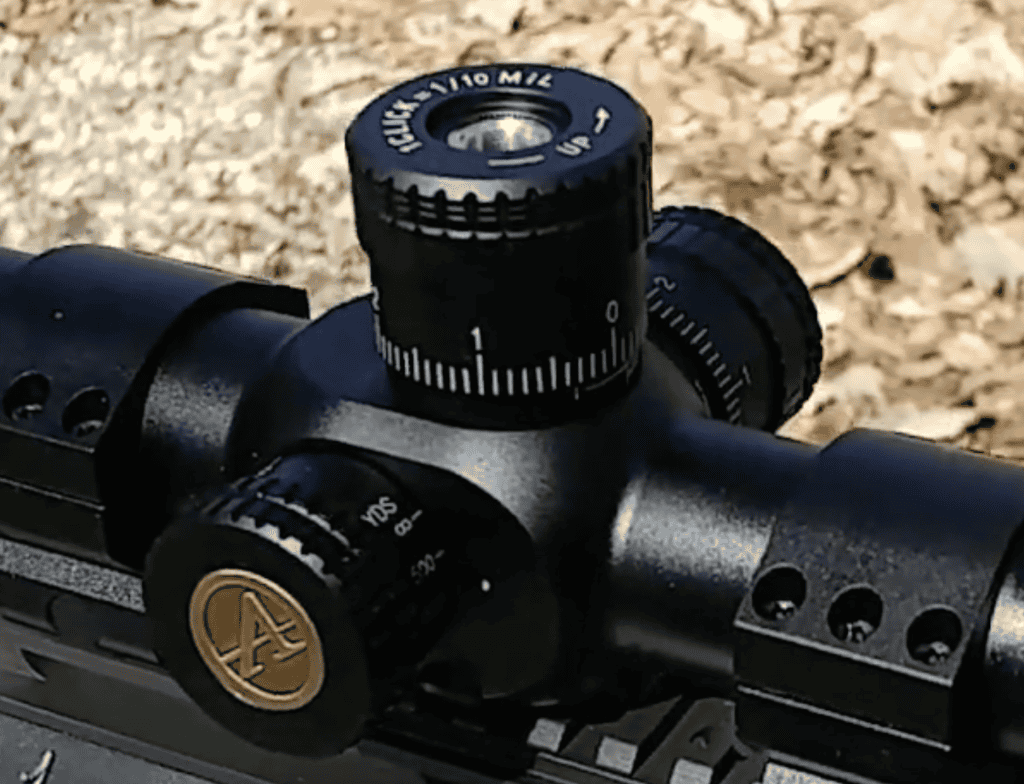
Athlon’s Precision Zero Stop does what these systems are supposed to do. Dial up for a longer shot, dial back blind, and the turret stops crisply at your set zero point. The clicks are positive and tactile without being heavy. I ran a box test and tracking verification at 100 yards across 30 MOA of elevation and the scope returned to point of impact every time. Athlon’s tracking quality has been the steadiest improvement I’ve watched in the value tier over the past few years. The GEN2 generation tightened up some of the QC variability I’d seen on earlier Argos samples, where turret feel could vary noticeably between units. The GEN2 scopes I’ve handled have all felt the same out of the box, which is a small thing that matters at this price point.
Where I’d Reach for This Over the Arken
There’s no obvious reason to pick the Athlon over the Arken on outright capability, but the Athlon’s reticle illumination is genuinely better-executed, and the 30mm tube fits a wider range of common rings. If you already own 30mm hardware, that alone can tip the decision. If you’re mounting fresh on a rifle where you can spec 34mm rings, the Arken is the call. Either way, you’re getting a scope that does things under $500 couldn’t do five years ago.
Two range trips and a box test later, here’s what the numbers said.
Field Test Data
| Test Parameter | Result |
|---|---|
| Box Test (10 MOA square, 100 yds) | Passed |
| 30 MOA Elevation Tracking | Passed |
| 5-Shot Group Average (100 yds, bipod) | 0.98 MOA across 4 groups |
| Eyebox Tolerance at 24x | Narrow, requires consistent head position |
| Illumination Visibility in Overcast Light | Clearly visible, cleanly etched |
| Zero Stop Repeatability | Returns precisely to zero from any elevation setting |
Tested with: Ruger American Predator 6.5 Creedmoor | Hornady Match 140gr ELD Match
Pros and Cons
PROS
|
CONS
|
Performance Ratings
The Argos BTR GEN2 6-24×50 is the scope you pick if you want most of the Arken’s capability with a better-executed illuminated reticle and a more conventional 30mm tube. You give up adjustment range and outright glass headroom, but for shooters who actually use illumination in their typical conditions, that trade can be the right one.
4. Leupold VX-Freedom 3-9x40mm – Best Pure Hunting Scope
The Scope That Doesn’t Try to Impress You
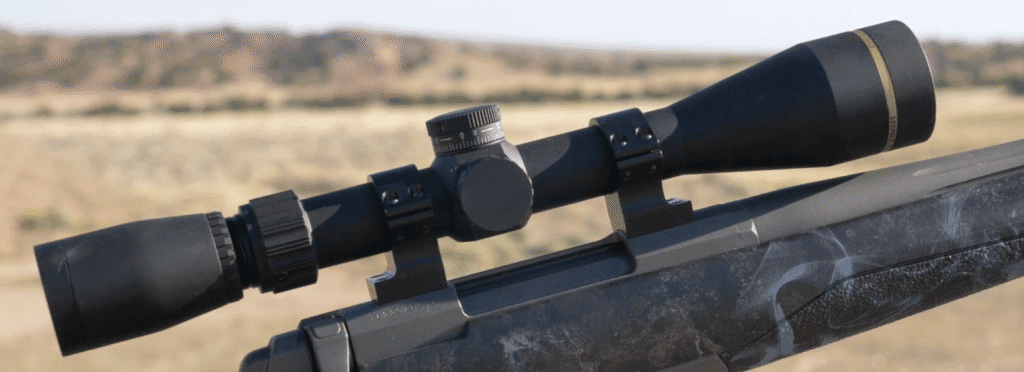
The VX-Freedom 3-9×40 is the only scope in this test that doesn’t try to impress you with its feature list. Pick it up against the Arken or the Athlon and you immediately understand the trade. No FFP reticle, no exposed turrets, no parallax adjustment, no illumination. What you get instead is a scope that weighs less than the eyepiece assembly on the Arken and that holds zero the way a Leupold should. After dragging the SH-4J and Argos around for a month of testing, picking up the rifle wearing the VX-Freedom was a small relief I didn’t expect to feel.
Twilight Light Management Through Texas Mornings
Twilight Light Management is the marketing name on the box, and the claim of about ten extra minutes of usable shooting light is roughly a third of what I observed. On cool spring mornings at the range outside Dallas, I could pick out clear definition through the VX-Freedom twenty to thirty minutes earlier than I’d expect from a scope at this price. The glass has real edges to it in the way only Leupold glass tends to do, which is hard to put a number to. The image is bright at 9x, sharp through about 7x with some softening at the field margins past that. The overall optical character feels honest rather than punchy.
What the Duplex Asks You to Give Up
The Duplex reticle is the simplest thing in the test, and your reaction to it tells you whether this scope is for you. Thick outer posts that pull your eye to center, fine inner crosshairs that don’t block the target, no holdover references at all. For a deer rifle shooting reasonable distances, this is everything you need and nothing you don’t. For target work, long-range steel, or any shooting that requires holdovers without dialing, the Duplex is a hard sell next to the FFP reticles on the other three scopes. There’s no right answer there, just whether the use case fits.
Fixed at 150 Yards and What That Means in Practice
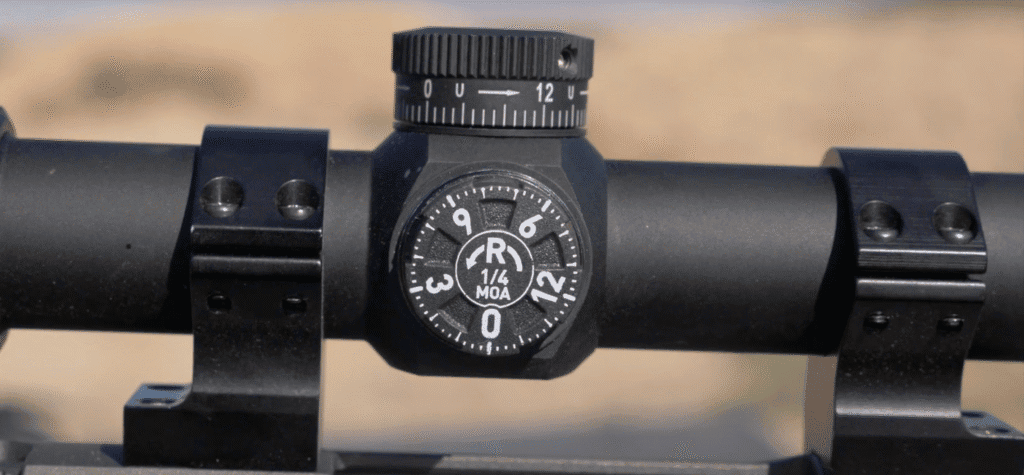
Fixed parallax at 150 yards is the other major specification difference. For typical hunting from about 75 yards out to 300 or so, the fixed parallax isn’t a problem you’ll feel. Inside about 50 yards on small targets you’ll see noticeable parallax error if your eye drifts off center, which matters on small-game work but rarely shows up in normal deer hunting. The capped turrets click with light positive feedback, and I ran the scope through a box test out of curiosity. It returned to zero clean. Using a Duplex-reticle scope for tracking tests is mostly academic, though.
Why the Weight Number Matters More Than You Think
12.2 ounces is the spec that matters more than any other when you’re carrying a rifle for hours. The VX-Freedom is lighter than the turret-and-eyepiece assembly on some of the precision scopes I’ve handled, and it shows up in the balance of the rifle and in your shoulder by the end of a long day. The 1-inch tube fits any common ring setup, the lifetime warranty covers the original owner and any subsequent owner with no paperwork required, and the scope is built in Oregon. There’s a reason this 3-9×40 layout sells more units to deer hunters than any other configuration in this tier.
Field Test Data
| Test Parameter | Result |
|---|---|
| 5-Shot Group Average (100 yds, bipod) | 1.08 MOA across 4 groups |
| Low-light Detail vs Test Group | Usable definition 20-30 minutes past expected for the price |
| Weight Savings vs Arken | 24.4 oz lighter |
| Box Test (10 MOA square, 100 yds) | Passed, returned to zero clean |
| Parallax Shift at 50 yds (offset head) | Noticeable, expected with fixed-parallax design |
| Turret Tactile Feedback | Light positive clicks under capped covers, no slop |
Tested with: Ruger American Predator 6.5 Creedmoor | Hornady Match 140gr ELD Match
Pros and Cons
PROS
|
CONS
|
Performance Ratings
The VX-Freedom 3-9×40 isn’t the most capable scope in this test and doesn’t try to be. It’s the best pure hunting scope in the group, and for the buyer who wants nothing more than a reliable lightweight optic that holds zero and works in low light, it’s a clean answer. Put the same money into the Arken or Vortex and you get more capability. Put it into this and you get a scope you’ll probably never have to think about again.
The Rig and Range Days Behind These Numbers
All four scopes rode on a Ruger American Predator chambered in 6.5 Creedmoor. The Predator shows up under sub-$500 scopes more than any other rifle right now, and 6.5 Creedmoor pairs naturally with these magnification ranges. Ammunition stayed constant: Hornady Match 140gr ELD Match.
Testing ran across six weeks of spring 2026 at a public range outside Dallas, with days mostly in the 65 to 85 degree range typical of North Texas this time of year. I shot morning sessions in light wind and one afternoon with gusts past 12 mph. Round count came in around 360, weighted toward the Arken and Vortex because those two saw the most tracking work. Distances ran from 50 yards out to 600 yards on steel for the 6-24x scopes.
Three scopes didn’t make the final four. The Primary Arms SLx 4-14×44 FFP had reticle etching that washed out against bright steel under harsh light, which the Vortex EBR-2C didn’t. The Sig Sauer Whiskey3 4-12×44 had turret feel that ran loose compared to the Leupold’s clicks, with one elevation knob showing persistent turret slop after 40 rounds. The Hawke Vantage 30 4-16×50 weighed more than expected and gave up eye relief to the Vortex for similar money.
For how I run these range sessions, my testing process lives here.
Where Sub-$500 Buyers Trip Up Most Often
More magnification than the use case actually calls for
At this tier, 6-24x scopes are precision tools. If your rifle hunts deer and rarely sees past 200 yards, a 6-24x on top is overweight, narrower-FOV than you need, and asks you to crank back to 6x every time you actually shoot. The Leupold’s 3-9x layout fits deer-rifle work more naturally than the bigger scopes here. Buying for the spec sheet rather than the use case is the most common error at this budget.
Treating “FFP” as one spec instead of an execution question
Three of these four scopes use FFP reticles, and they don’t perform the same way. Etching quality, illumination behavior, and low-magnification reticle visibility vary meaningfully between scopes that all check the same FFP box. Assuming an FFP reticle is automatically better than a Duplex misses the point. A reticle you don’t actually lean on for holdovers is just visual clutter in the field of view.
Treating the $500 ceiling as a hard wall
Several scopes sit just above this ceiling, and a small step over the line can deliver a real performance jump over what’s available right at it. If your budget is firm, fine. If it’s a target rather than a wall, a slight stretch for a meaningful step up in glass or feature execution is sometimes the smarter spend. The reverse is also true. Stretching to the top of the ceiling for specs you won’t use is throwing money around.
Questions I Hear Most About Sub-$500 Scopes
Is the Arken really better than the Vortex for the money?
Depends on use. The Arken delivers more feature execution per dollar with its 34mm tube, illumination, and adjustment range. The Vortex wins on weight, consistent eye relief, and warranty terms. Dedicated precision rifle, Arken. Do-everything optic that hunts and shoots range, Vortex.
Can you actually get long-range precision out of a sub-$500 scope?
Yes, with caveats. The Arken or Athlon will hold zero and track at typical long-range distances. What you give up against pricier scopes is glass headroom at extreme magnification and absolute tracking repeatability. Inside about 600 yards with realistic expectations, these scopes deliver.
Should I pay extra for an illuminated reticle at this price?
Only if you actually shoot in failing light. Illumination execution varies wildly under $500, and poor implementations add nothing. The Athlon’s etched-glass version is genuinely useful in low light. If you hunt or shoot mostly in daylight, skip the feature and put the savings into glass quality.
Which One You Actually Want on Your Rifle
For range and mid-distance precision work, the Arken is the easy call. The 34mm tube and 108 MOA elevation actually matter on a precision rifle, and the weight isn’t a factor when the rifle lives in a soft case between sessions.
For a rifle that hunts and shoots range without committing fully to either, the Vortex Diamondback Tactical is the more versatile pick. Almost a pound lighter than the Arken, consistent eye relief, and a warranty that quietly underwrites part of the value.
For shooters who already own 30mm rings or who actually use illumination for low-light work, the Athlon makes more sense than the Arken on those grounds alone.
For a dedicated deer rifle, the Leupold VX-Freedom is the cleanest answer in the group.
Disclosure
This guide includes affiliate links to Amazon and OpticsPlanet, and I earn a small commission if you buy through them. The Arken SH-4J in this review was bought direct from Arken Optics USA after the GEN2 launch; the other three came through general retail outlets. Nothing here was paid for or sponsored.
Final Thoughts
The four scopes in this test cover most of what under $500 actually buys right now. The Arken SH-4J GEN2 6-24×50 came out on top because it’s the rare scope at this price where the spec sheet matches the product. Japanese ELD glass that does real work through most of the magnification range, an AZS zero stop that locks crisp, 108 MOA of elevation, and a 34mm tube that feels two tiers above its asking price. Nothing else in this group matches that combination.
The Vortex Diamondback Tactical is the more versatile answer for anyone whose rifle has more than one job. The Athlon Argos BTR GEN2 is the better illumination story for low-light work. The Leupold VX-Freedom is the cleanest pure hunting scope here. None of those are wrong picks, just answers to different questions.
If you came here looking for a single clean recommendation, the Arken is mine. If your needs run different from the precision-rifle case, the right answer depends on what your scope is actually going to do on the rifle. The under-$500 tier rewards specificity. Buyers who get the most out of this budget are the ones who think hardest about how they’ll actually use the optic before pulling the trigger.
Mike Fellon is the founder of ScopesReviews and an optics specialist with 15+ years in precision shooting. A former Bass Pro Shops firearms advisor and NRA-certified instructor, he’s hands-tested 200+ rifle scopes across hunting and competition. Based in Dallas, Texas.