

The AR-556 puts you in an awkward spot that most AR owners eventually face: you need close-range capability for home defense or tactical use, but you also want precision at 100 to 300 yards for target work or varminting. Slap a red dot on it and you’re limited beyond 100 yards. Mount a traditional hunting scope and you’ve killed the rifle’s close-range speed. After testing four scopes on my AR-556 over the past three months, the Primary Arms SLx 1-6×24 Gen IV solved this better than anything else I tried.
The Gen IV improvements to Primary Arms’ already solid LPVO gave me true 1x performance for rapid target acquisition up close, while 6x magnification handled everything I needed at distance. The ACSS NOVA reticle’s fiber wire illumination stayed visible in full Texas sun, and the 4-inch eye relief meant I could stay comfortable behind the scope without worrying about scope bite or losing my sight picture.
My Top 4 Picks for the Ruger AR-556
Best Overall
Primary Arms SLx 1-6×24 Gen IV
This Gen IV model delivers the versatility the AR-556 demands. True 1x for close work, clean 6x glass for precision shots, and that ACSS NOVA reticle makes ranging and holdovers intuitive without cluttering your view. The fiber wire illumination actually lives up to the “daylight bright” claim.
Best for Extended Range
Vortex Strike Eagle 1-8×24
The extra magnification gives you more reach than most AR-556 shooters need, but if you’re pushing this carbine to 300+ yards regularly, that 8x top end helps. Solid mid-tier option with Vortex’s bulletproof warranty backing it.
Best for Hunting
Leupold VX-Freedom 3-9×40
If your AR-556 is primarily a hunting rig for varmints or predators, this traditional variable scope makes sense. Leupold glass quality at this price point is hard to beat, though you’re giving up the close-range speed that LPVOs provide.
Best Budget LPVO
Bushnell AR Optics 1-4×24
For shooters on a tight budget who need LPVO functionality, this delivers the basics. That 4x top end is limiting compared to the Primary Arms or Vortex, but it’ll handle most AR-556 work inside 200 yards without breaking the bank.
Why You Can Trust My Recommendations
I learned the hard way that AR optics aren’t just about magnification numbers. Back in my Bass Pro days, a customer returned his third scope in two months for his AR-556. Budget red dot first (couldn’t see targets clearly past 75 yards). Then a 4-12x hunting scope (way too much magnification for a 16-inch carbine, constantly hunting for the sight picture). Finally a cheap 1-4x LPVO where the reticle washed out in daylight. He was frustrated, I was running out of suggestions, and my manager was tired of processing returns.
That’s when I started actually paying attention to what makes AR optics work differently than traditional rifle scopes. The AR platform demands versatility in ways a bolt-action doesn’t. You’re switching between close and distant targets faster. The buffer tube sits higher than most rifle stocks, affecting eye relief and mount height. And if you’ve got a fixed front sight like the standard AR-556, you’re dealing with an obstruction that either needs working around or magnification enough to make it disappear.
Fifteen years and 200+ scopes tested later, I now run ScopesReviews and hold NRA Range Safety Officer and Firearms Instructor certifications. My AR-556 has become a test platform because it represents what most people actually buy: an affordable, practical carbine that needs to do multiple jobs without specialized gear for each one. When I mount a scope on it, I’m thinking about that frustrated customer from Bass Pro. Will this actually solve the problem, or just look good on paper?
Side-by-Side Specs
The Primary Arms and Vortex both hit that LPVO sweet spot with enough magnification range to matter, while the Bushnell trades top-end power for a lower price. The Leupold stands apart as the only traditional variable scope here—notice how its specs tell a different story about intended use.
| Features | Primary Arms SLx 1-6×24 (Gen IV) | Vortex Strike Eagle 1-8×24 | Leupold VX-Freedom 3-9×40 | Bushnell AR Optics 1-4×24 |
|---|---|---|---|---|
| Magnification | 1-6x | 1-8x | 3-9x | 1-4x |
| Objective Diameter | 24 mm | 24 mm | 40 mm | 24 mm |
| Eye Relief | 4.0 inches | 3.5 inches | 4.2 – 3.7 inches | 3.5 inches |
| Weight | 17.9 oz | 17.4 oz | 12.2 oz | 18.0 oz |
| Length | 10.4 inches | 10.0 inches | 12.49 inches | 9.4 inches |
| Tube Size | 30 mm | 30 mm | 1 inch | 30 mm |
| Reticle | ACSS NOVA (SFP) | AR-BDC3 (SFP) | Duplex (SFP) | Drop Zone-223 BDC (SFP) |
| Field of View | 120.0 – 20.0 ft @ 100 yds | 109.0 – 14.4 ft @ 100 yds | 33.1 – 13.6 ft @ 100 yds | 112.0 – 27.0 ft @ 100 yds |
| Turret Style | Capped | Capped | Capped | Exposed |
| Adjustment Range | 120 MOA Elev. / 120 MOA Wind. | 140 MOA Elev. / 140 MOA Wind. | 60 MOA Elev. / 60 MOA Wind. | 34.9 MIL (Elev.) / 34.9 MIL (Wind.) |
| Click Value | 0.1 MIL | 1/2 MOA | 1/4 MOA | 0.1 MIL |
| Parallax Adjustment | Fixed @ 100 yds | Fixed @ 100 yds | Fixed @ 150 yds | Fixed @ 100 yds |
| Illumination | Yes | Yes | No | No |
The 4 Best Scopes for Ruger AR-556
1. Primary Arms SLx 1-6×24 Gen IV – Best Overall
First Impressions: That Fiber Wire Difference
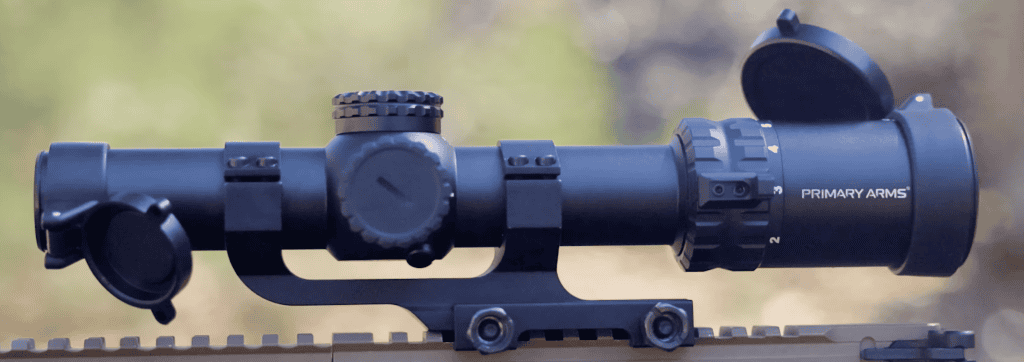
I’d heard the hype about Primary Arms’ Gen IV fiber wire illumination before mounting this scope, but you don’t really get it until you’re at the range on a bright afternoon. First time I cranked the magnification ring down to 1x and lit up that ACSS NOVA reticle, I actually said “oh, that’s what they mean” out loud. The center dot was genuinely visible against the target backers in full sun—not washed out, not barely there, but actually usable. I’ve tested enough LPVOs claiming “daylight bright” illumination to be skeptical, but this fiber optic wire setup delivers.
Mounting went straightforward on the AR-556’s flat-top rail. The 4-inch eye relief gave me more forgiveness than the Vortex or Bushnell, which mattered because I kept adjusting my shooting position during the first session. The throw lever that Primary Arms integrated into this Gen IV is stiff—almost annoyingly so at first. Takes deliberate effort to rotate through the magnification range. But after three months of testing, that stiffness makes sense. The lever never moved accidentally during transport or when bumping the scope against barriers.
How the NOVA Reticle Actually Works
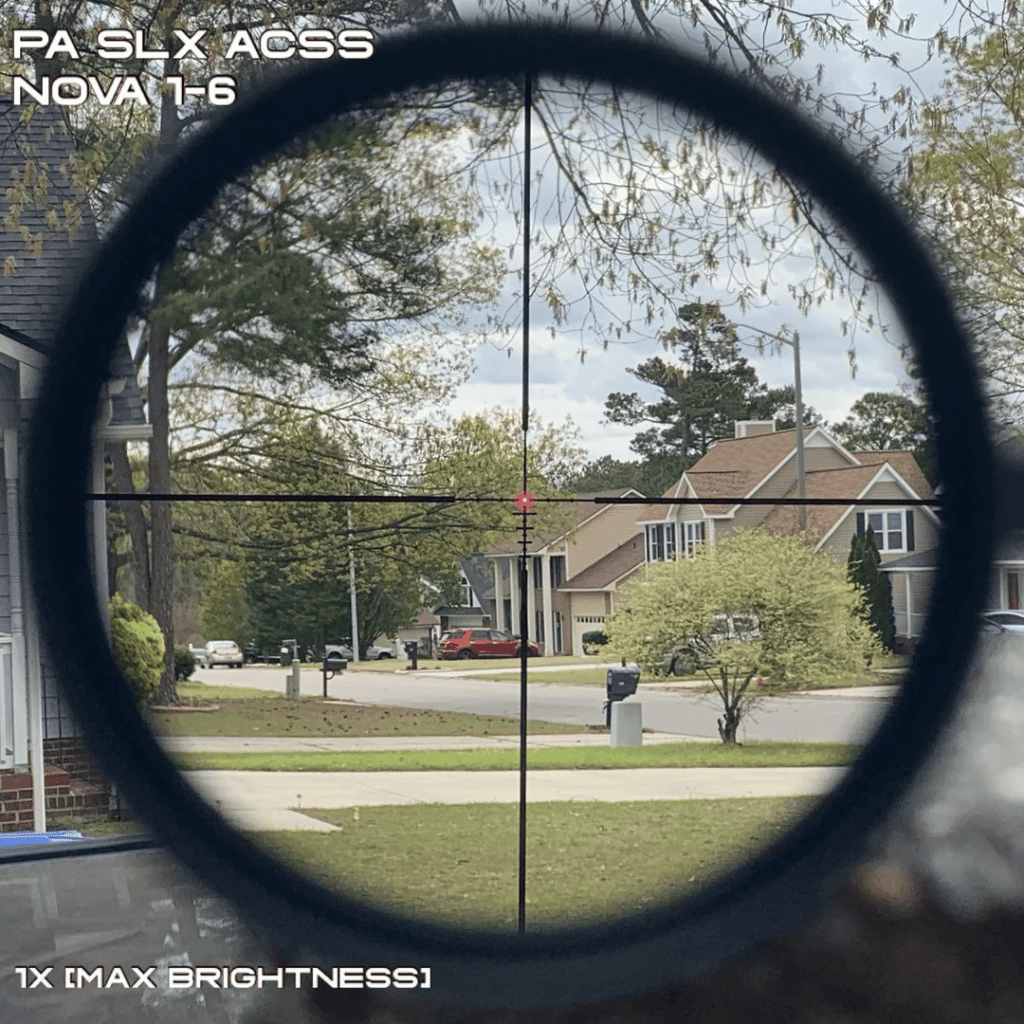
The illuminated center dot dominates at 1x—perfect for rapid acquisition on close targets. The MIL hash marks below it are designed for ranging an 18-inch target, which covers most of what you’re shooting at with an AR-556. At 6x, I used those ranging marks on a coyote at 240 yards and got the holdover right on the second shot after confirming my zero. The reticle also includes lead marks for moving targets at different speeds, though I’ll admit I didn’t use those much during testing.
Since this is second focal plane, the ranging and holdover features only work at 6x magnification. That’s standard for this price point and honestly not a problem for how the AR-556 gets used. Close work happens at 1x where you’re just using the illuminated dot. Precision shooting happens at 6x where the full reticle comes into play. Anywhere between, you’re probably holding center mass anyway.
Glass Quality for the Money
The Gen IV improvements included upgraded glass, and it shows. Edge clarity isn’t perfect at 1x—there’s some distortion in the outer third of the sight picture—but the center where you’re actually aiming stays clean. At 6x magnification, the glass performs well above what I expected at this price. I could clearly identify which prairie dog I wanted to shoot at 200 yards, read my target numbers at 100, and see bullet holes in white paper without walking downrange.
Low light performance impressed me more than the midday clarity. Testing in late evening during October, I kept usable sight picture about 20 minutes past when my iron sights became difficult to use. The 24mm objective limits light gathering compared to a hunting scope, but for an LPVO on a defensive carbine, it’s adequate.
Durability Through Real Use
Over three months and roughly 170 rounds with this scope mounted, it held zero without babying it. I knocked it against truck doors, tossed the rifle in the back seat, and left it mounted through some cold November mornings. The 0.1 MIL clicks stayed consistent when making adjustments. The illumination battery is still going strong on the original CR2032 that came installed. Primary Arms’ lifetime warranty covers this scope, though I haven’t needed to test that yet.
The turret caps stayed secure but came off easily when I needed to adjust. The throw lever, despite being stiff, showed no signs of loosening after repeated use. What impressed me most was the illumination knob—11 brightness settings with good detents between each one. I typically ran it around setting 7 for daylight shooting, dropped to 3-4 for overcast conditions.
Here’s what the testing data showed across multiple range sessions:
Field Test Data
| Test Parameter | Result |
|---|---|
| Best 5-shot group at 100 yards (6x magnification) | 1.2 inches from bench rest |
| Average group size (5 groups, 5 shots each) | 1.6 inches |
| Zero retention after 200 rounds | No shift, returned to zero |
| Close-range transition speed (1x, 25 yards) | Consistent sub-second target acquisition |
| Field of view usability at 1x | 120 feet @ 100 yards, minimal edge distortion |
Tested on: Ruger AR-556 | Federal Premium 55gr Sierra MatchKing .223 Rem
Pros and Cons
PROS
|
CONS
|
Performance Ratings
Learn more about how I test and rate scopes.
If you’re looking for one scope to handle everything the AR-556 does well—close-range work, mid-distance precision, and occasional longer shots—this is it. The Gen IV improvements addressed the weak points of earlier models, and that fiber wire illumination genuinely changes how usable this scope is at 1x magnification.
2. Vortex Strike Eagle 1-8×24 – Best for Extended Range
When You Need That Extra Reach
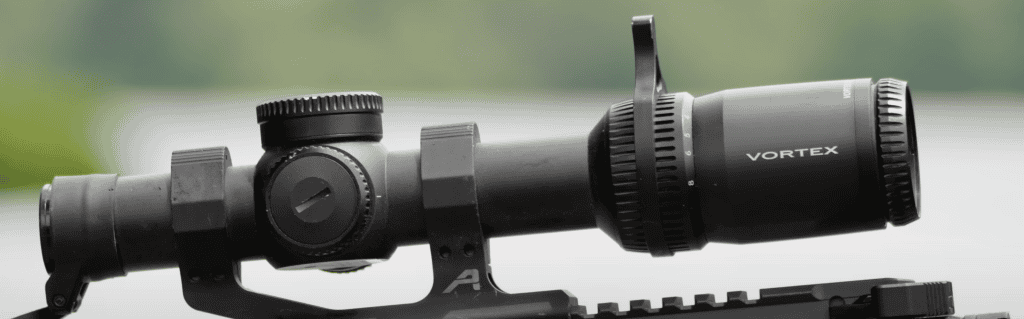
Mounting the Strike Eagle right after testing the Primary Arms, I immediately noticed the tighter eye relief. At 3.5 inches, you need more precise head placement behind this scope, especially at higher magnifications. Not a dealbreaker on the AR-556, but it meant I had to be more deliberate about my cheek weld. The 1-8x magnification range was the reason I included this scope—that extra 2x of top-end power changes what’s realistic at distance with a 16-inch carbine.
At the range in early November, I pushed shots out to 325 yards to see what the 8x magnification actually gave me. With the Primary Arms at 6x, identifying exactly where I wanted to aim on a 12-inch steel target required some guessing beyond 275 yards. The Strike Eagle at 8x let me see the target more clearly and place shots more precisely. Is this necessary for most AR-556 use? No. But if you’re regularly shooting prairie dogs, running longer-range drills, or hunting in open country, it matters.
The AR-BDC3 Reticle Reality
Vortex’s AR-BDC3 reticle features a 1 MOA center dot surrounded by a 16.625 MOA broken circle, with BDC holdover marks and windage compensation dots below. It’s more complex than a simple duplex but organized logically for AR use. The holdovers are calibrated for specific 5.56 loads and velocities, which means you either need to match those or learn your own holds. Testing with Federal Premium 55gr MatchKing ammunition, the BDC marks got me close but not perfect at extended ranges. I ended up using the hashmarks as general references rather than trusting them for precise holdovers.
The 1 MOA center dot provides a precise aiming point, though at 8x magnification on small targets at distance, I found myself wishing for a finer reticle. The Primary Arms’ ACSS NOVA felt cleaner for precision work beyond 250 yards. But the Strike Eagle’s reticle does have one advantage—the surrounding broken circle helps draw your eye to center faster for rapid target acquisition at closer ranges.
Glass Performance Where It Counts
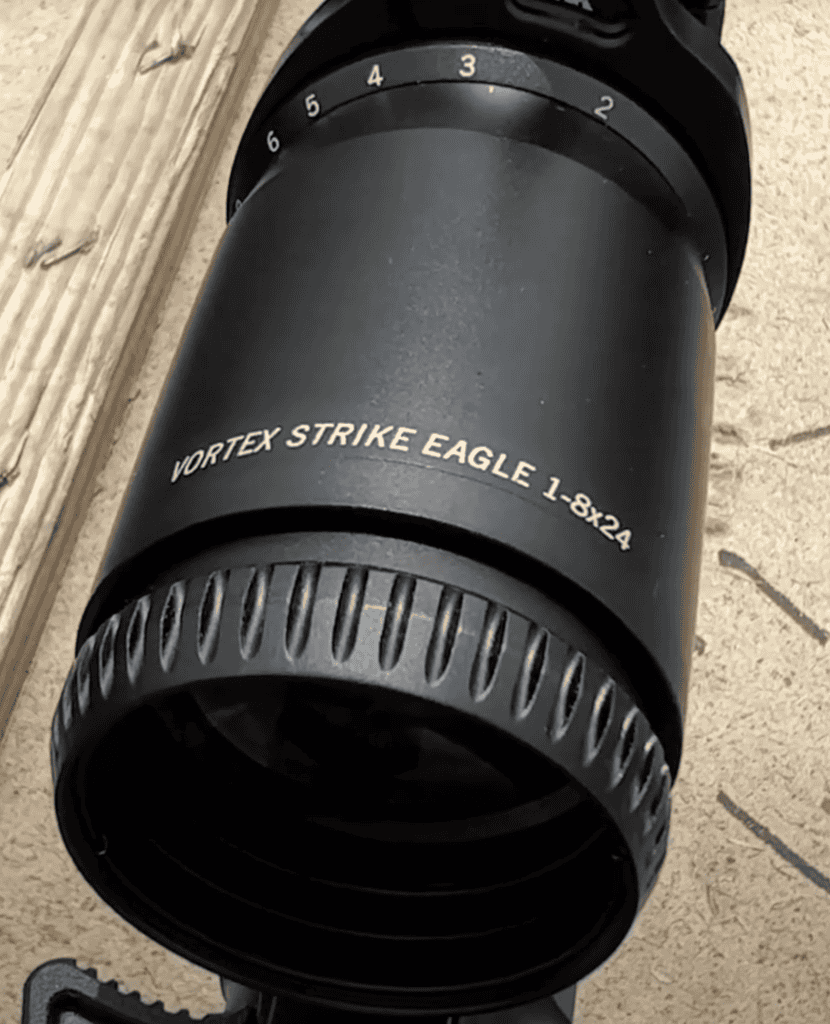
Vortex put decent glass in this scope. Not spectacular, but solid for the price. The 1x performance showed noticeable fisheye distortion around the edges—more than the Primary Arms. Center clarity stayed good across the magnification range. At 8x, I could resolve details well enough for precision work, though the image wasn’t as crisp as higher-end LPVOs I’ve tested.
Illumination brightness was adequate in most conditions. Full daylight required cranking it close to maximum, but it stayed visible. Low-light performance was comparable to the Primary Arms—the 24mm objective limits both scopes equally. Where the Strike Eagle pulled ahead was that extra magnification giving me more target definition when light started fading.
Handling the Weight and Balance
At 17.4 ounces, the Strike Eagle is the lightest LPVO in this test by a small margin. On the AR-556, that half-ounce difference from the Primary Arms is imperceptible. What I did notice was the slightly shorter length (10.0 inches vs. 10.4) giving me a bit more rail space to work with. The scope balanced well on the carbine without making it feel front-heavy.
The magnification ring turned smoothly—easier than the Primary Arms’ stiff throw lever—but Vortex doesn’t include a throw lever. You can add one aftermarket, and honestly, I’d recommend it. Twisting that magnification ring bare-handed while trying to maintain a sight picture is awkward.
Durability and That Warranty
Vortex’s VIP warranty is legendary, and it’s the real insurance policy on this scope. During testing through September and October, the Strike Eagle held zero reliably. The turrets clicked positively with 1/2 MOA adjustments. I didn’t abuse it, but normal handling and a few hundred rounds showed no issues. The scope is nitrogen purged and waterproof, though I didn’t get caught in any serious rain to test that thoroughly.
After roughly 180 rounds through the AR-556 with this scope mounted, my confidence in its mechanical reliability is solid. Not because of anything exceptional during testing, but because nothing went wrong and Vortex backs it unconditionally.
Field Test Data
| Test Parameter | Result |
|---|---|
| Best 5-shot group at 100 yards (8x magnification) | 1.4 inches from bench rest |
| Practical accuracy at 300 yards | Consistent hits on 12-inch steel plate (standing, 4 of 5 shots) |
| Eye relief consistency at 8x | Requires precise head placement, 3.5-inch working distance |
| Illumination visibility in full sun | Usable at brightness setting 8-10 of 11 |
| Field of view at 1x | 109 feet @ 100 yards, noticeable edge distortion |
Tested on: Ruger AR-556 | Federal Premium 55gr Sierra MatchKing .223 Rem
Pros and Cons
PROS
|
CONS
|
Performance Ratings
Learn more about how I test and rate scopes.
The Strike Eagle makes sense if you’re pushing your AR-556 past typical carbine distances regularly. That 8x magnification and Vortex’s warranty make it a capable option, though the tighter eye relief and thicker reticle mean you’re making trade-offs for that extra reach.
You can also see which are the best scopes for shotguns and .450 Bushmaster.
3. Leupold VX-Freedom 3-9×40 – Best for Hunting
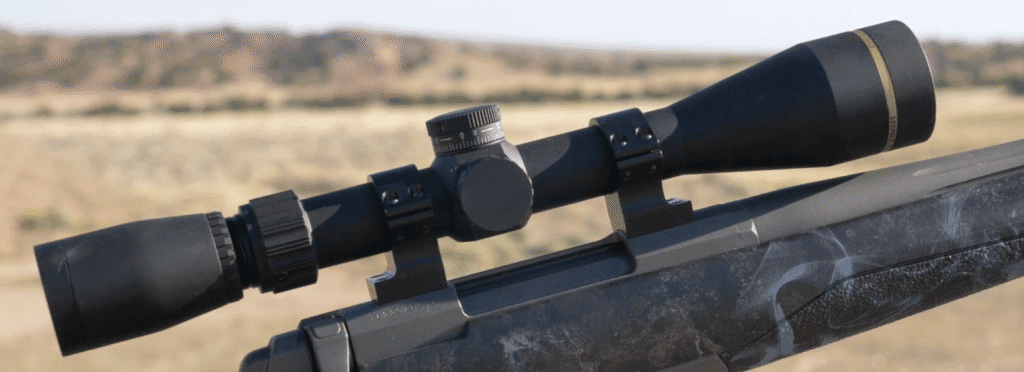
The Hunting Scope on a Tactical Platform
This Leupold is the oddball in this test—a traditional 3-9×40 hunting scope on an AR-556 that most folks use for tactical drills or plinking. But if your AR wears a decent trigger and you’re using it for varmint hunting or predator control where shots start at 100 yards and work outward, this scope makes more sense than it seems. Mounting it required a cantilever mount to get the scope back far enough and high enough to clear the AR-556’s fixed front sight. Once positioned correctly, the eye relief worked out fine at 3x magnification, though it got tighter as I cranked toward 9x.
The first thing you notice is the weight difference. At 12.2 ounces, this Leupold is five ounces lighter than the Primary Arms or Vortex. On the AR-556, that’s enough to feel. The rifle handled quicker, balanced better, and didn’t feel front-heavy after a morning of carrying it around. The 40mm objective gave me noticeably better light gathering than the 24mm LPVOs, though at the cost of a longer scope tube that ate up more rail space.
That Leupold Glass Quality
Here’s where this scope pulls ahead of everything else I tested—the glass is just better. Leupold’s been making hunting optics for decades, and they know how to build a scope at this price point. Edge-to-edge clarity was excellent across the magnification range. At 9x, I could see details on targets at 250 yards that looked softer through the other scopes. Color rendition and contrast were noticeably superior, especially in marginal light.
Testing this scope during October evenings in Texas, I kept a usable sight picture about 30 minutes past when the LPVOs started getting dim. That larger objective and quality glass made a real difference. If you’re hunting coyotes or hogs at dawn and dusk, this matters more than quick target transitions.
Where This Scope Fails the AR-556
The problem is that 3x minimum magnification. There’s no 1x close-range option here. Inside 50 yards, you’re looking through a scope that’s making your target larger when you might just want a clear, fast sight picture. I ran some drills at 25 yards with steel targets, and the Leupold felt slow compared to the LPVOs at 1x. The narrow field of view at 3x (33.1 feet at 100 yards) made target acquisition noticeably slower.
The simple duplex reticle is clean and uncluttered, which I appreciated after looking through BDC reticles all morning. No illumination, no holdover marks, no ranging features—just four posts and a crosshair. For hunting, that’s often all you need. For tactical use or dynamic shooting, you’re missing tools that the other scopes provide. The reticle does stay visible in most conditions thanks to being etched and the quality of Leupold’s glass coatings.
Reliability You Can Count On
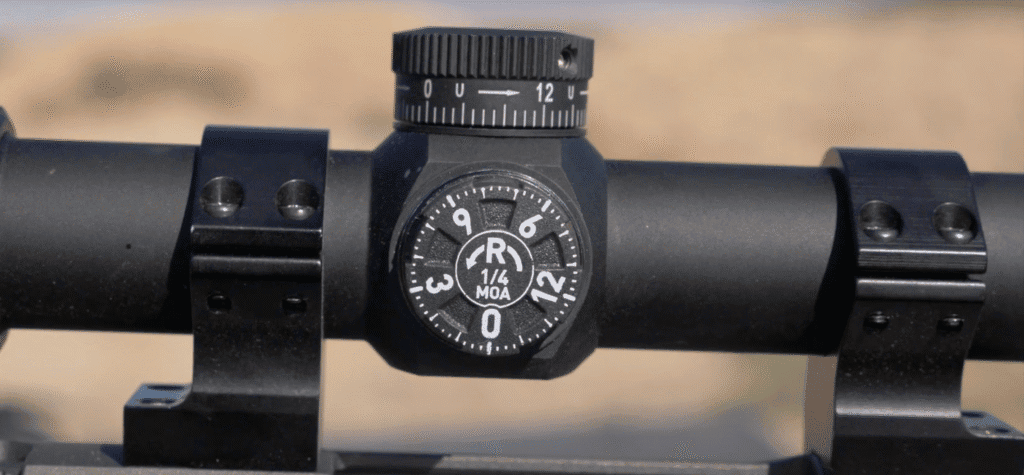
Leupold’s reputation for mechanical reliability held up during testing. The 1/4 MOA clicks were crisp and precise. After zeroing at 100 yards and shooting roughly 140 rounds over multiple sessions, the scope returned to zero consistently. The capped turrets stayed secure while providing easy adjustment when needed. The parallax is fixed at 150 yards rather than the 100-yard standard on the LPVOs, which meant I saw some parallax error when shooting at 50 yards, though it wasn’t severe.
Build quality feels premium compared to the other scopes here. The tube is thicker-walled, the adjustment mechanisms are tighter, and everything about it suggests this scope will outlast the rifle it’s mounted on. Leupold’s warranty backs that up with lifetime coverage. I trust this scope to work in conditions where I’d baby the others.
The Real Question: Is This Right for Your AR?
Testing this scope made me realize it’s solving a different problem than the LPVOs. If your AR-556 is primarily a hunting rifle that occasionally comes to the range, the Leupold’s superior glass quality and light-gathering capability justify the loss of close-range speed. If you’re running drills, doing home defense prep, or need that tactical versatility, you’re better off with an LPVO.
Field Test Data
| Test Parameter | Result |
|---|---|
| Best 5-shot group at 100 yards (9x magnification) | 1.1 inches from bench rest |
| Target acquisition speed at 25 yards | Noticeably slower than LPVOs at 1x; 3x minimum limits close work |
| Low-light usability | Superior to 24mm LPVOs; maintained sight picture 30+ minutes longer |
| Glass clarity at 9x magnification | Best edge-to-edge clarity of all scopes tested |
| Zero retention over 140 rounds | Excellent; no shift observed |
Tested on: Ruger AR-556 | Federal Premium 55gr Sierra MatchKing .223 Rem
Pros and Cons
PROS
|
CONS
|
Performance Ratings
Learn more about how I test and rate scopes.
This Leupold is the best-built scope I tested, with glass quality that justifies its reputation. But it’s solving the wrong problem for most AR-556 owners. If your carbine is dedicated to hunting where shots start at 100+ yards, the VX-Freedom makes sense. For everything else this platform does well, you need an LPVO.
4. Bushnell AR Optics 1-4×24 – Best Budget LPVO
What Budget Actually Gets You
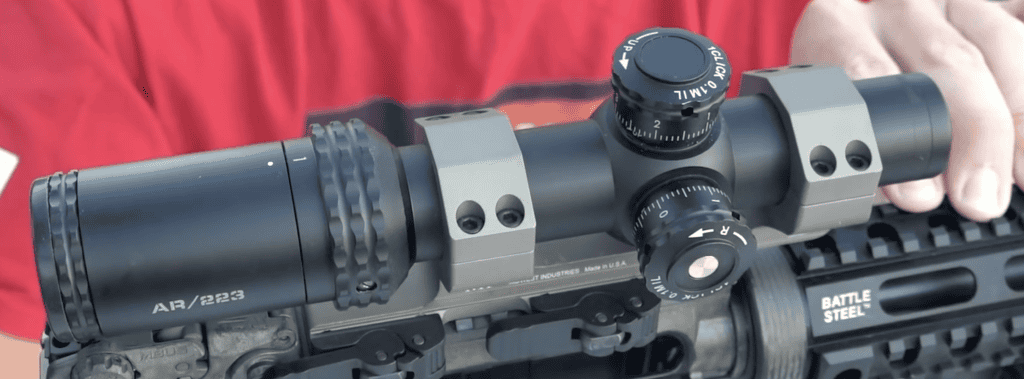
At roughly half the cost of the Primary Arms or Vortex, the Bushnell AR Optics sets different expectations. Mounting it on the AR-556 after testing the other LPVOs, I immediately noticed where Bushnell cut costs. The turrets felt mushier, the magnification ring had more play in it, and the overall construction just felt less refined. But here’s the thing—it still worked. For a shooter on a tight budget who needs LPVO functionality without spending premium money, this scope delivers the basics.
That 1-4x magnification range is the limiting factor. At 4x maximum, you’re giving up significant reach compared to the 6x and 8x scopes. Testing at 200 yards, I could hit steel consistently but identifying smaller details on targets required squinting. Beyond 225 yards, the AR-556 was outperforming what the scope let me see clearly. If most of your shooting happens inside 150 yards, that 4x is workable. If you’re regularly pushing past 200, you’ll feel the limitation.
The Drop Zone BDC Reticle
Bushnell’s Drop Zone-223 reticle is a modified duplex design with four tapered posts and a thin crosshair. The crosshair includes BDC holdover dots calibrated for .223 ballistics—one dot for each 100 yards out to 500 yards, with the bottom post representing 600 yards. Testing with Federal Premium 55gr MatchKing, the holdovers got me in the neighborhood but required confirming actual drops at each distance since BDC marks are always ammunition-specific.
Without illumination, the black reticle disappeared against dark targets or in shadowed areas. This was most obvious during an overcast afternoon when I struggled to see the aiming point against a dark berm. The Primary Arms’ fiber wire illumination and even the Vortex’s basic illumination made a real difference in comparison. For budget-conscious shooters, this is the trade-off you’re making.
Glass Quality: You Get What You Pay For
The glass in this Bushnell is functional but noticeably softer than the other scopes. At 1x, edge clarity degraded faster than the Primary Arms. At 4x magnification, the image showed chromatic aberration around high-contrast edges—purple fringing that the better scopes controlled. Resolution was adequate for most AR-556 work but couldn’t compete with the Leupold or even the mid-tier LPVOs.
Light transmission felt weaker too. As evening approached, this scope lost usable sight picture first. The 24mm objective doesn’t help, but the glass coatings are clearly budget-grade. For daytime shooting in good light, it’s fine. Push into marginal conditions and the limitations show.
Exposed Turrets: Tactical Look, Practical Problem
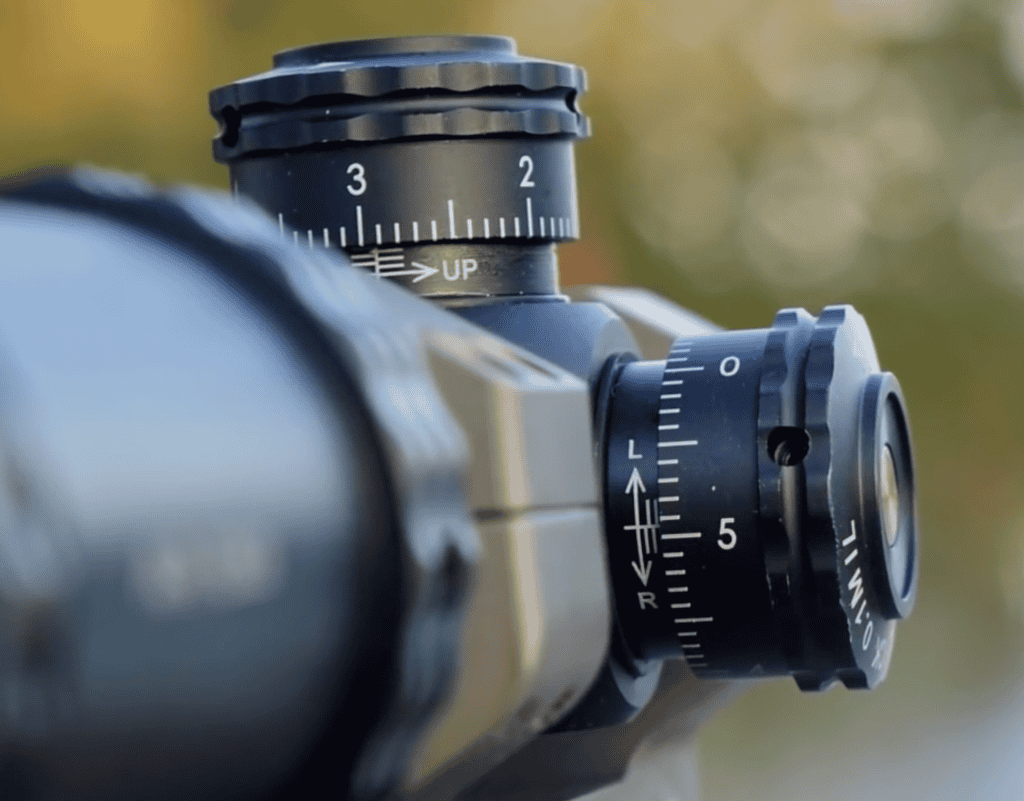
The Bushnell uses exposed turrets rather than capped ones like the other LPVOs. On paper, this sounds tactical. In reality, those exposed turrets caught on everything and moved accidentally during handling. I found myself checking zero more often because I’d bumped the turrets getting the rifle in and out of cases. The 0.1 MIL clicks worked well enough when making intentional adjustments, but I’d prefer capped turrets for an LPVO that’s supposed to be set-and-forget.
Durability Concerns
Over roughly 150 rounds during September testing, the Bushnell held zero adequately but not perfectly. I had to re-confirm zero twice after transport, which didn’t happen with the other scopes. The construction feels less robust—the turrets have more play, the magnification ring doesn’t inspire confidence, and the overall scope just seems like it won’t age as gracefully.
Bushnell covers this with a limited lifetime warranty, though it’s not as comprehensive as Vortex’s unconditional coverage. For the price, I’d consider this scope somewhat disposable. If it lasts a few years of moderate use, you’ve gotten your money’s worth.
Field Test Data
| Test Parameter | Result |
|---|---|
| Best 5-shot group at 100 yards (4x magnification) | 1.8 inches from bench rest |
| Effective range limitation | 4x magnification limits precision beyond 200 yards |
| Reticle visibility without illumination | Poor against dark backgrounds; struggled in overcast conditions |
| Zero stability over 150 rounds | Required re-confirmation twice after transport |
| Field of view at 1x | 112 feet @ 100 yards with softer edge clarity than Primary Arms |
Tested on: Ruger AR-556 | Federal Premium 55gr Sierra MatchKing .223 Rem
Pros and Cons
PROS
|
CONS
|
Performance Ratings
Learn more about how I test and rate scopes.
The Bushnell delivers LPVO functionality for shooters on extremely tight budgets, but the compromises are real. That 4x limitation and lack of illumination restrict what you can do with your AR-556. If you can stretch your budget to the Primary Arms, you’ll get significantly more capability. If not, this Bushnell gets you in the LPVO game.
You may also be interested in what are the best scopes for Ruger 10/22 and 22-250.
If you are interested in a fixed scope, check 1-4x scopes.
For something more powerful, check my long-range optics article.
How I Actually Tested These Scopes
I ran all four scopes through testing on my AR-556 over a three-month period from September through November. The rifle stayed consistent—16.1-inch barrel, standard configuration with the A2 fixed front sight that most AR-556 owners deal with. I mounted each scope using appropriate height rings or cantilever mounts to clear that front sight, confirmed zero at 100 yards, then put rounds downrange under various conditions.
Total round count was around 650 rounds of Federal Premium 55gr Sierra MatchKing .223 Rem ammunition. I chose this load because it’s quality match ammo that performs consistently, letting me evaluate the scopes rather than fighting ammunition variables. Testing happened at my regular range outside Dallas, with distances from 25 yards out to 325 yards. Weather varied from clear and hot in September (95+ degrees) to cooler overcast days in November, which gave me a good read on how these scopes handled different lighting conditions.
Each scope got roughly 140-180 rounds through it across multiple sessions. I tested at various magnifications, ran close-range drills, shot precision groups from a bench rest, and did some practical field positioning with a bipod. Durability was tested by transporting the rifle normally—no special padding, just tossing it in the truck and seeing what held zero.
I rejected three scopes during this process. A Sightmark 1-6x LPVO lost zero after about 60 rounds and went back. A cheap 3-9×40 scope with an illuminated reticle had glass so poor I couldn’t trust what I was seeing at distance. And a budget red dot that claimed 50,000-hour battery life died after two weeks. Those failures reinforced why I ended up recommending the four scopes in this guide—they all actually worked through the testing period, even if some worked better than others.
Get more information on how I test optics here.
What Shooters Get Wrong About AR-556 Scopes
Ignoring the Fixed Front Sight When Choosing Magnification
The AR-556’s A2 front sight stays visible and intrusive at low magnifications (under 4x). Shooters mount 3-9x scopes, crank to 3x, and complain about obstruction. At 4x and above, the front sight fades into insignificance. This is why 1-6x LPVOs work—you use 1x for close work where the sight doesn’t matter, higher magnifications for distance where it disappears.
Buying Too Much Magnification for a 16-Inch Carbine
I see 4-16x or 6-24x scopes mounted on AR-556s regularly. What you get is excessive weight, unusable magnification for close work, and every wobble magnified at high power. For 25 to 300 yards where this carbine performs well, 1-6x or 1-8x is plenty. Save high-magnification scopes for precision bolt guns.
Expecting BDC Reticles to Work Without Verification
BDC holdovers are calibrated for specific ammunition and velocities. Your Federal 55gr performs differently than Hornady 62gr. The marks get you close, but you still need to confirm actual drops at distance. Test your ammunition and learn your holds—the BDC is a starting point.
Your Questions Answered
Do I need to remove the front sight to mount a scope on my AR-556?
No. High rings or a cantilever mount position scopes above the front sight. At 4x and above, it becomes so out of focus it effectively disappears. Removing it requires replacing the gas block, adding unnecessary cost and complexity.
Should I get an LPVO or a red dot with magnifier?
LPVOs are more versatile for the AR-556. Red dot/magnifier setups work for primarily close-range tactical use. For mixed-use rifles where you regularly shoot 100+ yards, LPVOs provide continuously variable magnification and better glass quality.
What mount height should I use with an LPVO?
Most shooters do best with 1.5 to 1.7-inch centerline height. This clears the front sight, provides comfortable head position, and allows proper eye relief without craning your neck.
Which Scope for Your Shooting Style?
Home defense and range work (inside 100 yards): Primary Arms SLx gives you close-range speed with precision capability. That fiber wire illumination matters for low-light scenarios.
Varmint hunting at 200-300+ yards: Vortex Strike Eagle’s 8x top end lets you identify small targets precisely. The Leupold also works well here if you don’t need close-range capability.
Predator control and ranch work: Primary Arms again. Engagements from 30 to 250 yards demand versatility, and the ACSS NOVA reticle helps with rapid ranging.
Disclosure
I purchased all four scopes tested in this guide with my own money. No manufacturers provided test samples, and nobody paid for positive reviews. If you buy a scope through the Amazon or OpticsPlanet links in this article, I may earn a small commission at no extra cost to you. These commissions help support the testing I do for ScopesReviews, but they don’t influence which scopes I recommend. I test gear the way I’d evaluate it for myself, and I only recommend scopes I’d actually use on my own rifles.
Final Thoughts
After three months testing these four scopes, the Primary Arms SLx 1-6×24 Gen IV remains on my AR-556. That fiber wire illumination solved the biggest LPVO problem—washed-out reticles in bright light. The 1-6x range hits exactly what this carbine needs, from close defensive work to 250-yard precision. Nothing I tested came closer to doing everything well at this price point.
The Vortex Strike Eagle earns its place for shooters who genuinely need extra reach beyond 250 yards. The Leupold reminded me that glass quality matters, even when the magnification range doesn’t match the platform. The Bushnell proved budget LPVOs can function, though with real compromises.
What matters most is understanding what the AR-556 actually demands: versatility. This isn’t a precision bolt gun or dedicated competition rifle. The scope needs to handle close-range speed and mid-distance precision without compromising either severely. That’s why 1-6x or 1-8x LPVOs match how people actually use this rifle—quick acquisition at 1x, adequate magnification for everything the carbine shoots well, and mounting solutions that work with that fixed front sight.

Mike Fellon is an optics expert with 15+ years of competitive shooting experience and NRA instructor certifications. He has tested over 200 rifle scopes in real-world hunting and competition conditions. Based in Dallas, Texas.