
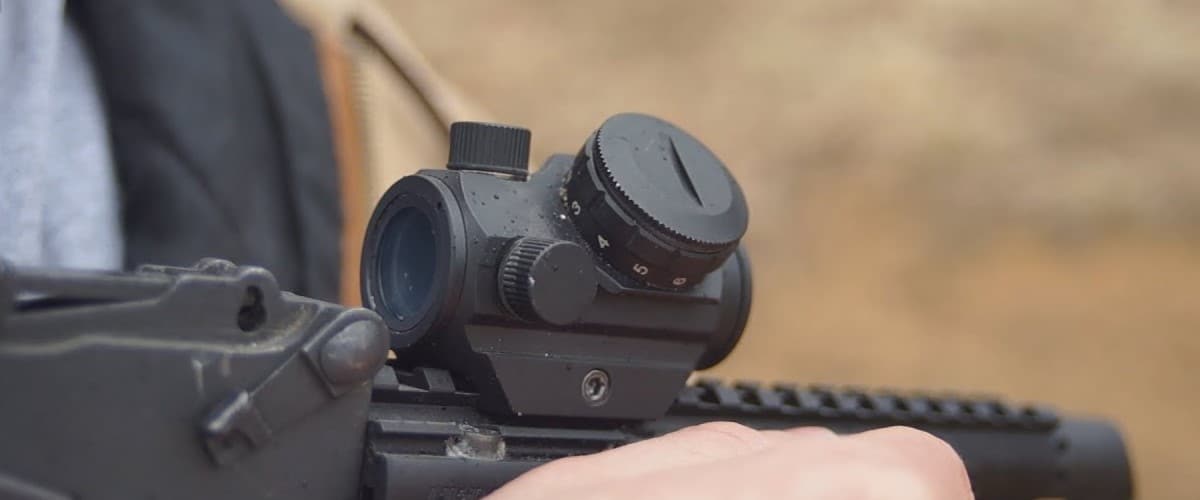
Ask around any rimfire range or first-rifle forum which red dot to start with, and the TRS-25 comes up before anything else. It has held that spot for more than a decade, which is most of why I finally bolted one to a plinker and ran it hard: an optic that survives that long on word of mouth either does something right or coasts on a price tag. Bushnell sells it as a rugged, sealed, do-everything entry dot for rimfires, shotguns, and light carbines, and the reputation says it holds zero and shrugs off weather better than its tier should.
What I came away with is narrower than the all-purpose pitch. The little tube is genuinely tough and the zero stayed put through a high round count, no drama there. The catch sits in the diode: top-end daylight brightness runs out before a bright Texas noon does, and there is no auto-off or shake awake to manage the battery for you. None of that sinks it for the buyer this optic was built for. It just means you should know which buyer that is before you order one.
Bushnell TRS-25 Review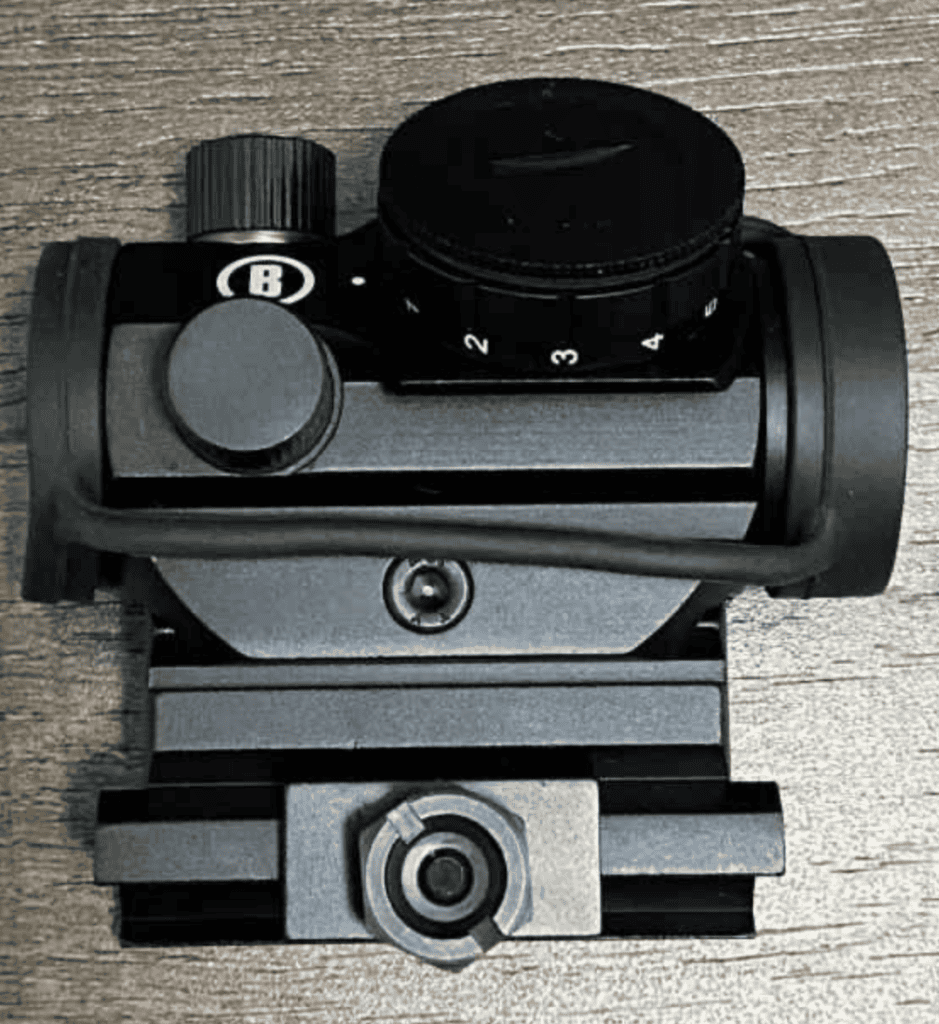
I built the test around the gun most people actually pair this optic with, a Ruger 10/22, and spent most of a hot stretch of late spring plinking steel and culling squirrels off a hayfield edge. A .22 is not going to beat up an optic, so I was not chasing a recoil story. My questions were narrower: does the sealed-tube toughness hold up, does the dot stay crisp, and do the brightness complaints I have heard for years actually show in full sun?
The Dot Is Crisp Until the Sun Wins
For most of a morning the 3 MOA dot did exactly what a plinking dot should. It sat round and clean against shaded steel, came up fast when I shouldered the rifle, and let me run a row of swingers about as quick as I could call them. At settings six and seven under tree cover it was crisp enough that I stopped thinking about it, which is the whole point of a red dot.
Then the sun cleared the treeline and climbed, and the picture changed. Around noon I set up on a white-painted gong with the sun high and behind me, cranked the rotary dial to ten, and the dot looked like a faint coal against the glare. I bumped it to eleven, the top setting, and it firmed up but never got to the eye-grabbing brightness I get from a better diode. On one string I caught myself cupping a hand over the front of the tube to shade the lens just to pick the dot back up against that white paint. That is the ceiling people warn you about, and it is real. Against darker targets or in overcast it was a non-issue all day; it is specifically bright sun on a light background where the diode runs out of room.
If you have astigmatism, know that the dot picks up a mild starburst at the higher settings, more flare than flawless circle. It was minor for my eyes and worse for a buddy who shot it without his glasses. Not a defect, just the reality of a budget emitter.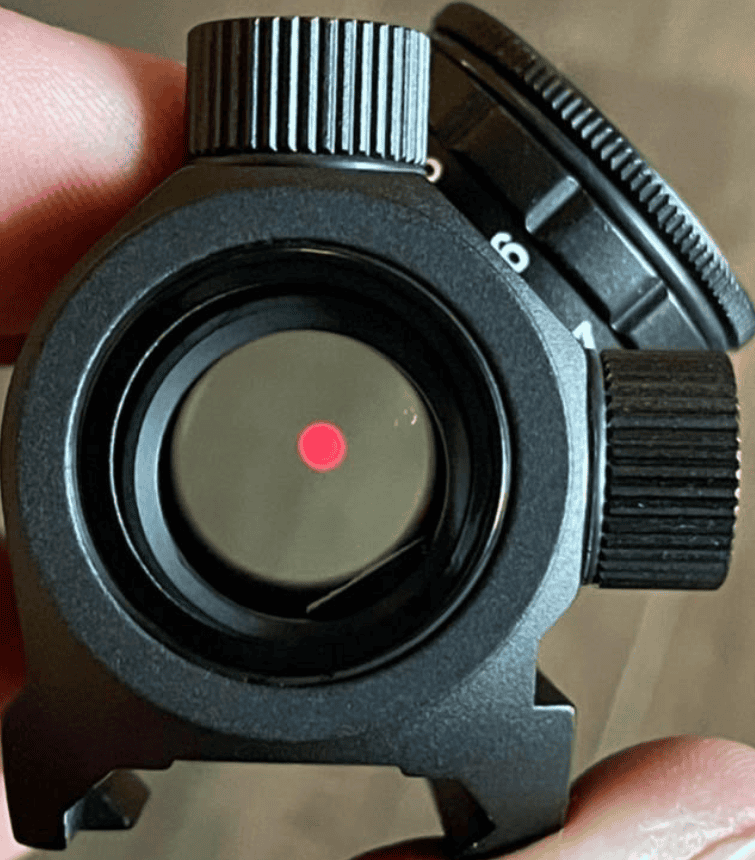
Toughness and Zero Were the Pleasant Part
Where the TRS-25 quietly earns its reputation is in the boring stuff. I zeroed it at 50 yards off a bag, walked the 1 MOA clicks in, and the adjustments tracked honestly with no mushy backlash. Once it was on, it stayed on. Somewhere near 800 rounds of CCI Mini-Mag went downrange, plus a tailgate drop onto gravel that made me wince, and the point of impact never wandered. I pulled the rifle in and out of a truck bed for two weeks of evening sessions, knocked the tube against the door frame more than once, and rechecked zero out of habit each trip. Nothing moved.
The sealing held up too. A short downpour caught me mid-session and I kept shooting; the nitrogen-purged tube never fogged and the IPX7 rating proved out for the kind of weather a plinker actually sees. The integrated Picatinny mount is simple and locks down solid, though it is a fixed-height affair, so co-witness and riser choices are on you to plan around before you buy.
The Thing You Have to Remember to Do
The manual rotary dial is the design choice that follows you home. There is no shake awake and no auto-off, so the dot burns until you twist it back to zero. One evening I drove home, got busy, and realized after dark I had left it running on a low setting. The CR2032 was fine the next morning, but with only 3,000 to 5,000 hours on tap and nothing to save me from myself, leaving it on is a habit that will eventually strand you with a dead dot at the wrong moment. It became muscle memory to click it off when I cased the rifle, and that is the tax for the simplicity.
Pull it all together and the TRS-25 is honest about what it is. The dot is fast and clean until a bright sky outmuscles the diode, the build is tougher than the tier usually delivers, and the power management is entirely on the shooter. For a rimfire or a casual range gun, that trade leans heavily in your favor.
How I Ran the TRS-25 on a Rimfire Through Full-Sun Conditions
I mounted it on a Ruger 10/22 in .22 LR and fed it CCI Mini-Mag 40gr the whole way through, because that is the exact combination this optic lands on in real garages and gun safes. Nobody buys a TRS-25 for a duty carbine; they buy it for a plinker, a truck gun, or a kid’s first optic, so testing it on anything heavier would have answered questions nobody is asking. I ran it over several weeks of evening and midday range trips on an open field range with steel out to 75 yards, in everything from flat overcast to hard noon sun, with one rain squall thrown in.
My five years on the optics counter at a big-box outdoor store taught me what actually walks back through the return door, and budget tube dots are near the top of the list for one reason: a first-time buyer takes one out at noon, cannot find the dot against a bright target, and assumes it is broken. It almost never is. It is the diode hitting its ceiling, the same ceiling I watched the TRS-25 hit against that white gong. Knowing that pattern is why I deliberately tested this one in the worst light it would ever see instead of only in the flattering shade, and why I weigh its brightness honestly rather than as a fatal flaw. You can read more about how I structure these evaluations in my full testing methodology.
Going in, my one real concern was zero retention, since the cheapest tube dots are the ones I have seen lose their settings. That concern got answered early and stayed answered.
Performance Ratings
Field Test Data
| Test Parameter | Result |
|---|---|
| Zero retention over ~800 rounds | No measurable shift; impact stayed put |
| 50-yard group off a bag (10-shot) | ~1.5 in, limited by the 3 MOA dot, not the rifle |
| Dot visibility, overcast / tree cover | Settings 6 to 7 plenty crisp |
| Dot visibility, noon sun on white target | Required settings 10 to 11; still faint |
| Drop / handling abuse | Tailgate drop + repeated truck-bed knocks, zero held |
| Weather exposure | One rain squall, no fogging or intrusion (IPX7) |
| Battery (left on overnight, low setting) | Survived; no auto-off to prevent the drain |
Tested on: Ruger 10/22 | .22 LR | CCI Mini-Mag 40gr
Pros and Cons
PROS
|
CONS
|
Who Should Actually Run a TRS-25 (and Who Should Walk Past It)
This is the right dot for the rimfire crowd above all. If it is going on a 10/22, a plinking AR, or a kid’s first optics-ready rifle, the toughness and zero retention are exactly what you want, and the brightness ceiling rarely bites because that shooting tends to happen in shade, at dusk, or against targets that do not blow the dot out. It is also a smart first red dot for someone learning both-eyes-open shooting on a budget, and a fine truck or ranch gun dot that can take a beating in a console.
It is the wrong buy if your shooting lives in open bright sun against light backgrounds and the dot has to be instantly there every time. A defensive or duty role where a washed-out dot at noon is unacceptable asks for a brighter emitter than this one has. Shooters with stronger astigmatism who need a clean circle should handle one first, since the starburst gets worse as you climb the settings. And if you are the type who forgets to switch optics off, the lack of auto-off paired with the modest battery life will eventually leave you staring at a dead dot when you least want to.
Match it to its lane and it is hard to beat for the money. Push it outside that lane and the compromises start to show fast.
Disclosure
Everything here comes from my own range time with the optic and my honest read on it. The post may contain affiliate links, meaning I could earn a small commission if you buy through them at no extra cost to you. Those relationships do not influence my evaluation or conclusions.
The TRS-25 Is Still the Default First Dot, As Long As You Buy It for Its Lane
Buy it, with your eyes open. After a high round count on a rimfire, a drop, and a soaking, the TRS-25 did the things that actually matter at this price: it held zero, it stayed sealed, and it put a fast, clean dot on close targets. That is more dependable hardware than the entry tier usually hands you, and it is why the thing has stayed the default recommendation for over a decade.
The brightness ceiling is real and worth respecting, but it only matters if you drag this optic into bright-sun work it was never meant for. For the plinker, the truck gun, the first-timer, and the rimfire shooter, that ceiling almost never gets touched, and what you are left with is a tough little dot that earns its keep. Just remember to turn it off when you case the rifle. For its intended buyer, it remains the budget benchmark, and I would put one on a plinker again without hesitating.
For other reviews, check the Vortex Venom red dot and the Vortex Crossfire red dot reviews.
Mike Fellon is the founder of ScopesReviews and an optics specialist with 15+ years in precision shooting. A former Bass Pro Shops firearms advisor and NRA-certified instructor, he’s hands-tested 200+ rifle scopes across hunting and competition. Based in Dallas, Texas.