
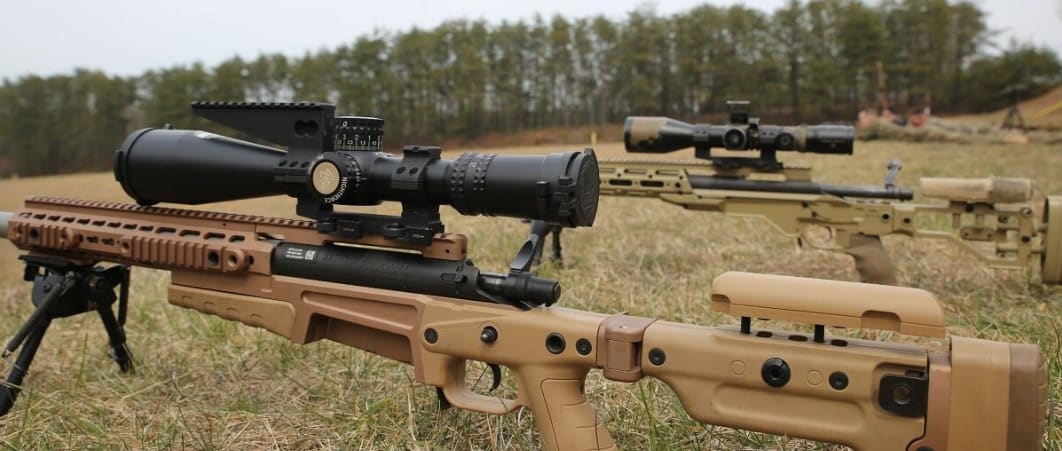
“Sniper scope” gets thrown around loosely, but actual sniper-style shooting makes specific demands that separate it from general precision work. You need a scope that tracks the same on round one as it does on round two hundred, holds zero through abuse, gives you a reticle that ranges and corrects at any magnification, and lets you and a spotter communicate in a shared unit system. Most tactical scopes claim all of that. Far fewer hold up when you’re prone in a 15-mph crosswind dialing for an 1100-yard plate and the light is changing on you.
I spent roughly six weeks running these four scopes through tracking tests, hard-use abuse, and dialing exercises out to that distance to sort out which one actually does the job. The Nightforce ATACR 5-25×56 F1 came out on top, though by a narrow margin.
My Top 4 Sniper Scope Picks
Best Overall
Nightforce ATACR 5-25×56 F1
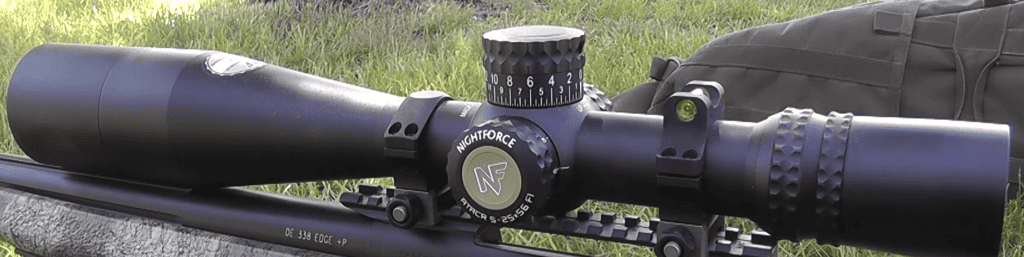
This is the scope that does everything a sniper-style optic needs to do without forcing you to compromise on the parts that actually matter. The MIL-XT in the front focal plane ranges and holds at any power. The DigIllum stays usable when the light gets ugly. And the turrets have that tactile authority where each click confirms what just happened before you even look down at the dial. The price isn’t friendly, but it’s the only scope in this group I’d genuinely stake a hard shot on without a second thought.
Best Lightweight Tactical Pick
Leupold Mark 5HD 5-25×56
At 30 ounces this is the only flagship-tier scope in the group that doesn’t punish you for carrying it. Glass is excellent, the ZeroLock elevation behaves under hard use, and the optical clarity at the top end is genuinely close to the Nightforce. Capped windage is where some shooters will balk, and fairly so if you dial for wind.
Best for Varied Engagement Distance
Vortex Razor HD Gen II 4.5-27×56
The 4.5x low end is what separates this scope from the other two flagships. You can take a closer shot with a usable field of view, then climb to 27x for the long stuff. The L-TEC locks are the cleanest locking turrets I’ve worked with. The cost is 48.5 ounces hanging off your rifle and a Gen II that’s starting to feel its years next to newer designs.
Best Budget Option
Sightron SIII 8-32×56
I’ll be straight: calling this a sniper scope is a stretch. The SFP reticle, 8x bottom end, and 20.4 MRAD of total elevation are target-shooter choices, not tactical ones. But the Japanese glass punches well above its tier and tracking is honest enough that if your budget caps closer to four figures and most of your shooting happens from one position at known ranges, it earns its slot in this group.
What Qualifies Me to Rank Sniper Optics
The bulk of my testing for this guide came from a stretch of weeks where I ran the same four scopes in rotation on the same rifle, pushing each one to 1100 yards. That repetition matters for sniper work because the failures that disqualify a candidate rarely show up in the first 50 rounds. They show up around round 80 to 100, after the elevation turret has been dialed up and back forty times and the clicks start feeling mushy, or the return-to-zero stops finding home cleanly.
I’ve put a lot of glass through that kind of treatment over the last fifteen years (past 200 scopes if I’m counting honestly), and the pattern is consistent: marketing copy doesn’t predict what survives. A scope can track perfectly on paper and still wash out in the dim end of legal light. It can have great glass and a turret that tells you nothing tactile when it moves. The only way to find out what holds up at sniper distances under sustained use is to actually shoot it that way. That’s what this guide is.
Side-by-Side Specs
Two specs matter more for sniper work than buyers usually realize: parallax adjustment range (you want it precise at the distances you actually shoot) and total elevation travel (you’ll burn through it faster than you think with a 100-yard zero and a 1000-yard target). Most everything else is either a personal preference or a function of price tier.
| Features | Nightforce ATACR 5-25×56 F1 | Leupold Mark 5HD 5-25×56 | Vortex Razor HD Gen II 4.5-27×56 | Sightron SIII 8-32×56 |
|---|---|---|---|---|
| Magnification | 5-25x | 5-25x | 4.5-27x | 8-32x |
| Objective Diameter | 56mm | 56mm | 56mm | 56mm |
| Eye Relief | 3.35″ – 3.54″ | 3.6″ – 3.8″ | 3.7″ | 3.6″ – 4.0″ |
| Weight | 38.0 oz | 30.0 oz | 48.5 oz | 26.5 oz |
| Length | 15.37″ | 15.7″ | 14.4″ | 15.35″ |
| Tube Size | 34mm | 35mm | 34mm | 30mm |
| Reticle | MIL-XT (FFP) | PR2-MIL (FFP) | EBR-7C (MRAD, FFP) | LR MD/CM MIL (SFP) |
| Field of View | 18.7 – 4.92 ft @ 100 yds | 20.4 – 4.2 ft @ 100 yds | 25.3 – 4.4 ft @ 100 yds | 12.2 – 3.1 ft @ 100 yds |
| Turret Style | Exposed, ZeroStop | Exposed Elevation (ZeroLock), Capped Windage | Exposed Locking, L-TEC Zero Stop | Exposed Target (Resettable) |
| Adjustment Range | 35 MRAD Elevation / 24 MRAD Windage | 35 MRAD Elevation / 17 MRAD Windage | 33 MRAD Elevation / 14 MRAD Windage | 20.4 MRAD Elevation / 20.4 MRAD Windage |
| Click Value | 0.1 MRAD | 0.1 MRAD | 0.1 MRAD | 0.1 MRAD |
| Parallax Adjustment | 45 yds to infinity | 50 yds to infinity | 32 yds to infinity | 40 yds to infinity |
| Illumination | Yes (DigIllum) | Model dependent (Standard PR2 is No) | Yes | Model dependent (Standard is No) |
1. Nightforce ATACR 5-25×56 F1 – The Sniper Benchmark
Mounting Day and First Zero
First mount was a 34mm Spuhr unimount on the Tikka, rings lapped, screws torqued to spec. The ATACR settled in like it belonged there. First zero took five rounds (three to find where it was hitting, two to confirm). What got my attention happened on round 47 of the tracking test that afternoon.
Tracking the Way You Want It To
I ran a box test at 100 yards, the kind where you dial 5 mils up, fire, dial 5 right, fire, dial back, and check whether the holes land where the math says. The ATACR was dead on through 12 dial-and-fire cycles. End of session, with the elevation dialed near its top end, same result. After 48 more rounds spread over the next two range days, same again. Crisp tactile clicks on round 95, no difference from round 1. That repeatability is exactly the test that separates real sniper optics from imitators, and the ZeroStop returned to mechanical zero every single time without any guesswork about whether I was actually back home.
Glass at 25x When the Light Gets Ugly
The optical performance is where Nightforce earns its asking price. About three weeks into testing I had a late-afternoon session where the wind came up around 5 PM and the sun started dropping behind a low ridge to the west. Shooting at 1000 yards on a paper-and-cardboard target, the resolution at 25x stayed crisp enough that I could see my bullet impacts on the cardboard backer without grabbing the spotter. The Leupold was close. The Vortex was a noticeable step behind. The Sightron was a different conversation entirely. Contrast holds out to the edges of the image, which is what you actually care about when you’re trying to read a target that’s the same washed-out tan as the country behind it.
Why the MIL-XT Reticle Works
The MIL-XT in the front focal plane is one of the cleaner tactical reticles I’ve put in front of my eye. The center dot is open enough to see through at the top of the magnification range without burying small targets, the 0.2-mil hash marks let you hold for elevation and wind together, and the floating crosshair gives you a clean reference when you’re holding off significantly. For sniper-style work where you might not have time to dial a wind correction, that grid lets you hold for everything and still know exactly what your offset is. The DigIllum (this unit had it) gives you center illumination that’s bright enough to pick up against grass at sunrise without blooming out the rest of the reticle on the daylight settings.
Where the Trade-Offs Sit
Two of them. The eye relief at 3.35 to 3.54 inches is the shortest in this test, and on the 6.5 Creedmoor that didn’t matter, but anyone running a hard-recoiling magnum should mount this scope with that number in mind (if you’re unsure why that figure matters, eye relief and why it’s important is worth a read). The other is the price. This is a $3000 optic. There’s no math that gets around that. What you’re buying is a scope that doesn’t surprise you in the wrong direction at distance, and I’d argue that’s exactly what sniper work demands.
Performance data from the session work breaks down like this:
Field Test Data
| Test Parameter | Result |
|---|---|
| Best 5-shot group @ 1000 yds (prone, bipod) | 6.5 inches |
| Box test tracking accuracy (5 mil cycles) | True to within 0.1 MRAD |
| Return-to-zero after 40 dial cycles | Zero shift undetectable |
| Low-light reticle usability (DigIllum on) | Usable to ~25 min past sunset |
| Dialing range used at 1100 yds | ~9.5 MRAD from zero |
| Round count through scope | ~95 rounds |
Tested with: Tikka T3x TAC A1 chambered in 6.5 Creedmoor | Hornady ELD Match 140gr
Pros and Cons
PROS
|
CONS
|
Performance Ratings
If you’re spec’ing out a serious sniper-style rifle and the budget can handle it, the ATACR is the scope I’d put on my own rifle without a second thought. It’s the only one in this group I’d take on a high-stakes shot without checking myself first.
2. Leupold Mark 5HD 5-25×56 – The Carry-It-All-Day Pick
Eight Ounces Lighter Than You Think
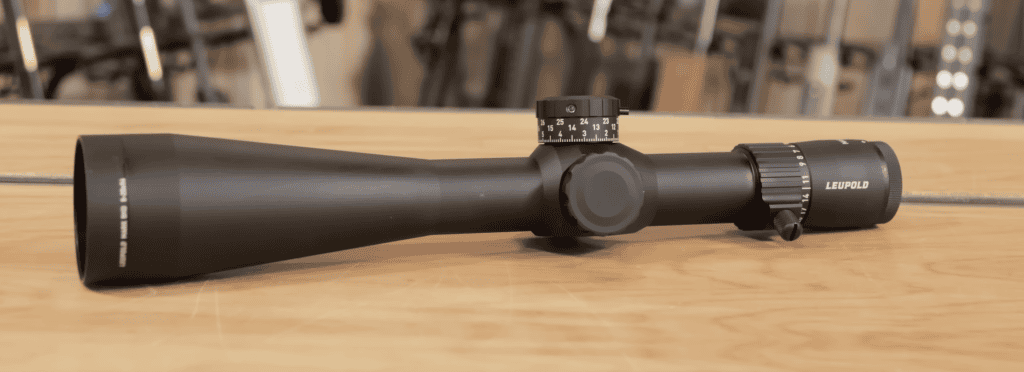
Pick up the Mark 5HD after handling the Nightforce and your rifle suddenly feels like it lost half a pound (it basically did). Pick it up after handling the Vortex Razor and the weight difference is over a pound. The 30-ounce figure puts it squarely in lightweight tactical territory, and on a precision rifle you’re going to carry into position, that’s a real thing. My Tikka with the ATACR on it sat at around 14.5 pounds ready. With the Leupold mounted it dropped to roughly 14.0. That difference shows up in your hands, your shoulders, and on a sling.
The ZeroLock vs. ZeroStop Question
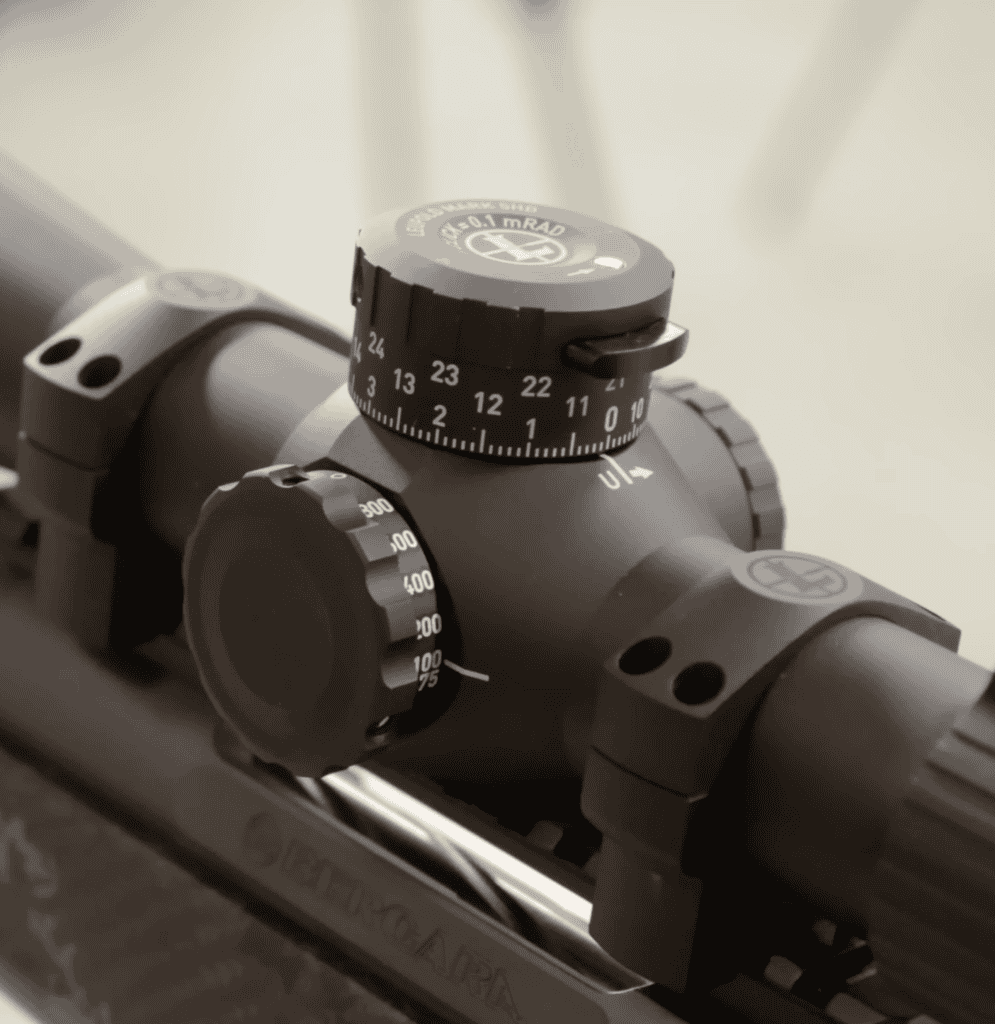
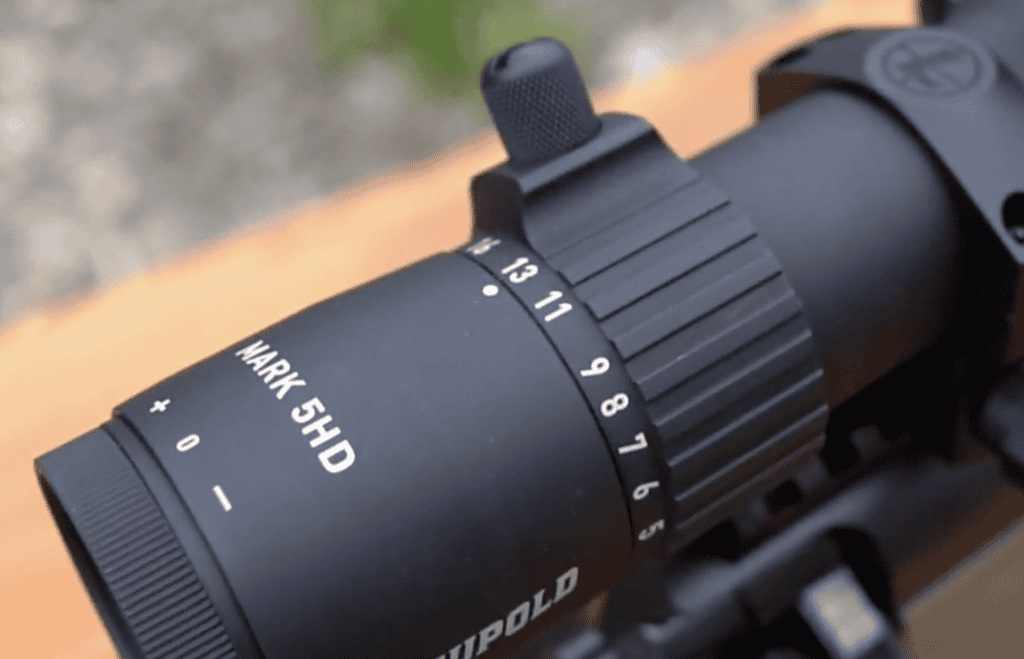
The Leupold uses ZeroLock on its elevation turret, which is a different beast from the ATACR’s ZeroStop and worth understanding. ZeroStop is a mechanical floor: the turret physically won’t dial below your set zero. ZeroLock uses a push-button on the edge of the dial that locks automatically at zero; you press it to unlock and dial up. You can dial past zero if you bypass the lock, but the turret won’t accidentally drift off zero during transport or rough handling. I’ve come around to it. After dialing the Leupold up and back through tracking tests for two solid sessions, the lock engaged cleanly every time and the click feel held consistent.
Capped Windage Is a Stance
This is where the Leupold and I have a small ongoing disagreement. Leupold caps the windage on the Mark 5HD because their design philosophy says you hold for wind, you don’t dial. Plenty of competition shooters and military teams hold for wind too, so they’re not wrong. But if you’re a dial-for-wind shooter, you’re going to pull a cap off every time you set up. It’s not deal-breaking, but it’s a real consideration if your training has you reaching for the windage turret. The PR2-MIL reticle gives you generous wind reference points, so the system works as designed, you just have to commit to using the reticle the way Leupold intends.
Glass That Punches Right at Its Tier
Optically, the Mark 5HD trails the Nightforce slightly at the very top of magnification in difficult light, and that gap is genuinely small. At 18x and below, picking a difference between the two in good light is nearly impossible. The Leupold edges the Vortex through most conditions and walks away from the Sightron without trying. The PR2-MIL reticle is what I’d consider a near-perfect Christmas-tree-style tactical reticle: enough grid for serious holdover work, not so cluttered that it obscures small targets at 25x. The non-illuminated version (which is what was tested) loses you the option for very low light, and if you do most of your shooting in marginal light an illuminated variant is worth the upgrade.
The 35 MRAD Elevation and What It Means
Same elevation travel as the Nightforce at 35 MRAD, which on a 6.5 Creedmoor with a properly set zero leaves you with comfortable margin to push past 1000 yards. The 17 MRAD windage falls behind the Nightforce and Sightron, though it sits ahead of the Vortex. But again, Leupold’s argument is you’re holding for wind anyway. For a sniper-style optic, the elevation matters more than the windage by a considerable margin, and Leupold spent its travel where it counts.
Numbers from the testing sessions:
Field Test Data
| Test Parameter | Result |
|---|---|
| Best 5-shot group @ 1000 yds (prone, bipod) | 7.2 inches |
| Box test tracking accuracy (5 mil cycles) | True to within 0.1 MRAD |
| ZeroLock engagement consistency | Engaged cleanly across 35+ cycles |
| Weight on rifle (with Spuhr mount) | 14.0 lbs ready |
| Round count through scope | ~85 rounds |
Tested with: Tikka T3x TAC A1 chambered in 6.5 Creedmoor | Hornady ELD Match 140gr
Pros and Cons
PROS
|
CONS
|
Performance Ratings
If the Nightforce is the benchmark, the Leupold is the rifle-owner’s answer to it: nearly the same glass, the same elevation travel, eight ounces lighter, and a thousand dollars cheaper. The capped windage is real, and so is the absent illumination on the standard variant, but the package delivers genuine sniper-discipline capability at a price that’s at least defensible.
3. Vortex Razor HD Gen II 4.5-27×56 – The Variable-Distance Specialist
Starting at 4.5x Is the Whole Argument
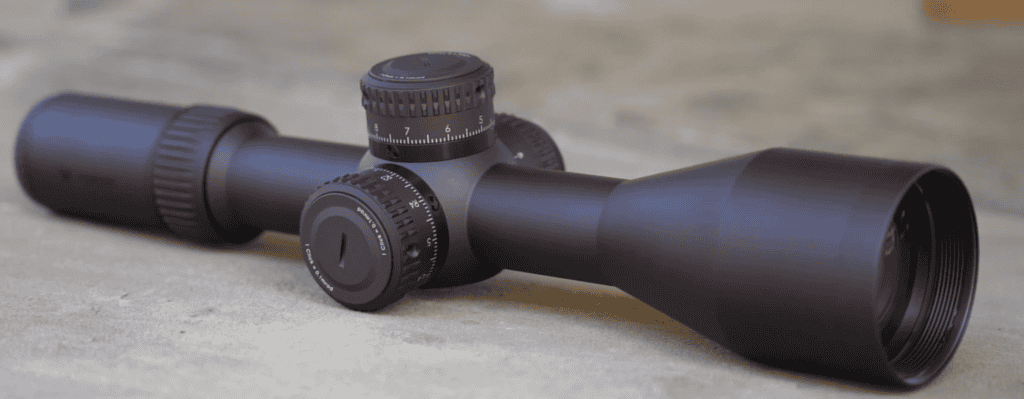
The other two flagship-tier scopes in this test bottom out at 5x. The Razor goes to 4.5. That half-power difference sounds tiny on paper. In practice it opens up usable engagement distance on the close end in a way that matters for tactical shooters who might need to take a 75-yard shot one minute and a 900-yard shot the next. At 4.5x with a 25-foot field of view at 100 yards (the widest in this group by a comfortable margin), you can find a target inside a brush line and stay on it. With the 32-yard parallax minimum, you can actually focus on something close enough to be problematic in a typical urban or LE scenario. None of the other scopes in this test will do that.
L-TEC Locks Are the Best Locks in This Group
Vortex’s L-TEC locking system is, in my opinion, the cleanest execution of locking turrets among the four. Pull the turret up to unlock, dial, push down to lock. The action is positive enough that you know what state the turret is in without looking. The Leupold’s ZeroLock is good, but the L-TEC is faster. The zero stop returns to your set point cleanly across sustained dialing, and the click feel held its character through my full round count without any of the mushiness that creeps into lesser turrets after sustained use.
Forty-Eight Ounces Has a Cost
The Razor weighs three pounds and a half-ounce. That’s an extra 18.5 ounces over the Leupold and 10.5 over the Nightforce. On a sandbag bench you’ll never notice. On a sling carrying the rifle a half-mile to a shooting position, you’ll notice every step. This is the trade-off for the build quality and the durability that Vortex put into the chassis, but it’s the trade-off. If you’re spending most of your shooting time prone and stationary, the weight doesn’t bother you. If you’re carrying the rifle to get to where you’ll shoot from, weigh that 48.5-ounce number against your typical day.
The EBR-7C and the FOV Question
The EBR-7C MRAD reticle in the front focal plane is solid sniper-discipline tooling: hash marks at 0.2 mil and 0.5 mil, hold-over reference well laid out, illumination available across multiple settings. It’s not quite as refined as the Nightforce’s MIL-XT (the floating crosshair on the Nightforce is just a cleaner reference, in my experience), but it does the job and the illumination on the Razor is genuinely useful at the lower settings without bloom. At 27x on the top end, the glass holds up well in good light. In late-afternoon dimming, the Nightforce and Leupold both edge ahead in resolution and contrast.
Where Gen II Shows Its Age
Vortex now has the Razor Gen III out and it improves on some things the Gen II did well enough but not exceptionally: the turret feel is sharper on the newer scope, the glass is slightly better, the weight is slightly lower. That doesn’t make the Gen II bad. It makes it a known quantity with a few years of design behind it. The 33 MRAD elevation is the lowest of the three premium scopes here, and 14 MRAD windage is genuinely tight for anyone who dials wind. For sniper work, neither of those numbers is disqualifying, but they’re worth knowing.
Test session numbers came out like this:
Field Test Data
| Test Parameter | Result |
|---|---|
| Best 5-shot group @ 1000 yds (prone, bipod) | 7.8 inches |
| Box test tracking accuracy (5 mil cycles) | True to within 0.1 MRAD |
| L-TEC lock engagement consistency | Crisp through 40+ cycles, no slop |
| Close-range usability (50 yards at 4.5x) | Wide FOV, parallax usable from 32 yds |
| Weight on rifle (with Spuhr mount) | ~15.2 lbs ready |
| Round count through scope | ~100 rounds |
Tested with: Tikka T3x TAC A1 chambered in 6.5 Creedmoor | Hornady ELD Match 140gr
Pros and Cons
PROS
|
CONS
|
Performance Ratings
The Razor Gen II is still a capable sniper-style optic, particularly if your shooting takes you across very different engagement distances in the same session. But the weight is the wall it runs into, and shoppers should look hard at the Gen III if their budget can stretch.
4. Sightron SIII 8-32×56 – The Budget-Constrained Choice
What the Sightron Isn’t
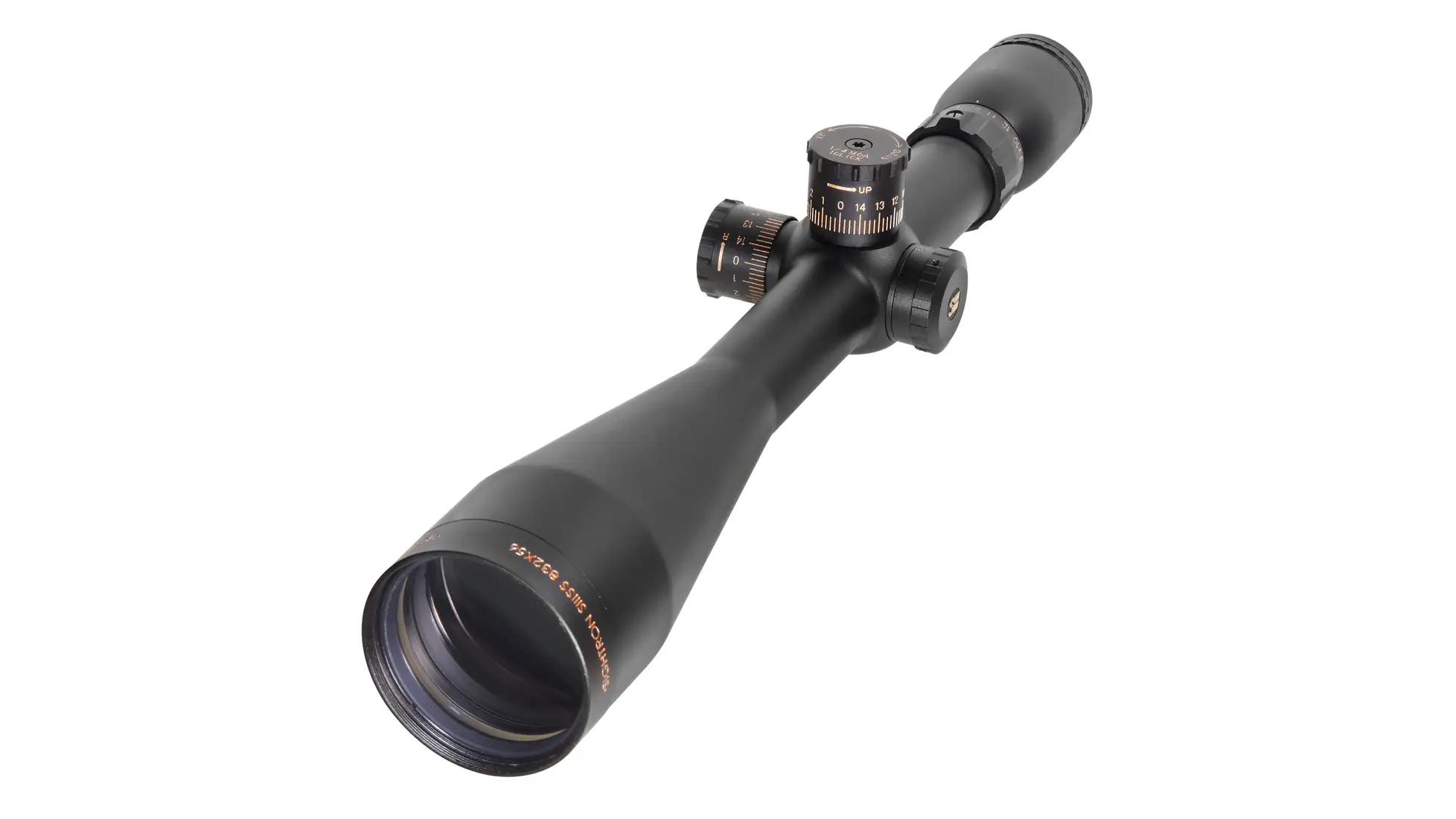
Calling the Sightron SIII a sniper scope is a stretch. It’s a target and F-Class scope that I included in this test because it’s the only optic in the group that lives below the $2000 line, and people shopping a sniper-style rifle on a tight budget keep asking about it. So I shot it for sniper-style applications and I’m reporting what I found, but understand going in: this isn’t what Sightron designed it to do.
Where the SFP Reticle Hurts You
The LR MD/CM MIL reticle in the second focal plane is the single biggest issue for sniper use. Mil holdovers only subtend correctly at one calibrated magnification, usually somewhere at or near the top of the range. So if you’re using the reticle to range a target or hold for wind at 16x or 20x, your math is wrong unless you’re doing the conversion in your head. For target shooting at known distances, where you’re dialing for everything and not using the reticle as a tool, SFP is fine. For sniper-discipline work, the reticle is supposed to be a working instrument at any magnification, and SFP doesn’t allow that.
An 8x Bottom End Is a Real Constraint
The other scopes in this group bottom out at 4.5x or 5x. The Sightron starts at 8x. For known-distance target work, that’s not a problem. For sniper applications, where you might need to find a target in terrain or take a closer shot than your bench position was set up for, 8x is a frustrating minimum. The 12.2-foot FOV at 100 yards (at that bottom end) is also the narrowest in this test by a significant margin. Anyone who’s spent time trying to acquire a target in trees or brush at 8x knows why this matters.
Glass That Surprises at Its Price
This is where the Sightron earns its place in this discussion. The Japanese glass is genuinely excellent for what the scope costs. At 16 to 20x in good light, image clarity sits comfortably above what you’d expect at the price. It’s a step behind the three premium scopes here in challenging low-light conditions, but the gap is smaller than the price differential would suggest. Pulled off the rifle and set up on a tripod, the SIII makes a capable spotting glass in its own right.
Turrets, Tracking, and the 20.4 MRAD Question
The exposed target turrets click well and tracked true through my testing, with no detectable drift on a box test. They lack the zero-stop or zero-lock mechanisms the other three scopes have, which means dialing back to zero in field conditions takes attention rather than feeling for a hard stop. For paced target shooting, that’s fine. For sniper work where you might need to come down fast under pressure or after losing track of where you are in the dial, it’s a real concern. The 20.4 MRAD total elevation is the gating issue: from a 100-yard zero on 6.5 Creedmoor reaching 1000 yards, you’re using most of your travel just to get there, with little margin for atmospheric variation or pushing past.
Who This Scope Actually Fits
If your shooting is mostly from a fixed position at known distances and your budget caps at roughly half what the others demand, the SIII is a legitimately good scope. The Japanese glass alone makes it competitive on optical merit, the tracking is honest, and the weight is the lightest in this test. If you’re trying to do sniper-discipline work at a discount, my honest read is that you’re better off saving longer than buying this and trying to make it fit a job it wasn’t built for.
Numbers from testing came out as follows:
Field Test Data
| Test Parameter | Result |
|---|---|
| Best 5-shot group @ 1000 yds (prone, bipod) | 8.5 inches |
| Box test tracking accuracy | True (no detectable drift) |
| Resettable turret return-to-zero | Manual, requires attention each time |
| Optical clarity at 20x (good light) | Competitive with mid-tier $2000 scopes |
| Round count through scope | ~80 rounds |
Tested with: Tikka T3x TAC A1 chambered in 6.5 Creedmoor | Hornady ELD Match 140gr
Pros and Cons
PROS
|
CONS
|
Performance Ratings
The Sightron earned its slot in this guide because shoppers keep asking about it, but the honest assessment is that it’s a competent target scope being asked to do a job it wasn’t built for. If your shooting is bench/F-Class at known distance, the value is real. For sniper-discipline applications, the limitations stack up against it.
The Six Weeks That Sorted These Scopes
Testing ran from late March through early May 2026 out of a private long-range range in north-central Texas where the prairie opens up enough to set steel from 300 to 1100 yards. Six weeks of access gave me roughly 360 rounds of trigger time spread across the four scopes.
The rifle was a Tikka T3x TAC A1 in 6.5 Creedmoor, mounted in a 34mm Spuhr unimount for the Nightforce and Vortex, a 35mm Spuhr unimount for the Leupold, and switched to 30mm rings for the Sightron. Ammunition was Hornady ELD Match 140gr across every shot, every scope, every distance. If the 6.5 Creedmoor is your platform specifically, I’ve broken down the best scopes for the 6.5 Creedmoor in a separate guide.
Two scopes didn’t make this guide. The Bushnell Elite Tactical XRS3 6-36×56 tracked fine but its elevation turret developed noticeable softness after about 40 dial cycles, the kind of mushiness that makes you doubt how many tenths you just took. For sniper work where you come back to the rifle and need to trust the dial without re-confirming, that’s disqualifying. The Burris XTR III 5.5-30×56 had a parallax adjustment that wouldn’t lock the image cleanly at extended distances; small head shifts kept showing parallax error. On a committed sniper-style position, that precision is non-negotiable.
The full process behind each test step is laid out in my testing methodology.
Where Sniper Scope Buyers Go Sideways
Reaching for the highest magnification on the spec sheet
Shooters new to extended distance assume 32x or 35x helps more than 25x at long range. In practice, you can’t hold the rifle steady enough to use the top end of any 25-plus optic in field positions, and mirage limits resolution before reticle size does. Most 1000-yard work happens at 18 to 22x. A scope with excellent glass at 25x beats one with worse glass at 32x every time.
Picking SFP because the reticle “looks cleaner” at high magnification
FFP reticles get small at low power and large at high. SFP stays the same apparent size throughout, and some shooters prefer that consistency. For known-distance target work it’s reasonable. For sniper applications, SFP costs you ranging and holdover capability at any magnification other than calibrated. If you have to crank to max to use your reticle as a measuring tool, you’ve thrown away the point of a tactical grid.
Underestimating how fast elevation disappears
From a 100-yard zero on a 6.5 Creedmoor reaching 1000 yards, you’ve burned roughly 7.5 to 8.5 MRAD just to get there. If your scope has 20 MRAD total, half is gone after one trip up. Look at travel above your zero, not the headline number. The Sightron here, and plenty of competition designs elsewhere, fall short for sniper work on this single spec alone. If your shooting is built around that distance more than tactical work, my picks for the best 1000-yard scope approach the same problem from a pure-distance angle.
What People Actually Ask Me About Sniper Optics
Do I really need FFP, or is SFP fine for sniper work?
FFP is strongly recommended. The point of a tactical reticle is using it at any magnification, and SFP only gives you that at one calibrated power. For known-distance target work, SFP is fine. For true sniper applications, you want FFP, though SFP scopes can serve as budget stand-ins for static positional shooting. If FFP is non-negotiable for you, my roundup of the best first focal plane scopes covers options across price tiers.
MIL or MOA for a sniper scope?
MIL/MIL is the practical answer. Military and LE teams operate in mils, so if you’re ever spotting with someone or being spotted, you’ll be working in mils anyway. MOA can work for solo shooters but you’ll find fewer top-tier tactical optics in MOA.
Is 5-25x enough, or should I go higher?
5-25x is the sweet spot. The top end is usable in field positions, the bottom gives you usable FOV for closer work. Pushing higher trades top-end glass quality for marketing magnification, and that trade rarely pays off when you’re actually shooting.
Does illumination matter on a sniper scope?
Depends when you shoot. Pre-sunrise or post-sunset, illumination is critical for picking up the reticle against shadows. Daytime-only shooters can manage without. The Nightforce’s DigIllum is the cleanest implementation here, and if illumination is a priority for you, I’ve ranked the best illuminated reticle scopes separately.
Disclosure
All four scopes in this guide were acquired by me for testing purposes. This article contains affiliate links to Amazon and OpticsPlanet; if you click through and purchase, I receive a small commission at no extra cost to you. The Tikka T3x TAC A1 I tested on is one I bought for my own precision work last year, not a manufacturer loaner.
When the Marketing Stops and the Shooting Starts
Six weeks of testing reinforced what I went in thinking: real sniper-discipline work is a short list of demands taken seriously, not a long feature stack. Tracking that doesn’t lie. A reticle in the right focal plane with the right grid. Enough elevation to do the job. Turret feel that confirms what you just did. Glass that holds up when light gets ugly.
The Nightforce ATACR 5-25×56 F1 delivers all of that without compromise, which is why it earned the top spot. The Leupold Mark 5HD is close enough that if your budget caps at $2000 and you carry your rifle into position, you can buy it without feeling like you settled. The Razor Gen II handles variable engagement distance. The Sightron is a target scope being asked to do sniper work it wasn’t built for.
Mike Fellon is the founder of ScopesReviews and an optics specialist with 15+ years in precision shooting. A former Bass Pro Shops firearms advisor and NRA-certified instructor, he’s hands-tested 200+ rifle scopes across hunting and competition. Based in Dallas, Texas.