
Burris hasn’t played the feature race with the FastFire 3. When Holosun arrived with shake awake, solar cells, and larger windows at the same price tier, Burris’s answer was quieter: a compact open reflex that weighs under an ounce, produces a clean 3 MOA dot, and comes backed by a no-questions-asked Forever Warranty. Whether that trade is enough depends on where this optic ends up living.
For this test, I mounted the 3 MOA version on a CZ Shadow 2 OR, choosing the platform because the Docter/Noblex footprint seats natively on the Shadow without adapters, and because competition-focused shooting is exactly the context where the FastFire 3’s power management trade-offs become concrete rather than theoretical. The test covered roughly 450 rounds of Fiocchi 124gr FMJ 9mm across three sessions, conditions ranging from dry overcast to a wet afternoon.
The FastFire 3 is a genuinely capable dot. The question this review answers is whether it’s the right dot for your specific gun, and that answer is less ambiguous than you might expect.
Burris FastFire 3 Review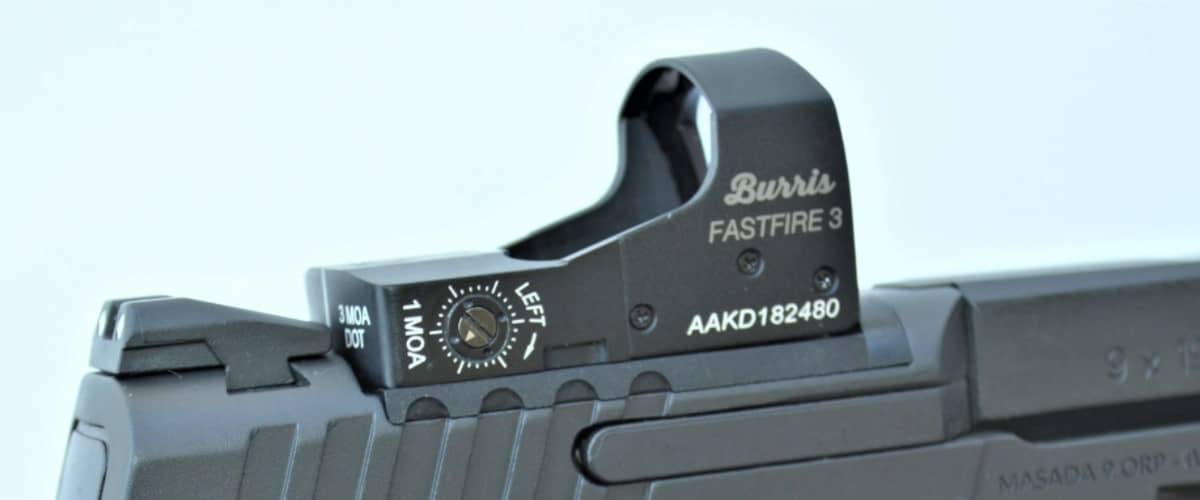
Out of the box, the FastFire 3 feels unmistakably small. At 0.9 oz without the mount, it adds almost nothing to the Shadow 2’s slide, and seating the Docter footprint without adapters means the sight sits as low on the gun as physically possible. First string at the range, the 3 MOA dot came up clean and sharp at the manual brightness level I was using. No muddy edges, no significant haze at 25 yards. It’s crisp enough to hold with confidence for target-focused pistol work, and the 3 MOA size does not wash out the target the way an 8 MOA dot can at anything past 10 yards.
How the Auto-Brightness Sensor Handles Moving Light
The automatic brightness sensor is the FastFire 3 feature that gets undervalued in spec comparisons. That first session ran from midmorning overcast into direct afternoon sun, the kind of conditions that would require repeated manual dial adjustments on other optics. The sensor tracked it without my involvement. I shot the first 200 rounds without touching the brightness control once, which is a small thing until you’ve had to manage brightness manually enough times to know what a disruption it is mid-drill.
The four total settings, one auto and three manual, are enough for typical use. There are no dedicated night-vision levels, which reflects the optic’s intended market plainly. If NV compatibility is part of your planning, this is not your sight.
What the Auto-Off Costs You in Practice
Third session, I’d been running draw strings and stopped to walk through a drill sequence with a training partner. Somewhere between 15 and 20 minutes. When I came back to the line, picked up the Shadow 2, and drove the gun toward the target, the window was dark. The auto-off had cut power during the break. A button press restarted it and I was shooting again inside five seconds, but those five seconds are not neutral in any context where the gun might be picked up fast, in the dark, under pressure.
Over the full test, the optic went dark four times: twice during drill set breaks, once during a longer reload preparation, and once during lunch at an outdoor bay where I’d left the pistol staged on a sandbag. There is no shake awake on the FastFire 3, so every restart required manual button input. I adapted by clicking the optic on before stepping to the line, which is a habit anyone staging this sight will have to build, whether deliberately or through a missed rep.
The 21 x 15 mm Window in Practice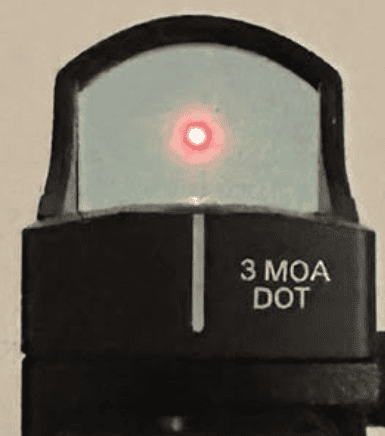
Coming up from a competition draw at speed, I found the dot on roughly eleven of twelve presentations during the first session. The twelfth miss was consistent: a slightly off-angle drive that put my eye at the corner of the glass rather than through it. On a 507C or Viper, that same sloppy presentation still lands you in the window. At 21 x 15 mm, the FastFire 3 has less margin for error, and your draw has to be cleaner to take advantage of it.
By session three, my presentation had tightened and misses dropped to near zero. That improvement represents real deliberate practice, not a learning curve the optic should require. Once the glass is acquired, the view is clean with no noticeable distortion at the edges for any typical pistol engagement distance.
CR1632 and What It Means for Practical Use
The top-load battery design is the correct upgrade from the FastFire II. Swapping the CR1632 without pulling the optic off the gun matters on any pistol with a close slide-to-frame fit. On the downside, the CR1632 is not shelf-ubiquitous the way CR2032 is. I tracked down a four-pack at a hardware store on the second stop of the afternoon. For a dedicated range or competition gun, planning ahead for this is simple. For a carry or duty setup, it’s a stocking consideration that compounds the power management picture.
The optic ran the full test on the original CR1632, consistent with the claimed 5,000-hour battery life and the auto-off feature doing most of the conservation work.
Zero Retention and the Warranty in Context
Through 450 rounds of 9mm cycling, zero never shifted. No point-of-impact drift between sessions, no loosening at the base. The nitrogen-filled housing kept the glass clear through the wet overcast session without fogging. Construction quality at this tier is uneven across brands, and the FastFire 3’s Forever Warranty changes the risk equation for a mid-tier open reflex that will absorb years of slide cycling and weather exposure. Burris replaces or repairs at no cost, no receipt needed. For this type of optic on this type of platform, that backing is part of the value proposition in a way that’s easy to take for granted until it matters.
For more red dot sights have a look at my articles about Vortex Viper red dot sight or Bushnell TRS-25.
Setting Up the FastFire 3 Test: Competition Pistol and Power Management Focus
Choosing the CZ Shadow 2 OR came down to footprint compatibility and realistic use case. The Docter/Noblex cut is native on the Shadow without a plate, which is how most buyers who specify this footprint actually intend to run it. The Shadow 2 is a competition pistol, not a carry gun, which means it gets set down between strings, staged on a bag between sessions, and left idle during range breaks. Those are exactly the conditions that activate auto-off on a sight without shake awake, making the Shadow a more informative test platform for this specific optic than a carry pistol would be.
Sessions ran across five weeks, three visits total, approximately 450 rounds of Fiocchi 124gr FMJ 9mm. The work was a mix of draw-string repetitions, transition drills between steel targets, and slower accuracy confirmation at 25 yards from a bag rest. Weather included morning clear, direct afternoon sun, overcast, and one session that turned wet about two hours in, which put the nitrogen sealing and auto-brightness sensor through conditions close enough to real use to matter.
I’ve run competition pistol optics in USPSA Production and Limited class matches long enough to have a direct opinion on what power management costs in a competition context. Stage breaks, idle time between squads, and the dead time at a table load all create the conditions where a dot without shake awake goes dark, and I’ve watched it happen on other competitors’ guns across multiple matches. Running several open reflex sights across this specific use case has made the shake awake question concrete rather than theoretical in my evaluations. That shaped this test’s focus on staged use rather than pure round count. For full detail on how I structure these evaluations: full testing methodology.
Performance Ratings
Field Test Data
| Test Parameter | Result |
|---|---|
| Zero confirmation (25 yards, 5-shot group from bag rest) | 1.1 inches |
| Return-to-zero after re-torque (session 2) | Confirmed; no measurable POI shift |
| Auto-off activations during testing | 4 events (breaks ranging 15 to 45 minutes) |
| Draw-to-first-acquisition (clean presentation, 12 reps timed) | Average 0.71 seconds |
| Zero shift through 450 rounds | None detected at final confirmation |
| Battery consumption across testing | Minimal; original CR1632 retained charge through all three sessions |
Tested on: CZ Shadow 2 OR | 9mm | Fiocchi 124gr FMJ 9mm
A Well-Built Dot for Dedicated Use: Who the FastFire 3 Is Actually For
This optic belongs on a dedicated range or competition pistol. If you run a CZ Shadow 2 OR, a dedicated 1911 with a Docter cut, or any competition handgun that lives in a range bag between sessions, the FastFire 3 fits cleanly. You control the on/off cycle deliberately. The 3 MOA dot, the crisp glass, the auto-brightness sensor, and the Forever Warranty add up correctly for that buyer. A rimfire handgun or carbine is also a strong pairing, where the 0.9 oz optic-only weight and the compact profile carry real weight as a selection factor.
The FastFire 3 is the wrong choice for daily carry or a duty gun. Without shake awake, a holstered or staged gun requires a manual power-on before use. In any fast-access scenario, that is a failure mode. At this price tier, Holosun makes optics with shake awake standard; Sig offers the Romeo Zero Elite with it as well. Those are the correct options for a pistol worn regularly in a holster or staged for home defense.
Night vision compatibility is absent entirely, so any setup that requires NV-paired brightness settings should not consider this optic regardless of platform. The 21 x 15 mm window is also a real consideration for shooters whose draw mechanics are less consistent, where a larger-window optic provides meaningful forgiveness on off-angle presentations.
Avoid it if you need shake awake or night vision capability. Consider it seriously if you do not need either and are running a dedicated platform where power is managed intentionally before each use.
Common Questions About the Burris FastFire 3
Does the Burris FastFire 3 have shake awake?
No. The FastFire 3 has an 8-hour auto-off but no motion-activated wake feature. Once it powers down, you restart it manually with the button on the left side of the housing. For a range or competition gun this is manageable with a deliberate pre-shoot habit; for a carry or staged home defense pistol, it is a meaningful limitation to weigh.
What changed from the FastFire II to the FastFire 3?
The 3 moved the battery compartment to the top of the optic, so you can swap a CR1632 without removing the sight from the gun. Burris also replaced the slide-style power switch with a push-button that handles on/off and brightness cycling. The core optical performance is similar between generations; the accessibility improvement is the headline change.
Is the CR1632 battery hard to find?
Less common than the CR2032 but not rare. Hardware stores and some big-box retailers carry them; online is the easiest source for spare packs. If the FastFire 3 is going on a gun you depend on, staging spare batteries in your range bag or home kit is worth the five minutes of planning up front.
Should I get the 3 MOA or 8 MOA version?
The 3 MOA works better for targets from 10 to 25 yards where some precision matters. The 8 MOA is faster at close range but the larger dot covers more of the target at distance. For most pistol and general-purpose use: 3 MOA. For shotgun or close-range-only defensive use where speed inside 10 yards is the priority: 8 MOA.
Which pistols accept the Docter/Noblex footprint natively?
The CZ Shadow 2 OR and CZ P-10 F OR take it without adapters. Several Smith & Wesson M&P M2.0 OR variants, the Springfield Armory Prodigy with the appropriate optic cut, and select Ruger platform configurations accept the Docter footprint directly. Beretta APX A1 Full Size and some Sig P320 X-series variants accept it via a plate.
Disclosure
This review may contain affiliate links. If you purchase through one of those links, I earn a small commission at no additional cost to you. Affiliate relationships do not influence my evaluations or recommendations.
The FastFire 3 Earns Its Spot on the Right Platform, Not on a Carry Gun
The Burris FastFire 3 delivers what Burris built it to deliver: compact form factor, honest 3 MOA dot, an auto-brightness sensor that genuinely works across mixed conditions, and a lifetime warranty that carries real weight at this price tier. For a dedicated range pistol, a competition gun, or a rimfire handgun where weight and footprint matter more than carry-specific features, this is a straightforward buy.
The limitation is real and narrow. No shake awake at the mid-tier price point is a deliberate design choice with a concrete cost on any gun that might need to come up fast without a manual power-on first. Holosun and Sig have both made this feature standard at competing prices. Carry buyers should use those options.
Buy the FastFire 3 for a gun you manage intentionally. Pass on it for a gun you depend on reacting immediately. That line is clear enough that the decision makes itself once you know which side you’re on.
More information about other red dot and holographic sights can be read in my EOTech 512 review and Vortex Strikefire 2 review.
Mike Fellon is the founder of ScopesReviews and an optics specialist with 15+ years in precision shooting. A former Bass Pro Shops firearms advisor and NRA-certified instructor, he’s hands-tested 200+ rifle scopes across hunting and competition. Based in Dallas, Texas.