
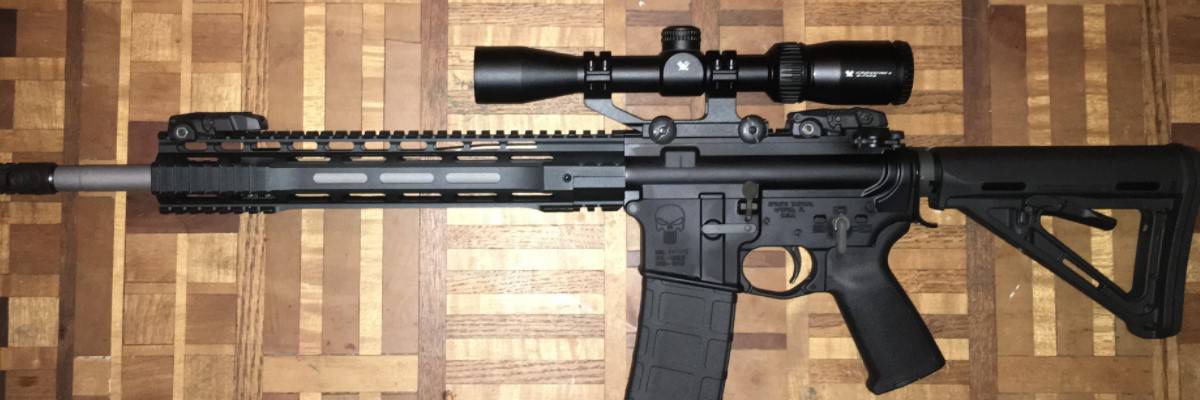
Nobody gets excited about a 2-7×32. It’s the optic you bolt to a lever gun or a rimfire and stop thinking about, which is exactly why the category gets overlooked and exactly why it’s worth talking about. The Vortex Crossfire II 2-7×32 sits at the bottom of Vortex’s lineup, priced at entry-level money, built for hunters who take their shots inside 200 yards in timber and will never once dial a turret for distance. V-Plex duplex reticle, fixed parallax, capped turrets, one-inch tube. Nothing on the spec sheet is reaching for your attention.
What I wanted to find out was straightforward: at this price, does it work and keep working, or does it cut a corner that bites you when an animal finally steps out? I ran it through a fall season on a .30-30 in thick cover to settle it. The result is about the least dramatic verdict I’ve reached in a while, and for a scope like this, that turns out to be the entire point. It does its job, gets out of the way, and the warranty behind it erases the one risk that normally comes with buying cheap glass.
Vortex Crossfire II 2-7×32 Review
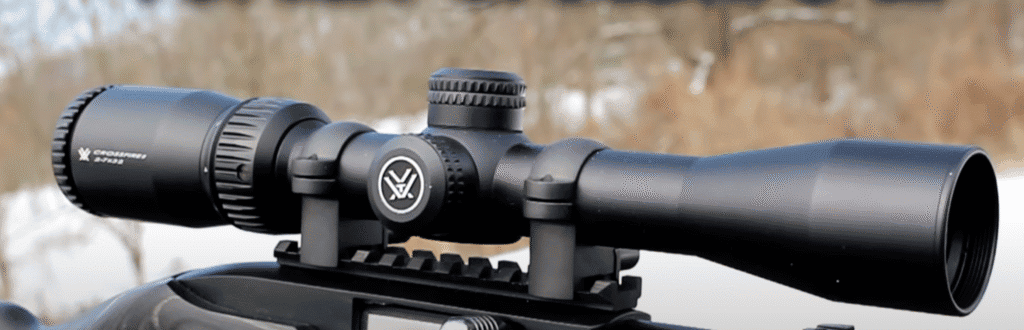
Why a 2-7x still earns a spot on a brush gun
The 2-7x range isn’t a compromise on a woods rifle, it’s the correct tool. I mounted the Crossfire II on a Marlin 336 in .30-30 and spent the season in hardwood bottoms where most shots fall between 25 and 125 yards, often on a deer that’s moving and won’t wait around. Set to 2x, the 42-foot field of view is wide and both eyes stay open without any swimming sensation, so catching an animal in brush happens fast. Roll up to 7x for a deliberate shot down a logging road or across a cut and there’s enough magnification to place the bullet precisely without the wobble that higher power piles onto an unsupported hold. For this rifle in this country, I never wished for more zoom. That isn’t a shot at bigger scopes, it’s the honest match between glass and gun.
The V-Plex does one job and doesn’t pretend otherwise
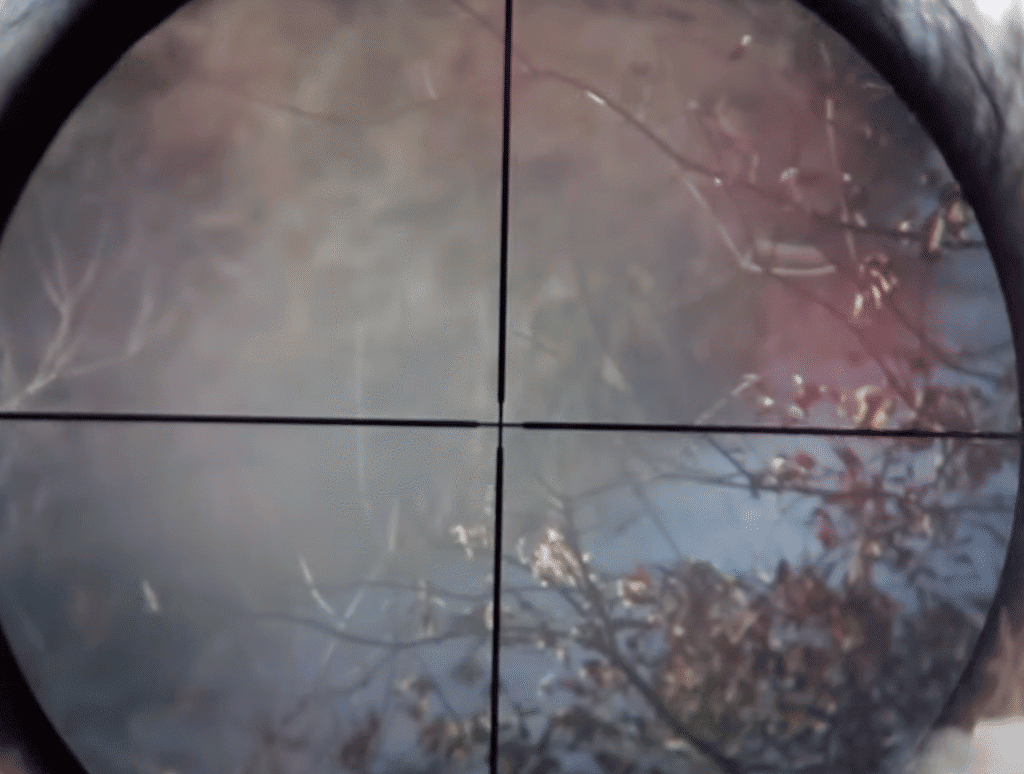
The V-Plex is a plain duplex: heavy outer posts tapering to a fine center cross. No hash ladder, no drop dots, nothing to memorize or calibrate. After time behind busy reticles whose marks only read true at one power, there’s something clarifying about a crosshair with nothing to get wrong. It’s second focal plane, so the center holds the same apparent size through the zoom range, but with no subtension marks to calibrate, the focal-plane question that snags people on ballistic reticles never enters the picture here. You aim with the center, hold a touch high or into the wind by eye, and that’s the whole method. In dim timber those thick posts pull your eye to the middle of the picture quickly when light is fading, where a thin crosshair running edge to edge would leave you searching. On a brush gun this reticle suits the work better than a more elaborate one would.
Glass that knows what it costs
Optically this is what entry-level money buys: capable in the conditions it was built for, ordinary outside them. From 2x through about 5x the image is clean and bright enough, color stays neutral, and the center is sharp. At 7x the edges go soft and the picture dims slightly, and in the last few minutes of legal light the small 32mm objective and entry-grade coatings surrender ground a larger, costlier scope would keep. The eyebox tightens at 7x as well, asking for a more deliberate cheek weld to fill the picture. None of that cost me anything afield, because in the timber I lived at 2x to 4x, where the eyebox is forgiving and the glass is at its best. If your shooting routinely ends at last light across open country, that’s the seam where this scope shows its price. At woods ranges in woods light, it held up.
Zero it once, then quit thinking about it
Capped turrets are the right call for this gun and this reticle. You sight in, thread the caps back down, and you’re finished; there’s nothing to dial and nothing exposed to drift loose in a scabbard or knock against a tree on the walk in. The 1/4 MOA clicks have enough tactile detent to count under a thumb, and 60 MOA of total elevation is far beyond anything a .30-30 inside 200 yards asks for. I confirmed zero, ran a box check to be sure the adjustments moved true and came back, then left them alone for the rest of the season, which is precisely how the scope wants to live. The 3.9 inches of eye relief gave clean clearance off the .30-30’s brisk but manageable recoil, with no scope bite and no crawling up the stock between shots.
The warranty is the feature
This is what actually separates the Crossfire II from the heap of cheap scopes sharing its shelf. Vortex’s VIP warranty is unconditional, fully transferable, and indifferent to how the scope broke or whether you bought it new. No receipt to dig up, no fault to prove. On a budget optic that carries more weight than any line on the spec sheet, because the genuine hazard with inexpensive glass isn’t that it’s average, it’s that it quits and leaves you out the cash. Here that hazard is gone. The scope also stayed sealed and clear through several cold, damp mornings, going from truck heat into frosty air without a wisp of internal fog, the sort of thing that quietly kills lesser optics. Mine never gave me reason to file a claim, but knowing the claim would be honored is a real part of what the money buys.
What a Season on a .30-30 in Thick Timber Told Me
I built the test around the rifle this scope was made for. A Marlin 336 in .30-30 Winchester is the classic American woods gun, and a light 2-7×32 is the optic that’s ridden on thousands of them for decades, so pairing the two was the only honest way to judge it. I fed it Hornady LeverEvolution 160-grain FTX start to finish, a single load, since it’s what most 336 owners actually hunt with and swapping ammo would only blur what I was trying to see. The aim wasn’t to chase tiny groups, it was to learn whether a scope at this price holds zero and stays usable across a real season.
I hunted it through the fall in hardwood bottoms and creek-bottom timber, close cover where a 2-7x spends its time at the low end and shots arrive fast inside about 125 yards. Mornings ran cold and damp, a few of them frosty, and I moved the rifle from a warm cab into standing air over and over to lean on the seals. Roughly 90 rounds went downrange across sight-in and the season. I confirmed zero at 100 yards, ran a box check to verify the turrets tracked and returned, then let the scope ride untouched. The thing I most wanted to settle was dependability: does it stay zeroed under the sharp recoil pulse of a lever .30-30, and does it stay clear when the weather turns. It did both. How I run these evaluations start to finish is spelled out in my full testing methodology.
Performance Ratings
Field Test Data
Tested with: Marlin 336 | .30-30 Winchester | Hornady LeverEvolution 160gr FTX
| Test Parameter | Result |
|---|---|
| Zero retention over season (~90 rounds, .30-30) | Held; no measurable shift across sight-in and field use |
| Box check tracking (1/4 MOA clicks) | Tracked true and returned to zero |
| Close-range acquisition at 2x (brush, both eyes open) | Fast; wide field of view, easy target pickup |
| Image quality at 7x (edges / fading light) | Edges soften, picture dims in the last minutes of legal light |
| Eyebox behavior (low/mid vs 7x) | Forgiving at 2-4x; more demanding cheek weld at 7x |
| Fog / seal check (cold-to-warm, frost mornings) | No internal fogging or moisture |
| Eye relief on .30-30 recoil | Comfortable clearance, no scope contact |
Pros and Cons
PROS
|
CONS
|
The Hunter This Scope Fits, and the One It Doesn’t
This is a natural fit for the short-range woods hunter: lever guns in .30-30 and .35 Remington, compact .243 and .308 brush rifles, slug guns and muzzleloaders, anything that does its work inside roughly 200 yards in timber or thick cover. It’s also a smart first scope for a new hunter who wants something that mounts, zeros, and then disappears, with a warranty that takes the risk out of buying at the bottom of the price ladder. A truck rifle, a loaner, or a youth setup all make sense here too, helped by the light weight and the forgiving low-power eyebox.
Pass on it if your hunting stretches into open country or leans on the last light of the day across fields, because the small objective and 7x ceiling are where this scope runs out of room, and the glass gives up brightness right when an open-country shooter needs it most. Anyone who wants to dial elevation for distance or shoot precision targets at higher magnification is also looking at the wrong tool; the capped turrets and 2-7x range are built for holding, not dialing. And if you specifically want this scope on a rimfire, get the 50-yard-parallax rimfire variant rather than this 100-yard centerfire version.
If the Glass or the Low-Light Ceiling Holds You Back
If the soft 7x image and dim last-light performance are the parts that worry you, the Leupold VX-Freedom 2-7×33 is the obvious step up. Its glass is clearly brighter and sharper and it holds clarity deeper into low light, the exact window where the Crossfire ran short, though it costs roughly three times as much and gives you no extra magnification for the money.
For a closer cross-shop, the Burris Fullfield E1 2-7×35 sits in the same budget bracket with a slightly larger objective, a bit more usable brightness at the edges of the day, and a transferable lifetime warranty in the same spirit as Vortex’s. It’s the pick if you want a hair more light without leaving this price tier.
And if your real problem is squeezing a few more minutes out of dusk, the Hawke Vantage IR 2-7×32 brings an illuminated reticle at a comparable price, which keeps your aiming point visible against dark timber after the plain V-Plex starts to vanish. You trade Vortex’s warranty reputation for that lit center.
Disclosure
This review may contain affiliate links, and I may earn a small commission if you purchase through them at no extra cost to you. Affiliate relationships do not influence my evaluation, ratings, or conclusions. What’s written here reflects my honest findings from hands-on testing of this scope.
A Scope That Earns Its Keep by Disappearing
The Vortex Crossfire II 2-7×32 is not trying to wow anyone, and that’s its best quality. It mounts on a woods gun, takes a zero, holds it through a season of recoil and cold mornings, and then asks nothing further of you. The glass is honest about its price, sharp where it counts at the low and middle power you actually hunt at, and softer at 7x where you rarely linger in timber. The V-Plex keeps things simple, and the light, compact body never throws off the balance of a lever rifle.
Buy it for a brush gun, a slug gun, a first deer rifle, or any setup that works inside a couple hundred yards, and you’ll get a dependable optic with a warranty that takes the risk out of spending little. Skip it for open country, long pokes, or the last gray minutes of light across a field, where the small objective and 7x ceiling run out of room. Inside its lane, this is one of the easiest budget recommendations going, and the kind of scope you forget you bought because it never gives you a reason to remember it.
Mike Fellon is the founder of ScopesReviews and an optics specialist with 15+ years in precision shooting. A former Bass Pro Shops firearms advisor and NRA-certified instructor, he’s hands-tested 200+ rifle scopes across hunting and competition. Based in Dallas, Texas.