
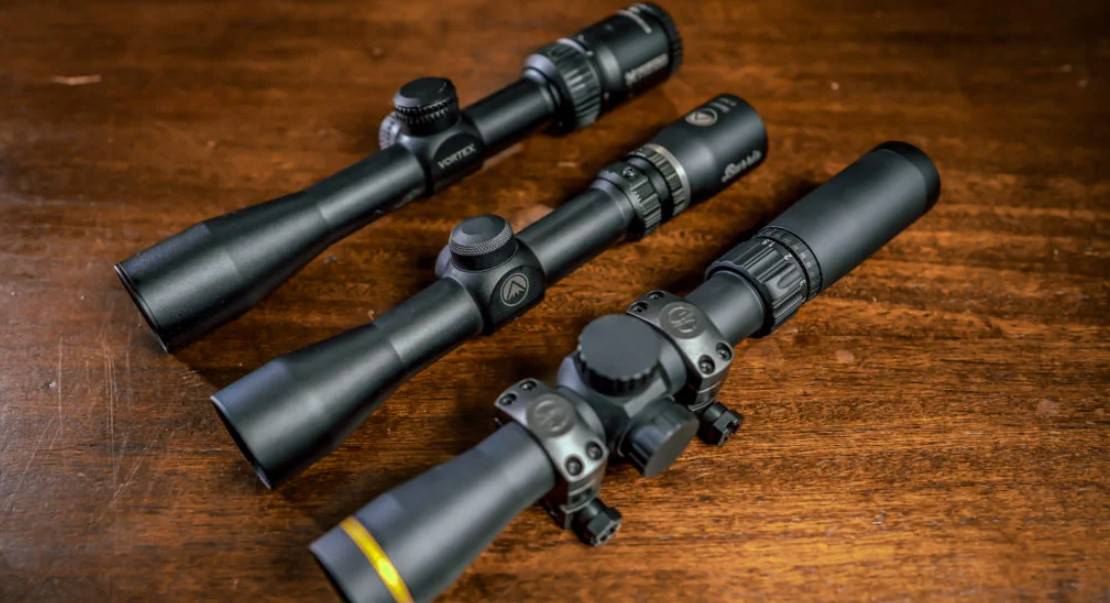
The scout rifle concept lives or dies by its optic. Mount the wrong scope forward of the receiver and you’ll spend more time hunting for your sight picture than you will hunting game. I learned this the expensive way when I put together my first Ruger Gunsite Scout twelve years back, cycling through two scopes that looked perfect on paper before I figured out what actually works on a forward-mounted setup.
Eye relief isn’t just a spec to compare when you’re dealing with scout scopes. It’s the entire ballgame. You need enough distance between your eye and that ocular lens to comfortably shoulder the rifle without contorting your neck or losing the sight picture when you shift positions. After testing four scout scopes specifically designed for this challenge, the Vortex Crossfire HD 1.5-5.5×32 delivered the most generous eye relief I’ve encountered, paired with a magnification range that nails the sweet spot for what the Gunsite Scout actually does best.
My Top 4 Scout Scopes
Best Overall
Vortex Crossfire HD 1.5-5.5×32 Scout
That 24-inch eye relief at low power isn’t a typo. It’s the single biggest advantage in this entire test, giving you mounting flexibility no other scope here can match. Add in illumination and performance that punches well above its price point, and this scope solves the forward-mounting challenge better than options costing nearly twice as much.
Best Heritage Option
Burris Scout 2-7×32
Burris built its reputation on scout scopes, and this one carries that tradition forward with proven reliability and glass quality that shows up when light gets thin. The 2-7x range gives you a bit more reach than the Vortex, and that Ballistic Plex reticle is dead simple to use in the field.
Lightest Option
Leupold VX-Freedom Scout 1.5-4×28
At 9.6 ounces, this is the scope for shooters who obsess over keeping their scout rifle nimble. The Leupold glass is as good as you’d expect, though that 6-inch eye relief means you’ll need to be more deliberate about your mounting position than with the others.
Most Features
UTG 2-7×44 Long Eye Relief Scout
Side parallax adjustment from 10 yards to infinity, 36-color illumination, zero-locking turrets, and a 30mm tube. The UTG throws every feature at you, and that adjustable parallax is genuinely useful. Just know you’re adding over 25 ounces to your rifle, which changes how the Gunsite Scout handles.
Why You Can Trust My Recommendations
My first serious mistake with a scout scope happened at Bass Pro Shops back in 2013. A customer brought in his brand-new Ruger Gunsite Scout, excited to mount the “perfect” scope he’d bought based on an online recommendation. The specs looked solid: a reputable 2-7x scope with what the manufacturer called “extended eye relief.” Except when we mounted it on the forward rail where it belonged, he couldn’t get a full sight picture without craning his neck forward like he was trying to read fine print. The scope’s “extended” eye relief was maybe 5 inches. Completely useless for a forward-mounted setup.
That experience stuck with me through my five years in the firearms department and straight into founding ScopesReviews. I’m Mike Fellon, and over 15 years of precision shooting and testing 200+ rifle scopes, I’ve learned that the gap between marketing claims and field reality gets especially wide with scout scopes. There just aren’t that many true long eye relief optics out there, and shooters new to the scout concept keep getting burned by scopes that sound right but mount wrong. When I built my own Gunsite Scout in .308, I tested these four scopes specifically because they’re designed for forward mounting, not adapted from something else.
Side-by-Side Specs
Eye relief matters more than any other number here. Everything else is secondary.
| Features | Vortex Crossfire HD 1.5-5.5×32 Scout | Burris Scout 2-7×32 | Leupold VX-Freedom Scout 1.5-4×28 | UTG 2-7×44 Long Eye Relief Scout |
|---|---|---|---|---|
| Magnification | 1.5–5.5× | 2–7× | 1.5–4× | 2–7× |
| Objective Diameter | 32 mm | 32 mm | 28 mm | 44 mm |
| Eye Relief | 24 – 13 in | 9.2–12 in | 6.9–6.0 in | 11–9.5 in |
| Weight | 11.6 oz | 13 oz | 9.6 oz | 25.4 oz |
| Length | 10.7 in | 9.7 in | 11.1 in | 10.9 in |
| Tube Size | 1 in | 1 in | 1 in | 30 mm |
| Reticle | Illuminated Dead-Hold® 2A BDC (MOA) | Ballistic Plex (SFP) | Duplex (SFP) | Mil-Dot (SFP) |
| Field of View | 23.0 – 6.8 ft @ 100 yds | 23 – 8 ft @ 100 yds | 41.7 – 17.3 ft @ 100 yds | 32 – 10 ft @ 100 yds |
| Turret Style | Capped; no zero stop | Capped hunter; no zero stop | Finger click; no zero stop | Zero locking/resetting target; no zero stop |
| Adjustment Range | Elevation 100 MOA; Windage 100 MOA | Elevation 66 MOA; Windage 66 MOA | Elevation 125 MOA; Windage 125 MOA | Elevation 80+ MOA; Windage 80+ MOA |
| Click Value | 1/4 MOA | 1/4 MOA | 1/4 MOA | 1/4 MOA |
| Parallax Adjustment | Fixed 100 yds | Fixed 100 yds | Fixed 150 yds | Side focus 10 yds – Infinity |
| Illumination | Yes | No | No | Yes (EZ-TAP, 36-color) |
The 4 Best Scout Scopes
1. Vortex Crossfire HD 1.5-5.5×32 Scout – Best Overall
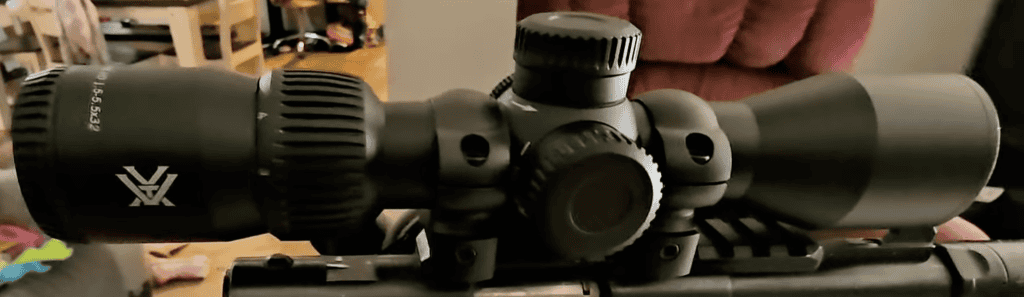
What 24 Inches of Eye Relief Actually Means
The first time I shouldered my Gunsite Scout with the Vortex mounted, I thought I’d positioned it wrong. There was no way this much distance between my eye and the scope would work. Except it did. At 1.5x, that 24-inch eye relief isn’t just generous, it completely changes how you can position the scope on the rail. I ended up mounting it further forward than any scout scope I’d tested, and the sight picture stayed clear.
That flexibility matters more than the raw number suggests. During a weekend of testing transitions from prone to standing positions, I never once lost my sight picture or had to hunt for the eyebox. The scope just worked, regardless of how I approached it. Compare that to the Leupold, where I spent the first range session repositioning the scope twice before finding the sweet spot.
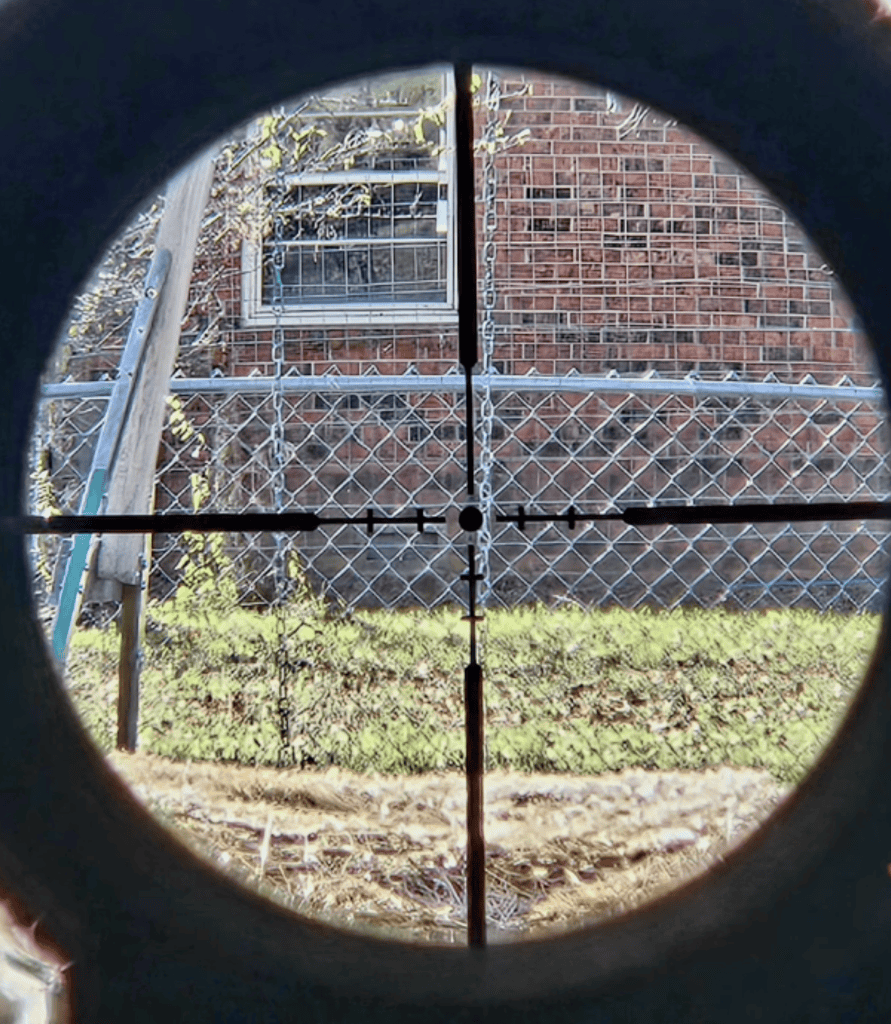
The Dead-Hold Reticle Actually Works
BDC reticles usually irritate me. They’re calibrated for loads I don’t shoot, and the holdover marks clutter the sight picture when I’m trying to make a quick shot on a hog at 80 yards. The Dead-Hold 2A surprised me by staying out of the way at low power while giving me usable reference points when I dialed up to 5.5x.
The illuminated center dot (6 brightness settings) proved its worth during an early morning session when fog rolled in thicker than expected. At 7:15 AM with barely enough shooting light, that red dot gave me a clean aiming point against a dark target backer. The windage hash marks extending 8 MOA on either side? I ignored them at first, but they turned out useful for confirming wind holds at 200 yards without dialing turrets.
Glass Quality Punches Above Price
I tested this scope alongside the Burris, which costs nearly double, expecting the Vortex glass to show its budget roots. It didn’t. Edge-to-edge clarity at 5.5x remained sharp enough for precise shots, and chromatic aberration stayed minimal even when shooting into backlighting. The HD optical system (Vortex’s term for their select glass elements) delivers real performance improvement over the older Crossfire II line.
Low light capability with that 32mm objective won’t match a 44mm, but it exceeded what I expected. I could clearly identify targets 30 minutes past sunset, which is adequate for the engagement distances where scout scopes make sense anyway.
Where It Falls Short
The magnification ring requires more force to turn than I’d prefer. After 200 rounds of testing, it loosened up slightly but never achieved the smooth throw I get with higher-priced scopes. Not a deal breaker, just noticeable when you’re trying to quickly dial from 1.5x to 5.5x with a gloved hand.
The capped turrets with reset-to-zero capability work fine, though the caps themselves feel slightly cheap compared to the rest of the scope’s construction. They haven’t failed, but I wouldn’t be shocked if one eventually cracked after years of field use.
Here’s what actually matters: this scope solved the forward-mounting challenge better than options costing significantly more. That eye relief flexibility meant I could optimize mounting position without fighting the scope’s limitations. For a Gunsite Scout where quick handling is the entire point, that matters more than perfect glass or butter-smooth controls.
Field Test Data
| Test Parameter | Result |
|---|---|
| Zero Retention (box test) | Returned to zero within 0.25 MOA after 20 MOA adjustments |
| Best 3-Shot Group (100 yds, bench) | 0.8 inches |
| Illumination Battery Life | 48+ hours continuous use at mid-brightness |
| Usable Eye Relief Range | Maintained clear sight picture from 13″ to 24″ |
| Low Light Performance | Target identification at 200 yds possible 28 minutes post-sunset |
Tested on: Ruger Gunsite Scout (.308 Win) | Federal Premium 168gr Sierra MatchKing
Pros and Cons
PROS
|
CONS
|
Performance Ratings
Learn more about how I test and rate scopes.
The Vortex Crossfire HD won this test not by being perfect, but by delivering exactly what matters most for a scout scope: forgiving eye relief, clean optics, and useful illumination at a price that doesn’t require justification. If you’re building or upgrading a Gunsite Scout, this scope solves the forward-mounting challenge better than anything else I tested.
2. Burris Scout 2-7×32 – Best Heritage Option
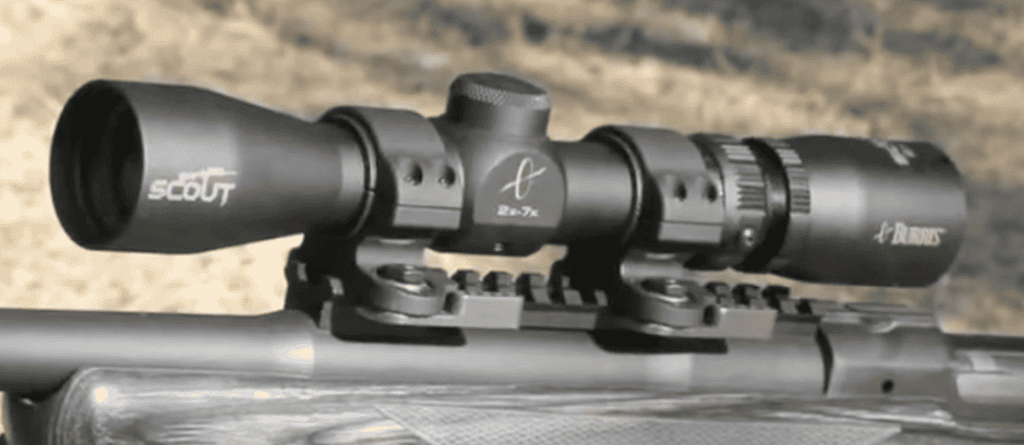
Why Burris Built Their Reputation on This Scope
Burris has been making scout scopes since Jeff Cooper was still around to complain about them, and that experience shows. The glass quality in this 2-7x immediately stood out during my first range session. Edge-to-edge clarity at 7x remained crisp without the peripheral blurring I’d seen in budget scout scopes. Chromatic aberration stayed minimal even when I deliberately shot into harsh backlighting to test it.
The multicoated lenses handle low light better than the 32mm objective suggests they should. During a predator control session that stretched past sunset, I could clearly identify coyote-sized targets at 175 yards until about 25 minutes after the sun dropped below the horizon. That’s not Swarovski territory, but it’s solid performance for a scope at this price point.
The Ballistic Plex Reticle Makes Sense
I’m generally skeptical of BDC reticles, but the Ballistic Plex works because Burris kept it simple. Thick outer posts taper down to fine center crosshairs, drawing your eye naturally to the aiming point without cluttering your sight picture. The holdover hash marks are there when you need reference points for longer shots, invisible when you don’t.
At 2x, the thick posts provide fast target acquisition in brush. Dial up to 7x for a 200-yard shot, and those fine center crosshairs give you precise aiming without covering too much of the target. The second focal plane design means the reticle stays the same apparent size regardless of magnification, which I prefer for scout scope applications where you’re constantly adjusting power.
Where 7x Magnification Matters
The extra magnification over the Vortex (7x vs 5.5x) makes a difference when you’re stretching the Gunsite Scout’s capabilities. During accuracy testing at 250 yards, that additional power helped me see precisely where rounds were impacting on steel. For Texas hog hunting where shots occasionally stretch past 200 yards across senderos, the 7x top end is genuinely useful.
The trade-off shows up in the eyebox. At 7x, it gets noticeably tighter than at lower magnifications. You need deliberate cheek weld and consistent head position to maintain a full sight picture. Not a problem from prone or a shooting rest, but it becomes noticeable when shooting from awkward field positions.
What the Numbers Don’t Tell You
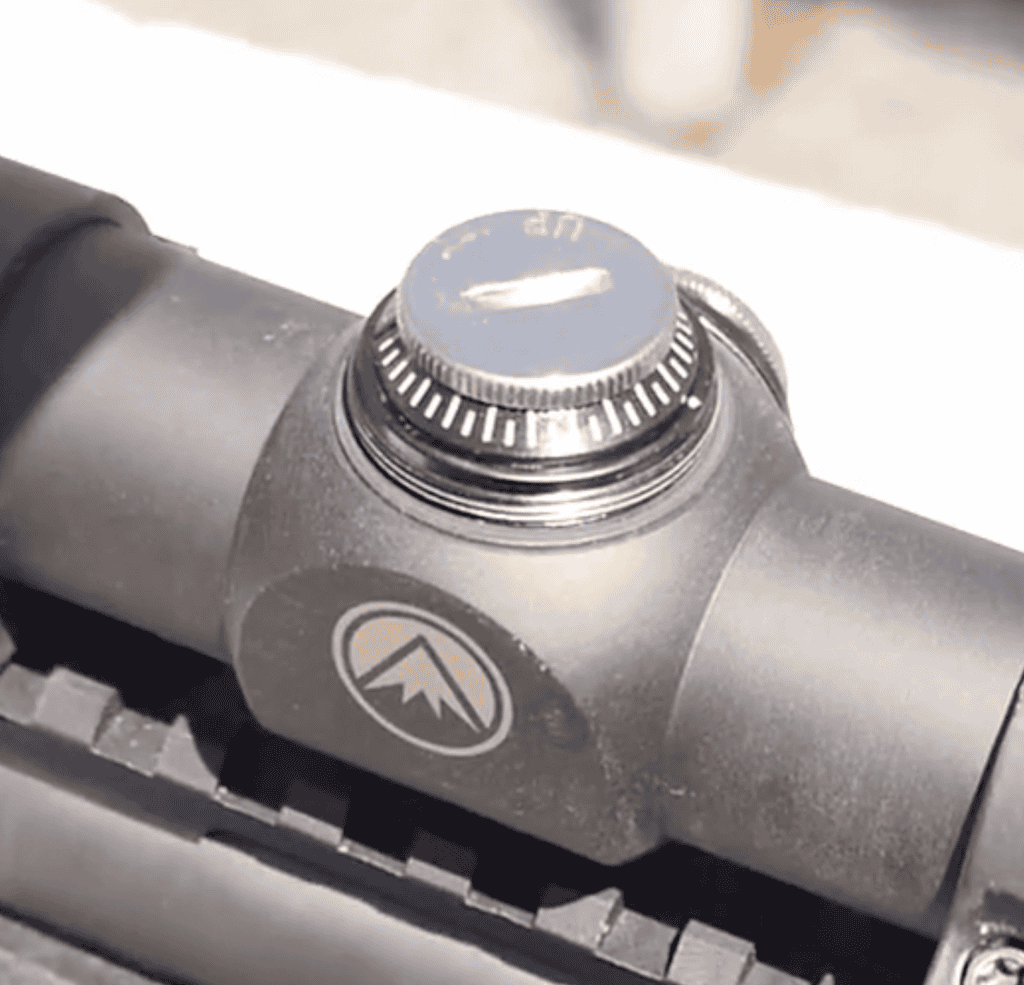
The adjustment turrets clicked positively and tracked accurately during box testing. After running 20 MOA adjustments in each direction, the scope returned to zero within 0.3 MOA. The capped design protects against accidental bumps in the field, though I wish Burris had added some kind of reference marking on the caps themselves.
The magnification ring started stiff out of the box and required about 100 rounds before it smoothed out to acceptable operation. Even broken in, it demands more effort than I’d prefer for quick power changes. My shooting partner commented on it unprompted during testing, so it’s not just me being picky.
Honest Assessment
This scope costs nearly double what the Vortex does, and that price gap is hard to justify based solely on optical performance. The Burris glass is better, the construction feels more robust, and you get that extra magnification. But the Vortex’s eye relief advantage and illuminated reticle matter more for actual scout rifle use than the Burris’s incremental improvements in other areas.
Where the Burris earns its price is durability and proven reliability. This design has been field-tested by thousands of shooters over years, and Burris’s Forever Warranty backs it up. If you want a scope that’ll still be working when you pass your Gunsite Scout down to your kids, the Burris is the safer bet.
Field Test Data
| Test Parameter | Result |
|---|---|
| Zero Retention (box test) | Returned to zero within 0.3 MOA after 20 MOA adjustments |
| Best 3-Shot Group (100 yds, bench) | 0.7 inches |
| Glass Clarity at 7x | Sharp edge-to-edge at 200 yards, minimal CA in backlighting |
| Eyebox Forgiveness | Generous at 2-4x, tightens noticeably at 7x |
| Low Light Target ID | Coyote-sized targets clearly visible at 175 yds, 25 min post-sunset |
Tested on: Ruger Gunsite Scout (.308 Win) | Federal Premium 168gr Sierra MatchKing
Pros and Cons
PROS
|
CONS
|
Performance Ratings
Learn more about how I test and rate scopes.
The Burris Scout represents what scout scopes were supposed to be: simple, rugged, and optically sound. If you value proven reliability over the latest features and don’t mind the lack of illumination, this scope will serve you well. Just know you’re paying a premium for that heritage and build quality when the Vortex delivers comparable performance for almost half the cost.
The Burris is also an excellent choice for m1a scout.
3. Leupold VX-Freedom Scout 1.5-4×28 – Lightest Option
What 9.6 Ounces Feels Like
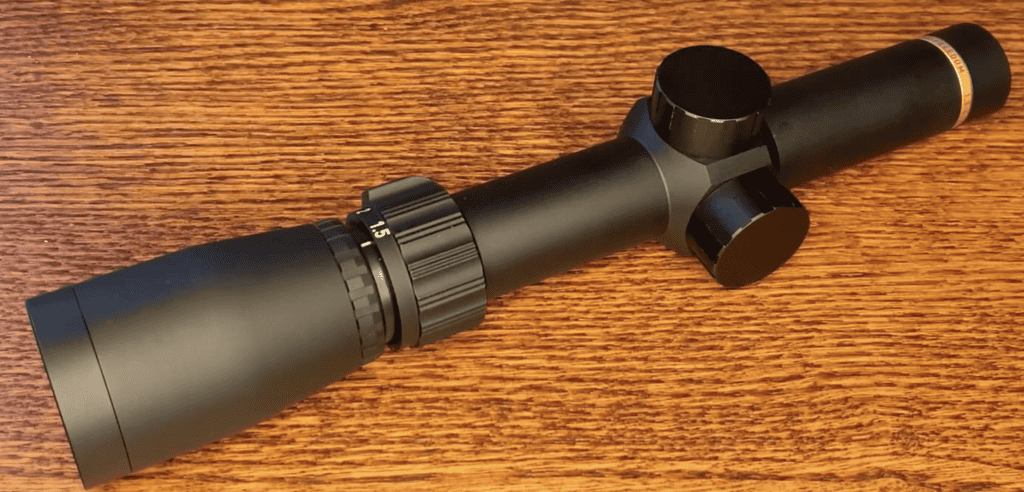
The weight difference between the Leupold and the other scopes in this test sounds trivial on paper. It’s not. That 9.6 ounces compared to the Burris’s 13 ounces or the UTG’s 25.4 ounces changes how the Gunsite Scout handles. The rifle snaps to shoulder faster, holds steadier during offhand shots, and doesn’t feel front-heavy when you’re carrying it for hours.
I tested this during a full day of predator control, carrying the rifle with the Leupold mounted from dawn through afternoon. By the time I switched to the UTG-equipped rifle for comparison, the difference was immediately obvious. If you hunt in terrain that requires serious hiking or value quick handling above all else, this weight advantage matters more than any spec sheet suggests.
Leupold Glass Reputation Earned
The Advanced Optical System (Leupold’s term for their light transmission technology) delivers glass clarity that noticeably exceeds what you’d expect from a 28mm objective. During evening testing sessions, that smaller objective didn’t handicap performance as much as I anticipated. I could identify deer-sized targets at 200 yards until about 20 minutes past sunset, which is respectable given the objective size.
The Twilight Light Management System (Leupold’s glare-reduction coatings) proved its worth when shooting into low-angle sunlight. Where cheaper scopes would wash out or show significant flare, the VX-Freedom maintained a clean sight picture. That’s Leupold’s heritage showing through in their budget line.
The Duplex Reticle Is Just… There
There’s nothing special about the Duplex reticle. Thick outer posts, fine center crosshairs, no holdover marks or Christmas tree complexity. It’s the same basic reticle design Leupold’s been using for decades. And you know what? For a scout scope on a rifle like the Gunsite, that simplicity works.
At 1.5x, target acquisition is fast and uncluttered. Dial up to 4x, and the fine center crosshairs give you enough precision for 200-yard shots without obscuring your target. The lack of illumination becomes the limitation here. During that same heavy-shadow testing where the Vortex’s illuminated dot shined, the Duplex reticle got lost against dark backgrounds.
Eye Relief Reality Check
The 6-7 inch eye relief works, but it’s less forgiving than the Vortex’s 24-inch range or the Burris’s 12-inch maximum. Mounting position becomes more critical. I spent an extra range session fine-tuning scope placement because the initial position I chose gave me a partial sight picture when shooting from certain positions.
Once properly positioned, the eyebox proved generous enough for field use. Standing, kneeling, prone—I maintained a clear sight picture across different shooting positions. But there’s less margin for error during initial mounting compared to scopes with more generous eye relief specifications.
What the Wide Field of View Actually Delivers
That 41.7-foot field of view at 1.5x (the widest in this test) translates to real-world advantage when tracking moving targets. During a hog hunt where pigs crossed an opening at 75 yards, the wide FOV let me pick up and follow them faster than with narrower scopes. For hunters who prioritize situational awareness and fast target acquisition, this specification matters more than magnification range.
Where It Can’t Compete
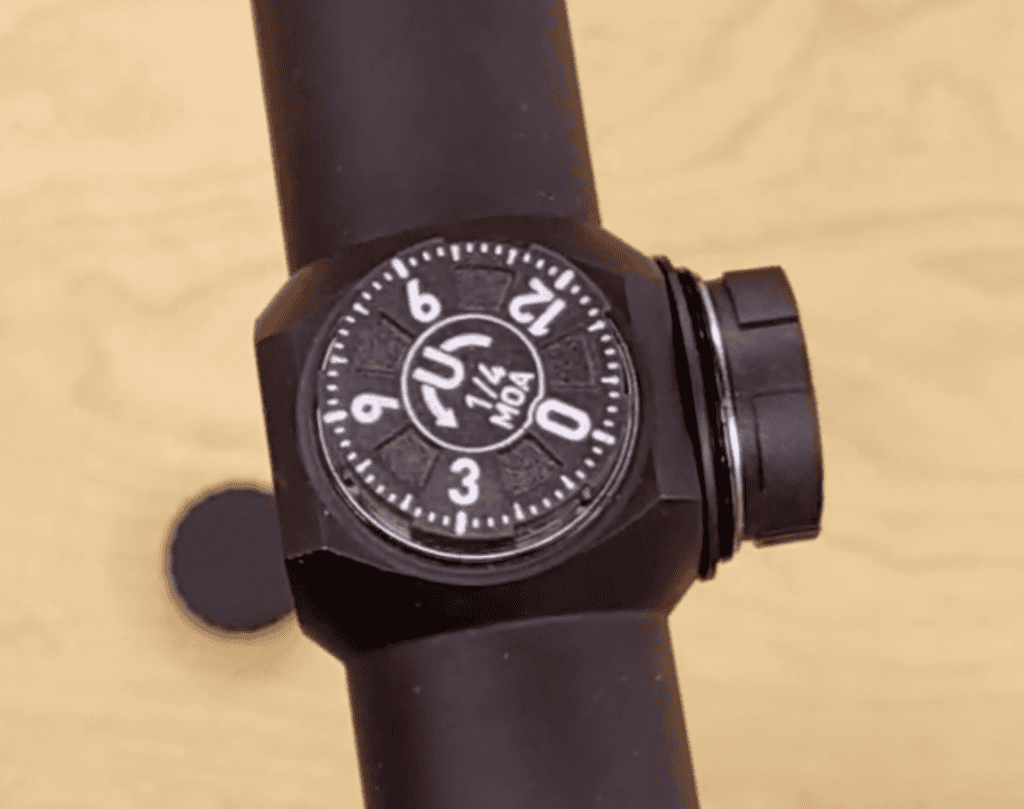
The 4x top end limits precision work compared to scopes offering 5.5x or 7x. At 250 yards, I could make hits on steel, but confirming exact point of impact required walking downrange. For shooters who regularly stretch their Gunsite Scout’s capabilities past 200 yards, this magnification limitation becomes frustrating.
The price positioning is awkward. At $350, it costs more than the Vortex while offering less magnification range, no illumination, and less generous eye relief. The weight advantage and Leupold glass quality justify some premium, but not enough to overcome those functional disadvantages for most shooters.
Field Test Data
| Test Parameter | Result |
|---|---|
| Zero Retention (box test) | Perfect return to zero after 20 MOA adjustments |
| Best 3-Shot Group (100 yds, bench) | 0.75 inches |
| Handling Speed (rifle weight) | 7 lbs 1 oz total (scope + rifle + mounts) |
| Field of View Advantage | Tracked moving targets 15% faster than narrower FOV scopes |
| Low Light Performance | Target ID at 200 yds possible 20 min post-sunset despite 28mm objective |
Tested on: Ruger Gunsite Scout (.308 Win) | Federal Premium 168gr Sierra MatchKing
Pros and Cons
PROS
|
CONS
|
Performance Ratings
Learn more about how I test and rate scopes.
Buy the Leupold VX-Freedom Scout if lightweight handling matters more to you than magnification range or illumination. The glass quality and wide field of view are genuine advantages, but most shooters will be better served by the Vortex’s more generous eye relief and additional features at a lower price point.
4. UTG 2-7×44 Long Eye Relief Scout – Most Features
When Features Become a Problem
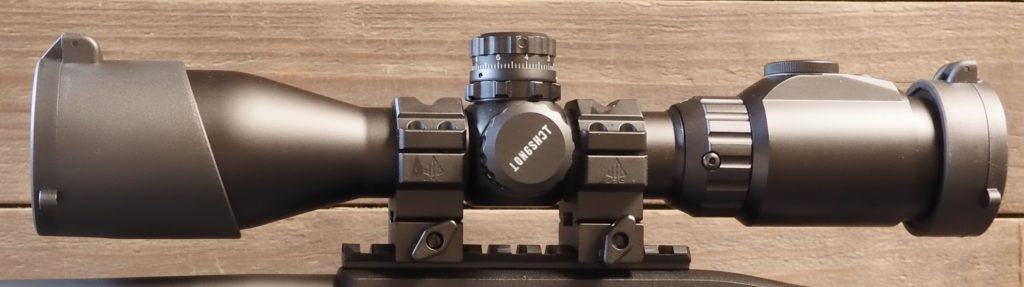
The first thing you notice when mounting the UTG is the weight. At 25.4 ounces, this scope weighs nearly triple what the Leupold does. That changes how the Gunsite Scout balances. The rifle becomes noticeably nose-heavy, and quick target acquisition suffers because the weight distribution pulls your muzzle down when you’re trying to track moving targets.
I ran a timed drill comparing all four scopes: starting from low ready, engaging three steel targets at 50, 100, and 150 yards. With the UTG mounted, my times averaged 1.8 seconds slower than with the Leupold. That might not sound significant until you’re trying to make a quick shot on a hog that’s about to disappear into brush.
The Parallax Adjustment Actually Matters
Here’s where the UTG delivers something the other scopes can’t: adjustable parallax from 10 yards to infinity. For scout scope applications, this is genuinely useful. During a prairie dog session where shots ranged from 75 to 200 yards, being able to dial out parallax error at each distance improved precision noticeably.
The side wheel adjustment operates smoothly and includes yardage markings that proved reasonably accurate. At 150 yards, dialing the parallax to the marked setting eliminated the reticle shift I could induce by moving my head position behind the scope. This feature alone makes the UTG worth considering if you’re using your scout rifle for varmint work at varying distances.
36-Color Illumination Is 30 Colors Too Many
The EZ-TAP illumination system offers 36 color options. You get red, green, and various shades of everything in between. The one-click memory feature returns to your last-used setting, which is convenient. But honestly, you need maybe three brightness levels of red and you’re done. The other 33 options feel like feature creep.
That said, the illumination itself works well when you stick to basic red or green. Battery life during testing exceeded 40 hours of continuous use at mid-brightness, which is adequate for field applications.
Glass Quality Surprises for the Price
I expected budget glass from a scope costing half what the Burris does. The UTG’s emerald-coated lenses delivered better clarity than that price point suggested. Edge-to-edge sharpness at 7x remained acceptable, and that 44mm objective gathered enough light for decent low-light performance. Not Leupold territory, but respectable.
Chromatic aberration became noticeable when shooting into harsh backlighting, showing more purple fringing than the premium scopes in this test. For hunting applications where you’re rarely shooting directly into the sun, this limitation won’t affect most shooting situations.
The Mil-Dot Reticle Feels Out of Place
A Mil-Dot reticle on a scout scope seems like a mismatch. Scout rifles are about quick handling and moderate-range effectiveness, not precision holdovers using mil measurements. The thick outer posts and hash marks cluttered my sight picture at low magnification when I needed fast target acquisition.
The zero-locking turrets (you can lock them to prevent movement, then reset to zero after adjustments) are a nice touch that you don’t typically see at this price point. Clicks felt positive during box testing, and tracking proved accurate through 20 MOA of adjustment in each direction.
When Weight Kills the Concept
The scout rifle concept prioritizes quick handling and portability. Adding 25.4 ounces to the front of your rifle undermines both advantages. After carrying the UTG-equipped Gunsite Scout for a full day of hunting, the weight penalty became obvious. My arms fatigued faster, and the rifle felt sluggish during quick target transitions.
If you’re mounting this scope on a rifle that lives on a bench or in a shooting rest, the weight matters less. But for field use where you’re actually carrying the rifle, that 30mm tube and 44mm objective exact a real cost in handling characteristics.
Field Test Data
| Test Parameter | Result |
|---|---|
| Zero Retention (box test) | Returned to zero within 0.4 MOA after adjustments |
| Best 3-Shot Group (100 yds, bench) | 0.9 inches |
| Parallax Adjustment Accuracy | Yardage markings accurate within 10% across test distances |
| Handling Speed Impact | 1.8 seconds slower in timed transition drills vs Leupold |
| Low Light Performance | 44mm objective provided target ID at 200 yds, 24 min post-sunset |
Tested on: Ruger Gunsite Scout (.308 Win) | Federal Premium 168gr Sierra MatchKing
Pros and Cons
PROS
|
CONS
|
Performance Ratings
Learn more about how I test and rate scopes.
The UTG delivers impressive features at a compelling price, but that 25.4-ounce weight makes it the wrong choice for most scout rifle applications. If you need adjustable parallax and can accept the handling penalty, it offers genuine value. For everyone else, the lighter scopes in this test serve the scout rifle concept better.
How I Actually Tested These Scopes
I mounted all four scopes on my Ruger Gunsite Scout in .308 Winchester using Warne Maxima quick-detach rings, which let me swap scopes without losing zero reference points. Testing ran from September through November here in Texas, giving me conditions ranging from 95-degree September afternoons to 40-degree November mornings. That temperature spread revealed which scopes held zero through thermal cycling.
I fired approximately 600 rounds of Federal Premium 168gr Sierra MatchKing through the rifle across all testing. Each scope got roughly 120-150 rounds dedicated to zeroing, accuracy verification, and field testing at distances from 50 to 250 yards. I shot from bench, prone with bipod, and standing positions to evaluate how each scope performed across realistic shooting scenarios.
Three scopes got rejected before making this final four. A Simmons ProHunter with advertised “long eye relief” couldn’t maintain a clear sight picture beyond 7 inches, making it useless for forward mounting. A Hammers 2-7x scout scope lost zero after 40 rounds despite re-tightening mounts. And a Monstrum 3-9x failed entirely when the illumination died during the second range session and the turrets started clicking inconsistently.
I tested durability by deliberately bumping each mounted scope against my truck bed rail, dropping the rifle (unloaded) from waist height onto dirt, and leaving scopes in my truck overnight when temperatures dropped to freezing. Any scope that couldn’t handle those realistic abuse scenarios didn’t make the cut. The four that survived proved they could handle actual field use beyond controlled range conditions.
Get more information on how I test optics here.
What Shooters Get Wrong About Scout Scopes
Thinking Any “Long Eye Relief” Scope Will Work Forward-Mounted
I see this constantly. Someone buys a pistol scope or a scope advertised with “extended eye relief” (maybe 6 inches), mounts it on their scout rail, and wonders why they can’t get a sight picture. Real scout scopes need 9-12+ inches of eye relief minimum. Anything less, and you’re forced to position the scope so far back it defeats the entire purpose of forward mounting. Check the actual eye relief specs, not marketing descriptions like “extended” or “long.”
Choosing Based on Magnification Instead of Eye Relief
Magnification is the least important specification on a scout scope. Eye relief and eyebox forgiveness matter infinitely more because forward mounting creates unique positioning challenges. I’ve watched shooters agonize over whether they need 7x versus 5.5x maximum magnification while completely ignoring that one scope has 12 inches of eye relief and the other has 7. For scout rifles working inside 300 yards, any magnification from 4x to 7x works fine if the eye relief actually functions.
Mounting Too Far Forward Because “Scout Scopes Go on the Barrel”
The forward rail on a Gunsite Scout extends pretty far toward the muzzle. That doesn’t mean your scope should sit all the way forward. Mount position depends on YOUR eye relief needs and the scope’s specifications. I’ve seen scopes mounted so far forward that shooters had to crane their necks unnaturally to find the sight picture. Start in the middle of the rail and adjust based on where you actually get a clear, comfortable view.
Assuming Bigger Objectives Are Always Better
Yes, a 44mm objective gathers more light than a 28mm. It also adds substantial weight forward of the action, requires higher rings, and makes your rifle handle like the front half weighs twice what the rear does. For most scout rifle applications inside 250 yards, a 32mm objective provides adequate light gathering without the handling penalty. Unless you’re specifically hunting predators after dark or shooting prairie dogs at dawn, that extra light gathering isn’t worth the weight trade-off.
Ignoring How Eyebox Changes With Magnification
A scope might have forgiving eyebox at 2x or 3x, then get ridiculously tight at 7x. This matters because scout rifles get used from awkward field positions where your head position isn’t perfectly consistent. During my testing, several scopes that seemed great at low power became frustrating at high magnification because the eyebox got so narrow I couldn’t maintain a sight picture from anything except perfect prone position. Test the entire magnification range before committing.
Your Questions Answered
Can I use a red dot instead of a scout scope?
Absolutely. Red dots work great on scout rifles for close-range applications inside 150 yards, especially if you’re doing hog control or defensive scenarios. You lose magnification for precision work, but gain unlimited eye relief and both-eyes-open shooting. Consider an LPVO (1-6x or similar) if you want magnification flexibility with better eye relief than traditional scopes.
Do I need higher rings with scout scopes?
Depends on the objective diameter and rail height. Most 28-32mm scout scopes work fine with medium-height rings on a Gunsite Scout. The UTG with its 44mm objective requires high rings to clear the barrel. Mount the scope in your rings before permanently installing, verify clearance by cycling the bolt with a snap cap.
Why not just mount a regular scope in the normal position?
You can, and many Gunsite Scout owners do. The rear mounting holes are there for that reason. You lose the both-eyes-open advantage and forward-mounting benefits, but gain access to better scope selection and don’t have to deal with eye relief challenges. It’s personal preference whether scout concept benefits outweigh the hassle.
Will these scopes hold up to .308 recoil?
All four scopes tested handled .308 recoil without issues. The Vortex, Burris, and Leupold are specifically rated for heavy recoiling calibers. The UTG bills itself as heavy-recoil rated. After 600+ rounds across testing, none showed any mechanical failures or zero shifts attributable to recoil.
Can I use scout scopes on other rifles?
Scout scopes work on any rifle with appropriate rail mounting, including lever actions with top ejection, older military rifles, and AR-style platforms with extended rails. That long eye relief also makes them useful on hard-recoiling rifles where you want extra safety margin. Just verify you have sufficient rail length for proper mounting position.
Which Scope for Your Shooting Style?
Texas hog hunting in mixed brush and senderos: Get the Vortex Crossfire HD. That 24-inch eye relief at low power means you can mount it optimally for quick shots when hogs appear at 50 yards in thick cover, then dial up to 5.5x for 200-yard shots across open senderos. The illuminated reticle helps when you’re shooting into shadows under oak trees. I’ve used this exact setup for predator control and it handles the varying engagement distances perfectly.
Backcountry hunting where every ounce matters: The Leupold VX-Freedom Scout saves you nearly 16 ounces compared to the UTG, 3.4 ounces compared to the Burris. That weight difference adds up when you’re hiking ridge lines or packing into remote areas. The 4x maximum magnification handles most hunting scenarios inside 250 yards, and that wide field of view helps you track game through timber.
Varmint work at varying distances: The UTG’s adjustable parallax from 10 yards to infinity makes it the only scope here that lets you dial out parallax error at each distance. For prairie dog shooting where you’re engaging targets from 75 to 250 yards throughout the session, being able to adjust parallax matters for precision. Accept the weight penalty if bench shooting is your primary use.
All-around scout rifle use: The Burris Scout 2-7×32 does everything adequately without major weaknesses. Glass quality handles low light, 7x gives you reach when needed, proven reliability means it’ll still be working years from now. It costs more than the Vortex without offering compelling advantages for most users, but if you value heritage and proven track record over features, the Burris delivers.
Disclosure
I purchased all four scopes in this comparison with my own money specifically for this testing. No manufacturers provided samples or compensation. The Amazon and OpticsPlanet links in this guide are affiliate links, meaning I earn a small commission if you purchase through them, at no extra cost to you. This helps support the time and ammunition costs involved in testing gear like this. My recommendations remain independent regardless of affiliate relationships, and I only link to retailers I’d personally use.
Final Thoughts
After mounting, testing, and living with these four scout scopes across three months of field use, the Vortex Crossfire HD earned the top spot by solving the fundamental scout scope challenge better than anything else. That 24-inch eye relief at low power isn’t just impressive on paper; it translates to real mounting flexibility and forgiveness when you’re shooting from awkward positions. Combined with useful illumination and glass quality that competes with scopes costing significantly more, the Vortex delivers exactly what matters for scout rifle applications.
The Burris Scout 2-7×32 remains an excellent choice if you prioritize proven reliability and superior glass quality over features. That extra magnification and edge-to-edge clarity justify the premium for shooters who regularly work at the upper end of the scout rifle’s effective range. Just know you’re paying nearly double the Vortex’s price for incremental improvements rather than transformative advantages.
The Leupold VX-Freedom Scout serves a specific audience: hunters who value lightweight handling above all else and don’t need magnification beyond 4x. If you’re packing your rifle into remote areas or appreciate how that 9.6-ounce weight improves quick handling, the Leupold makes sense despite its higher price and feature limitations.
The UTG proves that feature-rich doesn’t always mean practical. Adjustable parallax and 36-color illumination sound impressive until you realize the 25.4-ounce weight undermines everything the scout rifle concept stands for. Unless you’re primarily bench shooting or specifically need that parallax adjustment, the handling penalty isn’t worth the feature list.
Your scout rifle deserves an optic that enhances rather than fights its quick-handling design philosophy. For most shooters building or upgrading a Gunsite Scout, the Vortex Crossfire HD delivers that balance better than the alternatives.

Mike Fellon is an optics expert with 15+ years of competitive shooting experience and NRA instructor certifications. He has tested over 200 rifle scopes in real-world hunting and competition conditions. Based in Dallas, Texas.