
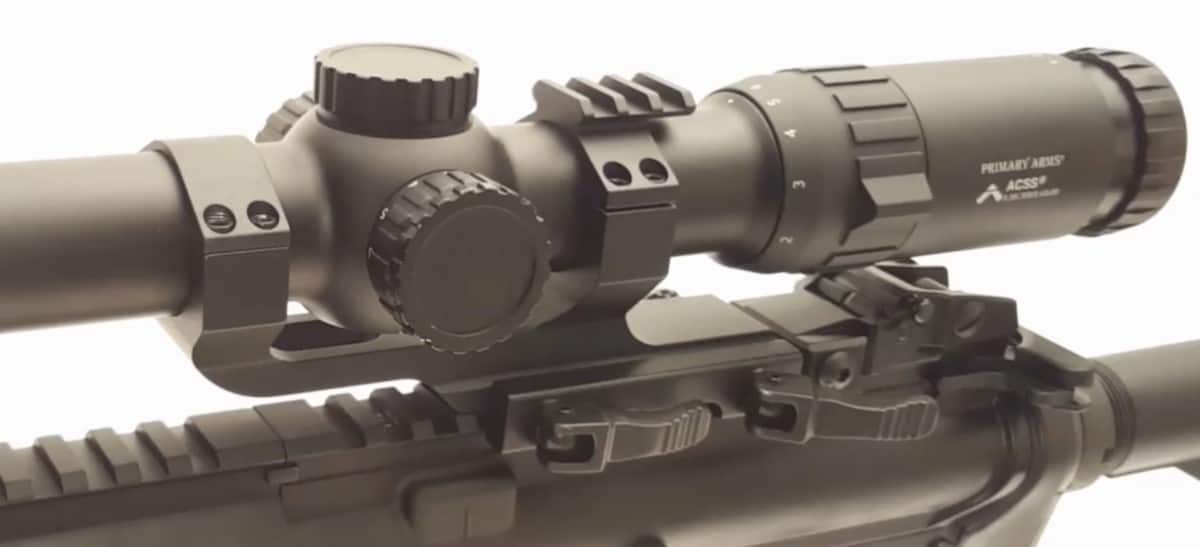
A quick detach mount only matters if it actually returns to zero. That sounds obvious, but I’ve pulled mounts off and put them back on dozens of times across multiple testing sessions, and the gap between “advertises return to zero” and “actually does it” is wider than most shooters expect. The whole point of a QD system is flexibility: swap your optic to a different rifle, clear it for transport, or drop back to irons when the situation calls for it. If you lose your zero every time, you’ve just bought an expensive inconvenience.
I tested four QD mounts during the last two weeks of October 2025 on an AR-15 platform, cycling each through repeated removal and reinstallation, and measuring where my point of impact landed after every remount. The Atibal Tactical Precision Lightweight 30mm QD came out on top, delivering the most consistent return to zero of the group at a price that doesn’t require selling a kidney.
The Four QD Mounts Worth Your Money
Best Overall
Atibal Tactical Precision Lightweight 30mm QD Mount
The Atibal nailed the one thing that matters most in a QD mount: it averaged 0.2 MOA of shift across ten cycles. The oversized levers with the press-button release operated smoothly even with Mechanix work gloves, and the cantilever design positioned my scope perfectly on the AR platform without fussing with eye relief. At its mid-tier price point, it beat the $170 Monstrum where it mattered.
Best Budget
UTG ACCU-SYNC QR 1″ Medium Pro
This mount has no business performing this well at its price. The squared recoil stops kept everything locked in place through sustained strings of fire, and the locking QR levers prevented any accidental release. UTG rates it for .338 Lapua Magnum recoil, which tells you something about their confidence in the design. For anyone running a 1-inch tube scope on an AR, this is a steal.
Best QD Mechanism
Monstrum Hypergrip Cantilever Scope Mount with Quick Release
Monstrum’s J-hook interface and push-button release combination is the most mechanically interesting QD system in this group. The dual-lever lockup felt genuinely secure, and the attachment/detachment action was the fastest of the four. Where it falls short is value: the Atibal delivers comparable or better return-to-zero performance for significantly less money.
Best for ATN Scope Owners
ATN Quick Detach Mount for 30mm Scope Tube
If you own an ATN X-Sight 4K, THOR 4, or THOR LT, this mount was designed around those optics and it shows. The fit is seamless, and the rounded corners protect the scope’s electronics housing. As a general-purpose QD mount for traditional glass, it sits behind the others in this group, but for ATN’s digital ecosystem it’s the obvious pairing.
Why My QD Mount Recommendations Carry Weight Beyond the Spec Sheet
The three 30mm mounts in this group all claim return to zero on their product pages. Most QD mounts market some version of return-to-zero performance. What separates a useful claim from marketing is how many removal cycles you put the mount through before you trust the numbers, and whether you’re measuring shift on paper or just eyeballing it through the scope. I ran each mount through a minimum of ten remove-and-reinstall cycles over multiple range sessions, checking point of impact against a marked reference target at 100 yards after every remount. That approach came from losing a local match placement years ago because a QD mount I trusted shifted just enough after a midday scope swap that my hits drifted outside the scoring zone at 300. I didn’t catch it until I was already three stages deep. Since then, every QD mount I evaluate gets cycled hard before I’m willing to say it holds zero, and the ones in this guide were no exception.
The 4 Quick Detach Scope Mounts Tested
1. Atibal Tactical Precision Lightweight 30mm QD Mount – Best Overall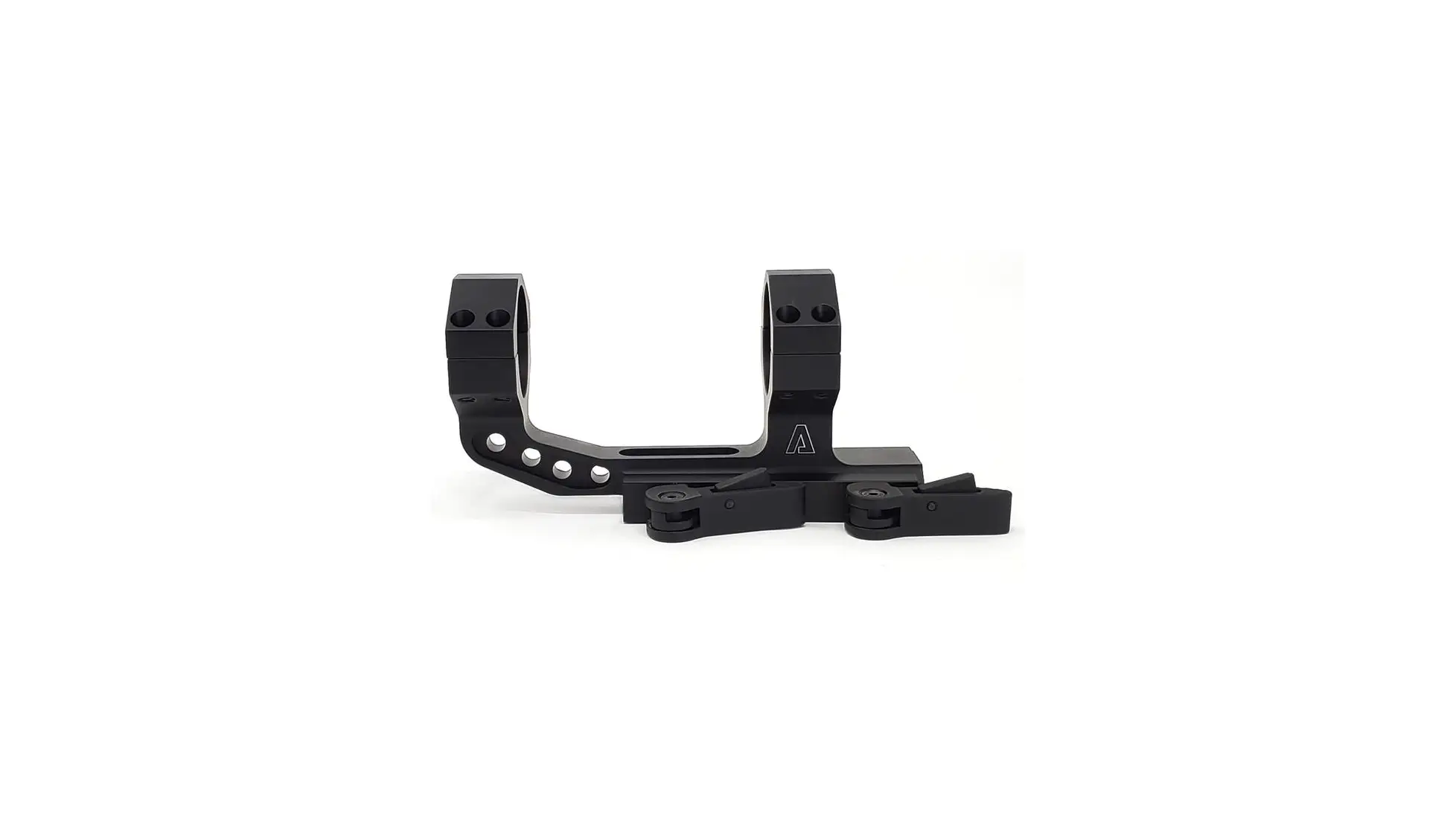
First Impressions Out of the Box
I mounted the Atibal first because the lever design caught my attention before I even opened the other three boxes. The oversized QD levers have a press-button release on top of each one, so you push down and pull the lever out in a single motion. No fumbling, no prying. I had it seated on my M&P15’s Picatinny rail in under a minute, and the cantilever design pushed the Diamondback Tactical forward just enough to nail my eye relief without any repositioning. The Type III hard-anodized finish (MIL-A-8625) felt like it belonged on a mount that costs twice as much. No rough edges, no tooling marks I could see or feel.
Where the Lever Design Actually Matters
Atibal’s lever tension is adjustable, which sounds like a basic feature until you’ve dealt with QD mounts that are either too loose on your rail or require a gorilla grip to close. I dialed in the tension on my second try, and once it was set, it stayed set. Across ten removal-and-reinstall cycles, the levers engaged at the same point every time. I wore Mechanix work gloves for half of those cycles specifically because Atibal markets the oversized levers as glove-friendly, and they are. The buttons are large enough that you’re not hunting for them with thick fingers.
Return to Zero Is the Whole Game
After each reinstall, I fired a three-round group at 100 yards onto a fresh reference target. The Atibal averaged 0.2 MOA of shift across those ten cycles. That’s roughly a fifth of an inch at 100, which is functionally invisible for anything short of benchrest precision. Two of the cycles showed zero measurable deviation, which pulled the average down and is why the average and the 0.25 MOA repeatability ceiling both matter. I’d put the scope back on, close the levers, and my next group stayed inside that narrow window. The mount that cost fifty dollars more (the Monstrum) averaged closer to 0.35 MOA under the same protocol. That difference might sound small on paper, but it adds up at distance.
Seventy-Five Rounds and No Surprises
I put about 75 rounds of Federal American Eagle .223 through the rifle with the Atibal mounted, including a couple of quick strings where I was loading and shooting as fast as I could acquire the target. No shift. The cantilever extends the optic roughly 6mm forward of Atibal’s standard TPM mount, which gave me enough room behind the scope for a rear BUIS if I wanted one. Weight sits right around what you’d expect for a one-piece 30mm QD cantilever; it didn’t change the rifle’s balance in any noticeable way.
One Thing I’d Change
My only real gripe is that the initial tension adjustment isn’t intuitive if you’ve never set up a QD mount before. There’s no marking or reference point to indicate where the sweet spot is for your specific rail. I figured it out quickly, but someone mounting their first QD could easily overtighten or undertighten the levers and either struggle to close them or end up with a loose mount. A simple guide mark or detent would solve this. It’s a minor complaint on a mount that otherwise did everything I asked it to.
Here’s how the testing data shook out.
Field Test Data
| Test Parameter | Result |
|---|---|
| Return to Zero (10 cycles, 100 yds) | 0.2 MOA avg shift |
| Recoil Resistance (75 rounds sustained) | No measurable POI shift |
| Installation Time | 45 sec first mount / 8 sec subsequent |
| Lever Engagement Consistency | Identical feel across all 10 cycles |
| Lockup Repeatability (10 cycles) | Within 0.25 MOA |
Tested on: Smith & Wesson M&P15 Sport II | Vortex Diamondback Tactical 4-16×44 | ~75 rounds
Pros and Cons
PROS
|
CONS
|
Performance Ratings
The Atibal earned the top spot because it did the one thing a QD mount absolutely has to do, and did it better than everything else on the bench. If you’re running a 30mm optic on a Picatinny-equipped rifle and you want the flexibility to remove and reinstall without losing your zero, this is where I’d put my money.
2. UTG ACCU-SYNC QR 1″ Medium Pro – Best Budget
Fifty Bucks and It Shows Up Like This
I’ll be honest: I expected to be writing about compromises. A QD cantilever mount at this price usually means soft aluminum, sloppy tolerances, or a lever mechanism that feels like it came out of a gumball machine. The UTG ACCU-SYNC didn’t give me any of that. The 6061-T6 aluminum body has visible lightening cuts that actually reduce weight (5.6 ounces installed) rather than just looking tactical. The matte black anodize was even and consistent. Edges are radiused, not sharp. I picked this up and genuinely had to remind myself what I paid for it.
Squared Recoil Stops Change the Equation
This is the feature that separates the UTG from most budget QD mounts. Squared recoil stops physically prevent the mount from sliding forward or backward on the rail under recoil. Most cheap QD mounts rely entirely on lever clamping pressure to resist movement, which means any loosening equals shifting. The ACCU-SYNC’s recoil stops engage the Picatinny rail slots directly, so even if the levers lost some tension over time, the mount can’t walk. Leapers (UTG’s parent company) rates this mount for .338 Lapua Magnum recoil. I didn’t have a .338 on hand, but the confidence behind that rating tells me the engineering team trusts the design under serious punishment. On my .223, it never budged.
A Different Scope for an Honest Comparison
Because this is a 1-inch mount and the other three in this test are 30mm, I swapped to a Vortex Crossfire II 3-9×40 for the UTG evaluation. Same rifle, same range, same protocol. I would have preferred to keep the Diamondback Tactical on all four mounts for a perfectly controlled test, but physics doesn’t care about my preferences. The Crossfire seated into the rings cleanly. UTG recommends 25 inch-pounds on the ring top screws, and the Torx hardware accepted that spec without any hint of stripping or deformation.
Holding Zero at a Price That Doesn’t Make Sense
Ten cycles of remove and reinstall. Average shift: 0.3 MOA, measured with the lighter 1-inch Crossfire setup rather than the 30mm Diamondback Tactical used on the other three mounts. That’s a tenth of an inch more than the Atibal at roughly half the price. The locking QR levers (which flip closed and then lock in position to prevent accidental release) engaged consistently every time. I ran 65 rounds through this setup including some prone shooting at 200 yards, and the Crossfire stayed exactly where I put it. On one cycle, I deliberately rushed the reinstall, snapping the levers closed faster than I normally would. The mount still came back within 0.35 MOA. The squared recoil stops are doing real work here.
Where the Budget Shows
The 34mm offset is shorter than the Atibal’s cantilever, which meant slightly less flexibility in scope positioning. On my M&P15 with the Crossfire II, eye relief worked fine, but a longer scope body might run into issues. The QR lever mechanism, while functional and reliable, doesn’t feel as refined as the Atibal’s press-button system. It’s stiffer, requires more deliberate force, and the tool-free tension adjustment is fiddly compared to the Atibal’s larger interface. These are the compromises you’d expect at this price, and honestly they’re smaller than they should be.
Field Test Data
| Test Parameter | Result |
|---|---|
| Return to Zero (10 cycles, 100 yds) | 0.3 MOA avg shift (1-inch Crossfire setup) |
| Recoil Resistance (65 rounds sustained) | No measurable POI shift |
| Torque Retention (25 in-lb ring screws) | Held spec through full testing period |
| Installation Time | 40 sec first mount / 10 sec subsequent |
| Weight as Installed | 5.6 oz |
| Lockup Repeatability (10 cycles) | Within 0.35 MOA |
Tested on: Smith & Wesson M&P15 Sport II | Vortex Crossfire II 3-9×40 (1″ tube) | ~65 rounds
Pros and Cons
PROS
|
CONS
|
Performance Ratings
If you’re shopping for a QD mount and your scope has a 1-inch tube, just buy this. The only reason it sits at #2 instead of #1 is the 1-inch tube limitation, which narrows your scope options compared to the 30mm Atibal. For shooters already committed to a 1-inch optic, this is the better dollar-for-dollar purchase.
3. Monstrum Hypergrip Cantilever Scope Mount with Quick Release – Best QD Mechanism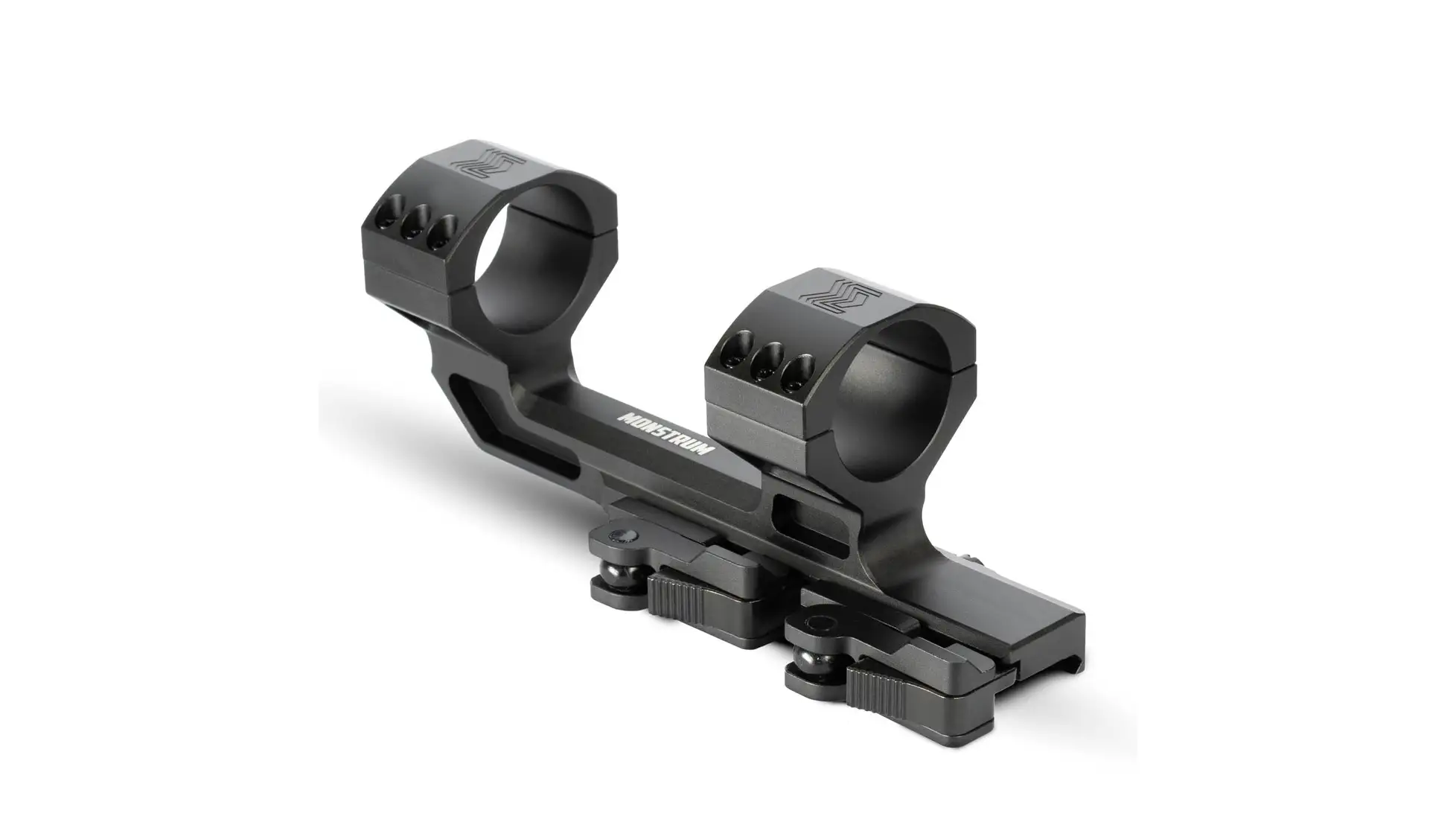
The Mechanism That Got Me Curious
Monstrum’s Hypergrip system is genuinely different from a standard QD lever. Instead of a simple cam-action lever pressing against the rail, the Hypergrip uses a precision-machined J-hook interface that locks into the Picatinny slot. The dual levers create adjustable tension, and then a separate push-button mechanism releases the entire assembly. It’s the most mechanically complex QD system in this group, and the detach-only action is almost satisfying: push the button, pull, done. I could get the mount off in about two seconds flat, which was faster than anything else I tested.
A Solid Lockup That Inspires Confidence
Once the Hypergrip levers are closed and the J-hooks are engaged, the mount doesn’t move. At all. I tried to wiggle it on the rail before firing a single round, just applying hand pressure, and there was zero play. The 6061-T6 aluminum construction is standard for this price range, but the dual-lever clamping spreads the force across a wider footprint than single-lever designs. When I ran 70 rounds through the rifle with the Monstrum mounted, point of impact stayed consistent. The cantilever design positions the scope well on an AR platform, and at 6 ounces it’s not adding meaningful weight.
Where It Falls Behind the Atibal
Return to zero is where the Monstrum’s story gets complicated. The J-hook interface is clever, but the push-button release introduces a variable that the Atibal’s simpler press-and-pull system avoids. Across ten removal cycles, the Monstrum averaged 0.35 MOA of shift, with one cycle hitting 0.5 MOA before settling back to around 0.3 on subsequent reinstalls. I think the issue is the J-hook engagement angle: it locks in from a specific direction, and if your reinstall motion isn’t exactly replicated each time, you get slight positional variation. It’s not a dealbreaker, and 0.35 MOA is still well within acceptable range for most applications. But at $170, you’re paying more than the Atibal and getting slightly less consistency where it counts most.
Speed vs. Precision Is the Real Trade-Off
The Monstrum is built for fast transitions. If your primary concern is getting the scope off and back on as quickly as possible (night vision swaps, clearing for backup sights, transport), this mechanism delivers. The push-button release is genuinely faster than any lever-only design, and the dual levers close with less effort than the UTG’s stiffer mechanism. Where I’d steer away from it is if quarter-MOA or better return to zero matters to you, because the Atibal holds that line more reliably. The Monstrum’s lifetime guarantee (covering manufacturing defects; check warranty terms for details) is a nice touch, and the overall build quality doesn’t embarrass itself at its price point. The finish held up fine through my testing, no wear marks from repeated mounting and removal.
Pricing Puts It in Awkward Territory
At $170, the Monstrum sits above the Atibal and competes with established names like Burris and Midwest Industries. The Hypergrip mechanism is genuinely innovative and the lockup is excellent, but the return-to-zero performance doesn’t quite justify the premium. If Monstrum priced this at $120 to $130, I’d be more enthusiastic about recommending it.
Field Test Data
| Test Parameter | Result |
|---|---|
| Return to Zero (10 cycles, 100 yds) | 0.35 MOA avg shift (one outlier at 0.5) |
| Detach-only Speed | ~2 sec |
| Full Cycle (detach + reattach) | ~4 sec average (fastest in test) |
| Recoil Resistance (70 rounds sustained) | No measurable POI shift |
| Installation | ~50 sec first mount / ~6 sec subsequent |
| Lockup Repeatability (10 cycles) | Within 0.5 MOA |
Tested on: Smith & Wesson M&P15 Sport II | Vortex Diamondback Tactical 4-16×44 | ~70 rounds
Pros and Cons
PROS
|
CONS
|
Performance Ratings
The Monstrum is the mount I’d reach for if I were swapping between a magnified optic and a thermal or night vision setup multiple times per session. The QD action is that smooth and that fast. But for a single-scope setup where return to zero is the primary concern, the Atibal and the 1-inch UTG setup both deliver better consistency at lower price points, and that’s hard to argue with.
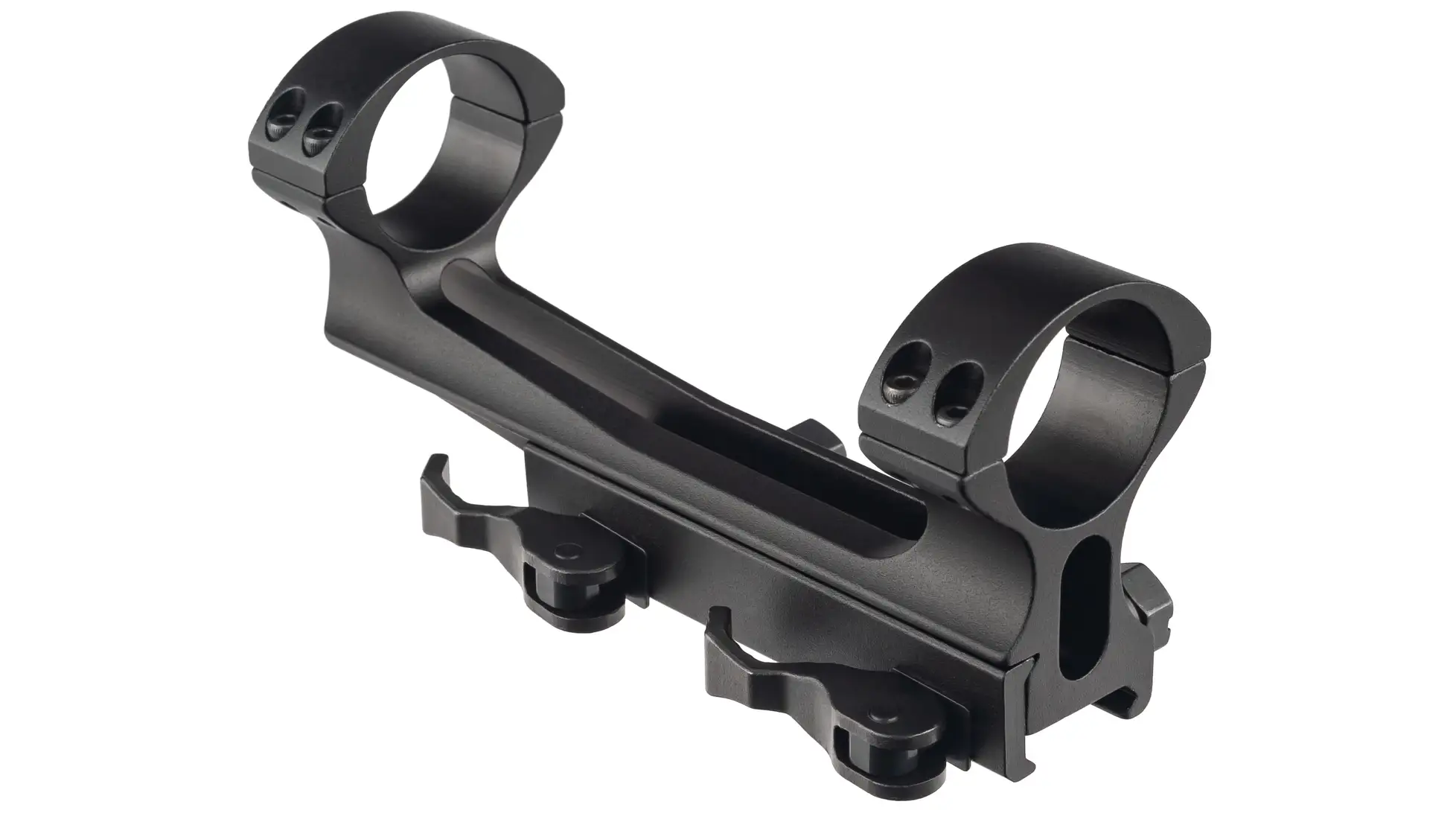
4. ATN Quick Detach Mount for 30mm Scope Tube – Best for ATN Scope Owners
Built Around an Ecosystem
ATN designed this mount to pair with their X-Sight 4K, THOR 4, and THOR LT digital and thermal scopes, and that intent is obvious from the moment you handle it. The rounded corners on the ring caps exist to protect the electronics housing on ATN optics, which protrudes slightly more than a traditional glass scope body. The dual QD levers sit at positions that don’t interfere with ATN’s battery compartment or SD card slot. If you own ATN glass, this mount accounts for details that a generic QD mount ignores. The question is whether it holds up as a general-purpose QD mount when you put a standard scope in it.
The Screw Situation
I seated my Vortex Diamondback Tactical into the rings and started tightening the cap screws. At 25 inch-pounds on my torque driver, one of the four screws on the rear ring started to feel soft. I backed off immediately. Because ATN only calls the material “hardened aluminum” without specifying the grade, its unspecified alloy makes a direct thread-resilience comparison to the 6061-T6 models impossible. I got the scope mounted securely by working the screws in a cross pattern and stopping just short of 25 in-lb, but the margin for error is narrower than I’m comfortable with. On the other three mounts in this test, I followed manufacturer torque specs without a second thought. Here, I was babying the hardware.
QD Performance Is Adequate, Not Impressive
The dual QD levers function. They lock, they release, they can be tension-adjusted. Compared to the Atibal’s oversized press-button levers or the Monstrum’s J-hook mechanism, the ATN’s levers feel like an afterthought bolted onto what is fundamentally a standard cantilever mount. They’re smaller, less ergonomic, and the tension adjustment doesn’t have the range of the other mounts in this group. Across ten removal cycles, the ATN averaged 0.5 MOA of return-to-zero shift, with the widest observed shift at nearly 0.7 MOA. For a scope that lives on one rifle and rarely comes off, 0.5 MOA is manageable. For frequent swapping between platforms (which is literally what ATN markets this mount for with their profile manager feature), that drift adds up.
Seventy Rounds Revealed a Drift
Somewhere around the 50-round mark, I noticed my groups opening up slightly. I checked the mount and found the QD levers had lost a fraction of their tension. Not enough to feel loose by hand, but enough that my bore sighter showed a slight lateral shift. I retensioned the levers and the groups tightened back up. The other three mounts held their tension through their entire round count without intervention. For a mount at this price point, I’m not surprised, but it’s something you’d need to monitor if you’re running higher round counts in a session.
The ATN Tax
At $70, this mount occupies a strange middle ground. It’s more expensive than the UTG ACCU-SYNC, which outperforms it in every measurable category. The ATN’s value proposition exists almost entirely for ATN scope owners who want the ecosystem integration: rounded corners that protect the optic, lever placement that doesn’t block controls, and compatibility that’s guaranteed rather than assumed. If you’re pairing it with an X-Sight 4K or THOR 4, it makes sense as a purpose-built accessory. If you’re mounting conventional glass, the UTG does more for less.
The numbers tell the same story the range sessions did.
Field Test Data
| Test Parameter | Result |
|---|---|
| Return to Zero (10 cycles, 100 yds) | 0.5 MOA avg shift (one outlier at 0.7) |
| Recoil Resistance (70 rounds sustained) | Minor lateral shift detected after ~50 rounds |
| Ring Screw Torque Tolerance | Thread softening at 25 in-lb on one screw |
| Installation Time | 60 sec first mount / 12 sec subsequent |
Tested on: Smith & Wesson M&P15 Sport II | Vortex Diamondback Tactical 4-16×44 | ~70 rounds
Pros and Cons
PROS
|
CONS
|
Performance Ratings
If you just bought an ATN X-Sight or THOR and need a mount that’s built around those optics, this works. The ecosystem fit is real. But go in with eyes open: keep your torque conservative, check lever tension periodically, and don’t expect the same return-to-zero consistency you’d get from the Atibal or UTG.
Four QD Mounts, One AR-15, and 280 Rounds of .223
I tested all four mounts on my Smith & Wesson M&P15 Sport II at an outdoor range about forty minutes south of Dallas during the last two weeks of October 2025. Mornings started in the low 50s and warmed into the mid-70s by afternoon, which gave me some mild temperature variation without any extreme conditions. Three of the mounts (Atibal, ATN, Monstrum) are 30mm, so I used a Vortex Diamondback Tactical 4-16×44 for those three. The UTG ACCU-SYNC is a 1-inch mount, so I swapped to a Vortex Crossfire II 3-9×40 for that evaluation. Not ideal for a perfectly controlled comparison, but honest about the physical constraints of testing mounts with different tube sizes.
Each mount went through the same protocol: initial installation, leveling, and zeroing at 100 yards, then ten cycles of complete removal and reinstallation with a three-round group after each remount to measure POI shift against a marked reference target. I confirmed shift with a bore sighter before firing to catch gross errors, then verified on paper. Total round count across all four mounts came to roughly 280 rounds of Federal American Eagle .223, 55-grain FMJ: about 75 with the Atibal, 65 with the UTG, 70 with the Monstrum, and 70 with the ATN, with each mount’s ten three-round return-to-zero groups included in its per-mount count. Distances tested ranged from 100 to 200 yards.
I also ran the Burris P.E.P.R. QD 30mm and the Midwest Industries QD 30mm Mount before settling on this final four. The Burris was solid mechanically but heavier than everything else at nearly 10 ounces, and its spring-loaded QD latches didn’t lock in the closed position on my sample, which made me uneasy. The Midwest Industries mount performed well, but I kept this guide focused on the final four mounts above.
QD-Specific Mistakes That Cost You Zero Retention
Assuming All QD Levers Are Ready Out of the Box
Every adjustable QD lever ships at a factory-set tension that may or may not match your specific rail. Picatinny rails have allowable tolerance variation per MIL-STD-1913, and a lever set too loose for your rail will clamp down without actually gripping. You have to adjust the tension to your specific rifle’s rail before you trust the mount. The Atibal and UTG both performed differently on my M&P15 than they did on a friend’s Aero Precision upper; the same mount needed different tension settings on each.
Treating QD Mounts Like Permanent Mounts Between Swaps
A lot of shooters install a QD mount once and never remove it, defeating the entire purpose. If you’re never taking the scope off, a fixed mount is lighter, cheaper, and more rigid. Where people get burned is buying a QD mount “just in case” and then never actually verifying return to zero before a hunt. If you own a QD mount, you need to cycle it at the range at least once. Confirm your specific mount on your specific rail returns to an acceptable POI before you stake a hunt on it.
Swapping Between Rifles and Expecting the Same Zero
Return to zero means the mount comes back to the same position on the same rail. It does not mean your scope will be zeroed when you move it to a different rifle, even if both rifles have Picatinny rails. Rail height, receiver machining, barrel harmonics, and bore axis all differ between guns. Every platform swap requires a re-zero, period. ATN markets their profile manager feature around multi-rifle swapping, and the mount returns to a usable position but posted the widest observed shift in this test (0.7 MOA outlier; 0.5 MOA average), so confirm zero after any swap.
Ignoring Lever Tension Drift During Long Sessions
Recoil can gradually loosen QD lever tension over sustained fire. I caught this on the ATN mount around 50 rounds, but it can happen with any lever-based QD system that doesn’t have a secondary locking mechanism. The UTG’s locking levers and squared recoil stops mitigate this; the Atibal’s lever design resisted it through 75 rounds. If your mount doesn’t have locking levers, check tension every 30 to 50 rounds during an extended range session.
Disclosure
I bought all four mounts through Amazon and OpticsPlanet over the course of September 2025, paying full retail on each. The Atibal arrived in two days; the ATN took nine, which delayed the start of testing by a week. This guide contains affiliate links, and I earn a small commission if you purchase through them. That income supports future testing and content on ScopesReviews.
The Final Verdict on These QD Mounts
Ten removal cycles per mount, 280 rounds total, and about twelve hours spread across four range sessions. The Atibal Tactical Precision Lightweight 30mm QD came out on top because it did the most important thing a QD mount can do: it kept return-to-zero shift to 0.2 MOA on average across ten remounts. At its mid-tier price point, outperforming the $170 Monstrum in the one metric that defines this category made the decision simple.
The UTG ACCU-SYNC was the surprise of this test. Squared recoil stops and locking levers on a mount that costs less than a decent box of match ammo is hard to believe until you actually run it. It nearly tied the Atibal in overall score and arguably offers better value per dollar. The Monstrum Hypergrip earns its spot for shooters who need rapid optic transitions; that push-button release is the fastest QD action I’ve used. The ATN fills its niche for digital scope owners, though I wish the hardware quality matched the design intent.
Mike Fellon is the founder of ScopesReviews and an optics specialist with 15+ years in precision shooting. A former Bass Pro Shops firearms advisor and NRA-certified instructor, he’s hands-tested 200+ rifle scopes across hunting and competition. Based in Dallas, Texas.