
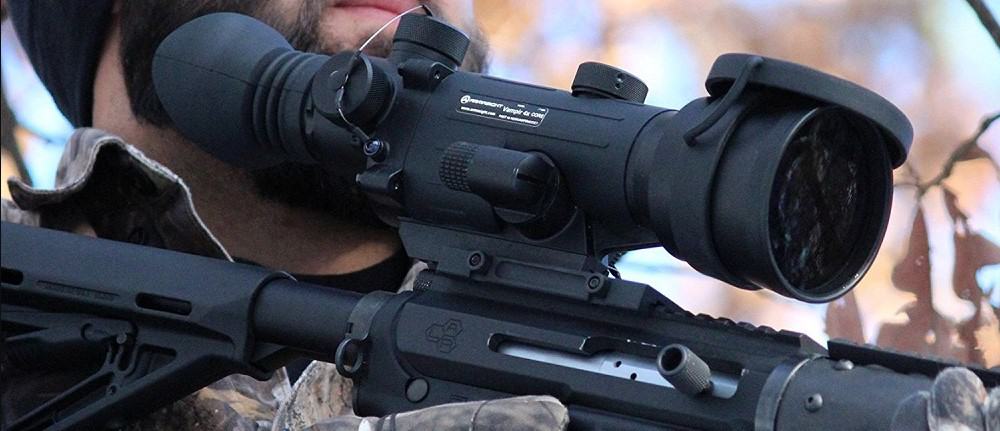
Picking a night vision scope is nothing like buying a daytime optic. With a regular scope, more magnification and a bigger objective gets you better performance, end of story. Night vision flips that on its head. Some of these scopes look great under a half-decent moon and turn into mud when clouds roll in. Others lean entirely on an IR illuminator and barely work without one. And those detection ranges on the box almost always have an asterisk attached.
So I pulled these four together, digital NV optics across price tiers, and ran them on the same rifle across multiple nights in Texas hog country. Conditions swung from a workable half-moon to thick overcast with very little ambient light. After all that, the AGM Spectrum LRF 4K came out on top, mainly because it handled the swing between lighting conditions better than anything else here.
My Top 4 Night Vision Scope Picks
Best Overall
AGM Spectrum LRF 4K 3.5-28x50mm
This one earned the top spot because of one number that doesn’t get discussed enough in spec wars: the F1.2 objective. That fast aperture sucks in more ambient light than anything else I tested, and the OLED display keeps detail that the LCD screens on the others were already smearing. The integrated laser rangefinder is the cherry on top, you stop guessing distance at night, which is half the battle on unfamiliar terrain. Yeah, it doesn’t ship with an IR illuminator, but anyone serious about night hunting was going to buy a better external IR anyway.
Best for Long Sessions and Smart Features
ATN X-Sight 4K Pro 5-20x
If you sit in a stand from dusk to 3 AM, the 18-hour battery on this thing is hard to beat. The ballistic calculator is genuinely useful if you take time to set it up properly, and the 70mm objective gathers serious light. It’s the most feature-packed scope in the group. The catch is the display resolution doesn’t keep up with the sensor and the weather sealing isn’t on par with the AGM or the RIX. Still, for shooters who want everything in one box and don’t want to fuss with batteries mid-night, it’s the obvious pick.
Best for Pressure-Shy Game
RIX Tourer T20 3.5-14x50mm
The integrated 940nm IR is the differentiator here. An 850nm illuminator throws a faint red glow that smart coyotes and educated hogs can clue in on; the 940 is practically invisible to game eyes. Combined with the IP68 rating and the lightest weight in the group, this is the scope I’d grab if I were chasing skittish predators on properties that have been worked over before. Detection range is more modest than the higher-tier options, but inside the realistic shooting envelope it stays sharp.
Best Budget Entry
SightMark Wraith 4K 4-32x40mm
Cheapest of the four and the only one that records in actual 4K, which matters if you want footage you can crop into without it looking like a potato. It’s a legitimate place to start if you’re new to digital NV and don’t want to drop a grand-plus on your first scope. The AA battery setup is its biggest weakness, you’ll burn through batteries fast on an all-night sit, and the 40mm objective shows its limits when ambient light gets thin. But for someone learning the ropes, it does the job.
Where My Night Vision Opinions Come From
My five years behind the firearms counter at Bass Pro overlapped with the years when digital NV scopes started hitting price points everyday hunters could actually consider. I watched the same pattern repeat: a customer would buy a scope based on the catalog claim, take it home, get into real Texas darkness, and bring it back two weeks later disappointed. The spec sheet said 300 yards. Their hog pasture said 120 if they were lucky.
That gap is what got me testing seriously after I left in 2020. Across 50-plus night vision optics since then, the gap hasn’t really closed. What changes is which side of it a given scope falls on. Some manufacturers quote detection under conditions you’ll see twice a month. Others quote numbers that hold up on your average overcast Tuesday. The only way to tell which is which is to mount the thing on a real rifle and run it across multiple nights with different ambient light, which is exactly what I did with these four.
Side-by-Side Specs
Quick note before you dig into the table: with night vision, the specs that get the most marketing attention aren’t always the ones that matter most in the field. Lens f-stop, display type, and IR wavelength tell you more about real-world performance than magnification range does. Keep that in mind as you scan across the rows.
| Features | AGM Spectrum LRF 4K 3.5-28x50mm | ATN X-Sight 4K Pro 5-20x | RIX Tourer T20 3.5-14x50mm | SightMark Wraith 4K 4-32x40mm |
|---|---|---|---|---|
| Magnification | 3.5-28x | 5-20x | 3.5-14x (1-4x Digital) | 4-32x |
| Objective Lens Diameter | 50 mm (F1.2) | 70 mm | 50 mm | 40 mm |
| Resolution | 3840×2160 Sensor / 1920×1080 OLED Display | 3864×2218 Sensor / 1280×720 Display | 1920×1080 Sensor / 1024×768 Display | 3840×2160 Sensor / 1280×720 Display |
| Published Detection Range | Day: 1,094 yds (1,000 m); Night: not specified | Night: not specified | 300 yds (274 m) | 300 yds (274 m) |
| Eye Relief | 55 mm | 90 mm | 50 mm | 60 mm |
| Weight | 2.6 lb (1180 g) | 2.2 lb (1010 g) | 2.1 lb (950 g) | 2.4 lb (1066 g) |
| Field of View | 8.8° x 5.0° | 5.0° | 4.8° x 3.6° | 4.0° |
| Reticle | 5 Styles, 4 Colors | Multiple Patterns & Colors, Smart Mil-Dot | Multiple Styles & Colors | 10 Styles, 9 Colors |
| IR Illuminator | Not Included (Requires External IR) | Included (Detachable IR850) | Included (Integrated 5W 940nm) | Included (Detachable 850nm LED) |
| Battery Life | Up to 11 hours (Internal/Removable 18650) | 18+ hours (Internal Li-ion) | Up to 14 hours (2x 18650 batteries) | 3.6 – 4.4 hours (4x AA batteries) |
| Waterproof Rating | IP67 | Weather resistant (no IP rating) | IP68 | IP55 |
| Video Recording | 1080p with Audio (Shot-Activated) | 1080p @ 30/60/120 fps (with RAV) | 1080p with Audio (with RAV) | 4K Resolution with Audio |
| Mount Type | 30mm Standard Rings (Requires Mount) | 30mm Standard Rings (Included) | Standard Picatinny Mount | Fixed Picatinny Mount |
The 4 Best Night Vision Scopes
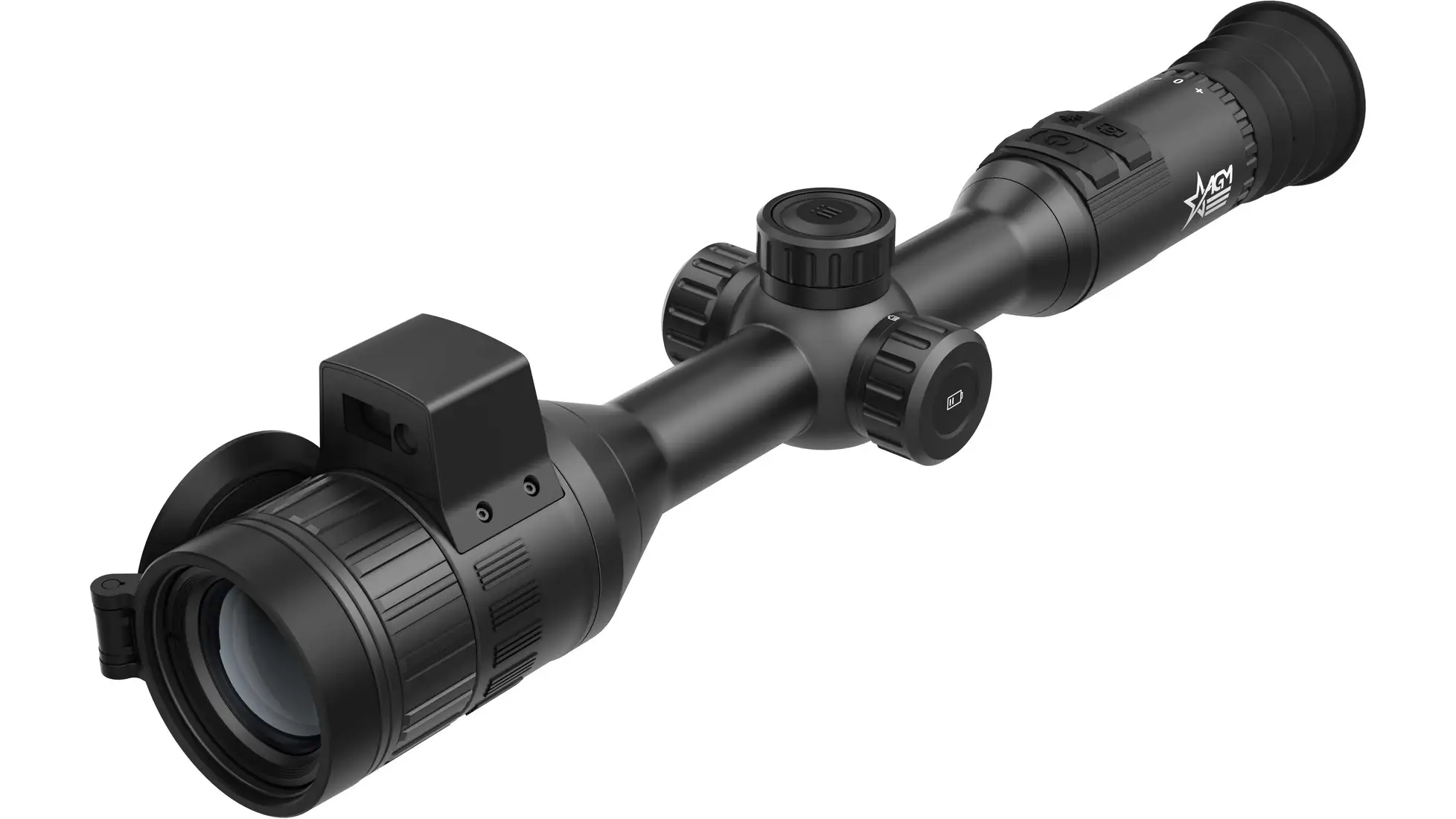
1. AGM Spectrum LRF 4K 3.5-28x50mm – Best Overall for Serious Night Hunting
That F1.2 Lens Is the Real Story
Forget every other spec on this scope for a second. The F1.2 objective is what separates this unit from everything else I tested, and it isn’t even close. The Wraith’s 40mm and the RIX’s 50mm both lag noticeably under the same starlight because their apertures aren’t gathering light at the same rate. The ATN’s 70mm objective is technically bigger, but bigger isn’t faster, and the AGM pulls in more usable photons per square millimeter than anything in the group. On the moonlit nights early in my testing window, I was running this scope on a lower gain setting and still getting a clean image. On a no-moon overcast night with very little ambient light and no external IR running, the AGM gave me something to work with when the Wraith was already mud.
OLED Made the Difference
The display story is half the night vision story. AGM put a 1920×1080 OLED on this thing while the ATN and Wraith are using 1280×720 LCDs. OLED blacks are actually black, which means you’re not staring at backlit gray when looking at a dark treeline. The contrast between a hog’s body and the brush behind it stayed legible at distances where the LCD screens had already started smearing edges together. That single design choice matters more in real hunting than the catalog spec comparison suggests.
The Rangefinder Saved Me Twice
Most people sleep on the built-in LRF as a luxury feature. A few nights with it convinced me it should be standard on any premium NV scope. Daytime, you estimate range off familiar visual cues, fenceposts, brush, ground texture. At night, all of that goes away. I had a sow at what felt like 80 yards, hit the LRF, and got 137. Held the right elevation instead of the one I’d have used by feel. Second time it mattered was a rangy boar across a cut soybean field where I’d have sworn he was 250, and the LRF gave me 188. The .300 Blackout would have shot under him if I’d trusted my eyes.
Pair It With Real IR or Don’t Bother
The big complaint people throw at this scope is that no IR ships in the box. I ran it with an external 940nm illuminator I already had, and honestly, the scope deserves that pairing. The included illuminators on the Wraith and the RIX are fine for casual work, but at this price tier you’d be downgrading the scope’s potential by sticking with whatever ships free. Budget another chunk for an aftermarket IR and you’ve got something that genuinely competes with much pricier setups.
The Catch
It’s the heaviest scope in the group at 2.6 pounds, which on a lightweight bolt gun you notice by the third hour of a sit. The 55mm eye relief is the second-shortest in the group, which on a .300 Blackout is fine but on heavy-recoiling rifles would have me thinking about mount placement carefully. And the menu system takes an evening of practice to get comfortable with in the dark. None of these are dealbreakers; they’re just the price of admission for what this scope actually does.
Here’s what the testing data looked like once I sat down to compile it.
Field Test Data
| Test Parameter | Result |
|---|---|
| Hog detection range under half-moon (no IR) | ~180 yards |
| Hog recognition with external 940nm IR (overcast) | ~240 yards |
| LRF accuracy vs laser-confirmed reference (to 300 yds) | Within ±2 yards |
| OLED edge detail in near-zero ambient | Held to ~150 yards |
| Battery life observed (continuous use, IR cycling) | ~9.5 hours |
| Cold-start to operational | ~6 seconds |
Tested on: Ruger American Ranch in .300 AAC Blackout | Conditions: Mixed half-moon and heavy overcast nights, with and without a paired external 940nm IR illuminator
Pros and Cons
PROS
|
CONS
|
Performance Ratings
The AGM is the scope I’d put on a serious hunting rifle if I were spending real money and wanted the best image my dollars could buy in the digital NV category. The included-IR gap and the weight are real, but the optical fundamentals are doing things the rest of the group can’t quite match.
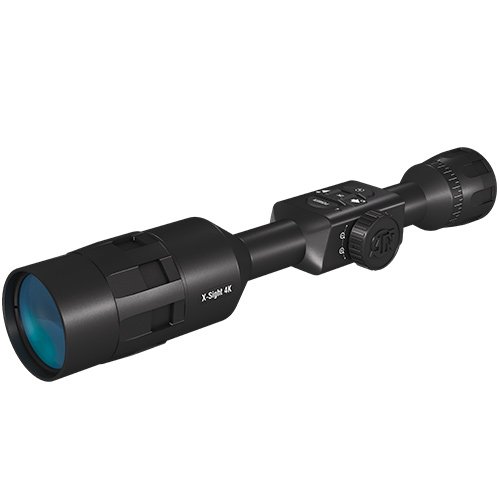
2. ATN X-Sight 4K Pro 5-20x – Best for Long Sessions and Smart Features
The Battery Life Is What I Bring Up First
18-plus hours on an internal lithium-ion is genuinely useful, not just a marketing number. I ran this thing from 7 PM until 5 AM on a hog hunt with the IR cycling on and off, and it still had charge left when I broke down at sunrise. The Wraith on its AA setup needed a battery swap somewhere between hours four and five. The RIX and the AGM both went the distance, but neither matched the ATN’s runway. For the kind of hunter who’ll sit a stand for an entire night, this is the scope. The ability to forget about battery anxiety changes how you hunt at night.
That 70mm Objective Earns Its Real Estate
The largest objective in the test by a fair margin. On a half-moon night the ATN gave me an image at 200 yards that the Wraith couldn’t quite match with its 40mm. The catch is that bigger isn’t necessarily faster, and the AGM’s F1.2 50mm still pulls in more light per square millimeter than this 70mm does. So you get a brighter base image at the cost of more glass to lug around. Worth it on most hunts, but if balance matters on a lightweight rifle, that big front end is going to make itself known.
Smart Features Help You or Get In Your Way
The ballistic calculator is real and works if you put in the time to enter your load data, environment, and reticle. Once dialed, holdovers update on your point of aim, and that’s a legitimate help on rangy night shots. The catch with most ATN smart features is the learning curve. Set it up properly and it earns its keep. Skip the setup and it actively gets in your way. The Smart Mil-Dot reticle, video recording with RAV, and dual-stream support are all useful if you lean into technology. If you don’t, the AGM keeps things simpler.
Where the Display Falls Behind the Sensor
This is the honest critique. The 4K sensor captures beautifully, but the 1280×720 LCD display you actually look through doesn’t do that sensor justice. Detail at the edges softens compared to the AGM’s OLED, and in low-ambient conditions the LCD’s backlight floor shows up as that soft gray cast on dark areas. The video files coming off the sensor are clean. What you see in the eyepiece just isn’t quite that.
The Eye Relief Was the Quiet Win
90mm of eye relief is generous, and on the .300 Blackout host rifle it was actually pleasant. The AGM and RIX both sit in the 50-55mm range, and I caught the AGM’s eyepiece more than once when settling into a quick shoulder mount in low light. The ATN gives you forgiveness on cheek weld, which matters more than I’d remembered until I went back to a short-eye-relief scope. Combined with the included 30mm rings, mounting was painless out of the box.
Here’s how the field testing broke down.
Field Test Data
| Test Parameter | Result |
|---|---|
| Battery life across overnight hunt (IR cycling) | ~18.5 hours |
| Hog detection with included IR850 (no moon) | ~175 yards |
| Hog recognition with included IR850 (no moon) | ~110 yards |
| Ballistic solver accuracy at 200 yards | Within 0.4 MOA of confirmed holdover |
| Cold-start to operational | ~4 seconds |
Tested on: Ruger American Ranch in .300 AAC Blackout | Conditions: New-moon and overcast nights using the included IR850 illuminator
Pros and Cons
PROS
|
CONS
|
Performance Ratings
For the hunter who wants every feature in one box and doesn’t want to think about batteries until next week, the ATN is the easy answer. The display ceiling is the honest compromise. If you can live with the LCD not quite matching the sensor’s ambition, you’re getting more all-in-one capability per dollar than the premium options in this test.
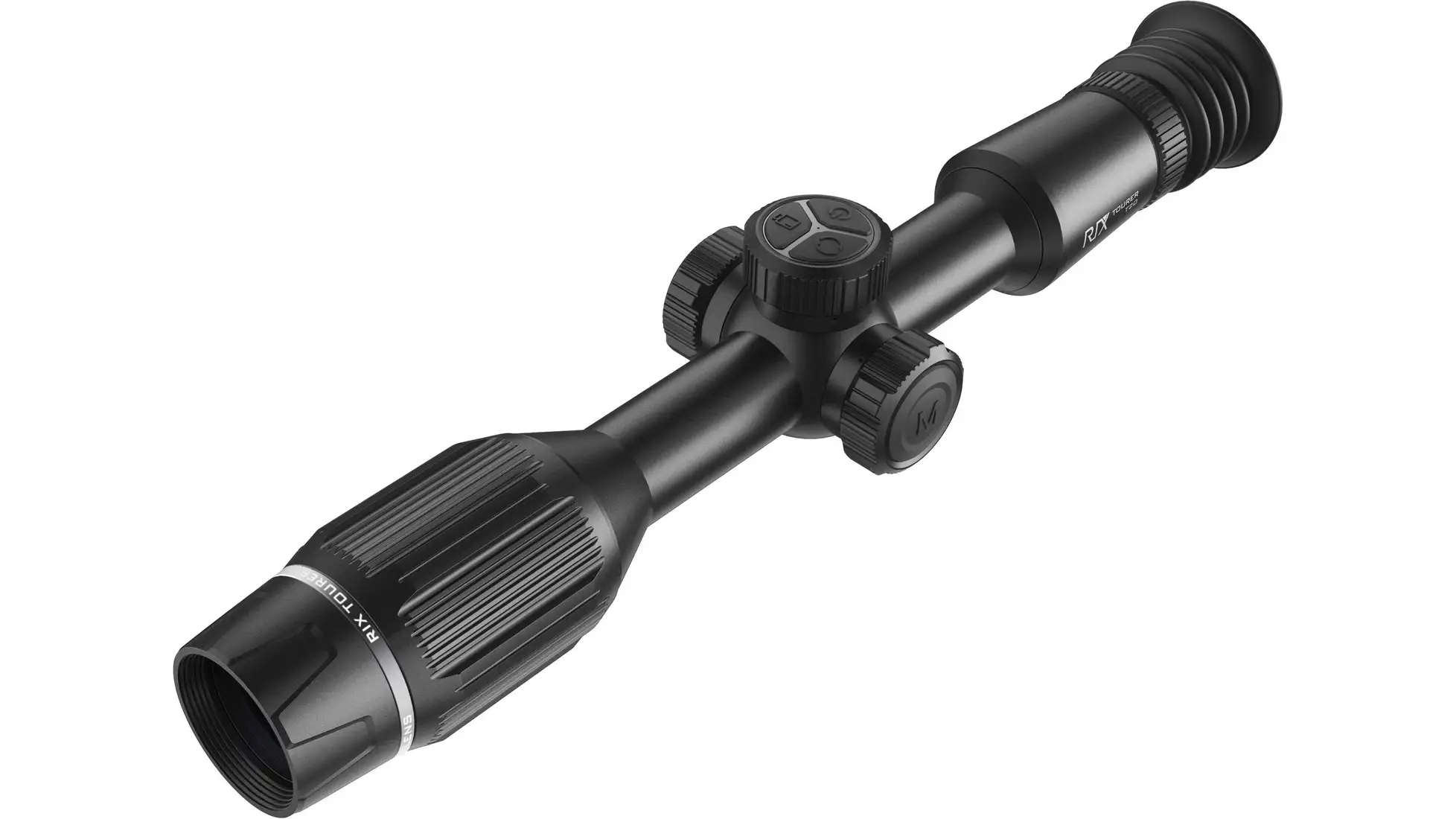
3. RIX Tourer T20 3.5-14x50mm – Best for Pressure-Shy Game
The 940nm IR Changes the Game with Pressured Animals
Here’s something that doesn’t get talked about enough: an 850nm IR illuminator throws a faint red glow that animals can absolutely see if they look directly at it. I’ve watched coyotes lock onto an 850nm beam more than once. The RIX runs an integrated 5W 940nm illuminator instead, which is essentially invisible to game. On heavily pressured properties where the coyotes have been worked over with night vision before, this is a real advantage. I called in two coyotes during my testing window on land that had seen heavy NV pressure all year, and neither showed any sign of clocking the IR. With the Wraith’s 850nm running at full power in a comparable spot the week before, the dog I called pulled up at 120 yards and refused to commit.
Lightest Scope in the Test, You Feel It
33.5 ounces is the lightest in the test by a noticeable margin. After carrying the Ruger American Ranch through cedar brakes with the AGM mounted, then switching the RIX in for the next outing, the weight difference was honest relief. On a lightweight bolt action it makes sense. The other side of the coin is that the integrated IR adds bulk on the front end, and the scope ends up a touch nose-heavy. Not a dealbreaker, but you notice it when transitioning between off-hand and rested positions.
The Sensor Resolution Is the Real Compromise
This is the honest part. The RIX runs a 1920×1080 sensor where the other three in the test use 4K sensors. Under good conditions you don’t really see the difference. In thin ambient at the edge of detection range, you do. The image gets softer faster as conditions degrade. At 150 yards under starlight with IR running, I could still identify hogs as hogs, but the level of detail the AGM was giving me at the same distance just wasn’t there. If your engagement envelope stays inside 150 yards, this won’t matter to you. Push past that and you’ll notice.
IP68 Earned Its Keep on a Wet Night
IP68 is the highest waterproof rating in the test, and on a wet night during my testing window I ran the RIX through actual steady drizzle for about an hour without thinking twice. The Wraith’s IP55 is a lower published ingress rating, and the ATN only claims weather resistance with no IP rating, so those are the two I would have treated more cautiously. The RIX shrugged it off. The 1500G impact rating is a related story: this scope is rated for serious recoil. On the mild-recoiling .300 Blackout it had zero issues across testing, and for a buyer mounting it on a .308 or .450 Bushmaster, that durability spec actually means something.
Where It Lands in the Lineup
The RIX is the scope I’d pick if I were hunting educated game on properties that get worked over. The 940nm IR keeps you genuinely invisible. The IP68 rating handles weather. The lighter weight handles long carries. But for pure image quality and detection at the outer edge of NV usable range, the AGM is still the better scope.
Field Test Data
| Test Parameter | Result |
|---|---|
| Coyote response to 940nm IR (pressured property) | No avoidance behavior observed |
| Hog recognition with integrated IR at 150 yards | Usable, detail soft compared to 4K units |
| Rain testing duration without water intrusion | 1+ hour of steady drizzle, no issues |
| Battery life observed (integrated IR running) | ~12 hours |
| Cold-start to operational | ~3 seconds (best in test) |
Tested on: Ruger American Ranch in .300 AAC Blackout | Conditions: Range of nights including starlight, light drizzle, and overcast no-moon
Pros and Cons
PROS
|
CONS
|
Performance Ratings
Curious about how the ratings get assigned? The testing methodology page spells out the whole process.
If you hunt properties that have been worked over, or you value durability and weather sealing over absolute image quality, the RIX is the right tool for the job. Just go in clear-eyed that you’re trading sensor resolution and detection-edge clarity for that covert IR advantage.
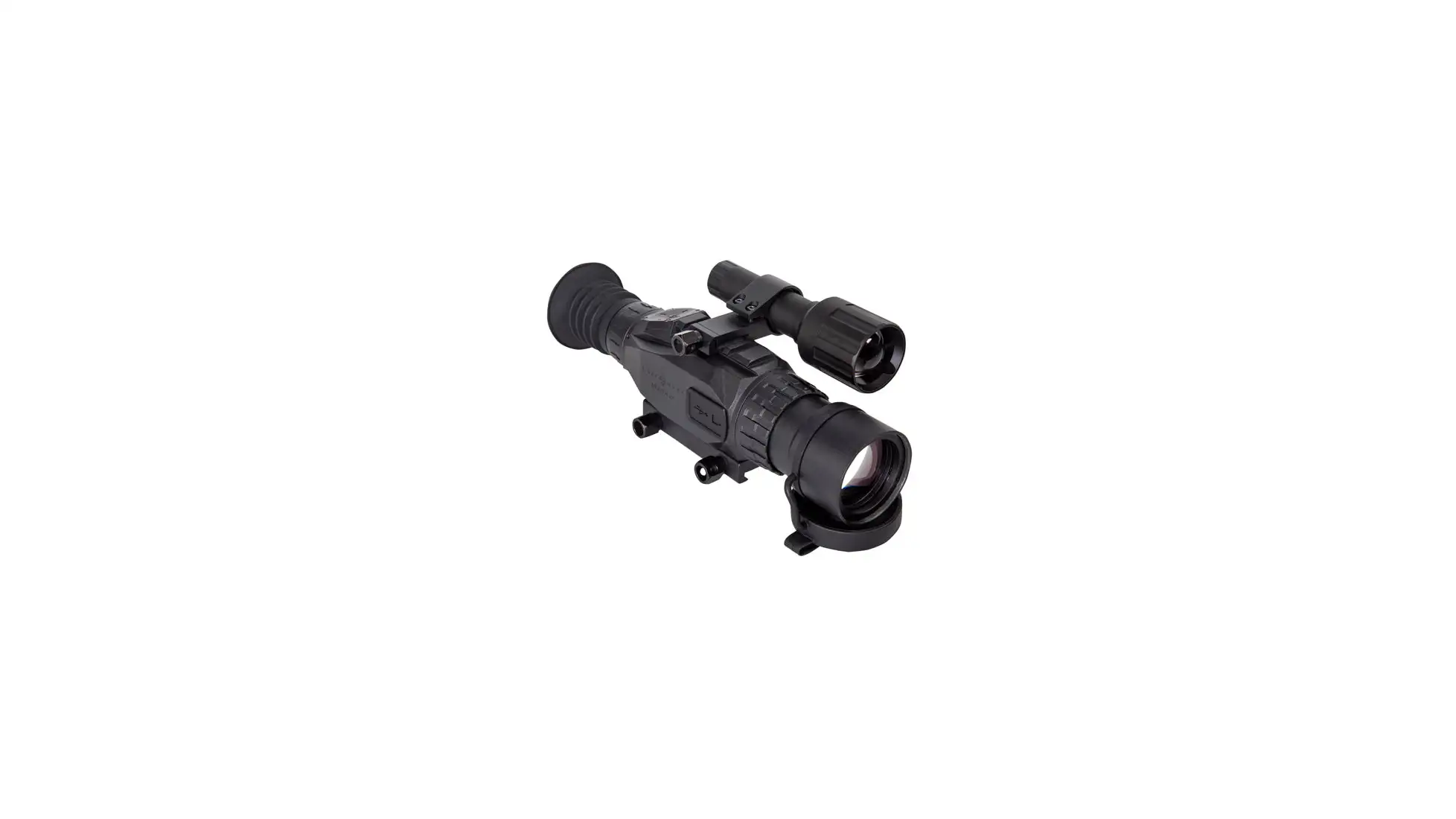
4. SightMark Wraith 4K 4-32x40mm – Best Budget Entry Into Digital Night Vision
The Budget Tier Is Where It Sits, and That’s Honest
The Wraith is the cheapest scope in this test by a meaningful margin, and that price point matters because it’s where digital NV becomes accessible to someone who isn’t sure they’re going to like it yet. For a hunter making their first foray into night work and not ready to commit a grand-plus to a setup they may not use enough, this is the sensible entry point. Just go in with realistic expectations. The Wraith does roughly half of what the AGM does, but for roughly a third of the cost. That math works for the right buyer.
4K Recording Is the One Spec Where It Wins Outright
Here’s the thing the Wraith does that nothing else in this test does: it records in actual 4K, not 1080p. The AGM, ATN, and RIX all max out at 1080p video output. If you crop into footage for social media or want to revisit shots in detail, the Wraith’s 4K files give you headroom the others don’t. This is genuinely useful for content creators or hunters who study their shots later. It’s the spec where the cheapest scope in the group quietly outperforms the rest.
AAs Are the Achilles’ Heel
Between 3.6 and 4.4 hours of battery life is what you get from the four AAs that power this thing. The ATN runs 18-plus hours by comparison, the RIX hits 12-14, and the AGM gets about 9.5 in practice. On a fall hog hunt the Wraith died between 1 and 2 AM, and I was glad I’d brought a fresh set of lithium AAs in my pack. The AA setup has one upside: spare batteries are everywhere, gas stations, feed stores, anywhere. But the burn rate is steep. Buy an external battery pack as your first accessory and the problem mostly goes away.
The 40mm Objective and IP55 Show Where the Money Went
The 40mm objective is the smallest in this test. Under a half-moon it’s still workable; under no moon and overcast, it’s the first scope where the image starts breaking down. The IR illuminator that ships in the box gets you to usable detail at maybe 100 to 120 yards, which fits the scope’s price point and is honest. The IP55 rating means it shrugs off light rain but isn’t built for a real soaking. I kept its wet-weather exposure to brief drizzle rather than the sustained rain I used to pressure-test the RIX.
The Reticle Menu Is Surprisingly Generous
One thing the Wraith does well: 10 reticle styles and 9 colors is the deepest reticle menu in the test. The AGM gives you 5 styles in 4 colors. The RIX and ATN are also flexible but neither quite this varied. For someone who likes to play with reticle setups or wants to match a specific holdover pattern to their load, the Wraith’s options are a quiet strength. Combined with a straightforward menu system that doesn’t require an evening of practice to learn, it’s the easiest scope in the test to set up out of the box.
Field test numbers below tell the rest of the story.
Field Test Data
| Test Parameter | Result |
|---|---|
| Hog detection with included IR850 (no-moon overcast) | ~110 yards |
| Hog recognition with included IR850 (no-moon overcast) | ~75 yards |
| Battery life on lithium AAs (continuous use) | ~4 hours |
| Included IR850 effective range | ~100-120 yards usable |
| Cold-start to operational | ~5 seconds |
Tested on: Ruger American Ranch in .300 AAC Blackout | Conditions: Half-moon and no-moon overcast nights using the included 850nm IR illuminator
Pros and Cons
PROS
|
CONS
|
Performance Ratings
The Wraith earns its place in this guide by being honest about what it is. Inside 120 yards on a moonlit night, with the included IR, it does the job for a fraction of what the others cost. Push it past those conditions and you’ll see why the AGM costs three times as much.
How These Four Got Their Time on the Rifle
Testing happened across three weeks during a fall window when hog activity was thick in central Texas brush country. Open senderos cutting through cedar and mesquite gave me clean shooting lanes out to about 250 yards, and the ambient light pollution was low enough that the no-moon nights actually went dark, which matters for proper testing. Lunar phase ran from a workable half-moon at the start of the window to genuine new-moon black by the middle, with one wet front rolling through late in the second week.
Each scope mounted on the same Ruger American Ranch in .300 AAC Blackout, an AR-mag-fed bolt action that’s affordable enough most hog hunters would actually own one, threaded for a suppressor, and easy enough on recoil that the optic could be the variable rather than the rifle. Every scope got at least two nights, and I rotated them across different ambient conditions: half-moon clear and no-moon overcast for the full group, plus one wet front that I used to pressure-test the waterproof-rated AGM and RIX while limiting the ATN and Wraith to brief drizzle consistent with their lesser sealing claims.
Two scopes that didn’t make this lineup are worth mentioning. The Pulsar Digex C50 was a serious candidate, but its integrated IR produced a hot spot at close range that washed out detail on hogs inside 60 yards, exactly where a lot of Texas pasture work happens. The Pard NV008S LRF gave a sharp central image, but the narrow field of view on its tube-style design made scanning brushland for moving game frustrating in a way the wider-FOV scopes here weren’t. Both are real options for certain buyers; they just lost on NV-specific compromises I couldn’t work around for the way I hunt.
If you want the full breakdown of how I assemble these tests, the testing methodology page walks through the process.
Where Most People Trip Up Buying a Night Vision Scope
Trusting the catalog detection range as universal
The number on the box is a best-case figure quoted under conditions you’ll rarely actually hunt in. A scope rated at 300 yards detection might be quoted under starlight with no obstructions and a known target shape. The same scope on a cloudy moonless night with brush in the foreground might top out at 120 yards. Always assume the catalog number is the ceiling, not the floor. Cross-check against real-world reviews and pay attention to what conditions the testers actually documented.
Treating the included IR as enough
Most IR illuminators that ship in the box are competent for casual close work and not much more. If you intend to hunt at the edge of your scope’s envelope, budget for a proper external IR illuminator from the start. The premium scopes in this test that don’t include one (the AGM) actually have the right approach: they’re built around the assumption that buyers will pair them with quality IR. Plan for that purchase rather than expecting the bundled illuminator to carry you.
Obsessing over sensor resolution while ignoring the display
Buyers see “4K sensor” on the spec sheet and assume that’s what they’ll see through the eyepiece. It isn’t. The display inside the scope is what your eye actually looks at, and if that display is 720p LCD, you’re losing a lot of what the sensor captured. The AGM’s 1080p OLED made more practical difference in this test than the sensor differences did. When comparing scopes, weight the display spec at least as heavily as the sensor.
Picking the wrong IR wavelength for your game
850nm IR throws more raw range and is what most hunters default to. The catch is that 850nm produces a visible red glow that pressured game can see if they look directly at it. If your hunting properties have been worked over with NV before, 940nm is the smarter call even though you give up some range. New properties or naive game, 850nm works fine. Pressured coyotes or older hogs, go 940nm. The RIX’s integrated 940nm earned its keep on properties where 850nm scopes were getting busted.
Questions That Come Up About Night Vision Scopes
Do I actually need an IR illuminator with a digital NV scope?
For most digital NV scopes, yes. Even with a fast lens and a good sensor, you’ll get more reach and better detail with an IR illuminator running, especially on overcast or no-moon nights. The exceptions are scopes like the AGM Spectrum LRF 4K with its F1.2 lens, which can hold a workable image in very little ambient light without IR. For the others in this test, plan on running IR most nights.
How does 940nm IR compare to 850nm?
850nm has more effective range and produces a slightly brighter image because digital sensors are more sensitive to it. The catch is the visible red glow that pressured game can see. 940nm is essentially invisible to most animals but gives up some effective range. For properties that get hunted with NV regularly, 940nm is the smarter call. For new properties, 850nm gets the job done.
Can I use a digital NV scope during the day?
Yes. All four scopes in this test work as full-color day scopes, which is actually a major advantage of digital NV over analog tube-based units. You can leave a digital scope mounted year-round and switch between day and night modes as needed. Tube-based NV (Gen 2, Gen 3) typically can’t handle bright daylight without damaging the tube.
What’s the realistic effective range of digital NV at night?
For these four scopes with proper IR, expect reliable detection between 150 and 250 yards depending on the unit and conditions. Recognition (knowing what species you’re looking at) drops to about half of detection. Identification (telling boars from sows, or distinguishing specific animals) drops further. Marketing usually quotes detection. Plan your shooting envelope around recognition or ID range, not detection.
Which Scope Actually Fits How You Hunt After Dark
When pure image quality matters most. The AGM is the right pick when image quality is the primary criterion and you understand that night vision is a system, not just a scope. Budget for an external 940nm or high-power 850nm IR alongside the scope itself. The F1.2 lens, OLED display, and built-in LRF combine to give the best image in the digital tier. The catch is weight and the second purchase, but if either is a dealbreaker, this price tier probably isn’t where you should be shopping.
For the all-night sit hunter. Pick the ATN if you need every feature in one box and you sit stands from dusk to dawn. The 18+ hour battery solves the biggest practical problem of long hunts, and the included IR850 saves a separate purchase. You give up display resolution and proper weather sealing for that all-in-one capability. If you’re someone who’d rather wait out the hogs than chase them, this is your scope.
The covert IR tradeoff. The RIX makes sense in one specific scenario: pressured game on properties that have been hunted with night vision before. The 940nm integrated IR is genuinely invisible to coyote eyes in a way the 850nm units aren’t. You give up some sensor resolution and detection-edge clarity to get that invisibility. If your properties are new or your game isn’t NV-educated yet, the tradeoff doesn’t pay off and you’re better with the AGM or ATN.
When the budget entry is the right call, and when it isn’t. Choose the Wraith if you’re new to digital NV and not sure you’ll hunt enough nights to justify a serious investment. Inside 120 yards on a moonlit night, it does the job at an accessible price. Don’t choose the Wraith if you plan to push 200+ yards or hunt no-moon overcast nights regularly, the 40mm objective and IP55 rating will frustrate you fast. As an introduction to NV, it works. As a primary serious-hunting setup, it’ll hit its limits within a season.
Disclosure
Affiliate links appear in this guide. If you click through to Amazon or OpticsPlanet and buy something, the site earns a small commission at no added cost to you. For this specific review, I ordered the AGM Spectrum LRF 4K and the RIX Tourer T20 specifically for testing and paid for them out of pocket. The ATN X-Sight 4K Pro and the Sightmark Wraith 4K were already on my test bench from earlier work. Nobody at any of these brands had editorial input into the rankings or even knew the guide was being written. The AGM earned its top spot through what its F1.2 lens and OLED display actually delivered across a wet October night and three no-moon sits on Texas hog country.
What Matters Once the Sun Goes Down
Night vision scope selection comes down to honest matching of capability to use case. The AGM Spectrum LRF 4K earned the overall top spot through optical fundamentals: F1.2 lens, OLED display, built-in LRF, IP67 sealing. If you’re spending serious money and want the best image, that’s where it goes. The ATN X-Sight 4K Pro is the feature-and-endurance leader and the right pick if you sit stands all night with a need for a complete out-of-the-box setup. The RIX Tourer T20 is the covert specialist for pressured game on properties that have seen NV before. The Sightmark Wraith 4K is the accessible entry that lets you learn whether you’ll like night hunting enough to invest further.
The thread running through this whole test is that detection range numbers on the box are starting points, not landing places. A scope rated at 300 yards is rated under specific ambient conditions you may or may not encounter on any given night. Match the technology to your actual darkness, not to the marketing copy.
Pick the scope that fits how you actually hunt, not how the catalog tells you to hunt. The four units here all have legitimate use cases. The question isn’t which is best in some abstract sense; it’s which one matches what you’re going to put it through. Get that right and you’ll get years of good service. Get it wrong and you’ll be writing a return email by week three.
Mike Fellon is the founder of ScopesReviews and an optics specialist with 15+ years in precision shooting. A former Bass Pro Shops firearms advisor and NRA-certified instructor, he’s hands-tested 200+ rifle scopes across hunting and competition. Based in Dallas, Texas.
I bought one of your night/day scope on December 23 2019 and haven’t heard a thing about when I will receive it. Any help with this matter would be appropriate. Thank you
Hello, I only test and recommending scopes, not selling them. If you ordered from Amazon or Opticsplanet to which I have links, contact them.
can coyotes see projected infrared and be scared off?
There is conflicting info on the subject, but most probably – no.