
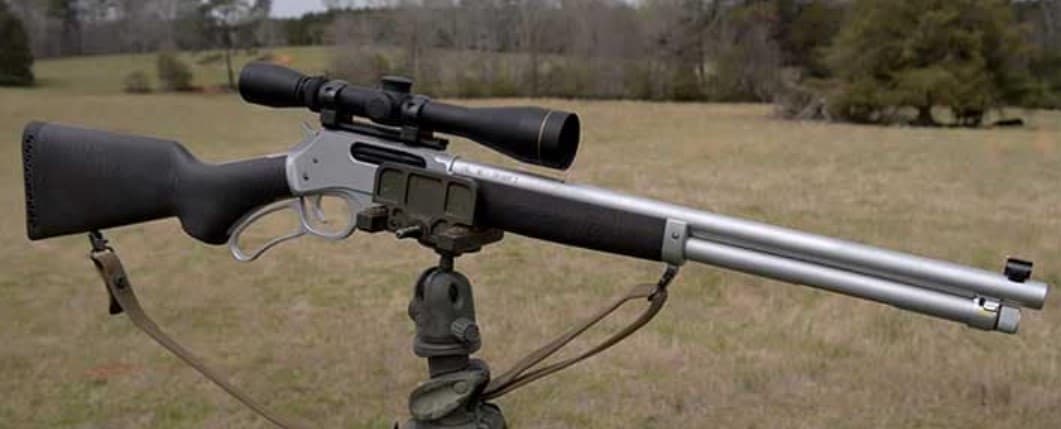
Walk into any deer camp in bear country and you’ll find Marlin 1895s leaned against the wall along with a few hunters wearing crescent-shaped scars above their eyebrows. The .45-70 punishes both ends of the rifle in ways the .308 crowd never has to think about. Short eye relief plus a 405-grain projectile produces results that look like a bar fight. Mediocre scope internals don’t survive the sharp recoil impulse of a heavy lever gun, either.
The real challenge isn’t picking glass that resolves elk at 600 yards, since you won’t be making that shot with this cartridge anyway. The challenge is picking glass that survives the rifle and respects your face. I tested four scopes this past fall on a Marlin 1895 SBL with that specific problem in mind, and the Burris Scout 2-7×32 took it by a wider margin than I expected.
My Top 4 Picks for the .45-70
Best Overall
Burris Scout 2-7×32
While originally designed for the bolt-action Scout Rifle concept, a forward-mounted optic is exactly what a heavy-hitting .45-70 wants. The generous eye relief completely eliminates the risk of a bashed eyebrow under heavy recoil, and at just 13 ounces, it preserves the Marlin’s famously quick handling. The 2-7x magnification range perfectly covers every realistic shot you’ll ever take with this brush cartridge. It might not be the absolute fanciest glass in the lineup, but it is undeniably the most appropriate setup for the platform.
Best for Brush and Low Light
Trijicon AccuPoint TR24 1-4×24
Battery-free illumination via fiber optic and tritium means the triangle post lights up automatically as ambient light drops, which is when most .45-70 work actually happens. Built like a tank, holds zero through anything, and the 1-4x range covers the cartridge’s effective envelope. The 3.2-inch eye relief is the only thing keeping me from putting it higher.
Best for Tactical Lever Gun Builds
Vortex Viper PST Gen II 1-6×24
Premium LPVO with illuminated MOA reticle and excellent glass. The catch is weight, almost 23 ounces, which fights against everything a lever gun is supposed to be. If you’re running a tricked-out modern lever build and want one scope that can do brush work, target shooting, and the occasional speed drill, this is your pick.
Best Budget Pick
Vortex Crossfire II 2-7×32
You won’t find a better scope at this price tier for someone who just wants to get a scope on their Marlin and hunt. The Dead-Hold BDC is workable for the cartridge’s rainbow trajectory, the build holds up to the recoil, and you’ll have enough left over for a year of ammo. Glass isn’t a standout, but it doesn’t need to be at these ranges.
Why I Can Tell You What Holds Up on a .45-70
Big-bore lever guns wreck scopes that bolt-action magnums leave intact. The recoil impulse from a Marlin 1895 isn’t the long sustained shove of a .300 Win Mag, it’s an abrupt, sharp slap that walks reticles, cracks lens cement, and shakes internal mechanisms loose in patterns I’ve watched recur often enough to stop assuming a scope’s general durability rating translates over. Some scopes that handle a .375 H&H just fine come apart on a .45-70 inside fifty rounds. The opposite happens too: cheap scopes I’d written off have surprised me on these rifles.
Across the past several years I’ve mounted scopes for .45-70 owners more times than I can count, both during my Bass Pro days and since starting ScopesReviews. Picatinny rails on the new Ruger-made Marlins have made mounting easier, but they’ve also encouraged folks to throw whatever LPVO they had lying around onto these guns, and the failure rate from that approach is something I have strong opinions about. This guide reflects a winter spent mounting and shooting all four of these scopes on the same Marlin 1895 SBL, with the same Hornady ammo, until my shoulder told me to stop.
Side-by-Side Specs
Before the table, one thing worth mentioning: for .45-70, the specs that matter most are eye relief, weight, and tube/mounting compatibility with your rifle. Magnification and adjustment range matter less than the marketing suggests, because you’re not dialing for distance with this cartridge.
| Features | Burris Scout 2-7×32 | Trijicon AccuPoint TR24 1-4×24 | Vortex Viper PST Gen II 1-6×24 | Vortex Crossfire II 2-7×32 |
|---|---|---|---|---|
| Magnification | 2-7x | 1-4x | 1-6x | 2-7x |
| Objective Diameter | 32 mm | 24 mm | 24 mm | 32 mm |
| Eye Relief | 9.2″ – 12.0″ | 3.2″ | 3.8″ | 3.9″ |
| Weight | 13.0 oz | 14.4 oz | 22.7 oz | 14.3 oz |
| Length | 9.7″ | 10.3″ | 10.8″ | 11.5″ |
| Tube Size | 1 inch | 30 mm | 30 mm | 1 inch |
| Reticle | Ballistic Plex (SFP) | Triangle Post (SFP) | VMR-2 MOA (SFP) | Dead-Hold BDC (MOA, SFP) |
| Field of View | 23.0 – 8.0 ft @ 100 yds | 94.2 – 24.1 ft @ 100 yds | 112.5 – 18.8 ft @ 100 yds | 42.0 – 12.6 ft @ 100 yds |
| Turret Style | Capped | Capped | Capped | Capped |
| Adjustment Range | 66 MOA Elevation / 66 MOA Windage | 90 MOA Elevation / 90 MOA Windage | 160 MOA Elevation / 160 MOA Windage | 60 MOA Elevation / 60 MOA Windage |
| Click Value | 1/4 MOA | 1/4 MOA | 1/2 MOA | 1/4 MOA |
| Parallax Adjustment | Fixed at 100 yds | Fixed | Fixed at 100 yds | Fixed at 100 yds |
| Illumination | No | Yes, Fiber optics & tritium (battery-free) | Yes, 10 settings | No |
The 4 Best .45-70 Scopes
1. Burris Scout 2-7×32 – Best Overall
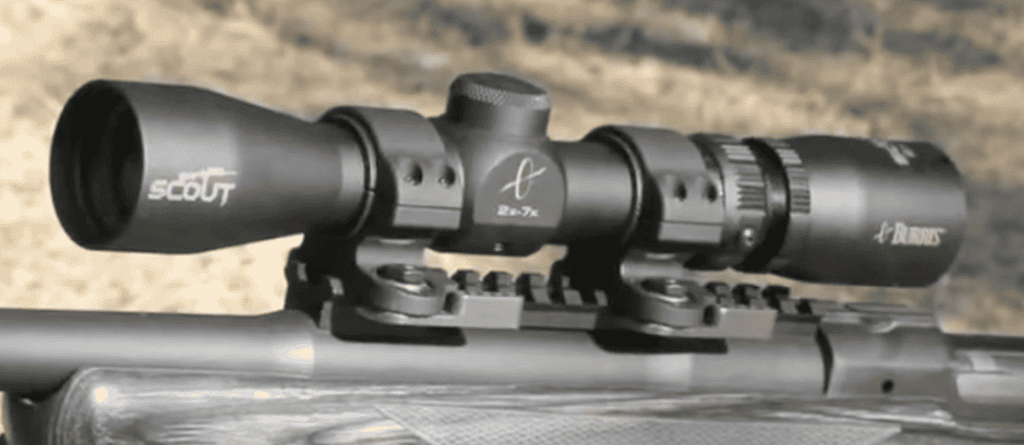
The Burris Scout was the only scope in this test I mounted forward of the receiver, and that’s the entire reason it won. The Marlin 1895 SBL’s Picatinny rail extends ahead of the action specifically to accommodate scout-style mounting, and the Burris drops into that role like it was custom-fitted. With the scope sitting over the barrel about an inch behind the rear sight, my cheek welds to the stock the way it would with iron sights, my head stays upright, and there’s nothing within ten inches of my face when the .45-70 reminds me what 1873 felt like.
Mounted Forward, Where It Was Born to Live
The first time I shouldered the rifle with the Burris in scout position, my brain wanted to dial up the magnification because the eyebox felt different from what I’m used to. Then I remembered I was supposed to be running it at 2x with both eyes open. That’s the whole point. Scout scopes work by giving you a low-magnification image with massive eye relief that lets you shoot like you would with a red dot but with actual glass when you need it. Pull the trigger on full-house Hornady loads and the scope just rides forward with the rifle’s movement. No fear, no flinch, no worrying about where my face is. After two sessions with the other three scopes mounted traditionally, the contrast was almost startling.
The Ballistic Plex Earns Its Keep at Sundown
The Ballistic Plex gets dismissed a lot in long-range circles because its holdover marks are calibrated for flatter cartridges, but for a .45-70 it works out more usefully than you’d think. The main crosshair zeroed at 100, the first hash gave me a reasonable hold for moderate distances, and anything beyond the next hash down is honestly farther than I’d shoot a hog with this cartridge anyway. Black reticle on dim brush isn’t ideal, and I missed having illumination during the last twenty minutes of legal light on a few evenings. That’s the trade-off for going battery-free. If illumination is a priority for your setup, my best illuminated reticle scopes guide covers the dedicated options. The Trijicon would beat it in that one specific window, but for most of the day the Plex is just fine.
13 Ounces That Don’t Wreck the Carry
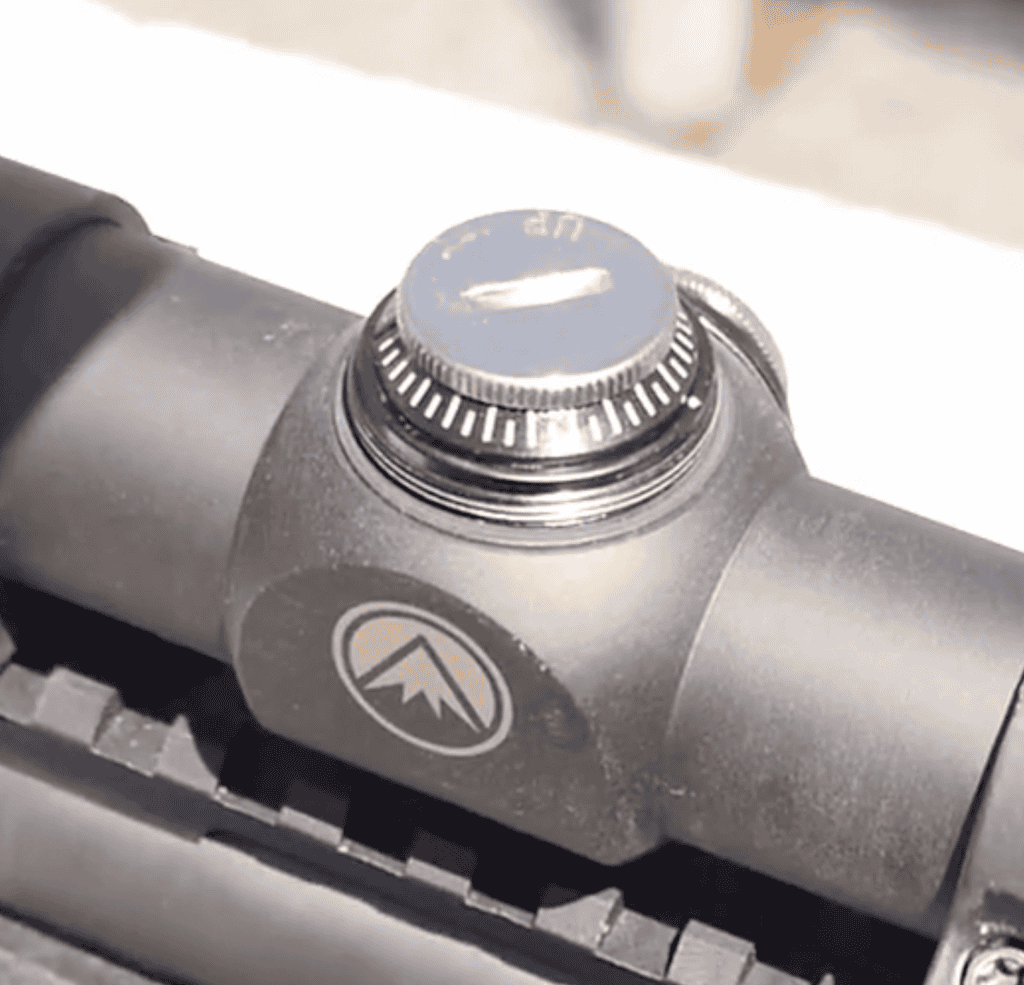
The Marlin SBL weighs about 7.3 pounds bare. Bolt the Vortex Viper PST Gen II to it with rings and you’re just over 9 pounds, which is enough to change how the rifle handles. The Burris kept the whole package light enough that I could carry it one-handed across uneven Hill Country terrain without thinking about it. After a couple long stalks through cedar breaks, that mattered more than I expected. A scoped Marlin should still feel like a Marlin, not like a deer rifle in a costume.
Where the 32mm Objective Shows Its Limits
Optical performance is the honest weakness. The 32mm objective is fine in good light, but at last shooting light the image gets soft around the edges and contrast drops noticeably. The Trijicon’s glass is brighter at sundown, and even the Viper’s is sharper across the center. If you hunt mostly at dawn and dusk in heavy timber, you’ll feel this. For midday range work, brush hunting in normal light, or hog hunting where you can use a light, the glass is plenty.
Survived the Hornady Beating
After roughly 60 rounds of Hornady LeverEvolution 325gr FTX, plus the abuse of removing and re-mounting it twice to test different rings, the Burris held zero perfectly. No tracking issues, no fogging during a 35-degree Texas morning, no problems. That matters as much as anything when you’re picking glass for a cartridge that breaks scopes.
Here’s how the testing data shook out:
Field Test Data
| Test Parameter | Result |
|---|---|
| Recoil zero retention (60 rounds, full-power loads) | No POI shift detected |
| Cold-bore fog resistance at 35°F | No internal fogging |
| Target acquisition from low ready at 2x | ~1.2 seconds average |
| Eye relief verification at full magnification | Confirmed 12″ with room to spare |
| Re-mount zero retention (two ring swaps) | Held within 1/2 MOA each time |
Tested with: Marlin 1895 SBL | Hornady LeverEvolution 325gr FTX
Pros and Cons
PROS
|
CONS
|
Performance Ratings
This is the scope I’d put on a first-time .45-70 buyer’s Marlin without hesitation. The scout-mount design isn’t a compromise, it’s the right answer for this cartridge on this platform. Pick it, don’t overthink it, go hunt.
2. Trijicon AccuPoint TR24 1-4×24 – Best for Brush and Low Light
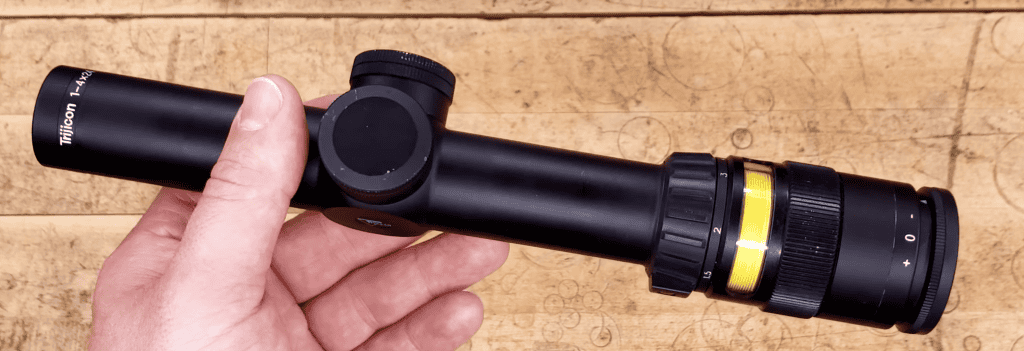
If the Burris hadn’t been in this test, the Trijicon would have won by a different route. Battery-free illumination is the killer feature. The triangle post lit up red automatically every time I moved from open pasture into cedar shade, and it stayed visible through the last shooting light without me ever touching a dial. Tritium handles the dim, fiber optic handles the bright, and the transition is seamless. For a cartridge you take into thick country at sunrise and sunset, that’s enormously useful.
Battery-Free Illumination That Reads the Light for You
I’ve used scopes with electronic illumination for years and I’d still rather have what Trijicon built into the TR24. There’s no button to fumble for, no battery to remember to swap, no chance of finding a dead reticle when you actually need it. On the third evening of testing, I came out of the woods at last legal light and realized the triangle had been lit the whole stalk without me thinking about it once. That’s the experience the engineering is designed to produce, and it earns the price tag in this one specific area.
The Triangle Post Earns the Cartridge
A lot of hunters look at the triangle post and assume it’s too coarse for serious work. On paper that’s true. For a .45-70 throwing a 325-grain bullet at a hog at 80 yards, it’s exactly right. The point gives you a precise aim mark when you need it, but the bulk of the triangle pulls your eye to center the way good combat reticles do, and that’s how this cartridge gets used in the real world. Compared to the Vortex Viper’s busy MOA tree, the triangle post is faster onto target by a noticeable margin every time.
Why That 3.2-Inch Eye Relief Made Me Nervous
Here’s where it earns the second-place finish instead of first. Mounted traditionally on the Marlin, 3.2 inches of eye relief is about as little as I’d want with hot Hornady FTX loads. I set my eye position carefully and never took a hit, but on a couple of shots I could feel the ocular bell whisper past the brim of my hat, and that’s a margin I don’t love on a .45-70. If you’re running 300-grain reduced loads or shooting mostly from a bench, you’ll be fine. If you’re a brush hunter who shoots offhand from awkward positions, that short eye relief is going to bother you.
Built Like Something That Will Outlive You
The TR24’s housing feels almost overengineered. After 50 rounds of full-power loads and a deliberately rough mounting cycle, point of impact didn’t move enough for me to measure. Every adjustment click has weight behind it, the magnification ring is firm without being stiff, the housing has no flex anywhere I could find. The build quality alone explains a chunk of the price difference between this and the Vortex Crossfire II, even though both are SFP scopes with capped turrets.
What It Costs You
The 90 MOA of total adjustment is more than you’ll ever need on a .45-70 in any reasonable use case, so the adjustment range is wasted money. The 24mm objective gathers a touch less light than the Burris and Vortex Crossfire II’s 32mm objectives, though the better Trijicon glass coatings make up most of the difference. The real cost is paying premium money for features that only partially apply to how this cartridge gets used.
Field Test Data
| Test Parameter | Result |
|---|---|
| Illumination transition test (sun to deep shade) | Seamless, no manual input needed |
| Recoil tolerance (50 rounds Hornady FTX) | Zero held throughout |
| Box drill tracking accuracy (20 MOA) | Returned to zero, no measurable drift |
| Pre-dawn glass clarity test (15 min before sunrise) | Usable image, surprisingly bright for 24mm |
| Eye relief stress check at low light | Tight margin, occasional hat-brushing |
| Magnification ring smoothness in cold | Firm but no binding at 28°F |
Tested with: Marlin 1895 SBL | Hornady LeverEvolution 325gr FTX
Pros and Cons
PROS
|
CONS
|
Performance Ratings
An excellent scope that happens to be slightly mismatched to the .45-70. If you’re willing to pay premium money for build quality that will last for decades, plus illumination that just works without thinking, the Trijicon delivers in those specific areas better than anything else here. But you’re paying for features that this caliber only partly needs, and the short eye relief is a real concern with full-power loads.
3. Vortex Viper PST Gen II 1-6×24 – Best for Tactical Lever Gun Builds
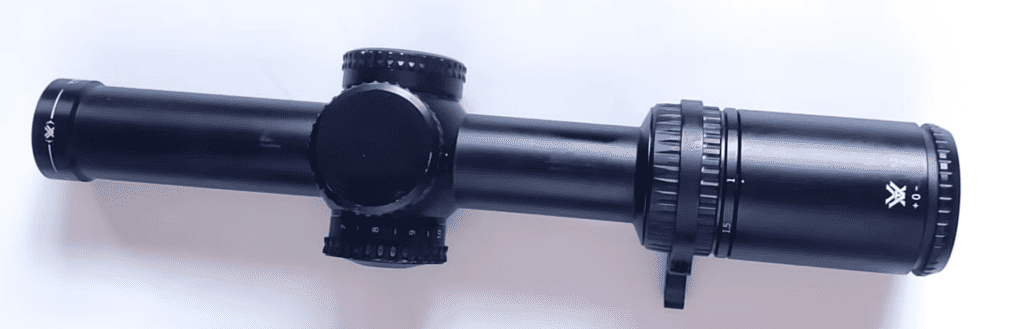
The Viper PST Gen II is a great scope built for a different rifle. Vortex designed this generation as a serious LPVO for AR-platform tactical use, and the upgrades from the original PST are real, improved glass coatings, brighter daytime illumination, smoother turret clicks, and a reticle redesign that genuinely helps fast holdover work. All of that translates to a Marlin 1895 SBL in technical terms, and not very well in practical ones.
What Gen II Actually Improved
I owned a first-generation PST years ago, and the differences here are easy to feel. The illumination on the daytime-bright settings actually pops against bright Texas sky now, which the original couldn’t manage. The clicks have a more positive feel, no mushiness. The VMR-2 reticle is cleaner than the original PST reticle and faster to read at speed. If you’re running a 5.56 carbine for competition or general-purpose work, this is one of the best LPVOs at its price point. The trouble is that almost none of those improvements pay off on a .45-70.
Almost a Pound and a Half of Glass on a Lever Gun
Here’s the problem. The Viper PST Gen II weighs almost 23 ounces, which is heavier than the next-heaviest scope in this test by more than a third. On a 7.3-pound Marlin SBL, you’re adding more than 10 percent to the rifle’s weight with the scope alone, never mind the rings. The Burris Scout in the same role added about a quarter of that. After two hours of carrying the Viper-equipped Marlin around the property checking hog wallows, I was actively missing how the rifle handled with the lighter scopes. A Marlin should feel quick. With this scope mounted, it doesn’t.
The VMR-2 Asks You to Do the Math
The VMR-2 MOA reticle is a precision tool. Elegant holdover marks, ranging brackets, windage references. For a 6.5 Creedmoor PRS shooter, that’s gold. For a .45-70 hunter, most of those references are calibrated for trajectories your bullet doesn’t share. You’ll either learn custom holdovers for the cartridge or you’ll just shoot center crosshair and treat the rest of the reticle as decoration. The Burris Plex and Trijicon triangle post both give you cleaner holds without requiring homework first.
Tracking Nobody Will Use
The Viper has 160 MOA of total elevation, which is more than 2.4 times what the Burris offers and almost three times what the Crossfire II provides. Even the smallest of those numbers is more than a .45-70 needs for any shot a hunter would ethically take. You’re paying for engineering you’re never going to exercise. The clicks themselves are crisp, the returns-to-zero are perfect, the tracking is honest. None of that helps you on a Marlin.
When This Scope Makes Sense Anyway
If you’re building a modern lever gun as a multi-purpose rifle, doing some 100-yard target work, occasional brush hunting, maybe lever-action competition, the Viper PST Gen II’s flexibility starts paying off. The daytime-bright illuminated reticle handles bright pasture and shaded cedar equally well. The glass is genuinely the best in this test, edge to edge. If you can live with the weight and you want one scope for a rifle you’re going to use in varied ways, the Viper is defensible. For a pure hunting Marlin, you’ve bought too much scope.
The numbers from testing:
Field Test Data
| Test Parameter | Result |
|---|---|
| Recoil retention (40 rounds Hornady FTX) | Zero held; no internal movement |
| Low-light glass clarity comparison | Best in test, edge to edge |
| Daytime illumination visibility (bright sky) | Visible at top settings against direct sun |
| Rifle weight increase with scope and rings | +1.75 lbs over bare rifle |
Tested with: Marlin 1895 SBL | Hornady LeverEvolution 325gr FTX
Pros and Cons
PROS
|
CONS
|
Performance Ratings
Honestly the best-engineered scope in this test, just on the wrong rifle. If you’re putting this on a 5.56 carbine or pairing it with a 6.5 Creedmoor, you’ve made an excellent choice. On a .45-70 lever gun, you’ve bought premium features you can’t use, added weight you don’t want, and gotten a reticle calibrated for a different trajectory.
4. Vortex Crossfire II 2-7×32 – Best Budget Pick
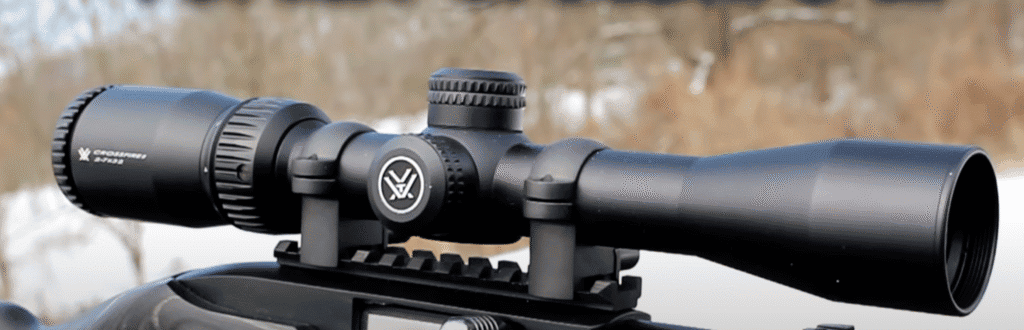
The Crossfire II is the only scope in this test priced under $200, and that context shapes everything I’m about to say. Compared to the Burris Scout it falls short on eye relief geometry, compared to the Trijicon it falls short on build, and compared to the Viper PST Gen II it falls short on optics. The right question, though, isn’t how it stacks against scopes that cost three to six times more. It’s whether it works on a .45-70 for someone who doesn’t want to spend up. The answer is yes.
What a Budget Price Tag Actually Buys You
A capped-turret, second-focal-plane scope with a usable BDC reticle, 60 MOA of total adjustment, and a build that survived 50 rounds of full-power Hornady through the Marlin without losing zero. That’s the package. No illumination, no zero-stop, no high-end glass, no battery to monitor. The Vortex VIP lifetime warranty backs it up if something does fail, which I appreciate more on a budget scope than a premium one. The Crossfire II doesn’t pretend to be anything it isn’t, and on a Marlin used for hog hunting or deer in heavy timber, that’s enough.
Dead-Hold BDC for a Cartridge It Wasn’t Designed For
The Dead-Hold BDC was calibrated for flatter cartridges, same trouble the Burris Plex has. On a .45-70, the lower hash marks correspond to distances you wouldn’t ethically shoot anyway, so you basically zero with the main crosshair at 100 and use the first hash for moderate distance work. Not elegant, but workable. The reticle is crisp at 7x and the open spaces around the crosshair give you visibility through brush. Compared to the Viper’s busy VMR-2, the Dead-Hold is actually more usable for typical .45-70 work even though it’s the much cheaper reticle.
The Eye Relief Surprise of the Group
Here’s something I didn’t expect: the Crossfire II has the longest eye relief of the three traditional-mount scopes in this test at 3.9 inches. That’s a tenth more than the Viper and seven-tenths more than the Trijicon. On a .45-70 that punishes scope-eye carelessness, that’s not nothing. I never had face contact concerns running the Crossfire II, and after a full session of full-power loads I wasn’t favoring my face the way I caught myself doing with the Trijicon. For a budget scope to win the eye relief comparison among the traditionally-mounted options is genuinely useful.
Glass That Won’t Win Awards
The image is fine, not great. At 7x in good light the picture is sharp enough. In low light it falls off noticeably, more than the Trijicon and quite a bit more than the Viper. Edge contrast gets soft. If you hunt the last twenty minutes of light hard, you’ll want to spend up. If you mostly shoot in adequate daylight or use a light for hogs, you won’t notice. The 32mm objective gathers about what you’d expect at this price point.
Why It Earns Last Place Without Being Bad
The Crossfire II finishes fourth not because it’s bad, but because it’s competing against three scopes that do specific things better. The Burris solves the recoil problem with scout mounting; the Trijicon has world-class illumination; the Viper has the best glass. The Crossfire II does none of those things at the level the others do, but it does the basic job adequately for less money than any other scope here. For a hunter who already has a good rifle, doesn’t want to spend much, and needs a scope that holds zero on a .45-70, this is the call.
Field Test Data
| Test Parameter | Result |
|---|---|
| Recoil retention (50 rounds Hornady FTX) | Zero held throughout |
| Eye relief at full magnification | 3.9″ confirmed, longest of traditional-mount scopes |
| Glass clarity comparison at last light | Noticeably soft at edges vs. premium options |
| Tracking test (10 MOA box drill) | Returned to zero with no drift |
| Cold weather function test at 38°F | Smooth ring rotation, no internal binding |
Tested with: Marlin 1895 SBL | Hornady LeverEvolution 325gr FTX
Pros and Cons
PROS
|
CONS
|
Performance Ratings
If you’ve got the budget for the Burris Scout, get the Burris Scout. If you don’t, this is a genuine option that does the basics right and won’t embarrass itself on a .45-70.
Putting Four Scopes Through a Texas .45-70 Winter
The rifle was a Marlin 1895 SBL in .45-70 Government, the 19.1-inch stainless model with the full-length Picatinny rail. Around 200 rounds went through it during testing, all Hornady LeverEvolution 325gr FTX from the same case to keep velocity variance out of the picture.
Testing ran from late October into January on central Texas property where open pasture gives way to cedar breaks and a creek bottom thick with mesquite. The terrain forced me to test these scopes the way .45-70s actually get used: open shooting out to 175 yards, then transitioning into thick cover where shots inside 50 yards became likely. Temperatures ran from 28 degrees on a cold morning to mid-70s during a November warm spell.
For zero I worked each scope at 50 yards first, then confirmed at 100 off a Caldwell rest. Groups ran 1.5 to 2.25 inches depending on the scope and how recoil-shy I was on any given day. The cartridge doesn’t deliver MOA performance through a lever gun anyway; it’ll print plenty good enough for what you’re actually doing.
Two scopes didn’t make the cut. The Leupold VX-Freedom 1.5-4×20 Pig-Plex looks tailor-made for .45-70 on paper, but its 20mm objective came up short in cedar shadows at last light, and the 4x ceiling offered less reach at range than the 2-7x options in the test. The Athlon Talos 4-14×44 was the opposite problem: the 4x bottom end is still too much for a 40-yard brush shot, and 14x is hardware nobody exercises ethically with this cartridge.
The Marlin and the Hornady stayed constant through all of it. The shoulder did not. For more on how I structure these comparative tests, see my testing and review methodology.
The Scope Mistakes That Keep Happening With This Cartridge
Loading Up on Magnification You’ll Never Use
.45-70 owners drift toward 3-9×40 or 4-12x scopes because that’s what they put on their .308. The cartridge maxes out around 175 yards for ethical hunting, and you can take that shot at 6x comfortably. Anything above 7x narrows your field of view at close range where most .45-70 work actually happens. A 2-7x or 1-6x covers the entire envelope. Bigger is wasted money and worse handling.
Putting a Bolt-Gun Scope on a Lever Gun
The sharp recoil impulse of full-power .45-70 loads through a straight lever-gun stock punishes scopes with marginal eye relief. The 3.0 inches that’s often perfectly fine on a .308 bolt rifle puts your eyebrow in the danger zone on a Marlin. I’ve seen more crescent-cut foreheads from this single mistake than any other scope-buying error. Either go scout-mount with real eye relief, or pick a traditional scope with at least 3.2 inches.
Trusting a BDC Reticle Calibrated for a Different Cartridge
The Dead-Hold BDC, the Ballistic Plex, AR-pattern reticles were not designed for a 325-grain bullet leaving the muzzle at 2050 fps. Most BDC hash marks calibrate for .308 or 5.56 trajectories. On a .45-70, the lower hash marks fall beyond the cartridge’s ethical range and are effectively decoration—treat the first hold as a rough moderate-distance reference only. Either zero with the main crosshair at 100 and use the first hash for moderate work, or buy a custom turret matched to your specific load.
Questions I Hear About .45-70 Scope Selection
Can I use a 3-9×40 scope on my .45-70?
You can. You probably shouldn’t. The bottom end at 3x is still too much magnification for a 30-yard brush shot, and 9x is overkill for the cartridge’s actual range. Most 3-9x40s have 1-inch tubes with limited internal adjustment, which matters if your scope rings sit high on a lever gun’s rail. Better to pick magnification that matches the cartridge’s envelope.
Is scout mounting really better, or is it just a fad?
Not a fad on a .45-70. Forward mounting solves the recoil-meets-eyebrow problem completely, lets you shoot with both eyes open, and keeps the loading port accessible on tube-magazine lever guns. The catch is that not every scope works in scout position. The Burris Scout is built for it specifically, which is why it tops this list. For a broader look at forward-mounted options, my best scout scopes guide covers the full category.
Will heavy .45-70 recoil destroy a budget scope?
Modern budget scopes from the major brands generally survive .45-70 recoil fine. I ran the Crossfire II through 50 rounds of full-power Hornady without issue. The real problem isn’t catastrophic failure, it’s the cumulative zero shift cheaper internals sometimes develop. Check your zero often the first hundred rounds and you’ll catch it early.
Which Scope Fits Your .45-70 Setup
For the traditional lever-gun hunter: Picatinny rail, hunting inside 150 yards, want a scope that doesn’t fight the rifle? The Burris Scout 2-7×32 is the call. Scout mounting solves the recoil problem and the weight preserves the Marlin’s handling. The tradeoff is glass quality at last light; if you hunt heavy timber at dusk, look at the Trijicon instead.
For brush and dawn-dusk hog work: The Trijicon AccuPoint TR24’s battery-free illumination earns its premium when you’re glassing cedar shadows at last legal light. The 3.2-inch eye relief is the tradeoff. If you shoot heavier loads than standard Hornady LeverEvolution, the already-tight 3.2-inch eye relief margin warrants extra care.
For the budget buyer: Get the Vortex Crossfire II 2-7×32 and put the savings into ammo and trigger time. Longest eye relief among the traditional-mount scopes in this test, excellent warranty, working scope on your rifle for less than a tank of gas on a hunting trip.
When NOT to pick the Viper PST Gen II: Skip it for a carry-all-day hunting Marlin. It earns its place only if you’re running a tactical lever build or shooting lever-action competition where the weight and adjustment range pay off. For pure hunting use, the Burris does the job lighter and cheaper.
Disclosure
Three of these four scopes I bought myself through normal purchases. The Trijicon I borrowed from a buddy at my local PRS club for testing, since nobody hands you a $$$ scope to bolt onto a .45-70 for fun. Some links here are affiliate links, which means a small commission to me at no cost to you if you buy through them. None of that affected the rankings.
The Bottom Line on .45-70 Optics
A winter on the Marlin SBL with the same case of Hornady settled this in the order it printed. The Burris Scout 2-7×32 takes the top spot because it solves the .45-70’s defining scope-selection problem better than anything else here. Forward mounting eliminates the recoil-meets-face issue, keeps the rifle’s handling intact, and covers every realistic shot you’ll take with this cartridge.
The Trijicon AccuPoint TR24 finishes a strong second because its build quality and battery-free illumination genuinely matter for low-light brush hunting. The Vortex Viper PST Gen II is a great scope on the wrong rifle, premium engineering wasted on a cartridge that can’t exercise it. The Vortex Crossfire II is honest budget glass that does what it needs to without pretending otherwise.
Scope choice matters more on a .45-70 than most folks credit. The right one turns a competent rifle into a fast, reliable hunting tool. The wrong one bites you in the face and sits in the safe.
If you’re choosing between lever cartridges, my .30-30 Winchester scope guide pairs well with this one. Pick the scope that fits how you actually hunt. Then go hunt.
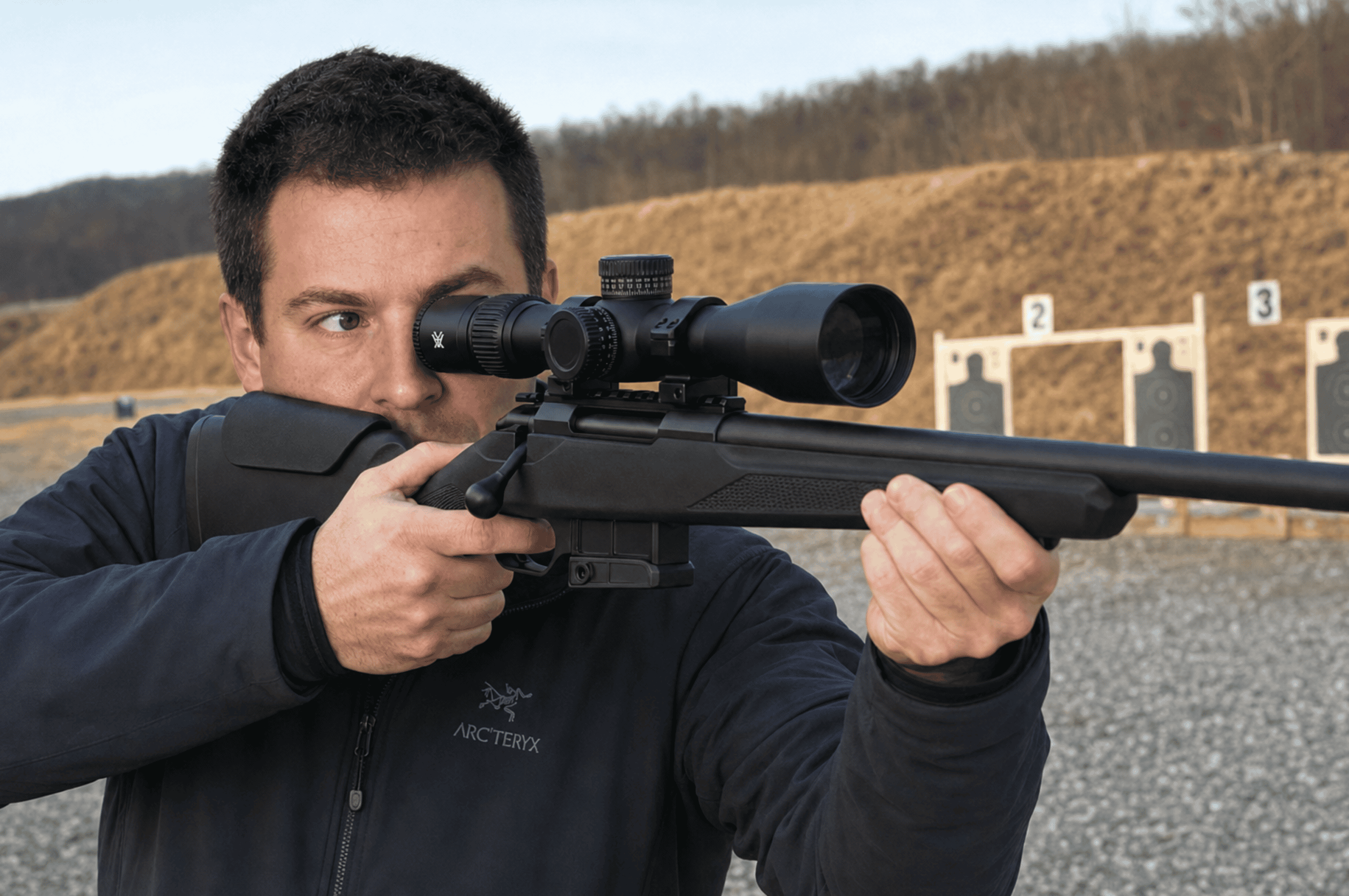
Mike Fellon is the founder of ScopesReviews and an optics specialist with 15+ years in precision shooting. A former Bass Pro Shops firearms advisor and NRA-certified instructor, he’s hands-tested 200+ rifle scopes across hunting and competition. Based in Dallas, Texas.