
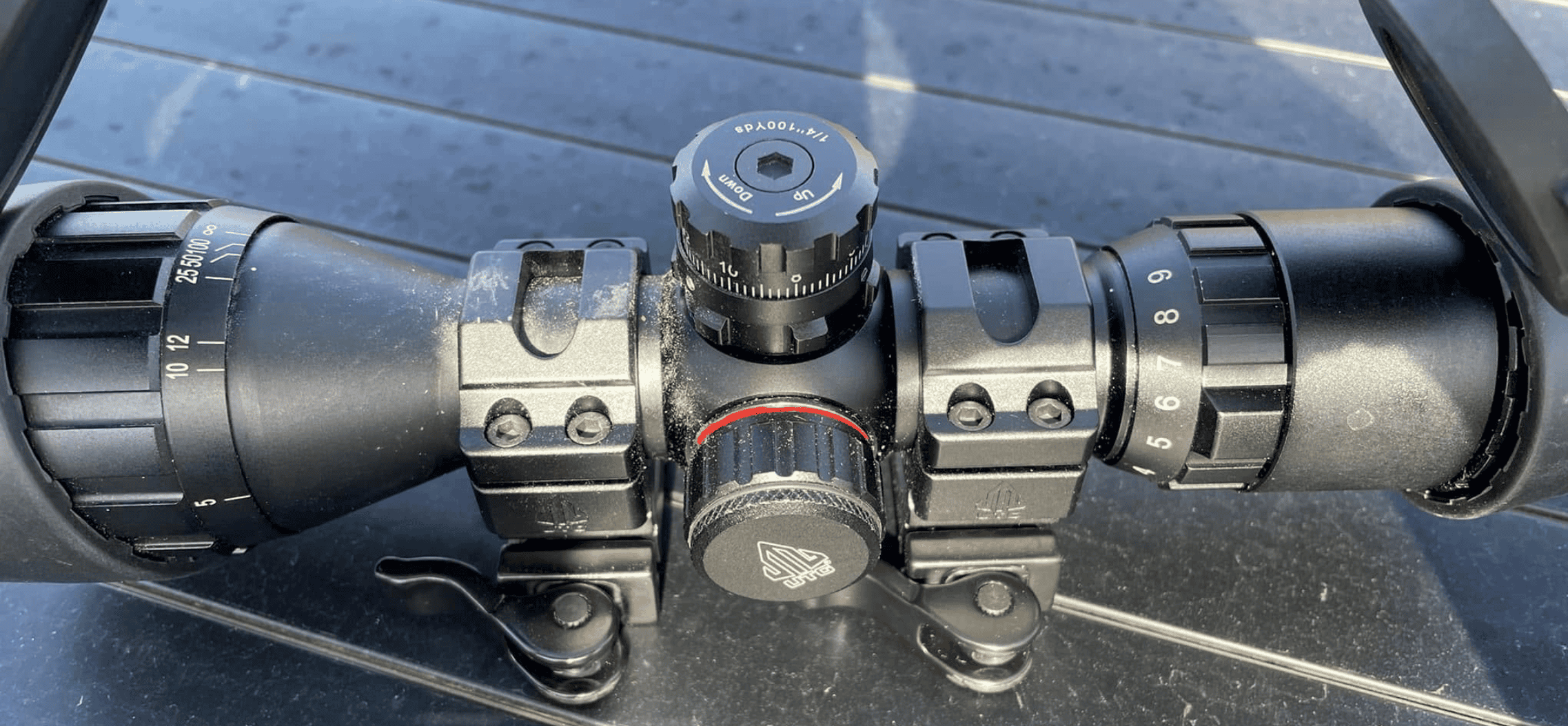
Ask around any airgun or rimfire forum for a compact scope that will focus down to spitting distance and survive a spring-piston gun, and the UTG BugBuster comes up within the first three replies. It has been the default answer for years, which is exactly why I wanted to put one through a proper stretch rather than repeat the forum consensus. UTG builds it as a purpose-made short-range optic: air-gun rated for the dual recoil that kills ordinary scopes, an adjustable objective that focuses from 3 yds to ∞, and a compact 8.11″ body meant for tin-can guns and pest rifles, not benchrest work.
What I wanted to know was whether the specialization actually holds up, or whether the reputation is just momentum. This is a budget optic, and budget optics in this category tend to promise close focus and airgun durability and then quietly fail at one of them. My verdict landed on the specialist side: run the BugBuster inside the narrow lane it was built for and it earns its keep, but the moment you ask it to be a general-purpose scope, the compromises that make it good at its job start working against you.
UTG BugBuster 3-9x32mm Review
Mounting it took longer than the rifle did
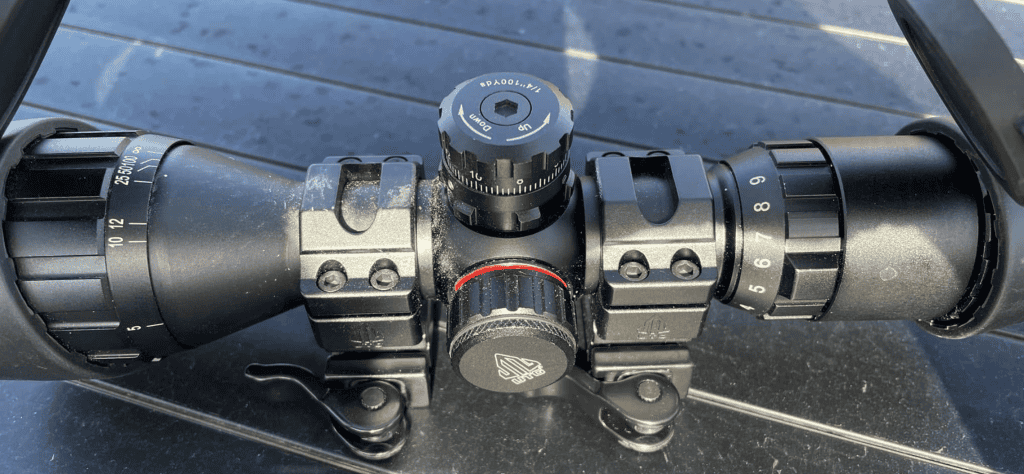
First thing that ate my morning was ring placement. On an 8.11″ body with the adjustable objective bell hanging off the front, there is not a lot of tube to work with, and the eye relief runs from 4.2″ down to 3.2″ as you climb the magnification. I mounted it on a Diana 34 EMS in .22, whose scope rail is short to begin with, and I ended up sliding the rings twice and re-shimming before I got a full sight picture at 9x that did not force me to crane forward. On a break-barrel that cocks by folding the barrel down, a scope sitting too far forward is a knuckle magnet, so the compact length that everyone praises actually made the setup fussier, not easier. Worth knowing before you buy rings.
The close focus is the whole point, and it delivers
Where the BugBuster stopped feeling like a budget scope was the first time I cranked the objective down for a rat sitting in a barn doorway at maybe four yards. Most scopes turn a target that close into a soft gray smear you cannot place a shot on. I rolled the AO ring down toward its 3 yds stop and the pellet-sized head snapped into focus with the reticle sitting crisp on top of it. That is the entire reason this optic exists, and it does the job without drama. For backyard pest work, indoor range plinking, and the close hedge-and-outbuilding shooting that airgunners actually do, having usable focus from a few yards out to distance is not a gimmick. It changes what you can take.
Spring-piston recoil is where cheap scopes go to die
Here is the test that separates airgun-rated glass from optimistic marketing. A spring-piston gun recoils forward as well as back, a fast double shove that walks the zero out of scopes never designed for it and can shake internal lenses loose. I have watched centerfire-rated budget scopes come apart on springers, reticles drifting a little further off every tin of pellets until the owner blames the pellets. So I ran a deliberate zero-retention block on the Diana: confirm zero, shoot a few hundred pellets across a session, re-check. Then again. The BugBuster held. After a couple thousand JSB Exact Jumbos through a gun that is genuinely hard on optics, my group center had not wandered. That is the promise on the box actually being kept, and given how many scopes fail this exact test, it is the single most important thing the BugBuster gets right.
Where the 32mm objective and thick reticle catch up with you
The compromises are real and they show up at the edges of the day. Late one evening I was on a squirrel working a trunk in fading light, and the small 32mm objective simply was not pulling in enough light for the picture to stay bright at 9x. Worse, the Mil-Dot posts are on the thick side, and against dark bark the center started swallowing the target instead of framing it. I clicked the illumination on, ran the green up a notch, and got the aiming point back, which is exactly what the IR feature is for. But it is a patch for a limitation, not a strength. This is a daylight and low-magnification tool. Push it into dusk or crank it to the top of the range and the glass tells you where the budget went.
Living with the mil reticle and MOA turrets
The reticle-to-turret mismatch I flagged earlier is not a dealbreaker, but it is friction. You range and hold in mils off the dots, then if you dial a correction the turret talks back in 1/4 MOA clicks. For most airgun and rimfire shooters this never matters, because you hold over off the dots and leave the turrets locked after zeroing, and the lockable, resettable turrets are genuinely nice at this tier for exactly that reason. But if you are the sort who dials, know that you are doing mental conversion every time. It is a design choice that fits the point-and-hold crowd this scope is built for and annoys everyone else.
How I Put the BugBuster Through a Springer’s Worst
I mounted the BugBuster on a Diana 34 EMS in .22 caliber and fed it JSB Exact Jumbo 15.89gr pellets for the entire test, because if you want to know whether a scope’s air-gun rating is real, you bolt it to a full-power break-barrel springer and let the reverse recoil do the interrogating. A PCP would have been kinder and told me less. Testing ran over roughly two months of pest control around barns, outbuildings, and a backyard pellet range, in everything from flat midday light to the low sun that pushes any small objective to its limit. Shooting was mostly off a bag or a fence rail at ranges from a few yards out to the far end of what a .22 springer honestly holds, with a hard focus on confirming zero, then breaking it loose on purpose with volume to see if it came back.
The reason I trust my read here is that spring-piston durability is a failure mode I have watched play out again and again across this category. The scopes that die on springers almost never die at the range; they die three hundred pellets later, zero creeping until the shooter swears the gun went off. Knowing that pattern is why my whole protocol was built around re-checking zero after volume rather than after a magazine, and why I care more about what the BugBuster did at the two-thousand-pellet mark than what it did on the first tight group. If you want the framework I run every optic through, my full testing methodology lays it out.
Performance Ratings
Overall sits slightly above the raw average because the two categories that define this scope’s actual purpose, parallax and recoil durability, are the two it scores highest in. For a specialist, weighting the specialty is the honest call.
Field Test Data
| Test Parameter | Result |
|---|---|
| Close-focus confirmed | Sharp reticle and target at roughly 4 yds, AO near its 3 yds stop |
| Best 5-shot group (25 yds, off bag) | 0.55″ center to center |
| Zero retention (approx. 2,000 pellets) | No measurable point-of-impact shift |
| Turret return-to-zero | Repeatable; box test returned to point of aim |
| Usable low-light window | Picture dims noticeably at dusk; illumination restores aiming point |
| Illumination check | Red and green both functional; green more usable against dark bark |
Tested with: Diana 34 EMS | .22 caliber air rifle | JSB Exact Jumbo 15.89gr
Pros and Cons
PROS
|
CONS
|
If the BugBuster’s Low-Light Ceiling Is Your Sticking Point
The BugBuster’s limits are specific, so the alternatives are too. If the 32mm objective giving out at dusk is what bothers you, look at the Hawke Vantage 3-9×40, which keeps the airgun-rated durability and close parallax focus but adds a larger objective that holds a brighter picture later into the evening, at the cost of a longer, less compact body. If you want cleaner glass and a crisper reticle for the money and can live without the extreme close focus, the Athlon Talos 4-14×40 steps up magnification and optical quality for rimfire work past the ranges where the BugBuster is happiest. And if you value light weight and a lifetime warranty over the 3-yard focus, the Vortex Crossfire II 2-7×32 Rimfire is a compact, versatile option that trades the BugBuster’s specialist close-focus talent for a more general-purpose personality. Each one wins on a specific axis the BugBuster gives up in exchange for being a dedicated close-range specialist.
Disclosure
Everything above comes from my own hands-on time behind this scope. This article may contain affiliate links, and ScopesReviews may earn a small commission if you purchase through them at no extra cost to you. Affiliate relationships do not influence the evaluation, the ratings, or the conclusions above.
Run It in Its Lane and It Rewards You
The BugBuster is not a scope you talk out of its category, and you should not try. As a close-range specialist for airguns and rimfire, it does the two hardest things in its class right: it focuses down to a few yards where almost nothing else will, and it shrugs off spring-piston recoil that quietly destroys optics that were never rated for it. Mine held zero through a couple thousand pellets on a gun built to break scopes, and that alone puts it ahead of most budget glass an airgunner is tempted by.
The trade-offs are the price of that focus. The small objective fades at dusk, the reticle reads thick against dark backgrounds, and the compact body asks for patience at mounting. None of that matters for the shooter this scope is actually for: someone knocking down pests and punching pellets at close-to-moderate range in decent light. Buy it for that and you will be glad. Buy it expecting a low-light do-everything optic and you will be annoyed by the exact compromises that make it good. Match it to close-range pest and plinking work and it is one of the easiest recommendations in the tier.
Mike Fellon is the founder of ScopesReviews and an optics specialist with 15+ years in precision shooting. A former Bass Pro Shops firearms advisor and NRA-certified instructor, he’s hands-tested 200+ rifle scopes across hunting and competition. Based in Dallas, Texas.