
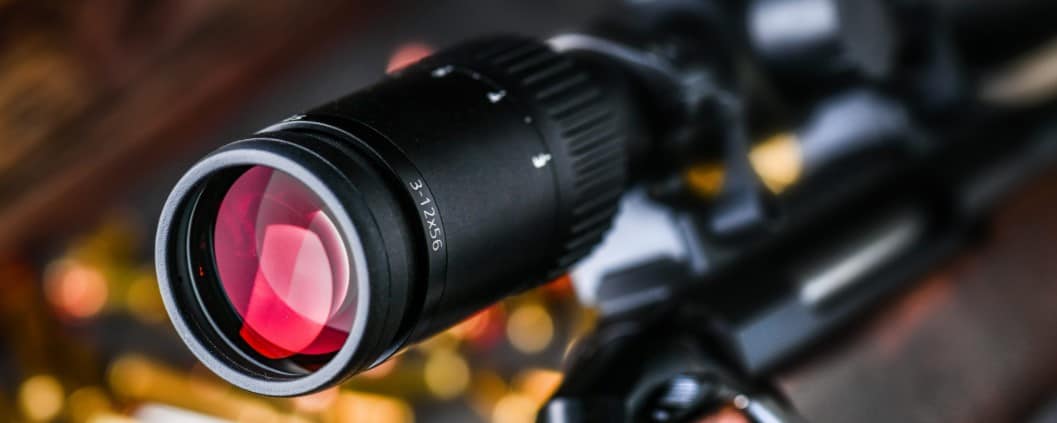
Nobody frames a UTG scope as an heirloom, and that is exactly why the brand works. Leapers builds these things to sit on guns that cost about what the optic does, get knocked around, and keep working anyway. The three I pulled for this guide sit right in that world: the compact BugBuster 3-9×32, the 3-12×44, and the 4-16×44. All budget-tier, all mil-dot, all built more for airguns, rimfires, and light varmint work than for chasing paper at distance. I ran each one on a gun that matches its job, and the BugBuster came out on top. It does the least on paper and the most in practice, which turns out to be the whole UTG story in one scope.
The Top 3 UTG Scopes
Best Overall
UTG Pro BugBuster 3-9x32mm
The one I’d hand a first-time airgun or rimfire shooter without a second thought. It’s the lightest of the three, focuses down to almost point-blank, and shrugged off a springer’s double thump for the whole test without losing zero. Nothing here is fancy. Everything here holds.
Best Balance of Reach and Compact Size
UTG Pro 3-12x44mm
Steps up the top-end magnification and the objective without turning into a full-length scope. If your rimfire work stretches past what 9x comfortably covers, this is the sensible middle rung, provided you accept that the glass gets soft once you push it hard.
Most Magnification on Tap
UTG Pro 4-16x44mm
The reach champion of the group and the one that asks the most of budget glass. Great when you’re picking apart small targets in good light and patient about your eye position. Less great when the light drops or you crank it to the top and want the picture to stay honest.
The Scope I Handed Across the Counter More Than Any Other
For five years I worked the optics counter at a Bass Pro, and the UTG box left my hands more than any other budget name on the wall. Not because I pushed it. People buying a .22 for their kid or a springer for the backyard would ask what to put on top without spending scope money on a scope, and UTG was the honest answer every time. I mounted dozens of them, watched them come back for warranty far less than the price suggested they should, and learned where they quit.
That history is why I tested the BugBuster on a springer air rifle for this guide instead of a bench gun. A break-barrel throws recoil in two directions and eats cheap scopes for breakfast; it is the one test that actually separates a UTG from the no-name glass a tier below it. Fifteen years of watching budget optics fail under exactly that kind of abuse is what tells me which corners UTG cuts safely and which it does not.
The 3 Best UTG Scopes
1. UTG Pro BugBuster 3-9x32mm – Best Overall for Airguns and Rimfires
Why a Break-Barrel Was the Right Torture Test
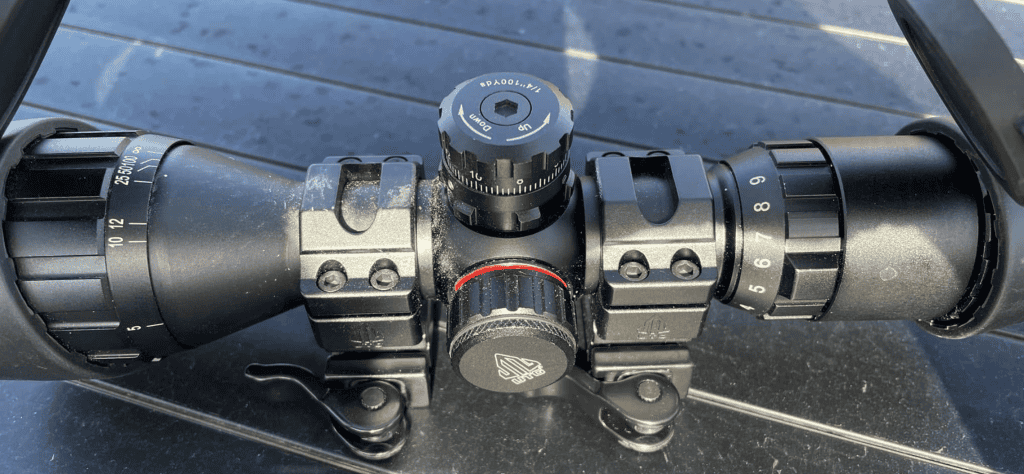
I bolted this one to a Diana 34 in .22 caliber, and that choice was deliberate. A springer air rifle recoils forward as the piston slams, then snaps back, and that reverse jolt has killed more budget scopes than anything else I’ve mounted. If the BugBuster was going to come apart, this is where it would. Over a couple hundred pellets it never drifted. I checked zero cold at the start of each session and it sat where I left it, every time.
Focusing Down to Almost Nothing
The adjustable objective goes to three yards, and on an air rifle that matters more than people expect. Backyard pest work and target lanes often happen inside twenty yards, where a scope stuck focusing at fifty gives you a fuzzy target and parallax error that walks your point of impact around. Dialing the front bell down to actual close range gave me a sharp reticle and a still target. Push it past a hundred yards and the parallax correction gets vague, but that’s not what this scope is for, and pretending otherwise would be dishonest.
The Mil-Dot Reticle and a Quirk You Should Know
The reticle is UTG’s mil-dot in the second focal plane, and it’s clean, with dots that stay thin enough to not swallow a squirrel’s head at 9x. The lit version gives you red and green, both usable in shade. Here’s the catch UTG never explains well: the dots are spaced in mils, but the turrets click in quarter-MOA. The two units don’t line up, so if you’re the type who ranges with the reticle then dials a correction, you’re doing conversion math no budget scope should ask of you. For hold-over shooting, which is how most people run a scope like this, it’s a non-issue. Just know the mismatch is there.
Where It Lands in the Lineup
Against the two bigger scopes, the BugBuster gives up top-end magnification and objective size. What it gives back is weight, handiness, and the closest focus of the three. On a compact rimfire or an air rifle, the balance is right and the scope disappears into the gun the way a good compact should. It’s the least ambitious optic here and the one I trust most.
Field Test Data
| Test Parameter | Result |
|---|---|
| Zero retention (springer recoil) | Held through ~200 pellets, no drift |
| 5-shot group @ 25 yds (rested) | 0.5″ center-to-center |
| Close-focus sharpness | Crisp from 3 yds; vague past ~100 |
| Illumination visibility (shade) | Red and green both usable |
| Return-to-zero (box test) | Returned true on 4 corners |
Tested with: Diana 34 (.22 caliber) | H&N Field Target Trophy 5.53mm pellets
Pros and Cons
PROS
|
CONS
|
Performance Ratings
If your shooting lives inside a hundred yards on a rimfire or an air rifle, stop reading here and buy this one. It won’t wow anybody at the range, but it’ll be on your gun, holding zero, long after flashier budget glass has quit.
2. UTG Pro 3-12x44mm – Best for Stretching Rimfire Range
A 10/22 and Some Extra Reach
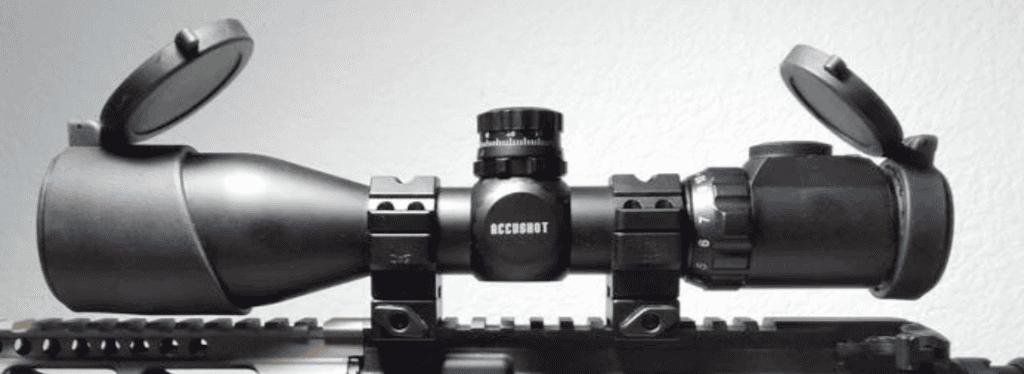
This one rode on a Ruger 10/22 for the test, feeding CCI Standard Velocity. That pairing tells you the scope’s job: rimfire work that runs a little longer than a fixed-power or a 3-9x wants to. At 50 yards, working off a rest, five-shot groups hovered right around nine tenths of an inch, which is more the rifle and the ammo than the scope, but the glass never got in the way of putting them there. The side focus made a real difference cleaning up the picture as I moved between closer plinking and the far end of the lane.
Where the Glass Starts Asking for Patience
Through about 9x, the view is genuinely good for a budget scope, sharp across most of the field with only the outer edge going soft. Crank it toward 12x and the honesty runs out: the center holds, but the edges smear and the whole picture loses a little contrast. That’s the tradeoff you accept stepping up from the BugBuster. You’re buying top-end magnification the smaller scope doesn’t have, and the price of it is glass that works best in the lower two-thirds of its range.
The Side Wheel and the Turrets
UTG’s side-focus system down to ten yards is the feature I’d point to as the reason to pick this over a plain 3-9x. Adjusting parallax from the side without breaking cheek weld is genuinely nicer to run than reaching for a front bell. The exposed turrets click with decent feel, a touch mushier than the BugBuster’s, and the zero reset needed a firm hand to seat. Same mil-dot-with-MOA-clicks arrangement as the rest of the line, so the same caveat applies.
The Weight Nobody Mentions
Here’s the one that surprises people: this is the heaviest scope in the group, heavier even than the higher-magnification 4-16x. On a light rimfire that’s a real chunk of weight hanging up top, and it changes how the gun carries and balances. Worth a thought before you assume the mid-scope is the mild choice.
Field Test Data
| Test Parameter | Result |
|---|---|
| 5-shot group @ 50 yds (rested) | ~0.9″ center-to-center |
| Side focus range | Clean from 10 yds to 100+ |
| Zero retention | Held through ~150 rounds |
| Edge clarity above 9x | Center holds; edges soften |
| Illumination range | 36-color, several usable settings |
| Turret feel | Tactile but slightly mushy |
Tested with: Ruger 10/22 | CCI Standard Velocity 40gr LRN
Pros and Cons
PROS
|
CONS
|
Performance Ratings
A capable pick if you specifically want more magnification than a 3-9x while keeping a UTG price and UTG durability. Just go in knowing you’re trading away some optical honesty at the top and carrying the heaviest scope of the three to get it.
3. UTG Pro 4-16x44mm – Most Reach, Most Compromise
Putting It Where 16x Belongs
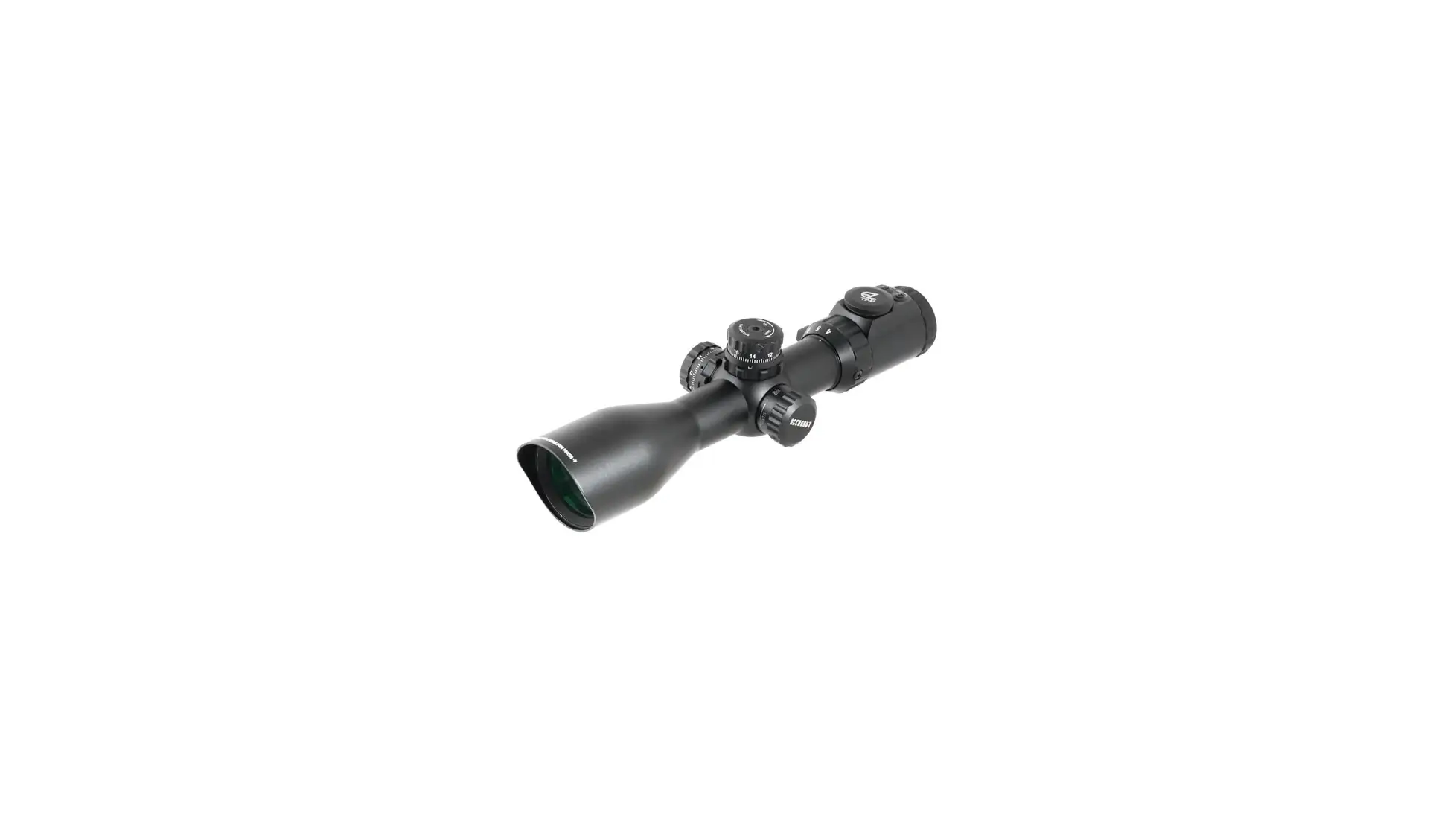
To give this scope a fair shot at its own magnification, I ran it on a Savage B17 in .17 HMR, feeding Hornady 17-grain V-MAX. That’s a flat, fast rimfire that actually earns 16x on small targets out past where the .22 rigs make sense. Zero held through the test, no complaints there, and the side focus tracked cleanly out past a hundred. On paper at 100 yards, five shots printed a bit over an inch, which for this rifle and this glass is a reasonable showing.
The Eyebox Is Where It Bites
The spec sheet lists eye relief from 3.4 down to 3.0 inches, but at the top of the magnification range it plays tighter than that number suggests. At 16x the eyebox turns fussy: a little too far forward or back and the picture blacks out at the edges, so you spend real effort settling your cheek into exactly the right spot before every shot. Off a bench you can manage it. Field positions, where your head placement isn’t repeatable, are less forgiving. This is the scope’s biggest weakness and it shows up exactly when you’re using the magnification you paid for.
Glass at the Ceiling
Same story as the 3-12x, more pronounced. The lower half of the range looks fine. Push toward 16x, especially as the light drops later in the day, and the image loses contrast and the edges haze. The 44mm objective gathers what light it can, but budget glass at high magnification is a physics problem no amount of coating fully solves at this price. This scope reaches further than the other two and shows the strain of doing it more clearly.
What It’s Actually For
Set against the lineup, the 4-16x is the specialist: good light, patient shooting, small targets you want to pick apart at rimfire-magnum distance. It’s not the do-everything scope its magnification range makes it look like. The mil-dot reticle stays usable for holds, and the same MOA-click mismatch carries over. Judge it as a good-light target and varmint optic and it holds up. Ask it to be a general-purpose scope and the eyebox and the top-end glass talk you out of it fast.
Field Test Data
| Test Parameter | Result |
|---|---|
| 5-shot group @ 100 yds (rested) | ~1.1″ center-to-center |
| Eyebox at 16x | Fussy; demands precise head position |
| Glass at top magnification | Contrast and edges fall off past ~12x |
| Zero retention | Held through ~120 rounds |
| Side focus tracking | Clean to 100+ yds |
Tested with: Savage B17 (.17 HMR) | Hornady 17gr V-MAX
Pros and Cons
PROS
|
CONS
|
Performance Ratings
This is the scope that most tests the budget-workhorse premise, because it reaches past what UTG’s glass comfortably delivers. In good light, on a bench, picking apart small targets with a .17-class rimfire, it does the job. Push it outside those conditions and the eyebox and the top-end image remind you what tier it lives in. Buy it for the narrow case, not the broad one.
A Springer, a 10/22, and a Rimfire Varmint Gun Across a Mild Texas Spring
Because these three scopes don’t share a job, I didn’t force them onto one rifle. Each rode the gun that matches what it’s built for, which is the only way to judge a lineup that spans from close air-rifle work to rimfire-magnum reach. The BugBuster went on a Diana 34 springer in .22, running H&N Field Test Trophy pellets, specifically to see whether it would survive a break-barrel’s brutal two-way recoil. The 3-12×44 rode a Ruger 10/22 with CCI Standard Velocity, and the 4-16×44 went on a Savage B17 in .17 HMR feeding Hornady 17-grain V-MAX, where the top-end magnification finally had targets far enough away to justify it.
All of it happened over a handful of weeks in a mild north Texas spring, mostly at a public range with a covered firing line and marked lanes out to 100 yards, plus some closer backyard pellet work for the springer. Temperatures stayed comfortable, light ranged from flat overcast to hard afternoon sun, and I confirmed each scope’s zero cold at the start of every session rather than trusting the last one. Total round and pellet count landed around 500 across the three guns, weighted toward the airgun since pellets are cheap and the durability test wanted volume. Nothing exotic in the conditions, which suits optics meant for backyards and rimfire lanes rather than mountainsides. If you want the full breakdown of how I run these, here’s my testing and review process.
What People Get Wrong Before They Even Mount a UTG
Reading the mil dots and the MOA clicks as one system
Every scope here has a mil-dot reticle and quarter-MOA turrets, and those units don’t match. Shooters who range a target with the dots and then try to dial a matching correction end up doing conversion math and missing. The fix is simple: pick one method. Either hold with the reticle and leave the turrets zeroed, or dial and ignore the dots. Don’t try to run them together as if they speak the same language, because they don’t.
Expecting premium glass because the scope looks premium
UTG scopes wear tactical looks and heavy tubes that photograph like something twice the price, and buyers talk themselves into expecting the optical clarity to match. It won’t. What you’re actually paying for is durability, illumination, and features like side focus at a budget number. Judge the glass against the price tier, not against the aggressive styling. Go in expecting a tough, feature-loaded scope with honest budget optics and you’ll be happy. Expect boutique clarity and you’ll feel cheated by physics.
Buying the 4-16x because more magnification looks like more scope
The highest number in the lineup pulls buyers toward the 4-16x by default, and plenty of them would be better served by the BugBuster or the 3-12x. Sixteen power only helps if you have good light, a steady rest, and targets far enough to need it. On a .22 inside a hundred yards it’s magnification you’ll never use, sitting behind a fussier eyebox and softer top-end glass. Match the scope to your actual distances, not to the biggest spec.
Assuming the lifetime warranty is frictionless
UTG’s lifetime warranty is real and doesn’t require registration, which is genuinely good. But it’s not the no-questions guarantee some premium brands offer, and there are documented cases of older scopes being turned away as too aged to service. Keep your purchase records, don’t assume a decade-old scope is automatically covered, and set your expectations to budget-brand support rather than lifetime-replacement-no-matter-what. It’s coverage, not a blank check.
UTG Questions I Field From First-Time Airgun and Rimfire Buyers
Where are UTG scopes actually made?
UTG is the optics brand of Leapers, based in Livonia, Michigan. Design and quality control run out of Michigan, while manufacturing is a mix, with some production overseas held to Leapers’ own standards. The upshot is more consistency than most budget brands, even if it isn’t fully domestic glass.
Will a UTG survive a springer air rifle?
Yes, and that’s genuinely where they shine. A break-barrel’s two-way recoil kills cheap scopes, and the BugBuster held zero through a couple hundred pellets on a Diana 34 for this test. UTG’s tube construction is built for exactly that abuse. It’s one of the few things I’d call a real strength of the brand.
Why does it have a mil reticle but MOA clicks?
It’s a quirk that runs across much of UTG’s line, and it isn’t ideal. The two units don’t correspond, so use one or the other: hold with the mil dots or dial with the MOA turrets, not both together. For hold-over shooting, which is how most people run these, it barely matters.
Which of these three should a first-timer get?
The BugBuster, almost always. It’s the lightest, the toughest for the money, focuses the closest, and does the airgun and rimfire job that most buyers actually have. Step up only if you have a specific need for more magnification and understand the tradeoffs that come with it.
Are UTG scopes good enough for a centerfire hunting rifle?
These three aren’t the ones I’d pick for it. They’re built and priced for airguns, rimfires, and light varmint work. On a hard-recoiling centerfire you’d want a scope designed around that recoil and those distances, and UTG has other models better suited than this compact trio.
Sorting Out Which UTG Fits Your Setup
The backyard and close-range crowd. If you’re scoping a springer, a PCP, or a .22 that lives inside a hundred yards, the BugBuster is the answer and it isn’t close. Its close focus down to three yards and its light, handy build were made for exactly this, and its durability means it’ll outlast the gun’s novelty. Nobody in this group serves the close-range shooter better.
The rimfire shooter reaching a little farther. Squirrels at the far end of the tree line, targets past where 9x feels comfortable, but still a rimfire and still a budget: that’s the 3-12×44’s lane. You get the extra top-end and the side focus, and you pay for it in weight and in glass that’s happiest below 9x. A fair trade if the distance is real, a bad one if you just liked the bigger number.
The small-target specialist in good light. A .17 HMR or similar, small targets you want to magnify hard, and the discipline to shoot off a rest in decent light: the 4-16×44 fits here, and only here. The one time to steer away from it is if you want a single do-everything scope, because its eyebox and top-end glass make it a specialist, not a generalist. Buy it for the narrow job or not at all.
When to look outside this trio entirely. If your gun is a centerfire that recoils hard or you’re shooting well past rimfire distances, none of these three is the right call. They’re airgun and rimfire optics at heart. Pushing them onto a magnum hunting rifle asks them to be something UTG didn’t build them to be, and you’d be better served elsewhere in the lineup or another brand.
Disclosure
I bought all three of these scopes myself and mounted them on my own guns, including the Diana 34 springer I specifically use to punish budget optics. ScopesReviews earns affiliate commissions when you buy through the links on this page, at no extra cost to you. That arrangement never touched the rankings here: the BugBuster finished first because it held zero through a break-barrel and did its narrow job better than the other two, and I’d tell you the same if there were no links on the page at all.
UTG Earns Its Spot by Not Pretending to Be More
After a spring of running these across a springer, a 10/22, and a rimfire varmint gun, the verdict is the one I expected walking in: UTG is a budget workhorse brand, and it’s best when you buy it as exactly that. The BugBuster 3-9×32 is the clear winner and the truest expression of what UTG does well, tough, light, close-focusing, and unbothered by recoil that ends lesser scopes. The 3-12×44 is a sensible step up for real added reach, with weight and softening glass as the cost. The 4-16×44 stretches furthest and shows the most strain doing it, a specialist worth owning only for its narrow case.
None of these will impress a shooter used to premium glass, and they aren’t trying to. The value is in matching the scope to a gun and a distance where its strengths carry and its limits don’t matter. Get that pairing right and UTG gives you more durability and features per dollar than almost anything at the price. Get it wrong, and you’ll blame the brand for a mismatch you created. If you’re weighing other options, my rimfire scope guide and air rifle scope guide cover the alternatives worth a look.
Mike Fellon is the founder of ScopesReviews and an optics specialist with 15+ years in precision shooting. A former Bass Pro Shops firearms advisor and NRA-certified instructor, he’s hands-tested 200+ rifle scopes across hunting and competition. Based in Dallas, Texas.
Hey Mike
An informative review, but inaccurate objective size!
30mm is the tube size, 44mm is the objective size.
Just an observation 😊
Thank you, it is fixed now.