
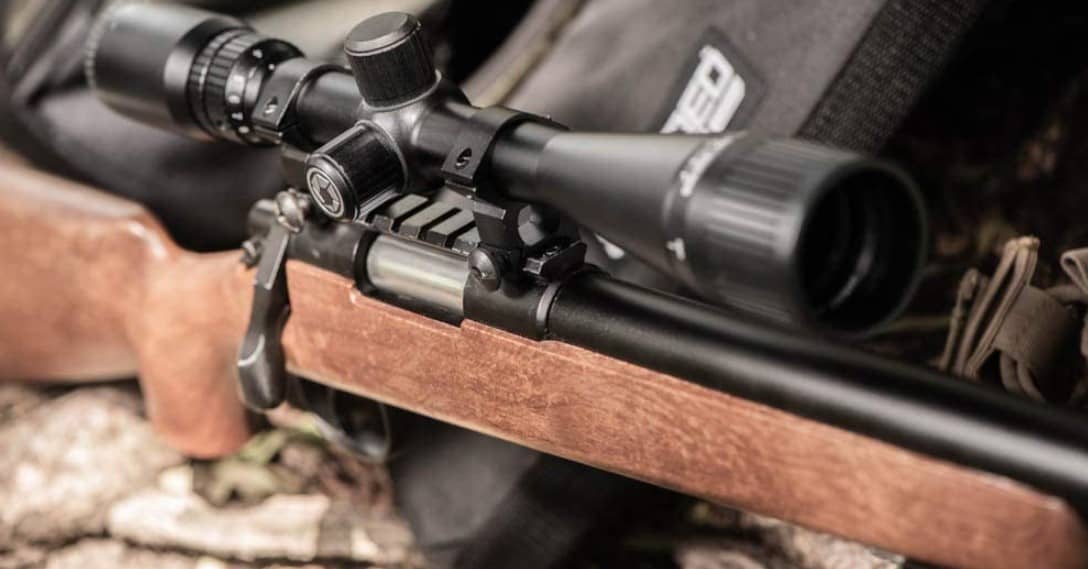
The .17 WSM occupies a strange spot in the rimfire world. It shoots flat enough and fast enough (3,000 fps with a 20-grain bullet) that you start thinking about it like a centerfire varmint cartridge, but it’s still a rimfire pushing a tiny, wind-sensitive projectile. That creates a specific scope problem: you need enough magnification to pick up prairie dogs and ground squirrels at 200-plus yards, but you also need a scope light enough that it doesn’t turn your 6-pound rimfire into a nose-heavy mess. And you need a parallax adjustment that actually works at rimfire distances, not one that bottoms out at 50 yards. I tested three scopes that handle this balance differently, and the Bushnell Engage 4-16×44 came out on top. It matched the .17 WSM’s personality better than anything else I mounted on my Savage B.Mag.
My Top 3 Picks for the 17 WSM
Best Overall
Bushnell Engage 4-16×44
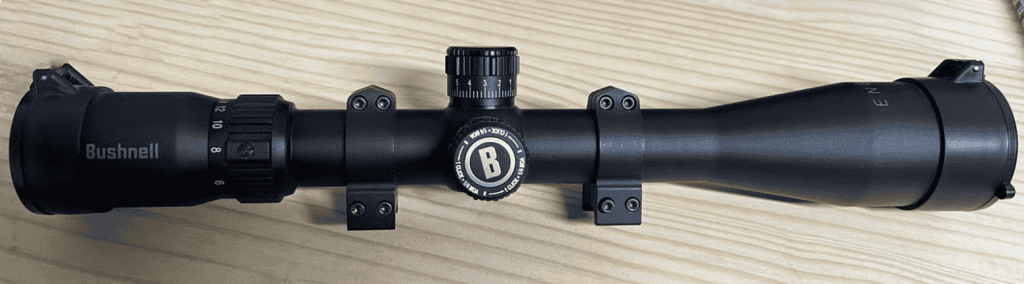
The 4-16x range is exactly what the .17 WSM needs. Enough bottom end to scan for varmints at moderate distance, enough top end to place shots on prairie dogs past 200 yards. At 20 ounces it doesn’t wreck the rifle’s balance, and the locking exposed turrets with zero reset give you features that most scopes in this price tier skip entirely.
Best Premium Glass
Sightron S-TAC 3-16×42
If glass quality is your priority and you don’t mind spending premium money on a rimfire setup, the Sightron delivers. Edge-to-edge clarity that competes with scopes costing considerably more, packed into the most compact body of the three I tested. The 3x low end also makes it the most versatile for varied shooting distances.
Best for Extended Range Precision
Athlon Argos BTR Gen 3 6-24×50
The only FFP scope in this group, with illumination and a true zero stop. If you’re shooting the .17 WSM at its absolute limits (250+ yards) and want precision dial-up capability, the Athlon gives you the tools. The trade-off is weight: at over 30 ounces, it turns a nimble rimfire into something top-heavy.
Why You Can Trust My Recommendations
I picked up my first .17 WSM about four years ago after a buddy at our local prairie dog spot kept outranging me with his Savage B.Mag while I was burning through .223 ammo at three times the cost. That got my attention. I’ve spent 15 years testing optics, first behind the counter at Bass Pro Shops where I helped hundreds of customers figure out what they actually needed, and now through my own testing at ScopesReviews. Along the way I’ve put hands on over 200 scopes across every price tier. The .17 WSM taught me something specific: scope weight matters more on a lightweight rimfire than on any centerfire rifle I own. My NRA Range Safety Officer and instructor certifications keep my testing methodology honest, but the real education came from burning through boxes of Winchester 20-grain ammo watching what worked and what didn’t on small targets at distance.
Side-by-Side Specs
For a rimfire varmint cartridge, pay attention to weight and parallax range first. A scope that can’t focus cleanly below 50 yards is going to frustrate you, and anything north of 25 ounces starts to feel silly on a rifle this light.
| Features | Bushnell Engage 4-16×44 | Sightron S-TAC 3-16×42 | Athlon Argos BTR Gen 3 6-24×50 |
|---|---|---|---|
| Magnification | 4-16x | 3-16x | 6-24x |
| Objective Diameter | 44 mm | 42 mm | 50 mm |
| Eye Relief | 3.6″ | 4.2″ – 3.8″ | 3.3″ |
| Weight | 20.1 oz | 23.5 oz | 30.3 oz |
| Length | 14.0″ | 12.9″ | 14.1″ |
| Tube Size | 30 mm | 30 mm | 30 mm |
| Reticle | Deploy MOA (SFP) | MOA-3 (SFP) | APLR11 FFP IR MOA |
| Field of View | 28 – 7 ft @ 100 yds | 32.3 – 6.1 ft @ 100 yds | 16.7 – 4.5 ft @ 100 yds |
| Turret Style | Exposed, Locking, Zero Reset | Capped Target Turrets | Exposed, Precision Zero Stop |
| Adjustment Range | 50 MOA Elevation / 50 MOA Windage | 70 MOA Elevation / 70 MOA Windage | 60 MOA Elevation / 60 MOA Windage |
| Click Value | 1/4 MOA | 1/4 MOA | 1/4 MOA |
| Parallax Adjustment | Side Focus, 10 yds to infinity | Side Focus, 10 yds to infinity | Side Focus, 10 yds to infinity |
| Illumination | No | No | Yes, Glass Etched |
The 3 Best .17 WSM Scopes
1. Bushnell Engage 4-16×44 – Best Overall
The Right Scope on the Right Rifle
I mounted the Engage on my Savage B.Mag Stainless Heavy Barrel and the first thing I noticed was how well it balanced. At just over 20 ounces, the scope didn’t make the rifle feel like a different gun. That matters more on a rimfire than people realize. The B.Mag is already a light rifle, and I’ve mounted scopes on it before that turned it into a see-saw tilting toward the muzzle. The Engage sat right where it needed to, and even after a full afternoon of shooting prairie dogs from a bench, I wasn’t fighting the rifle to keep it steady.
Getting Dialed at 100 and Beyond
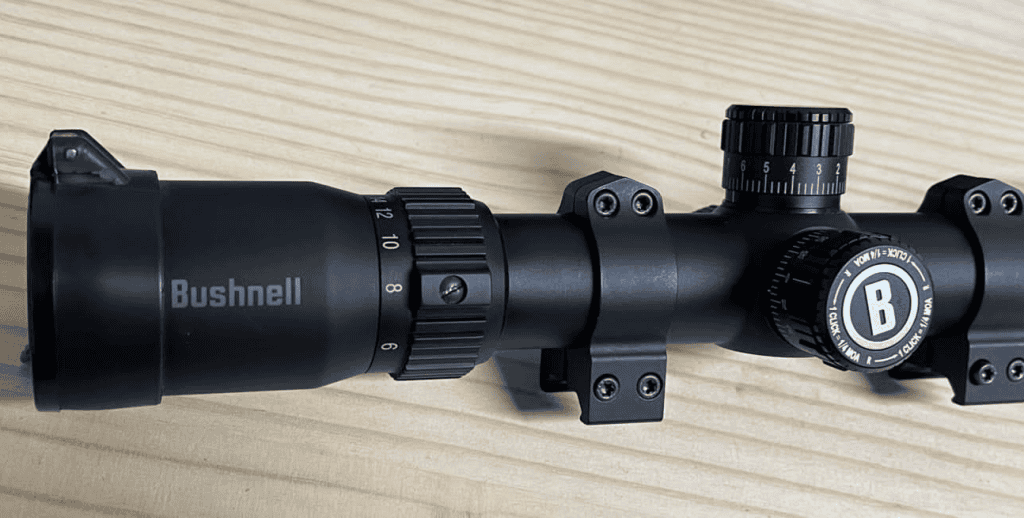
Zeroing at 100 yards with Winchester Varmint HV 20-grain took five rounds. The turrets clicked into place with solid, audible feedback, and the T-Lok locking mechanism gave me confidence that nothing was going to wander once I set it. I’ve used locking turrets on scopes that cost three times as much and didn’t feel this positive. The zero reset was simple: pull up, twist to your new zero, push back down. No tools, no guesswork. I ran a quick box test at 100 yards and the scope tracked back to my original group inside a quarter inch. That’s all I needed to see before pushing it out further.
At 200 yards, which is about where the .17 WSM starts asking more of both the shooter and the optic, I was holding consistent groups on a steel ground squirrel silhouette. The Deploy MOA reticle gave me a clean aiming point with the floating center dot, and the 1 MOA hash marks below the crosshair made holdover corrections intuitive. Since this is an SFP reticle, those subtensions are only accurate at 16x, but that’s exactly where I was parked for anything past 150 yards anyway. For closer varmint work inside 100 yards, I’d drop down to 8-10x and just use the center dot.
Where the Glass Surprised Me
I wasn’t expecting much from the optics at this price point, so the Engage caught me off guard. Clarity at 12x was sharp enough to spot a prairie dog’s head poking above its mound at 175 yards during a dusty October afternoon. Not quite Sightron-level glass (the S-TAC sitting in my case reminded me of that gap), but noticeably better than budget scopes I’ve used in this price neighborhood. The EXO Barrier coating earned its keep during one foggy morning session when the Athlon’s objective was catching condensation and the Bushnell wiped clean with a single pass of my shirt sleeve.
The Reticle Worked for This Caliber
The Deploy MOA’s Christmas tree pattern with 30 MOA of drop compensation below center is more than the .17 WSM will ever demand, but having those hash marks available meant I rarely needed to touch the turrets for field shooting inside 250 yards. I could set my 150-yard zero and hold for anything I was likely to encounter. The 0.18 MOA line thickness was thin enough that it never covered a prairie dog at distance, which matters when your target might be four inches wide. If I had a complaint, it’s that with no illumination, the crosshairs could get lost against dark backgrounds during early morning shoots before the sun got up. That’s a legitimate trade-off, though I compensated by waiting for better light or using a lighter-colored backstop when possible.
A Minor Gripe, and Then the Bottom Line
The eyepiece focus ring was a little stiff out of the box and took some working to loosen up. And the 3.6 inches of eye relief is adequate but not generous; I noticed it less on the B.Mag than I would on a harder-recoiling centerfire, since the .17 WSM produces next to no kick. After roughly 100 rounds through this setup, I kept reaching for the Bushnell over the other two for general field use. It just fits the way most people will actually shoot this cartridge.
Here’s what the numbers looked like.
Field Test Data
| Test Parameter | Result |
|---|---|
| 100-Yard Group (5-shot, benched) | 0.72″ (Winchester 20gr Varmint HV) |
| 200-Yard Group (5-shot, benched) | 1.68″ |
| Tracking Test (20 MOA box) | Returned within 0.25″ of original POI |
| Parallax Elimination at 100 yds | Clean focus, no perceptible shift |
| Eye Relief Consistency | Consistent across magnification range, minor vignetting past 14x at speed |
Tested with: Savage B.Mag Stainless Heavy Barrel | Winchester Varmint HV 20gr Polymer Tip
Pros and Cons
PROS
|
CONS
|
Performance Ratings
Learn more about how I test and rate scopes.
The Bushnell Engage earns the top spot because it matches the .17 WSM’s character better than anything else I tested. It’s light enough to preserve the rimfire experience, accurate enough to exploit the cartridge’s flat trajectory, and packed with features that have no business being on a scope this affordable. For the vast majority of .17 WSM shooters, this is the one.
2. Sightron S-TAC 3-16×42 – Best Premium Glass
Sightron’s Quiet Reputation
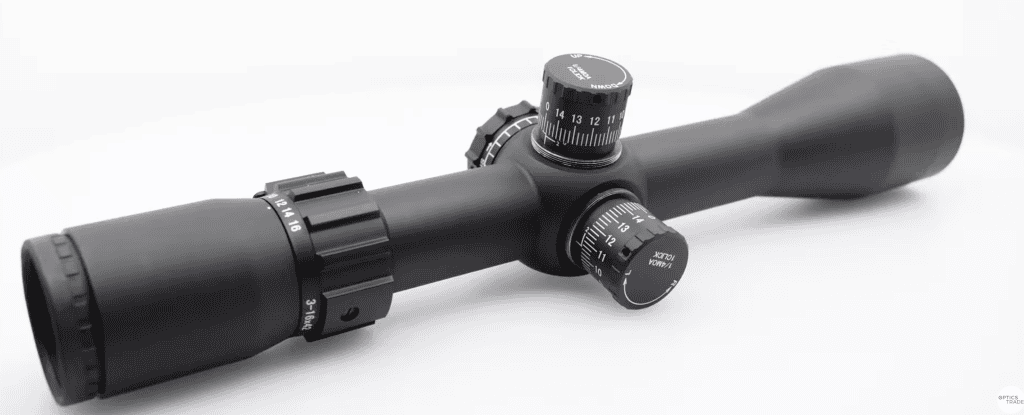
Sightron doesn’t get the attention that Vortex or Leupold commands, and that’s always struck me as odd because their glass punches well above what you’d expect. The S-TAC line is manufactured in the Philippines with optics designed by Sightron’s Japanese parent company, Kenko Tokina, and you can feel that heritage the moment you look through it. When I swapped the S-TAC onto the B.Mag after running the Bushnell, the difference in clarity was immediate. Colors looked truer, the image was sharper at the edges, and I could pick out details at 200 yards that required more effort through the Engage. Sightron’s ZACT-7 Revcoat multi-coating is doing real work here.
Glass That Made Me Look Twice
During a late October morning session with thin overcast light, I was shooting at some steel varmint silhouettes a neighbor had set at various distances across a pasture. Through the S-TAC at 12x, I could clearly resolve the edge of a four-inch steel ground squirrel at 225 yards. It sounds like a minor thing until you’ve squinted through cheaper glass trying to figure out if that dark spot is your target or a clump of dirt. The image stayed sharp from center to edge in a way that the Bushnell simply couldn’t match. I kept the Sightron at the same magnification I was running the Engage and the clarity gap was obvious.
Turrets Under the Caps
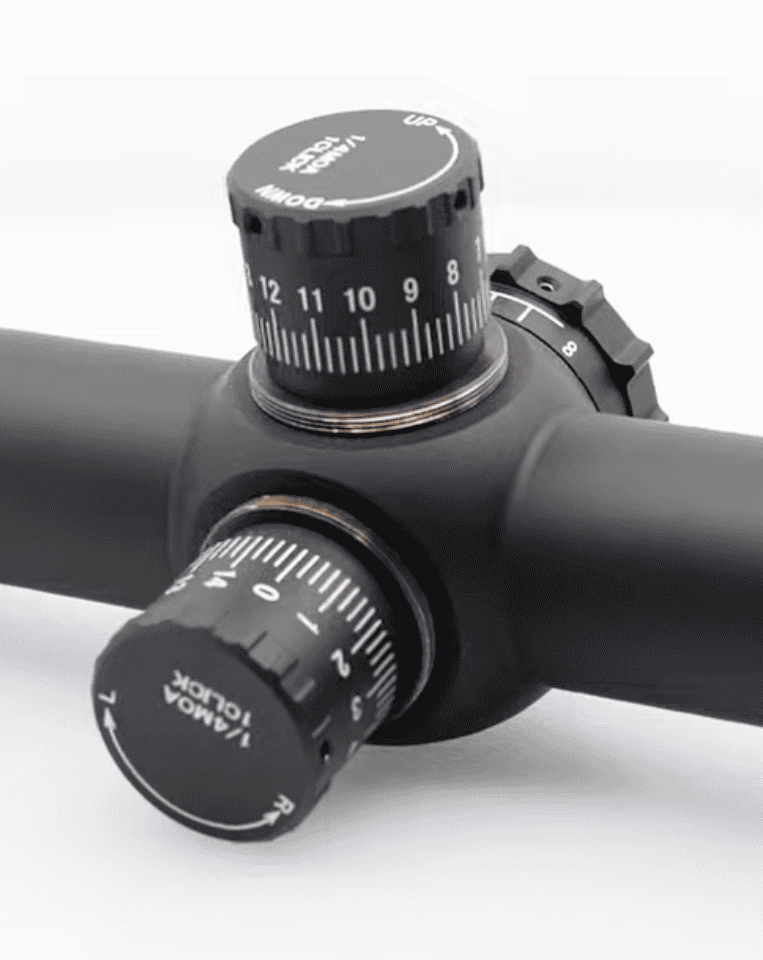
The capped target turrets are the part that will divide opinion. Underneath those caps, the clicks are outstanding. Crisp, distinct, and tactile enough that I could count adjustments by feel alone even with cold fingers. Sightron’s ExacTrack system earned that reputation honestly. But having to unscrew a cap every time I wanted to make a field adjustment slowed me down compared to the Bushnell’s exposed locking turrets. For a set-it-and-forget-it hunter who zeros at 150 yards and holds from there, the caps are actually a benefit since they protect against accidental bumps. For someone who likes to dial, it’s a compromise. Worth knowing which camp you fall into before you buy.
That Throw Lever Earned Its Keep
The flip-up throw lever built into the power ring isn’t something I expected to use much on a varmint gun, but it turned out to be genuinely useful. When a coyote materialized at 80 yards while I was parked on 16x watching a prairie dog town at distance, I was able to flip down to 6x in a hurry without fumbling for the power ring. The magnification change was smooth and positive. It’s a small thing, but Sightron designed it to pop up only when you need it and fold flat when you don’t, which means it doesn’t catch on anything during transport.
The MOA-3 Reticle at Varmint Distance
The MOA-3 uses hash marks spaced at 2 MOA intervals with a small floating center dot. Clean and uncluttered, 30 MOA of elevation markings below center. On prairie dogs and ground squirrels at the distances the .17 WSM handles, the reticle did its job without getting in the way. That said, Sightron chose thin crosshair lines on this reticle, and during one early morning setup before sunrise really broke through, I lost the aiming point against dark brush at lower magnifications. Above 8x it was fine, but this scope (like the Bushnell) has no illumination on the SFP model. If Sightron offered the S-TAC SFP with an illuminated reticle option, I’d bump this scope higher.
Premium Price on a Rimfire
Here’s the tension with the Sightron. The glass quality, the build, the turret feel, the compact profile at 12.9 inches, the consistently generous eye relief across the entire zoom range: it all genuinely justifies the premium price tag if you’re evaluating the scope in isolation. But you’re putting it on a rimfire that costs less than the optic. Plenty of shooters are comfortable spending that much on glass because they know they’ll move the scope to another rifle eventually. Others will look at the Bushnell delivering 85% of the optical experience for significantly less money and make the practical choice. Both perspectives are valid.
The data supported what I was seeing through the glass.
Field Test Data
| Test Parameter | Result |
|---|---|
| 100-Yard Group (5-shot, benched) | 0.65″ (Winchester 20gr Varmint HV) |
| 200-Yard Group (5-shot, benched) | 1.44″ |
| Tracking Test (20 MOA box) | Returned within 0.15″ of original POI |
| Parallax Elimination at 100 yds | Clean and precise; smooth single-turn adjustment |
| Low-Light Target Acquisition (overcast morning) | Noticeably brighter image than both competitors; lost reticle against dark backgrounds without illumination |
| Edge-to-Edge Clarity at 16x | Minimal distortion; sharper than both the Bushnell and Athlon at matched magnification |
Tested with: Savage B.Mag Stainless Heavy Barrel | Winchester Varmint HV 20gr Polymer Tip
Pros and Cons
PROS
|
CONS
|
Performance Ratings
Learn more about how I test and rate scopes.
If you plan to keep this scope for years and potentially move it between rifles, the Sightron is a genuinely smart purchase. The optical quality alone sets it apart from everything else in this test. But the price-to-platform ratio is hard to ignore when the Bushnell handles the .17 WSM’s practical needs for considerably less.
3. Athlon Argos BTR Gen 3 6-24×50 – Best for Extended Range Precision
A Long-Range Scope on a Short-Range Cartridge
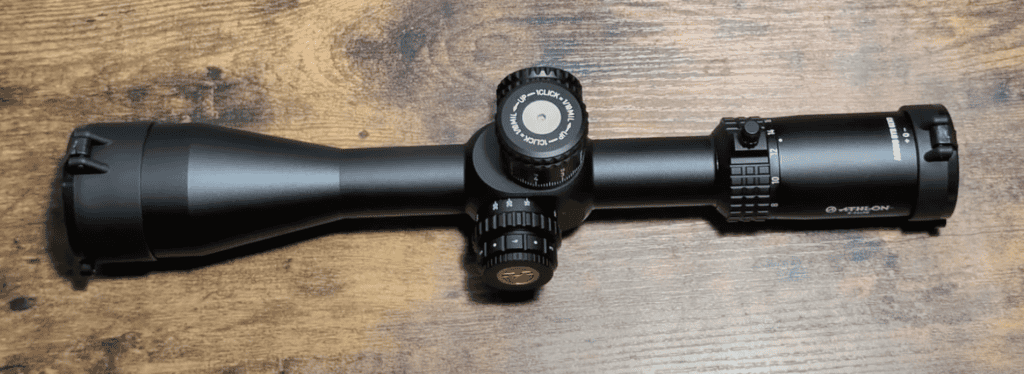
I’ll be upfront: the Argos BTR Gen 3 is designed for PRS shooters and long-range centerfire work. Putting it on a .17 WSM is a deliberate mismatch in some respects, and the moment I mounted it on the B.Mag that tension became physical. At over 30 ounces, this scope added ten extra ounces compared to the Bushnell, a 50% increase that was immediately obvious. The rifle went from a light, handy varmint gun to something decidedly front-heavy. I had to reposition my bipod and adjust my grip to keep things settled. If you’re walking fields looking for ground squirrels, you’re going to feel every ounce of that by mid-afternoon.
Where the Extra Magnification Mattered
That said, there’s a specific .17 WSM shooter this scope absolutely serves: the bench or bipod shooter who sets up in one spot and reaches out as far as the cartridge will go. At 20x on a calm day, I was placing shots on a prairie dog steel at 275 yards with a level of confidence neither the Bushnell nor the Sightron could match. The APLR11 reticle’s pyramid-style hash marks in the FFP stayed proportionally accurate regardless of where I had the power ring set, which meant I could range and hold without worrying about which magnification I’d forgotten to dial to. That’s the fundamental advantage of FFP on a varmint scope, and the Athlon delivers it at a price that makes most competing FFP options look overpriced.
Gen 3 Turrets Were a Real Upgrade
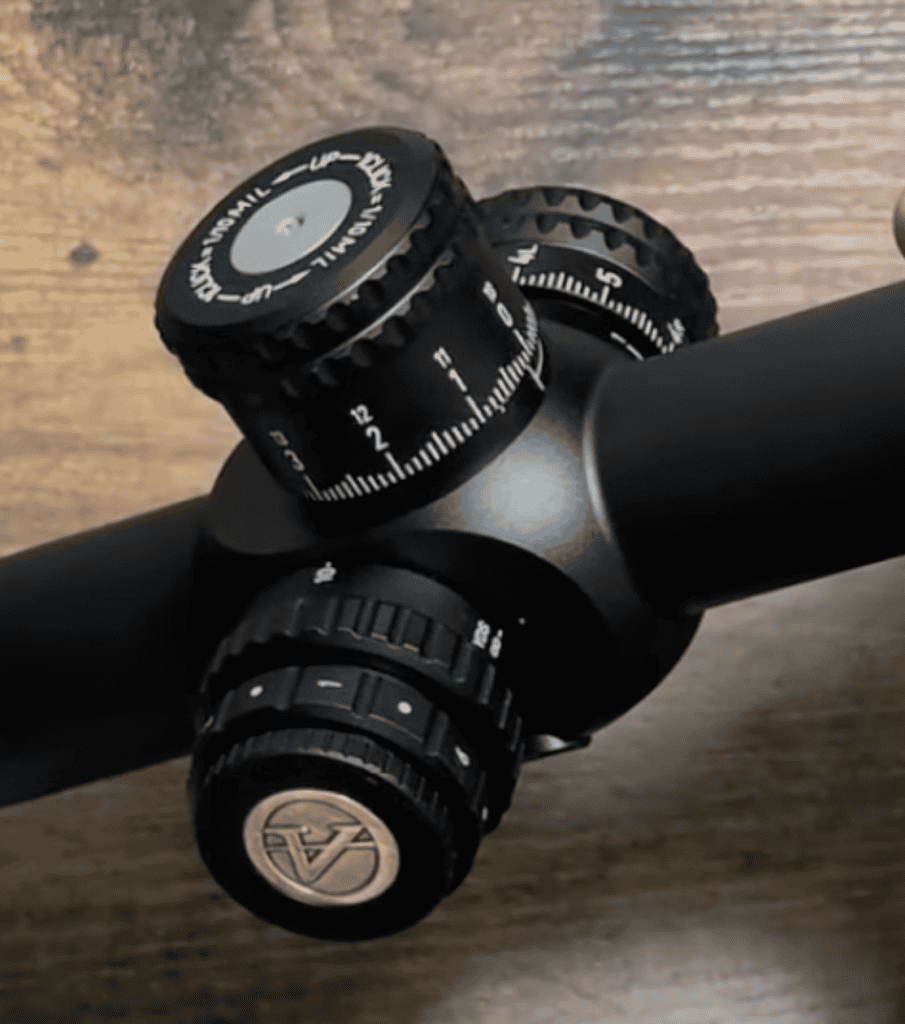
The Gen 3 improvements over the Gen 2 are mostly about the turrets, and they’re meaningful. Athlon redesigned them to be larger in diameter with better tactile feedback on each click. According to Athlon’s own customer service team, the glass between the Gen 2 and Gen 3 is identical; the upgrades focused on the turret feel, an integrated throw lever on the magnification ring, and new reticle options. The precision zero stop worked cleanly during my testing: I set my 150-yard zero, locked it, and could dial up for distance knowing I’d hit that firm stop on the way back down. For a scope at this price, that kind of mechanical refinement is genuinely impressive. The clicks weren’t as crisp as the Sightron’s ExacTrack system, but they were confident and consistent through a full rotation.
Illumination: Actually Useful Here
The Athlon is the only scope in this test with an illuminated reticle, and the off-position between each brightness setting is a smart design choice. During one overcast morning session, I flipped the illumination on at a moderate setting and the center of the APLR11 reticle popped against a shadowy treeline where both the Bushnell’s Deploy MOA and the Sightron’s MOA-3 had disappeared on me earlier. It’s not daylight-bright illumination (the red glow washes out in direct sunlight), but for the dawn and dusk shooting that varmint hunters actually do, it earned its place.
The Eyebox Demanded Discipline
Here’s where the Athlon asked the most of me. At higher magnifications, the 3.3 inches of eye relief combined with the narrow eyebox meant I had to be deliberate about my cheek weld every single shot. Any head movement, and the image would start to vignette or black out. On a bolt-action rimfire shot from a bench, this is manageable. But the few times I tried to use the Athlon in a less structured position (sitting against a fencepost, for instance), I fought to get a clean image quickly. The Sightron’s more forgiving eye relief made that kind of shooting far easier. And at 6x minimum, picking up a moving coyote inside 100 yards was noticeably harder than it was through the Bushnell at 4x or the Sightron at 3x. The restricted field of view at the low end is a real trade-off when your quarry doesn’t always sit still.
Field Test Data
| Test Parameter | Result |
|---|---|
| 100-Yard Group (5-shot, benched) | 0.69″ (Winchester 20gr Varmint HV) |
| 200-Yard Group (5-shot, benched) | 1.52″ |
| 275-Yard Group (3-shot, benched, calm conditions) | 2.35″ |
| Zero Stop Return Test | Returned to POI within 0.2″ after full dial-up and back |
| Illumination Visibility (overcast dawn) | Center reticle clearly visible against dark backgrounds at moderate setting |
Tested with: Savage B.Mag Stainless Heavy Barrel | Winchester Varmint HV 20gr Polymer Tip
Pros and Cons
PROS
|
CONS
|
Performance Ratings
Learn more about how I test and rate scopes.
The Athlon is the most capable scope in this test on paper, and if you shoot your .17 WSM exclusively from a bench or fixed position at extended distances, it delivers tools the other two simply don’t offer. But for the way most people actually carry and shoot a rimfire varmint rifle, the weight and ergonomic penalties are hard to overlook.
How I Actually Tested These Scopes
All three scopes went through testing on the same rifle: my Savage B.Mag Stainless Heavy Barrel in .17 WSM. I ran Winchester Varmint HV 20-grain Polymer Tip exclusively, around 350 rounds total across four range sessions and two field outings between mid-September and late October 2025. Testing happened at my family’s property outside Dallas and at a private range in Ellis County where I had access to steel out to 400 yards.
Each scope got zeroed at 100 yards from a bench with a front rest and rear bag, then run through a 20 MOA box test to confirm tracking. I shot groups at 100, 200, and (for the Athlon) 275 yards. Parallax was checked at each distance. I also spent time behind each scope during actual varmint shoots on prairie dog colonies and ground squirrel activity, because paper accuracy and field performance aren’t always the same thing.
Before settling on these three, I tested and rejected a Vortex Crossfire II 4-12×40 AO (the 1-inch tube limited internal adjustment and the AO ring was clumsy compared to side focus), a Simmons 8-Point 3-9×40 (glass quality was too poor for 200-yard work), and a UTG BugBuster 3-12×32 (eye relief was uncomfortably tight and it couldn’t handle the B.Mag’s sharp recoil impulse without shifting zero). The .17 WSM’s barrel heats up fast during rapid fire, so I cleaned the bore with solvent every 40-50 rounds to keep accuracy consistent, something I learned the hard way during my first session when groups started opening up after round 50.
Get more information on how I test optics here.
What Hunters Get Wrong About .17 WSM Scopes
Treating It Like a .22 LR
The .17 WSM shoots flatter and farther than any other rimfire, but plenty of shooters slap the same 3-9x scope they’d put on a .22 and call it done. At 200 yards, the targets you’re shooting at (prairie dogs, ground squirrels) are tiny, and 9x isn’t enough magnification to place shots confidently on a four-inch target at that distance. You need at least 12x on the top end, ideally 16x, to exploit what this cartridge can do.
Ignoring Parallax Requirements
Some budget scopes have fixed parallax set at 100 or 150 yards. That might work for deer-sized targets but it fails for varmint work. The .17 WSM demands a scope with adjustable parallax, and one that focuses cleanly below 50 yards. Prairie dogs at 75 yards with parallax set for 150 means your reticle is floating off your actual point of impact. Every scope in my top three has side parallax adjustment down to 10 yards for this reason.
Going Too Heavy on the Optic
I made this mistake myself with the Athlon. The .17 WSM lives in lightweight bolt-action rifles (Savage B.Mag, Ruger 77/17). A 30-ounce scope destroys the balance of a six-pound rimfire. If you’re shooting strictly from a bench, weight matters less. But most varmint hunters walk to their spot, set up, and shoot from field positions. Keep the scope under 24 ounces unless you have a specific reason not to.
Buying More Magnification Than the Cartridge Needs
The .17 WSM is effective to about 250 yards in realistic field conditions. A 6-24x scope pushes past what the cartridge can consistently deliver and locks you out of close-range versatility. That 4-16x range hits the sweet spot for this caliber: enough zoom for distance work, enough low end for scanning and close-in shots when something shows up unexpectedly.
Your Questions Answered
Can I use a .17 HMR scope on a .17 WSM rifle?
Physically, yes. But the .17 WSM shoots significantly flatter and reaches further than the HMR, so you’d be underserving the cartridge with a low-magnification scope. If you already own a good 4-16x scope on your HMR, it’ll work on a WSM. Just make sure it has adjustable parallax.
Do I need an FFP scope for the .17 WSM?
Not for most shooters. FFP is a genuine advantage if you’re constantly holding over at varying magnifications, but the .17 WSM’s practical range is short enough that parking an SFP scope at max power and using the reticle holdovers works fine. FFP adds cost and, in this test, weight.
Is the .17 WSM hard on scopes?
Harder than you’d expect for a rimfire. The .17 WSM produces a sharp, snappy recoil impulse that differs from the gentle push of a .22 LR. Cheap scopes with poor internal construction can lose zero. Stick with reputable brands and you won’t have problems, but skip the ten-dollar airgun scopes.
What magnification do I actually need for prairie dogs at 200 yards?
Minimum 12x to place shots reliably on a target that small. 14-16x is more comfortable and gives you margin for wind calls. Higher than 20x starts amplifying mirage on warm days, which is counterproductive at rimfire distances.
Which Scope for Your Hunting Style?
Prairie dog and ground squirrel colonies from a bench: The Bushnell Engage handles this perfectly. Light enough for a long session, enough magnification to reach 200+ yards, and the Deploy MOA holdovers mean you can work a colony without constantly touching turrets.
Walking fields and shooting from varied positions: The Sightron S-TAC’s compact size, wide FOV at 3x, and forgiving eye relief make it the best choice when you’re on your feet. The capped turrets also protect your zero when the rifle is getting bumped around during a hike.
Dedicated bench shooting at maximum effective range: This is the Athlon’s territory. The FFP reticle, zero stop, illumination, and 24x top end give you the precision tools to squeeze every yard out of the .17 WSM. Just accept that you’re building a bench gun, not a field rifle.
Predator control (coyotes and fox) on the property: The Bushnell or Sightron, depending on your budget. You need a scope that lets you quickly acquire a coyote at unpredictable distances, and both have the low-end magnification and field of view to do that. The Athlon’s 6x floor is too restrictive for this kind of shooting.
Disclosure
I purchased all three scopes with my own money through standard retail channels. ScopesReviews is reader-supported, and the affiliate links in this article may earn a small commission if you make a purchase. This doesn’t affect my testing, my rankings, or the price you pay. I’ve returned scopes from brands I have affiliate relationships with when they didn’t perform. The testing comes first.
Final Thoughts
The .17 WSM is a cartridge that rewards precision optics more than any other rimfire I’ve shot. It has the velocity and trajectory to reach out past 200 yards convincingly, but everything at that distance is small, and a scope that can’t resolve a four-inch target at 200 yards makes the cartridge’s potential irrelevant. That’s why the Bushnell Engage 4-16×44 took the top spot in this test. It pairs the right magnification range with locking turrets, a useful holdover reticle, and a weight that doesn’t punish the lightweight rifles this cartridge lives in. For what most .17 WSM shooters actually do in the field, nothing else I tested matched that combination.
The Sightron S-TAC proved that glass quality matters, even on a rimfire. I could resolve targets through the S-TAC that the other two scopes made me work harder to see. If you’re the type of shooter who values optical clarity above all else and plans to move the scope between platforms over the years, it’s money well spent. And the Athlon showed me that FFP, illumination, and zero stop at a budget price is genuinely achievable now, even if the weight penalty made it a poor fit for how most people carry a .17 WSM rifle.
One thing I didn’t expect going into this test: how much the .17 WSM’s sharp recoil impulse and barrel heat behavior influenced scope selection. The cartridge is a rimfire by classification but it asks centerfire questions of its optics. Every scope I recommended tracked reliably through 100-plus rounds and held zero through that snappy bolt cycling. The ones I rejected didn’t. If you’re mounting glass on a .17 WSM, buy from a manufacturer that stands behind their product with a real warranty. You may also want to check out my guides on the best scopes for .17 HMR and best rimfire scopes for related recommendations.
Mike Fellon is the founder of ScopesReviews and an optics specialist with 15+ years in precision shooting. A former Bass Pro Shops firearms advisor and NRA-certified instructor, he’s hands-tested 200+ rifle scopes across hunting and competition. Based in Dallas, Texas.