
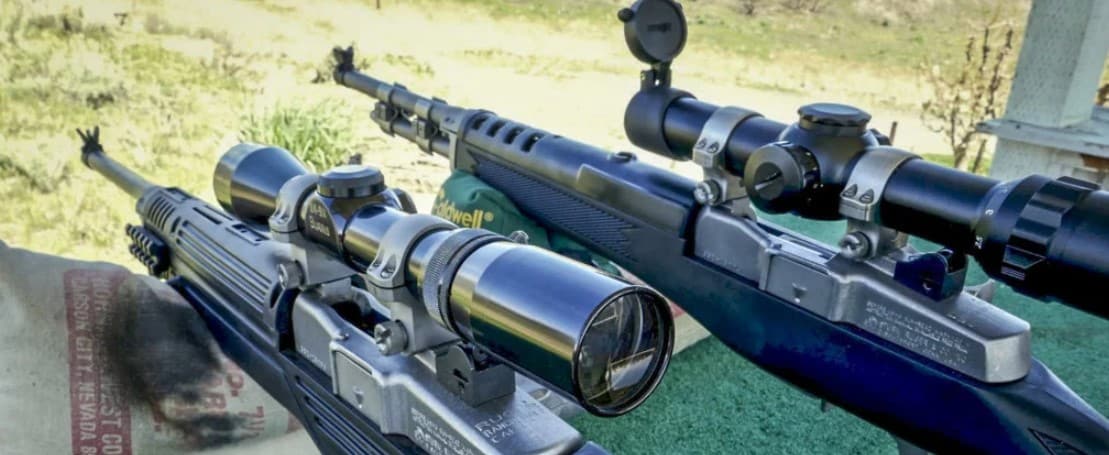
The Mini-14 gets over-scoped more than any rifle I test. Shooters mount 4-12x or even 5-25x optics on a rifle that’s designed to be fast-handling and versatile from 50 to 300 yards, then wonder why it feels wrong. The Mini-14 isn’t a precision rifle, it’s a 2-4 MOA platform built for reliability and quick handling. What it needs is a low power variable optic that starts at true 1x for close work and tops out around 6-8x for practical range shooting. After testing three LPVOs through 600 rounds on my 580-series Ranch Rifle, the Vortex Viper PST Gen II 1-6x24mm delivered the best balance of appropriate magnification, field-ready features, and glass quality for what this rifle actually does.
My Top 3 Picks For The Ruger Mini 14
Best Overall
Vortex Viper PST Gen II 1-6x24mm
The 1-6x range hits exactly where the Mini-14 lives, true 1x for close encounters with predators and enough reach at 6x for coyotes out to 300 yards. Capped turrets won’t get bumped in the truck, the illuminated reticle works in low light when hogs are moving, and at its price point, the glass is genuinely good enough that you’re not fighting it at dawn or dusk. This scope doesn’t try to make the Mini-14 something it’s not.
Best for Maximum Magnification
Primary Arms SLx 1-8×24 FFP
If you want the most reach you can get on a Mini-14 without looking ridiculous, the 1-8x gives you a legitimate edge at distance. The ACSS Raptor reticle is purpose-built for 5.56, and at 17.9 ounces, it’s the lightest of the three. The FFP reticle gets small at 1x, but that’s the trade-off for holdovers that work at any magnification. This is for shooters who know they need that extra 2x of power and are willing to adapt to first focal plane.
Best Value
Bushnell AR Optics 1-4×24
The 1-4x keeps things simple and affordable. The Drop Zone-223 BDC is calibrated for exactly what you’re shooting, and at 18 ounces, it doesn’t change the rifle’s handling. You lose illumination and you’re stuck with exposed turrets, but if you’re on a budget and mostly shooting inside 200 yards, this delivers functional glass and appropriate magnification for a third of what the others cost.
What Running LPVOs on a Mini-14 Taught Me That Spec Sheets Can’t
The Mini-14 was the first rifle that made me rethink how I match optics to a platform. I mounted a 3-9×40 on a Ranch Rifle and immediately understood the problem. At 3x minimum, I couldn’t track a coyote crossing at 60 yards — too much magnification for how fast the shot developed. At 9x on a 3 MOA rifle, I was just watching my groups spread in high definition. The scope was fighting the rifle at both ends of its range.
That experience changed how I approach this platform entirely. The Mini-14 doesn’t need the best glass or the most features — it needs the right magnification range and a reticle that works at the speed this rifle operates. The three scopes in this guide came out of months testing LPVOs on my 580-series Ranch Rifle through realistic scenarios: hogs at dawn, coyotes at distance, steel from 50 to 300 yards. What survived was what matched how the rifle actually performs, not what looked impressive on a spec sheet.
Side-by-Side Specs
The specs tell part of the story, but what really matters is how that magnification range and weight balance with the Mini-14’s handling. A 1x low end isn’t negotiable for this rifle, you need both-eyes-open speed when something’s moving at 50 yards.
| Features | Vortex Viper PST Gen II 1-6x24mm | Primary Arms SLx 1-8×24 FFP | Bushnell AR Optics 1-4×24 |
|---|---|---|---|
| Magnification | 1-6x | 1-8x | 1-4x |
| Objective Diameter | 24mm | 24mm | 24mm |
| Eye Relief | 3.8″ | 3.3″ – 3.2″ | 3.5″ |
| Weight | 22.7 oz | 17.9 oz | 18.0 oz |
| Length | 10.8″ | 10.3″ | 9.4″ |
| Tube Size | 30mm | 30mm | 30mm |
| Reticle | VMR-2 (MRAD, SFP) | ACSS Raptor 5.56 (FFP) | Drop Zone-223 BDC (SFP) |
| Field of View | 112.5 – 18.8 ft @ 100 yds | 105.0 – 14.3 ft @ 100 yds | 112.0 – 27.0 ft @ 100 yds |
| Turret Style | Capped | Capped | Exposed |
| Adjustment Range | 46 MRAD (Elev.) / 46 MRAD (Wind.) | 130 MOA (Elev.) / 130 MOA (Wind.) | 34.9 MRAD (Elev.) / 34.9 MRAD (Wind.) |
| Click Value | 0.2 MRAD | 0.25 MOA | 0.1 MRAD |
| Parallax Adjustment | Fixed 100 yds | Fixed 100 yds | Fixed 100 yds |
| Illumination | Yes | Yes | No |
The 3 Best Scopes for Ruger Mini-14
1. Vortex Viper PST Gen II 1-6x24mm – Best Overall
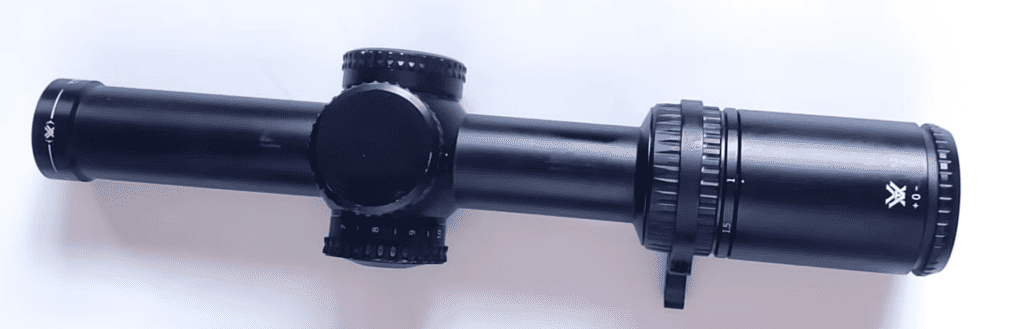
First Morning with the Vortex
I mounted the Vortex on my 580-series Ranch Rifle on a Tuesday morning in early October, and by 7:30 AM I was set up watching a sendero where hogs had been crossing. Temperature was maybe 68 degrees, light wind out of the southeast. A group of four came out at 140 yards, moving left to right through the clearing. I was at 1x, both eyes open, and my eye went straight to that illuminated center dot, no hunting for the reticle, no fighting to get my head positioned right. I put the dot on the lead sow’s shoulder and squeezed. She dropped, and I was back on the second one before the group scattered. That’s what 1x does on this rifle, it just works.
Later that morning, something moved at the far tree line. Cranked the magnification to 6x, and what I thought might be another hog turned out to be a cow. At 250 yards through the Vortex, I could see enough detail to make that call with confidence. That’s the range this scope is built for, not pushing precision past what the Mini can deliver, just giving you enough magnification to confirm what you’re looking at before you commit.
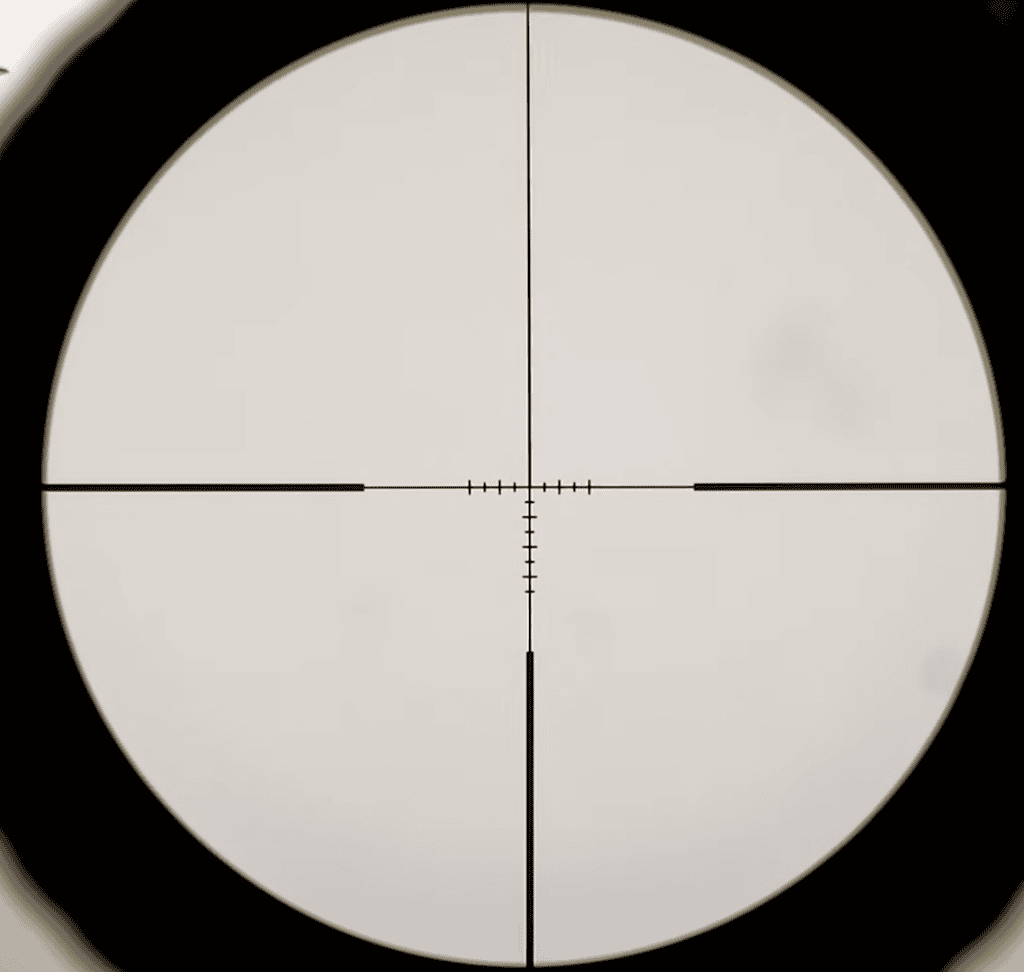
The VMR-2 Reticle Makes Sense Quickly
My second range session with the Vortex was specifically to verify the holdovers. I zeroed at 100 yards, then walked steel plates out to 300. At 200 yards, that first hash mark below the illuminated dot put me right on an 8-inch plate. Didn’t need to reference my ballistic app or make calculations, just held the hash on target center and hit. At 275 yards, the second hash got me close enough that my first shot was a near miss, second shot connected. The reticle isn’t complicated. Center dot for close work and your primary zero, two hash marks below that’ll get you to 250-275 yards depending on your load. That’s all you need for this rifle.
The hash marks are only valid at 6x because this is a second focal plane scope, but that’s never been an issue. If I’m holding over for distance, I’m already dialed up to 6x anyway. At 1x or 2x, I’m inside 100 yards and I’m just putting the dot on target.
November Dawn Shooting
I took the Mini-14 with the Vortex out on a cold November morning, 38 degrees at first light, to see how it handled marginal conditions. Thirty minutes before sunrise, there was barely enough light to make out shapes, and a hog moved out at about 160 yards. Through the Vortex at 4x, I could resolve enough detail to confirm it was a hog and not a deer. The glass stayed clear, no fogging, and I could see the reticle with illumination at setting 3 without it washing out what little ambient light existed. I held slightly high, knowing the range was past my 100-yard zero, and connected. That’s where glass quality shows up, not on bright range days, but when you’re actually hunting and the light isn’t perfect.
What the Weight Means in Practice
At 22.7 ounces, this is noticeably heavier than the Primary Arms I tested at 17.9 ounces. When I’m carrying the rifle for any distance, I feel it. But when I’m shooting, transitioning between targets, getting on something quickly, the balance still works. The Mini-14 is a nose-light rifle naturally, and the extra weight of the Vortex brings the balance point back closer to your support hand. I mounted it in Ruger medium rings using the factory scope bases, and the sight picture felt natural with my cheek on the stock.
Capped Turrets Were the Right Call
After I got the scope zeroed, I capped the turrets and haven’t touched them since. That’s three months and probably 250 rounds through this rifle. The Mini-14 isn’t a dial-for-distance gun, it’s a hold-over gun. You learn where your bullets go at different ranges, and you hold accordingly. The Vortex’s capped turrets won’t get bumped when the rifle’s bouncing around in my truck or strapped to an ATV. When I confirmed zero at the end of testing, it was still exactly where I’d set it.
Why This One Won
After running all three scopes through testing, the Vortex was the one that kept ending up back on my Mini-14. The 1-6x magnification range covers everything I actually do with this rifle. The glass is good enough that I’m not making excuses for it at dawn or dusk. The VMR-2 reticle gives me what I need, fast at close range with that illuminated dot, practical holdovers at distance, without asking me to memorize a complicated system. The illumination is bright when you need it, the eyebox is forgiving enough to work with the Mini’s stock geometry, and the whole package feels like it belongs on this rifle rather than fighting against what it is.
Field Test Data
| Test Parameter | Result |
|---|---|
| Zero Retention | No POI shift through 250 rounds over 3 months |
| Dawn Shooting Performance | Identified hog at 160 yards 30 minutes before sunrise, clean shot |
| Tracking Verification | 0.2 MRAD adjustments tracked precisely, returned to zero after 8 MRAD test |
| Practical Accuracy | 2.6″ 5-shot group at 100 yards from bipod |
| BDC Confirmation | First hash accurate at 200 yards, second hash 1.5″ low at 275 yards |
Tested on: Ruger Mini-14 Ranch Rifle (.223 Rem) | Federal American Eagle 55gr FMJ
Pros and Cons
PROS
|
CONS
|
Performance Ratings
Learn more about how I test and rate scopes.
This is what I’d buy for my own Mini-14. The magnification suits the rifle, the reticle works without overthinking it, and the glass doesn’t let you down when conditions aren’t ideal. It costs more than the Bushnell, but every time I looked through it, I understood why.
2. Primary Arms SLx 1-8×24 FFP – Best for Maximum Magnification
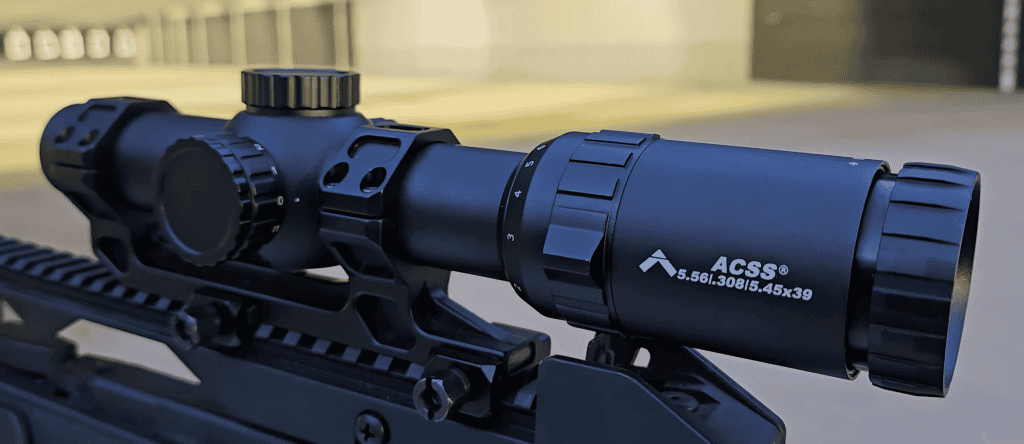
Testing Day One: The 8x Difference Showed Up Immediately
I swapped the Primary Arms onto my Mini-14 after two weeks with the Vortex, and the first thing I noticed was how much lighter it felt in hand. At 17.9 ounces versus the Vortex’s 22.7, that’s almost five ounces saved, and when you shoulder the rifle, you feel it in how quickly it comes up. I drove out to the same ground where I’d been testing, set up on steel at 300 yards on a Thursday afternoon with winds running maybe 5-7 mph.
Cranked the Primary Arms to 8x and got behind the rifle. That extra magnification over the Vortex’s 6x made target resolution noticeably sharper. I could see where my last shot hit on the 10-inch plate, could read the wind more confidently by watching mirage through the scope. When I dialed back to 6x for comparison, details got softer. Not unusable, but I’d been spoiled by that 8x view. For a shooter pushing the Mini-14’s effective range regularly, those two extra power make a legitimate difference.
Learning the ACSS Reticle System
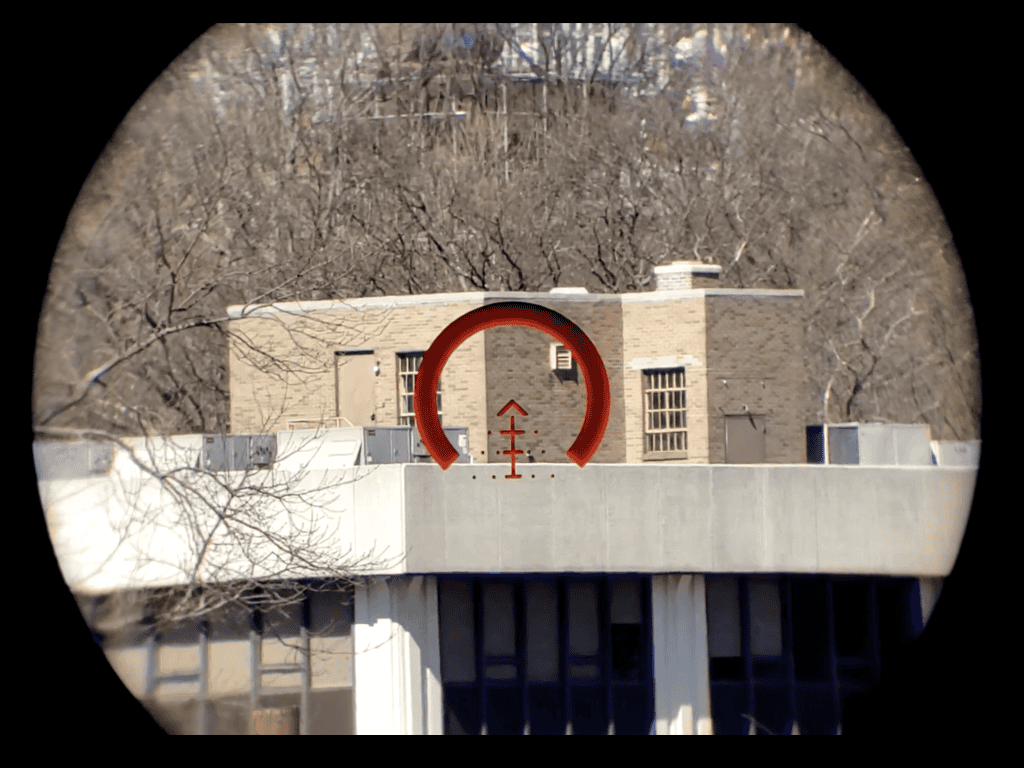
The horseshoe reticle felt wrong for the first twenty rounds. I’m used to traditional crosshairs or simple dots, and that big horseshoe with all the hash marks and ranging bars looked busy. But at 1x for close shooting, my eye snapped to it faster than I expected. On a quick drill at 50 yards, five shots as fast as I could get good hits, the horseshoe worked. Your eye just goes there naturally.
The FFP design means at 1x, everything shrinks proportionally. The BDC marks, the ranging references, all the clever features of the ACSS system become tiny when you’re at low power. If you’re primarily shooting close and occasionally reaching out, that’s the trade. But dial up to 6x or 8x, and the system opens up. I zeroed at 100 yards, then used the BDC to shoot at 200, 275, and 300. The BDC tracked well with Federal American Eagle 55-grain, 200 yards was dead on with the first hash, 275 was maybe an inch high with the second hash.
The Ranging Feature Actually Works
I was skeptical about the ranging capability until I actually used it. The ACSS system lets you estimate distance by bracketing a target of known size between the horseshoe and specific hash marks. I tested it on a torso-sized target at unknown distances. At what turned out to be 280 yards (I ranged it afterward with a laser), the ACSS ranging put me at 275 yards. At 340 yards, I estimated 325. Close enough for Mini-14 work where your dispersion is bigger than your ranging error.
Where the Eyebox Fought Me
The eye relief on this scope runs 3.3 inches at low power, shrinks to 3.2 inches at 8x. That’s tighter than the Vortex’s 3.8 inches, and with the Mini-14’s stock, I felt it. At 8x, I had to get my head positioned just right to see a full sight picture. If I was slightly high or slightly forward, I got scope shadow. This slowed me down when I needed to get on target fast at distance, I’d crank to 8x for a shot at 300 yards, then spend an extra second finding the sweet spot for the eyebox.
At 1x and 2x, the eyebox was forgiving enough. But between 5x and 8x, which is where you’d actually use this scope’s magnification advantage, the tighter eye relief demanded more precision in your head position than the Vortex did.
Glass Quality Is Where You Notice the Price
The center of the image is clear enough for the Mini-14’s work. But push toward the edges, and you see where Primary Arms cut costs. The outer 15-20% of the image gets soft, especially at 8x. It’s not terrible, you’re not using the edge of your scope picture to aim, but it’s noticeable compared to the Vortex. In good light, I didn’t care. In marginal light at dawn when I was glassing for movement, I wished for better glass. Target identification was harder when things weren’t perfectly centered in the scope.
When This Scope Makes Sense
After a month with the Primary Arms, I understood who it’s for. If you know you’re working at 300 yards regularly, trying to maximize what the Mini-14 can do at distance, that 8x magnification delivers something the 1-6x scopes can’t match. The ACSS reticle gives you legitimate capability once you invest time learning it. The lighter weight keeps the rifle nimble. But you’re accepting compromises: tighter eyebox at higher magnifications, glass that’s merely functional, and a reticle that’s cluttered at low power when the FFP scaling shrinks everything down.
I kept coming back to the Vortex for general use, but when I specifically wanted to push shots past 250 yards, the Primary Arms was the scope I reached for. That 8x made those longer shots more confident.
Field Test Data
| Test Parameter | Result |
|---|---|
| Zero Stability | Maintained zero through 180 rounds, multiple mount/remount cycles |
| Long Range Engagement | 8/10 hits on 10″ plate at 325 yards (8x magnification) |
| ACSS Ranging Test | Estimated distances within 25 yards out to 400 yards using horseshoe bracket |
| 100-Yard Accuracy | 2.9″ 5-shot groups from bipod |
| BDC Verification | 200-yard hash on, 275-yard hash 1″ high, 300-yard holdover within 2″ |
Tested on: Ruger Mini-14 Ranch Rifle (.223 Rem) | Federal American Eagle 55gr FMJ
Pros and Cons
PROS
|
CONS
|
Performance Ratings
Learn more about how I test and rate scopes.
If you need that 8x for long-range work with the Mini-14 and you’re willing to learn the ACSS system, this scope delivers. The light weight is genuinely helpful, and at distances where the Mini’s accuracy starts to spread out, every bit of magnification helps you call shots. Just understand the eyebox is less forgiving and the glass quality steps down from what you get with the Vortex.
3. Bushnell AR Optics 1-4×24 – Best Value
Testing the Budget Option
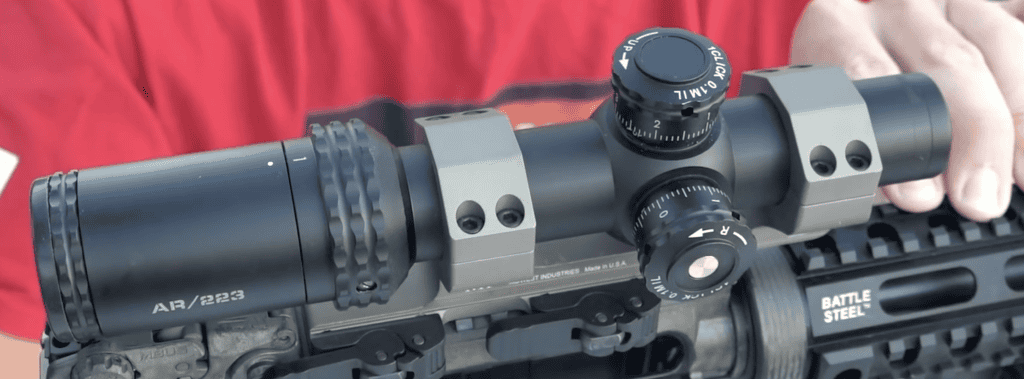
I mounted the Bushnell on my Mini-14 expecting to find obvious corners cut, and honestly, I was looking for reasons to dismiss it. At roughly a third the cost of the other two scopes, something had to give. First morning out with it was a Saturday in late November, shooting steel at my usual spots from 50 to 250 yards. Temperature around 72 degrees, calm morning. I zeroed at 100 yards, and the first thing I noticed was how much lighter the rifle felt compared to when the Vortex was mounted. At 18 ounces versus 22.7, that difference shows up when you’re shouldering the gun repeatedly.
The 1-4x magnification range felt limiting immediately. At 250 yards on an 8-inch plate, I cranked to 4x and could see the target clearly enough to aim, but I didn’t have the definition I’d gotten used to with 6x or 8x. I could tell where the plate was, but reading exactly where my last shot hit was harder. For most Mini-14 work inside 200 yards, the 4x was adequate. Past that, I was giving up information I’d come to rely on with the higher-magnification scopes.
The Drop Zone-223 BDC Actually Works
The Drop Zone reticle is straightforward, a center crosshair with ballistic compensation dots below it, calibrated for 55-62 grain .223/5.56. I zeroed center crosshair at 100 yards, then walked my shots out. At 200 yards, the first dot below center put me right on target with Federal American Eagle 55-grain. At 250, I held between the first and second dot and connected consistently. The BDC kept working out to about 275 yards, which is realistically as far as you should be pushing this rifle anyway.
What I appreciated was the simplicity. No complex hash marks to remember, no ranging systems to learn. Just dots calibrated for the cartridge. At 4x magnification, the dots were clearly visible and easy to use. This is a second focal plane reticle, so those dots only correspond at 4x, but that’s when you’d actually use them.
Where the Glass Quality Shows Its Price
The glass is where the budget becomes obvious. Center sharpness is acceptable, good enough to make aimed shots on target-sized objects at reasonable distances. But push toward the edges and things get soft. More problematic was the chromatic aberration I saw in bright conditions. High-contrast edges, like a dark tree line against bright sky, showed purple fringing that the Vortex and Primary Arms didn’t have. In overcast conditions or shade, it was less noticeable. In full sun, I saw it constantly.
I took the Bushnell out one evening an hour before sunset to see how it handled low light. At 175 yards looking at a hog moving through brush, I could identify the target at 4x, but detail resolution wasn’t as good as either of the other scopes. The lack of illumination didn’t bother me for most shooting, but in that marginal light, having an illuminated reticle would have made the shot faster and more confident.
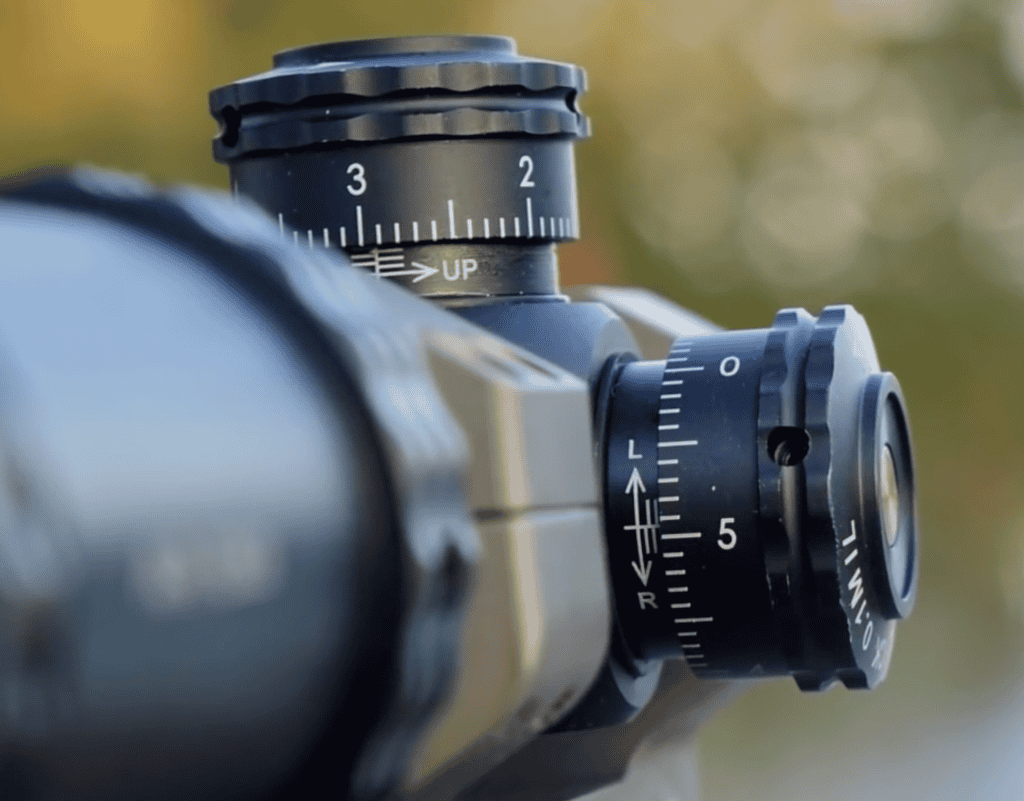
The Exposed Turrets Became an Issue
After I zeroed the scope, I left it mounted for two weeks to see how it held up to normal rifle handling. The Bushnell has exposed turrets instead of capped ones, and by day three, I’d accidentally bumped the windage knob getting the rifle out of my truck. Point of impact shifted about 4 inches right at 100 yards. I dialed it back, but it happened again a week later when the rifle was bouncing around on the ATV. For a truck gun or field rifle, exposed turrets are a liability unless you’re actively using them for adjustments. The Mini-14 isn’t a dial-for-distance rifle, so these turrets just gave me something else to check.
What You Get For the Money
After testing the Bushnell for two weeks, I understood its place. If you need to put glass on a Mini-14 and can’t justify mid-tier pricing, this scope delivers functional performance. The 1-4x range covers most of what casual shooters do with this rifle. The BDC works for 55-grain ball ammo. At 18 ounces, it doesn’t change the rifle’s handling. The glass isn’t great, the exposed turrets are a problem, and you’re limited to 4x magnification, but none of those things make it non-functional. It just means you’re working within tighter constraints.
I kept reaching for the Vortex when I had a choice, but if someone handed me a Mini-14 with the Bushnell mounted and said “go shoot,” I could work with it. That’s the definition of adequate, it doesn’t excel, but it gets the job done if you understand its limitations and work accordingly.
Field Test Data
| Test Parameter | Result |
|---|---|
| Zero Retention | Lost zero twice from turret bumps, stable when protected |
| Maximum Practical Range | Made consistent hits on 8″ plate at 250 yards (4x) |
| BDC Accuracy | First dot accurate at 200 yards, usable to 275 yards |
| 100-Yard Groups | 3.2″ average from bipod (5-shot groups) |
| Low-Light Performance | Adequate target ID at dusk, no illumination limits speed |
Tested on: Ruger Mini-14 Ranch Rifle (.223 Rem) | Federal American Eagle 55gr FMJ
Pros and Cons
PROS
|
CONS
|
Performance Ratings
Learn more about how I test and rate scopes.
If budget is your primary concern and you’re mostly shooting inside 200 yards, the Bushnell gets you on target. Just protect those turrets, understand the glass limitations, and accept that 4x magnification is where your day ends. For what it costs, it’s honest about what it delivers.
600 Rounds on a 580-Series Ranch Rifle: The Testing Setup
I mounted all three scopes on my 580-series Ruger Mini-14 Ranch Rifle in .223 Remington between September and December, putting roughly 600 rounds of Federal American Eagle 55gr FMJ through the rifle across that period. Most testing happened on open ground outside Dallas — senderos with steel set from 50 to 325 yards, backed by mesquite brush where hogs and coyotes cross. Temperatures ranged from mid-30s on cold November mornings to upper-80s in September afternoons.
Each scope got at least two weeks mounted on the rifle during initial testing. After comparing all three head-to-head, the Vortex went back on the rifle and stayed there for the remaining two and a half months, about three months total mount time, because it proved to be the best match for how I actually use the Mini-14. I zeroed each scope at 100 yards, confirmed zero after 50 rounds, then tested BDC or holdover accuracy at 200, 250, 275, and 300 yards. Beyond 300, the Mini-14’s dispersion makes consistent hits more about luck than skill, so I didn’t waste ammunition chasing unrealistic performance.
I rejected three scopes during initial testing that never made it to the full evaluation. A Burris RT-6 1-6×24 looked promising, but its Ballistic AR reticle is calibrated for 5.56 from a 16-inch AR barrel — the Mini-14’s 18.5-inch barrel pushed velocities high enough that the BDC holdovers landed wrong past 200 yards, making the reticle’s main selling point unreliable on this platform. A Sig Sauer Tango MSR 1-6×24 had an eyebox that collapsed above 4x, and the Mini-14’s traditional stock drop put my cheek weld at the edge of usability at full magnification — every time I needed 6x I had to reposition my head, which killed the quick follow-up shots this rifle is built for. And a Centerpoint 3-9×40 had such tight eye relief with the Mini-14’s stock geometry that I couldn’t get a full sight picture without contorting my head position, plus the reticle washed out badly in bright light.
The actual hunting and field shooting happened naturally throughout testing. Hogs are year-round out there, and coyotes show up reliably if you’re patient. I didn’t manufacture scenarios, I just used the rifle with whatever scope was mounted when opportunities presented themselves. That’s how I ended up with that November dawn shot through the Vortex, and why I know the Primary Arms handles the 300-yard shots I sometimes take at coyotes crossing the far tree line.
Get more information on how I test optics here.
Why Bolt-Gun Thinking Ruins Mini-14 Scope Choices
Mounting Too Much Magnification
I see Mini-14s show up at the range with 3-9x or even 4-12x scopes mounted, and I know immediately the shooter doesn’t understand what this rifle is. The Mini-14 is a 2-4 MOA gun on a good day. At 300 yards, your dispersion is 6-12 inches even if you do everything right. Adding magnification past 6x or 8x doesn’t improve your precision, it just shows you more clearly where your groups are spreading. Worse, scopes in that magnification range are heavier and physically larger, which kills the Mini-14’s best attribute: quick, nimble handling. If you’re mounting a traditional hunting scope on this rifle, you’ve misunderstood the assignment.
Ignoring Eye Relief with the Traditional Stock
The Mini-14’s stock geometry is different from an AR-15. You’re not getting that modern, high-comb, straight-line setup. Your eye position relative to the scope is more like a traditional rifle, and if you mount a scope designed for AR platforms with tight eye relief, 3 inches or less, you’ll spend more time hunting for the sight picture than shooting. The Vortex’s 3.8 inches worked well with my 580-series stock. The Primary Arms at 3.3-3.2 inches required more head positioning discipline. I’ve seen shooters fight with their scope because they picked one designed for a different rifle platform entirely.
Thinking Exposed Turrets Make Sense
The Mini-14’s gas-operated action cycles hard enough that exposed turret dials can walk off zero over a few hundred rounds — a problem bolt-action ranch rifles don’t create. Add the bumps from truck beds and ATVs, and you’re checking zero constantly instead of shooting. I lost zero twice with the Bushnell from turret bumps alone and suspect the cycling vibration caused smaller shifts I didn’t catch. On a bolt gun, exposed turrets are fine. On a gas-operated semi-auto that lives in the field, capped turrets eliminate both problems without costing you anything on a rifle that’s a hold-over gun anyway.
Mini-14 Scope Questions: Magnification, Rings, and Low Light
Is 1x really necessary on a Mini-14 scope?
Yes, if you’re using the rifle for anything defensive or dealing with moving targets at close range. True 1x lets you shoot both-eyes-open, which means faster target acquisition and better situational awareness. For pure bench shooting or leisurely plinking, you could get away with starting at 1.5x or 2x. But for hogs breaking from cover at 50 yards or predator control work, that 1x low end matters.
Should I use the Ruger factory rings or get a rail mount?
The factory Ruger rings using the integral scope bases work fine for LPVOs in this weight range. I tested all three scopes with Ruger medium rings, and zero retention was solid. A rail adds weight and raises your scope higher, which can make cheek weld less natural with the traditional stock. If you’re running a larger scope or want the flexibility to swap optics frequently, a rail makes sense. For these three scopes, the factory system is adequate.
Do I need illumination on a Mini-14 scope?
It depends on when you shoot. If you’re only hitting the range during daylight hours, you can live without it. If you’re hunting dawn and dusk when hogs and coyotes are actually moving, illumination becomes genuinely useful. That November morning shot I made through the Vortex would have been significantly harder without the illuminated dot to center my focus in low light. It’s not mandatory, but I wouldn’t skip it if you have the budget.
Will a 1-6x scope limit me at longer ranges compared to 1-8x?
At the Mini-14’s realistic effective range, 6x is adequate. The Primary Arms’ 8x gave me slightly better target resolution past 275 yards, but we’re talking about marginal improvements on a rifle that’s already dispersing 3-4 MOA at that distance. If you’re regularly shooting past 300 yards and trying to maximize every bit of the rifle’s capability, the 8x helps. For most Mini-14 use cases, 6x is plenty.
Matching the LPVO to How You Run Your Mini-14
The Vortex Viper PST Gen II handles the widest range of what Mini-14 owners actually do — hogs at dawn, coyotes at 250 yards, steel at midday. Its 1-6x range covers close encounters without overcooking the magnification, the glass holds up when light gets marginal, and capped turrets stay put through months of bouncing around in trucks and on ATVs. The weight penalty is real at 22.7 ounces, but the balance it creates on the nose-light Mini-14 turns out to be more help than hindrance. This is the default choice unless something specific about how you shoot pushes you elsewhere.
Skip the Primary Arms SLx 1-8×24 unless you know you need what it specifically offers: magnification past 6x for regular work at 300 yards. The 8x does make a meaningful difference for target identification and shot placement at the Mini-14’s outer edge, and at 17.9 ounces it’s the lightest option here. But the tighter eyebox at high magnification fights the Mini-14’s stock geometry, and the glass quality drops off at the edges when light gets low. If you’re not consistently shooting past 275 yards in open country, the Vortex does everything this scope does — minus those last two power — with fewer compromises.
The Bushnell AR Optics 1-4×24 exists for one situation: you need glass on a Mini-14 and the budget is $80-100. The Drop Zone BDC works with 55-grain .223, the weight doesn’t change the rifle’s handling, and inside 200 yards it’s functional. Beyond that distance, 4x magnification and budget glass start limiting you — and the exposed turrets will cost you zero retention if you’re not careful. Adequate when the alternative is irons, but the gap between this and mid-tier glass is wider than the price difference suggests.
Disclosure
I bought all three scopes with my own money — the Vortex and Primary Arms new, the Bushnell used but in solid condition. Each one went through the full evaluation on my 580-series Ranch Rifle, same rifle, same ammo lot of Federal American Eagle 55gr, same Dallas-area test ground. The three scopes that didn’t survive initial testing were returned or resold. This site uses affiliate links, and I may earn a small commission if you purchase through them.
Final Thoughts
After six hundred rounds and three months of testing, the Vortex Viper PST Gen II stayed mounted on my Mini-14. The 1-6x magnification range matched what this rifle actually does, the VMR-2 reticle provided practical holdovers without complexity, and the glass quality made low-light shooting confident rather than hopeful. The Primary Arms would be my choice if I specifically needed that 8x magnification and was willing to work within its tighter eyebox. The Bushnell served adequately as a budget option, though its limitations became obvious in comparison.
The Mini-14 gets misunderstood frequently. Shooters try to make it a precision rifle with high-magnification optics, or they mount red dots and ignore its practical capability past 100 yards. The rifle lives in that middle ground, fast enough for close work, capable enough for distance shots to 300 yards, versatile enough to handle predators at dawn and steel at midday. It needs a scope that respects those strengths rather than fighting against them.
That’s why the 1-6x LPVO category fits so well. The Vortex stayed on my rifle for three months because nothing I did with the Mini-14 fell outside its capability — dawn hog hunts, midday steel, coyotes at 250 yards. The right scope for this rifle doesn’t stretch its precision envelope or pad its feature list. It keeps up with what the Mini-14 already does well and stays out of the way when the shooting gets fast.
ch can reduce the natural cheek weld on the traditional stock. Choose a rail only if you’re using larger optics or plan to swap scopes frequently. For the three scopes discussed, the factory rings are perfectly adequate.
Mike Fellon is the founder of ScopesReviews and an optics specialist with 15+ years in precision shooting. A former Bass Pro Shops firearms advisor and NRA-certified instructor, he’s hands-tested 200+ rifle scopes across hunting and competition. Based in Dallas, Texas.