
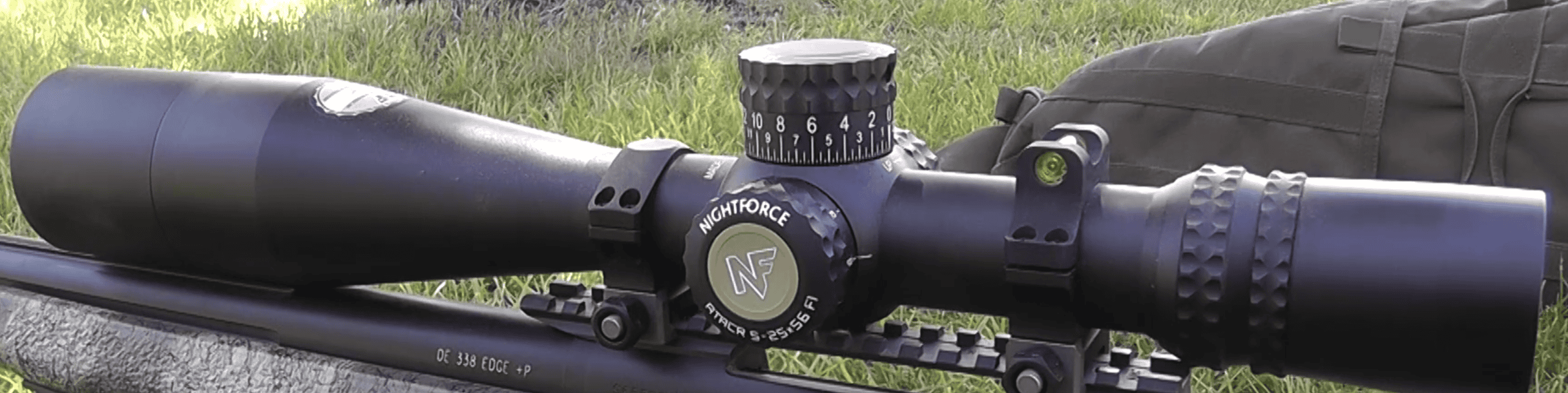
A precision scope has exactly one job that cannot be faked: put the bullet where the dial says it will go, this morning and three seasons from now. Everything else on the ATACR 5-25×56 F1 spec sheet is table stakes at the premium tier. ED glass, a 56mm objective, a 34mm tube, 35 MRAD of elevation travel and a ZeroStop are what this class of optic hands you as a matter of course, so the question I took to the range was never whether Nightforce had built a good scope. It was what this money removes that a competent mid-tier optic leaves in place.
Nightforce sells this one on mechanical honesty rather than a feature list, and the MIL-XT reticle in first focal plane is the current default for shooters who think in mils and want holds that stay true at any power setting. The 0.1 MRAD clicks match it. The whole package is built to be treated as equipment instead of jewelry.
I ran it for ten weeks on a chassis rifle, mostly on steel, in heat and in cold. What I came away with is not a story about a scope that impressed me with a trick. It is a story about a scope that removed a category of doubt I had stopped noticing I carried. There is also one control on this optic I would happily hand back to the engineering department.
Nightforce ATACR 5-25×56 F1 Review
The Tracking Test That Made the Rest of the Review Easy
Second morning with the scope mounted, before I shot at anything interesting, I taped a six-foot strip of butcher paper to a frame at 100 yards, hung a plumb bob off the top to get the line honest, and shot the tall-target drill. Three shots at the bottom mark, dial 10 MRAD of elevation, three more, dial back down, repeat. I did it three times across the morning. The measured spacing came out at 10 MRAD each run, to the limit of what I could resolve with a tape and a sharp pencil. No creeping shortfall, no scale error hiding in the travel.
That sounds like a boring result and it is exactly the result you are paying for. When I ran the box drill afterward, five MRAD square, three laps, the group came home on top of the original point of aim. The turret has a firm, audible detent that does not go vague under a gloved thumb, and the ZeroStop caught the dial every single time I spun it back down without looking. Over ten weeks I stopped counting revolutions entirely, which is a habit I had not realized was a habit until it went away.
The Afternoon at 900 Yards That Sent Me Back Down to 18x
Late July, roughly two in the afternoon, air shimmering off the gravel, I set up on a plate at 900 yards and cranked to full magnification because that is what the top end is for. It did not work. The reticle sat crisp and the plate boiled, and when I tuned the side focus to sharpen the plate the reticle picked up a soft edge. I spent six rounds fighting it before I gave up, backed down to 18x, and started hitting. The mirage was the villain, not the optic, but the lesson stands: on a hot afternoon the useful ceiling of this scope sat somewhere in the high teens, and I only got real value out of the 25x setting in cold, still air or on paper.
In the conditions where it can work, the glass is genuinely excellent. Edge to edge it stays flat, and color rendition does not shift when you run the power ring through its range. What impressed me more was the low-light behavior. One evening I stayed on the gun past legal light, well after I would normally have packed up, and a plate at 400 yards was still a distinct shape at 15x. The 56mm objective is doing real work there, and it is the honest justification for hauling a tube this size.
The Parallax Knob Is the One Thing I’d Send Back to Engineering
Nightforce put the DigIllum control in the center of the side parallax knob, and the whole assembly turns with almost no resistance. Working a barricade in practice, I set the fore-end down hard on a post, and when I got back behind the glass the picture at 25x had gone soft. The knob had rolled a good chunk of its range against the wood. It happened three separate times across the ten weeks, always after the scope contacted a prop or a bag, and after the first one I started checking parallax the way you check a safety.
The markings on that knob are also decorative more than useful. The number printed at my 700-yard setting was nowhere near 700. You focus by eye and ignore the engraving, which is fine once you know, and irritating on an optic at this price. The illumination itself is good, five intensities in red or green, and green against dark steel at dawn was noticeably easier on my eye than red. Operating that little button with cold fingers and a glove, though, is fussier than it should be, and the press-and-hold shutoff is not something you do quickly.
MIL-XT: Fine Enough to Aim With, Thin Enough to Lose at 5x
The MIL-XT is first focal plane and pure mil, which keeps it consistent with the 0.1 MRAD clicks. The center is a .05 MRAD floating dot, the wind holds are .2 MRAD hash marks, and there are floating dots at each mil down the vertical stadia. Chasing a wind call on steel, that .2 MRAD spacing is fine enough to make a real correction rather than a guess, and the alternating number sizes meant I could find my line under a shot timer without hunting for it.
First focal plane always costs you something at the bottom of the range, and here it costs a lot. At 5x the reticle is a whisper. In dim timber I could barely find the center dot without illumination. That is not a defect, it is physics, and it is worth knowing before you buy: this scope’s low end exists for finding your target, not for shooting it.
Fourteen Pounds Up a Shale Slope in September
On the bench and on a bipod, 38.0 oz on a chassis rifle is a stabilizing asset. Carried up a shale slope in September with an already heavy rifle slung on my back, it is a punishment. The whole rig came out around fourteen pounds and I felt every one of them in my shoulders. The 15.37″ length also eats rail, so plan your mounting before you order rings, and check that eye relief in the 3.35″ to 3.54″ band actually lands where your head goes on your stock. Mine did, with room to spare, but that window is not generous enough to solve a bad stock fit for you.
Why a 6.5 PRC Chassis Rifle and Ten Weeks of Steel Told Me What I Needed to Know
The scope went on a Seekins Precision Havak HIT in 6.5 PRC, fed Berger 156gr EOL Elite Hunter, and stayed there for 470 rounds across ten weeks. The pairing was deliberate. This is a scope built to be dialed hard at distance, so it needed a rifle with an integrated 20 MOA rail and a cartridge that stays supersonic far enough to make the far plates meaningful. High desert flats and a bench under an open shed gave me distances out past a thousand yards, midday heat in the nineties, and a stretch of mornings cold enough to leave frost on the chassis.
The first thing I do with any scope I intend to trust is the tall-target drill, and I do it because a mid-tier scope taught me not to skip it. A few years back I had one pass a box test cleanly and then measure short on a ten-mil tall-target run, a small percentage each mil that only added up to something visible once I stretched the travel. A box test only proves the scope comes back to where it started. It cannot see a scale error, because the error cancels itself on the return leg. That distinction is the difference between a scope that shoots well at 400 and one you can dial at 1,200, and it is the exact failure this ATACR had to rule out before anything else about it mattered.
Going in, my one open concern was optical: the forums are full of people who cannot get target and reticle simultaneously crisp at the top end, and I wanted to know whether that was the scope or the atmosphere. The rest of my testing sequence, and how I confirmed zero and validated tracking, follows my full testing methodology.
Performance Ratings
Field Test Data
| Test Parameter | Result |
|---|---|
| Tall-target tracking (10 MRAD dialed, 100 yds, 3 runs) | Measured 10 MRAD each run; no cumulative shortfall detectable by tape |
| Box drill (5 MRAD square, 3 laps) | Returned to original point of aim within 0.1 MRAD |
| ZeroStop return reliability | 40 of 40 blind spin-downs stopped on zero |
| Best 5-shot group, 100 yds (bipod and rear bag) | 0.52 in |
| Practical magnification ceiling, midday heat, 900 yds | 18x; 25x unusable in mirage, reticle and target would not sharpen together |
| Low-light usability | 400 yd plate still resolvable at 15x roughly 8 minutes past legal light, green illumination on low |
| Unintentional parallax knob shifts | 3 over 470 rounds, all after fore-end or scope body contacted a prop |
| Cold soak (4 hours, 19°F) | No zero shift; illumination retained last color and intensity setting |
| Total rounds fired | 470 over ten weeks |
Tested with: Seekins Precision Havak HIT | 6.5 PRC | Berger 156gr EOL Elite Hunter
Pros and Cons
PROS
|
CONS
|
The Shooter Who Actually Needs 35 MRAD and a 56mm Objective
Buy this if you dial for a living. Competition shooters, long-range hunters who commit to real distance, and anyone whose day involves spinning elevation up and back down under time pressure will feel the return immediately. The value here is not a feature you can point to on a shelf. It is the absence of a whole category of doubt: when a shot misses, you diagnose your wind call and your data, and the scope never enters the conversation. That is worth what it costs, but only if you shoot enough for it to matter.
Buy it if your rifle already lives on a bipod. On a chassis gun or a heavy-barreled bolt rifle, 38.0 oz and 15.37″ settle the whole package down. On a mountain rifle you carry all day, this scope is an act of self-harm. Nightforce makes lighter options and so does everyone else.
Skip it if your longest realistic shot is inside 500 yards. The 35 MRAD elevation range and the 25x top end are answers to problems you do not have. You would be paying a premium for travel you will never spend and magnification that mirage will take away from you most afternoons anyway.
Think hard if you shoot in low light at low power. The first-focal-plane MIL-XT at 5x is thin enough that a dim timber setting turns into a hunt for the center dot. Illumination fixes it, but you have to remember to switch it on, and the control is not the kind you find quickly with cold hands.
Disclosure
Some of the links on this page are affiliate links, and a purchase made through one of them may earn me a commission at no additional cost to you. Those relationships have no bearing on my testing, my ratings, or what I write here. Every observation above came out of the 470 rounds described, and I have said the same things about this scope’s parallax knob to people who were about to hand over their money.
Why I’d Pay the Weight Penalty Again
Buy it. If you shoot past 800 yards with any regularity and you dial rather than hold, the ATACR 5-25×56 F1 does the one thing that actually justifies premium money: it takes itself out of the equation. The tall-target run came back true, the ZeroStop never missed, the turret never went soft, and after ten weeks I trusted the dial the way I trust a good scale. That trust is not a feeling. I measured it.
The gripes are real and I am not going to soften them. That parallax knob spins off its setting if you look at it wrong, its yardage engraving is fiction, and 38.0 oz is a genuine cost on any rifle you carry rather than drive to. The MIL-XT at 5x is a rumor. None of that is a reason to walk away, because none of it touches what the scope is for, and every one of them is a thing you learn to work around inside a week.
What you should not do is buy this because it is the expensive one. The travel, the objective, and the top end are all answers to distance. If your shooting does not stretch out that far, the money is better spent on a lighter optic and more ammunition. For everyone else, this is the scope that stops being something you think about, and starts being something you simply use.
Mike Fellon is the founder of ScopesReviews and an optics specialist with 15+ years in precision shooting. A former Bass Pro Shops firearms advisor and NRA-certified instructor, he’s hands-tested 200+ rifle scopes across hunting and competition. Based in Dallas, Texas.