
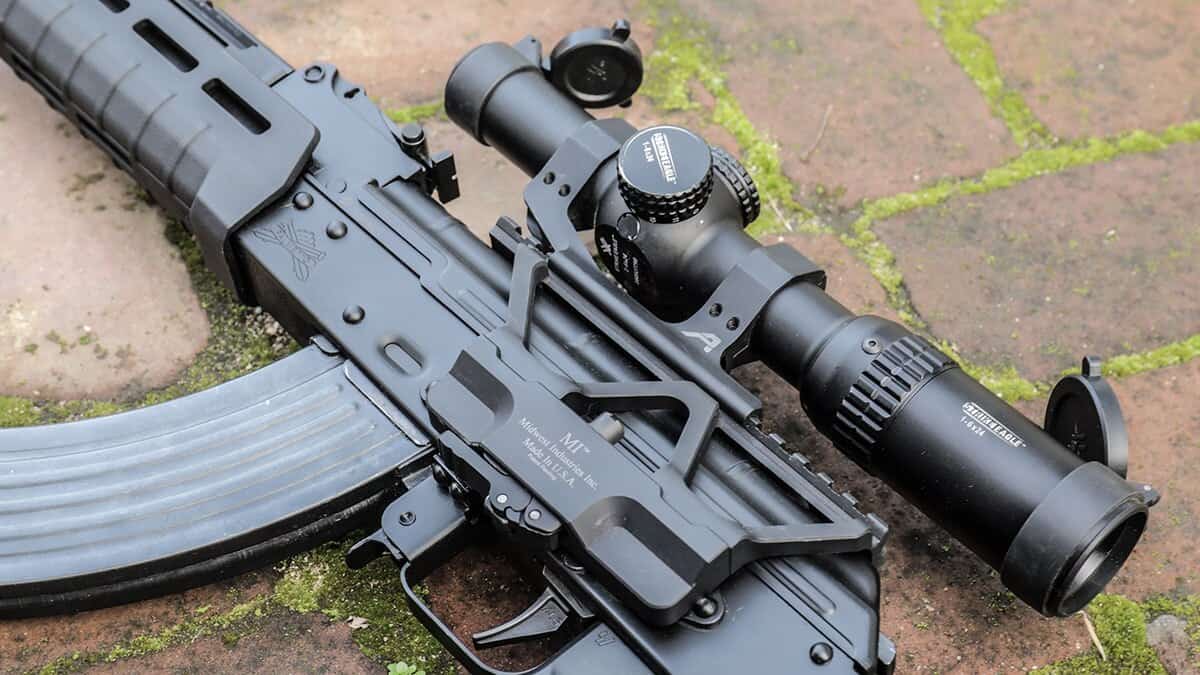
The AK-47 presents a scope mounting challenge that trips up more shooters than it should. That side rail mount positions your optic forward and off-center from the bore, which means eye relief becomes critical in ways it isn’t on an AR platform. Mount a scope with 3 inches of eye relief, and you’ll spend your range session hunting for a full sight picture. Go too high trying to clear the dust cover, and your cheek weld disappears. I’ve watched plenty of shooters at the range struggle with scopes that work great on bolt guns but turn their AK into an awkward, uncomfortable rifle.
After testing these four scopes on my Arsenal SAM7 over the past three months, the SIG SAUER Tango-MSR 1-8x24mm came out ahead. That 1-8x magnification range gives you actual versatility—true 1x for close work where the AK excels, plus enough power to push the 7.62x39mm out past 300 yards when you need it. The other three scopes each have their place, but the SIG solves the AK’s scope challenge better than anything else I tested.
My Top 4 Picks For The AK-47
Best Overall
SIG SAUER Tango-MSR 1-8x24mm
The 1-8x magnification range delivers exactly what an AK needs. You get true 1x for close quarters where this rifle was designed to work, but you’re not stuck there when targets push out to 300 or 400 yards. The MSR BDC reticle is actually useful with 7.62x39mm, and the eye relief works with side rail mounting without making you crane your neck forward.
Best Premium Glass
Vortex Viper PST Gen II 1-6x24mm
If you want the clearest glass and don’t mind paying for it, the Vortex delivers. That 1-6x range covers most of what you’ll actually do with an AK, and the optical quality is a step above everything else here. It’s heavy at 22.7 ounces, which changes how the rifle carries, but the image clarity justifies the weight if that matters to you.
Best for CQB
Trijicon AccuPoint TR-24 1-4x24mm
The fiber optic and tritium illumination means this scope doesn’t need batteries, ever. At 14.4 ounces, it keeps the AK’s handling characteristics intact. The 1-4x range is limiting if you shoot past 250 yards regularly, but for home defense or close-range work, the battery-free reliability and light weight make sense.
Best for Hunting
Leupold VX-Freedom 3-9x40mm
If you’re using your AK for hunting deer and hogs where shots start at 75 yards and don’t push past 250, this traditional hunting scope works. No true 1x means it’s not versatile for tactical use, but the 4.2 inches of eye relief at low power handles side rail mounting better than anything else I tested. Just know what you’re giving up.
Why You Can Trust My Recommendations
I figured out the AK mounting problem the expensive way. About nine years ago, a customer came into Bass Pro with an Arsenal AK and a Nikon scope he’d just bought—$400 scope, quality glass, worked great on his bolt gun. He wanted it mounted. I installed it on a side rail mount, we bore sighted it, and he left happy. Three days later he was back, frustrated. Couldn’t get a sight picture without pushing his face so far forward his cheek weld was gone, and the scope kept losing zero because the mount wasn’t solid enough.
That’s when I learned that AK scope mounting isn’t like anything else. The side rail positions optics forward, which demands more eye relief than most scopes offer. Mount height matters differently because of how the rail sits. And that forward position means the scope needs to be bulletproof because it’s taking more abuse than it would on a traditional mounting setup. I spent five years in the Bass Pro firearms department helping people avoid that exact mistake, and now I test scopes specifically for these problem cases. I’m an NRA-certified Range Safety Officer and firearms instructor, and I’ve tested over 200 rifle scopes across different platforms. The AK taught me more about what actually matters in scope selection than any precision rifle ever did.
Side-by-Side Specs
Here’s what matters when you’re comparing these four. Eye relief is critical with side rail mounting—anything under 3.5 inches creates problems. The magnification range determines whether you’re stuck at certain distances or actually have versatility.
| Features | SIG SAUER Tango-MSR 1-8x24mm | Vortex Viper PST Gen II 1-6x24mm | Trijicon AccuPoint TR-24 1-4x24mm | Leupold VX-Freedom 3-9x40mm |
|---|---|---|---|---|
| Magnification | 1-8x | 1-6x | 1-4x | 3-9x |
| Objective Diameter | 24mm | 24 mm | 24 mm | 40mm |
| Eye Relief | 3.93″ – 3.74″ | 3.8″ | 3.2″ | 4.2″ – 3.7″ |
| Weight | 18.6 oz | 22.7 oz | 14.4 oz | 12.2 oz |
| Length | 10.9″ | 10.8″ | 10.3″ | 12.39″ |
| Tube Size | 30mm | 30mm | 30 mm | 1 inch |
| Reticle | MSR BDC8 (SFP) | VMR-2 (MOA) (SFP) | Triangle Post (SFP) | Duplex (SFP) |
| Field of View | 124.8 – 19.6 ft @ 100 yds | 112.5 – 18.8 ft @ 100 yds | 94.2 – 24.1 ft @ 100 yds | 33.1 – 13.6 ft @ 100 yds |
| Turret Style | Capped | Capped | Capped | Capped |
| Adjustment Range | 100 MOA Elevation / 100 MOA Windage | 160 MOA Elevation / 160 MOA Windage | 90 MOA Elevation / 90 MOA Windage | 60 MOA Elevation / 60 MOA Windage |
| Click Value | 1/2 MOA | 1/2 MOA | 1/4 MOA | 1/4 MOA |
| Parallax Adjustment | Fixed | Fixed 100 yds | Fixed 100 yds | Fixed 150 yards |
| Illumination | Yes | Yes | Yes, Fiber Optics & Tritium (Battery-free) | No |
The 4 Best Scopes for AK-47
1. SIG SAUER Tango-MSR 1-8x24mm – Best Overall
What 1-8x Actually Means on an AK
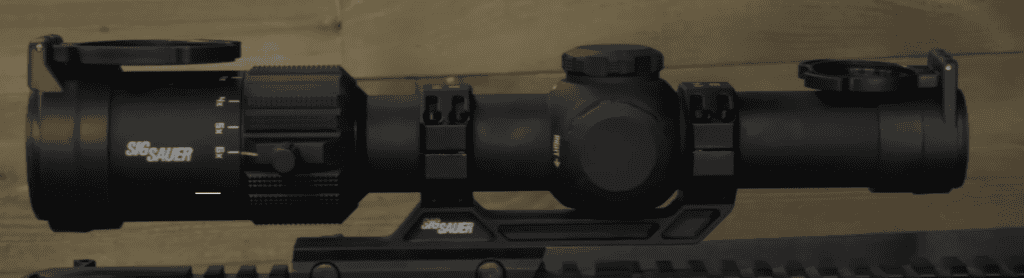
I mounted this scope on my Arsenal SAM7 in late September, when the mornings were starting to get cool and deer season was a month out. The 1-8x magnification range immediately solved the problem that every other AK scope I’ve tested creates: you’re either good up close or good at distance, never both. At 1x, the reticle is fast enough for steel at 25 yards. Wind it up to 8x, and I was tagging prairie dogs at 350 yards on my buddy’s ranch outside Amarillo in early November.
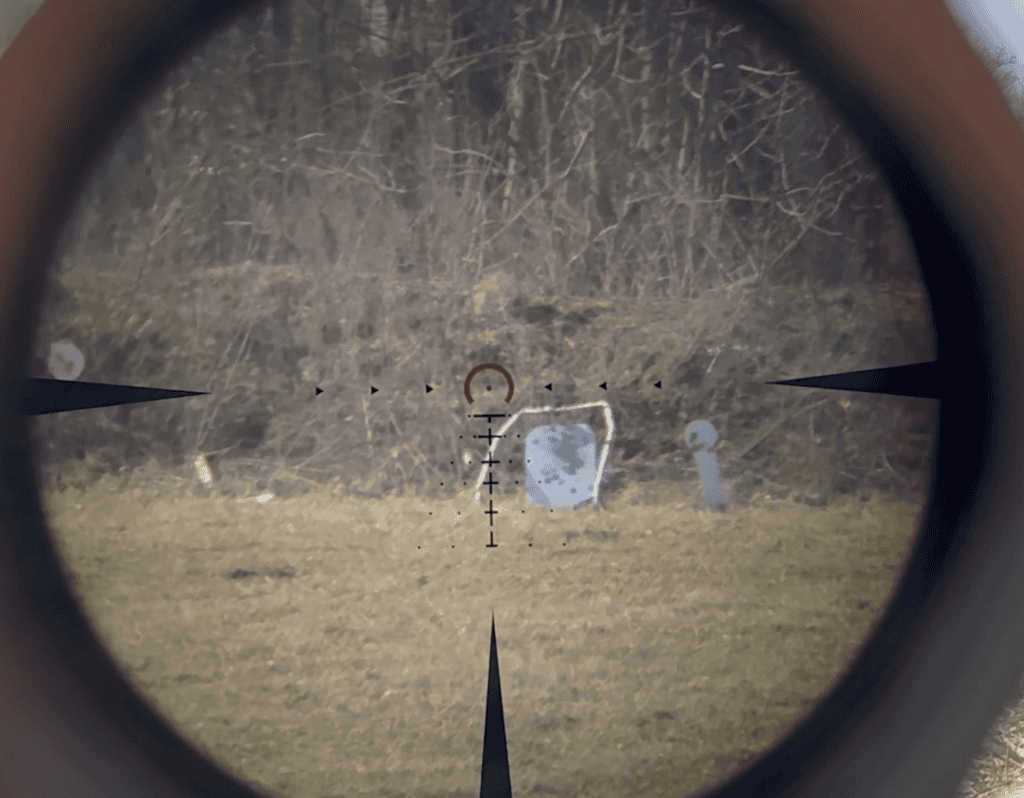
The MSR BDC8 reticle has that center floating dot inside a horseshoe, with hash marks stacked underneath. On 7.62x39mm, the holdovers aren’t calibrated for your exact trajectory, but they’re close enough that you’re not guessing. I zeroed at 50 yards and the first hash got me on steel at 200. The second put me close at 275. Past that, you’re dialing or Kentucky windaging, but you’ve pushed the cartridge past where it wants to work anyway.
The Side Rail Mount Reality
Here’s what matters with AK mounting: that scope sits forward. The 3.93 inches of eye relief at low power gave me a full sight picture without jamming my face forward to find it. I’ve used scopes with 3.2 inches on this same rifle, and you feel like you’re chasing the eyebox every time you shoulder it. This one, you mount up and it’s there. At 8x, the eye relief tightens to 3.74 inches, which is still workable but less forgiving.
The included throw lever threads into the magnification ring. I didn’t use it for the first few weeks because I’m stubborn about accessories I didn’t ask for, but after a morning trying to twist the ring with cold hands wearing gloves, I threaded it on and left it. Makes the magnification changes fast enough that you’re not stuck at the wrong power when a shot presents itself.
Glass Quality Against the Competition
The low dispersion glass is noticeably clearer than what you get on budget LPVOs, though the Vortex Viper PST Gen II still edges it out. I shot this scope next to a Primary Arms 1-6x for comparison, and the SIG’s image was crisper at higher magnifications. Not a massive difference, but enough that targets at 300 yards were easier to define. In low light during an evening hog hunt in December, the scope pulled in enough brightness to stay usable through the last 20 minutes of shooting time.
The illumination has 11 settings. I keep it around 5 or 6 for general daylight use. Crank it to 10 or 11 and the dot washes out in direct sun, which defeats the purpose. The off positions between brightness levels mean you can rotate through without accidentally leaving it on, though I killed the battery once by forgetting to turn it off after cleaning.
Where It Falls Short
At 18.6 ounces, this scope changes how the AK balances. Not drastically, but you notice the front-heaviness after carrying it for a few hours. The Trijicon AccuPoint sits 4 ounces lighter and the difference is real. The turrets are capped, which makes sense for a general-use scope, but the caps are stiff enough that getting them off quickly is annoying. I’ve started leaving the windage cap loose during range sessions.
The 124-foot field of view at 1x is the widest of the four scopes I tested, but the Leupold’s 33 feet at its lowest power reminds you that true 1x makes a difference for situational awareness. This scope is fast, but it’s not a red dot.
Field Test Data
| Test Parameter | Result |
|---|---|
| 100-Yard Zero Retention | Held zero after 150+ rounds, three removals/reinstalls |
| Box Test (20 MOA square) | Tracked within 0.5 MOA across full square |
| Cold Weather Performance | No fogging at 22°F, turrets remained smooth |
| Low Light Usability | Target identification at 200 yards 15 minutes after sunset |
| Best Group at 100 Yards | 2.1 inches (5 shots, bipod, 8x magnification) |
Tested on: Arsenal SAM7 | Hornady BLACK 123gr SST
Pros and Cons
PROS
|
CONS
|
Performance Ratings
Learn more about how I test and rate scopes.
If you need one scope that handles everything the AK platform does well, this is it. The magnification range covers the rifle’s practical envelope without compromise, and the execution is solid enough that you’re not making excuses for what it can’t do. It’s heavier than I’d like and the turret caps are annoying, but those are minor complaints against a scope that actually solves the AK mounting challenge.
2. Vortex Viper PST Gen II 1-6x24mm – Best Premium Glass
The Glass Makes the Difference
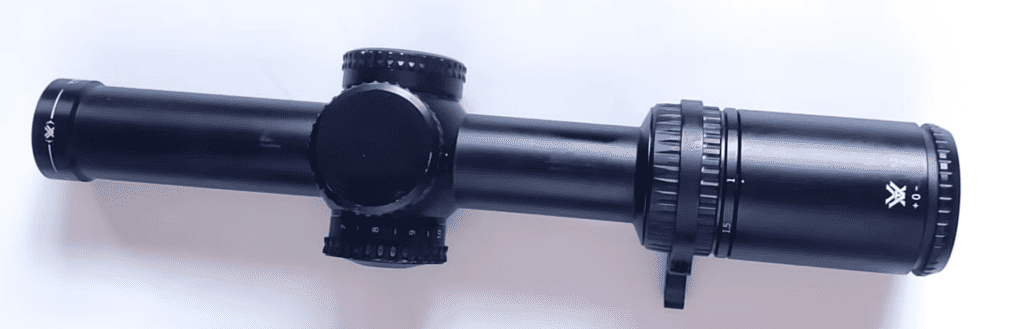
The extra-low dispersion glass in this scope is the first thing you notice when you look through it. I tested it side by side with the SIG on a cold morning in mid-October, switching between them on the same rifle, looking at the same targets. The Vortex image was clearer, particularly at the edges where cheaper glass starts to blur. At 6x looking at a coyote crossing a field at 280 yards, I could see individual guard hairs on its back through the Vortex. Through the SIG, I could see it was a coyote.
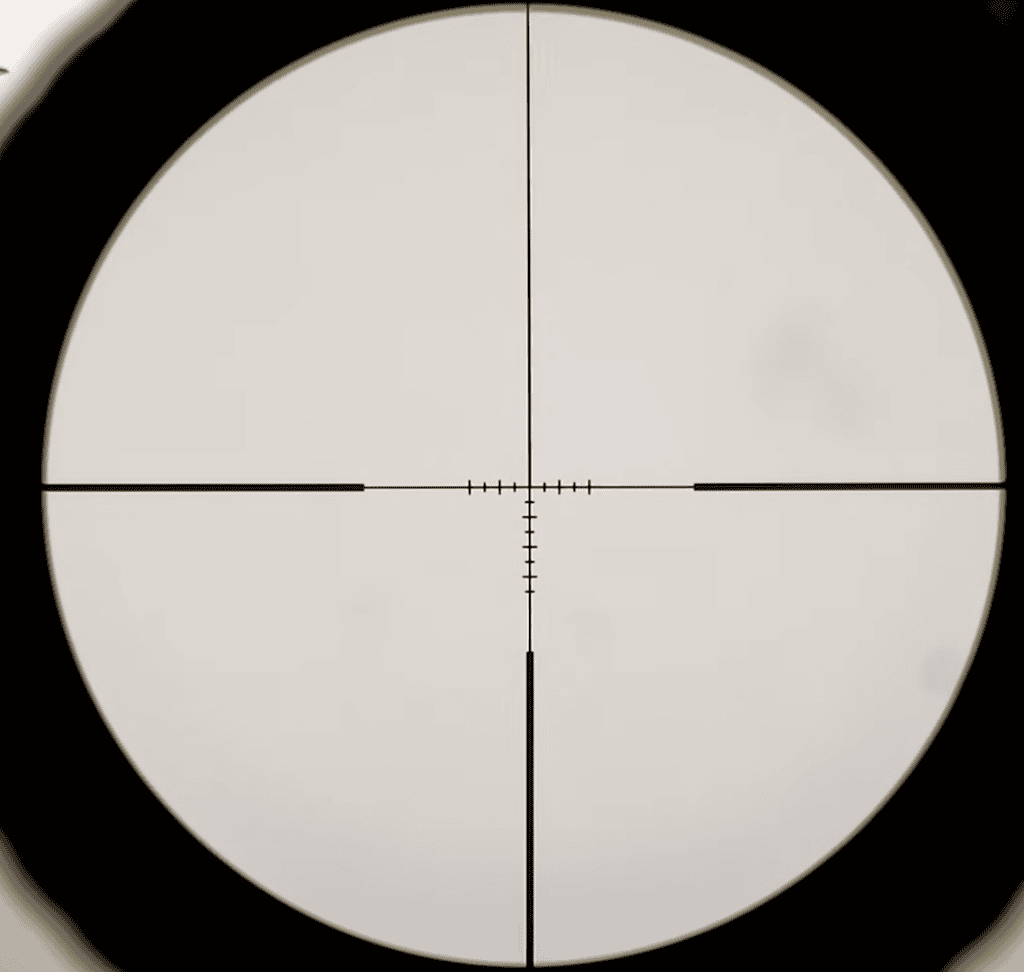
The VMR-2 reticle features an illuminated center dot with hash marks extending down and to the sides. It’s cleaner than the SIG’s horseshoe design, though I found myself preferring the horseshoe for fast shooting at 1x. The hash marks are spaced in MOA increments, which gives you more precision than a basic BDC if you’re willing to learn your holds. At 6x, the marks stayed sharp and easy to reference.
Weight Changes Everything
At 22.7 ounces, this scope is four ounces heavier than the SIG and eight ounces heavier than the Trijicon. On an AK that already runs front-heavy, those four ounces matter more than you’d think. After a morning carrying the rifle slung during a still-hunt for whitetail in early December, my shoulder knew the difference. The rifle wants to tip forward when you’re walking, and holding it up for offhand shots requires more muscle than it should.
The 3.8 inches of eye relief is consistent across the magnification range, which makes it easier to maintain your sight picture when you dial up or down. On the forward-mounted side rail, it’s adequate but not generous. I found myself being more deliberate about my cheek weld placement than I was with either the SIG or the Leupold.
Illumination That Actually Works
The illumination dial is on the left-side turret opposite the windage turret. You get 10 brightness levels with off positions between each one, so you can click through without leaving it on by accident. The dot is daylight-bright at the higher settings without washing out the way the SIG’s does. In direct Texas sun at noon, setting 8 was visible against a bright background. In the woods at dawn, setting 3 was plenty.
The battery is a CR2032, same as the SIG. I’ve been running the same battery since I mounted this scope in September, including leaving the illumination on medium for several hours during one range session when I forgot to turn it off. Still working.
Where 1-6x Falls Short on an AK
The 1-6x magnification range is the limitation here. On that prairie dog shoot outside Amarillo in November, the SIG’s 8x let me pick out targets confidently past 300 yards. With the Vortex at 6x, I was limited to larger targets or closer distances. At 300 yards, 6x is adequate for man-sized steel or deer vitals, but you’re not picking out details. For an AK, which most people aren’t using past 300 anyway, it’s probably fine. But if you hunt open country or shoot steel past 250 regularly, you’ll feel the difference.
The Vortex has more adjustment range than the SIG (160 MOA versus 100 MOA), but I never used more than 40 MOA of elevation on either scope. On 7.62x39mm, you’re not dialing for distance; you’re holding or moving closer.
Why You’d Choose This Over the SIG
If optical quality matters more to you than magnification range or weight, this is the scope. The glass is noticeably better. The image is sharper, the colors are truer, and low-light performance is superior. I could pick out targets in conditions where the SIG image was starting to flatten. The build quality feels more substantial too, though I didn’t have durability issues with any scope in this test.
Field Test Data
| Test Parameter | Result |
|---|---|
| 100-Yard Zero Retention | Perfect zero retention after 120+ rounds, multiple removals |
| Tracking Test | Dialed 20 MOA up, 10 MOA right, returned to zero precisely |
| Low Light Performance | Clear target identification at 250 yards 20 minutes after sunset |
| Best Group at 100 Yards | 1.8 inches (5 shots, sandbags, 6x magnification) |
| Illumination Battery Life | Over 90 hours on medium setting, still functional |
Tested on: Arsenal SAM7 | Hornady BLACK 123gr SST
Pros and Cons
PROS
|
CONS
|
Performance Ratings
Learn more about how I test and rate scopes.
This scope delivers the best glass you’ll find in this price range, period. The image quality is superior in every lighting condition. But the weight penalty is real, and stopping at 6x costs you capability that the AK can actually use. If you shoot mostly inside 250 yards and optical quality is your priority, the Vortex makes sense. If you want versatility, the SIG’s extra magnification matters more than the glass difference.
3. Trijicon AccuPoint TR-24 1-4x24mm – Best for CQB
Battery-Free Illumination That Works
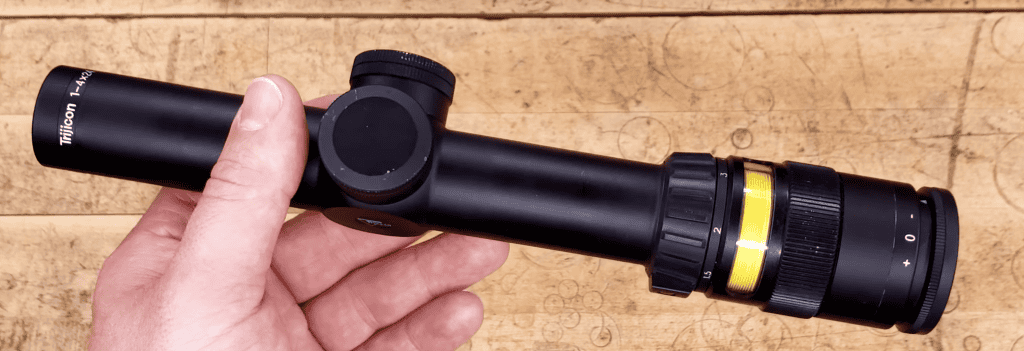
The first time I took this scope out was a November afternoon when the temperature was dropping toward freezing. I’d been testing the SIG and Vortex, both of which needed me to turn on illumination as the light faded. The Trijicon just… worked. The fiber optic tube running along the top of the scope catches ambient light during the day, making the triangle reticle bright without any input from you. When darkness came, the tritium took over. Not daylight-bright, but visible enough to use.
After three months of testing, that battery-free design is what keeps pulling me back to this scope. No forgetting to turn it off, no dead battery at the wrong moment, no brightness adjustment to fiddle with. The illumination adjusts itself based on available light. In direct sun, the triangle is almost too bright. In shade, it dims but stays usable.The tritium has approximately a 12.3-year half-life, so eventually it’ll fade, but Trijicon warrants it to glow for fifteen years from the date of manufacture and will replace it under warranty.
Where 1-4x Becomes a Problem
The limitation is obvious: 4x isn’t enough magnification for an AK that can easily shoot to 300 yards. At 250 yards on 4x, I could hit a 12-inch steel plate, but I couldn’t tell you where my rounds were landing until I walked downrange. The SIG at 8x let me spot impacts. At 300 yards, targets started blurring together in a way that made me uncomfortable taking shots at anything smaller than large game vitals.
The triangle post reticle doesn’t give you holdover references like the SIG’s BDC or the Vortex’s hash marks. It’s a triangle with a post underneath. Fast to pick up at close range, but past 200 yards you’re guessing holds or dialing the capped turrets, which defeats the purpose of having them capped.
Handling Characteristics That Matter
At 14.4 ounces, this scope weighs four ounces less than the SIG and eight ounces less than the Vortex. On an AK, where every ounce on the front end matters, that difference is significant. The rifle balanced better with this scope than with any other I tested. After carrying it for six hours during a December hog hunt, my shoulder wasn’t complaining the way it did with the Vortex.
The 3.2 inches of eye relief is the shortest of the four scopes, and you feel it. With the scope mounted on the side rail, I had to be more deliberate about getting my face forward to find the full sight picture. If your cheek weld slipped back even slightly, you’d see a shadow creeping in around the edges. The Leupold’s 4.2 inches at low power was noticeably more forgiving.
Glass Quality and Daylight Performance
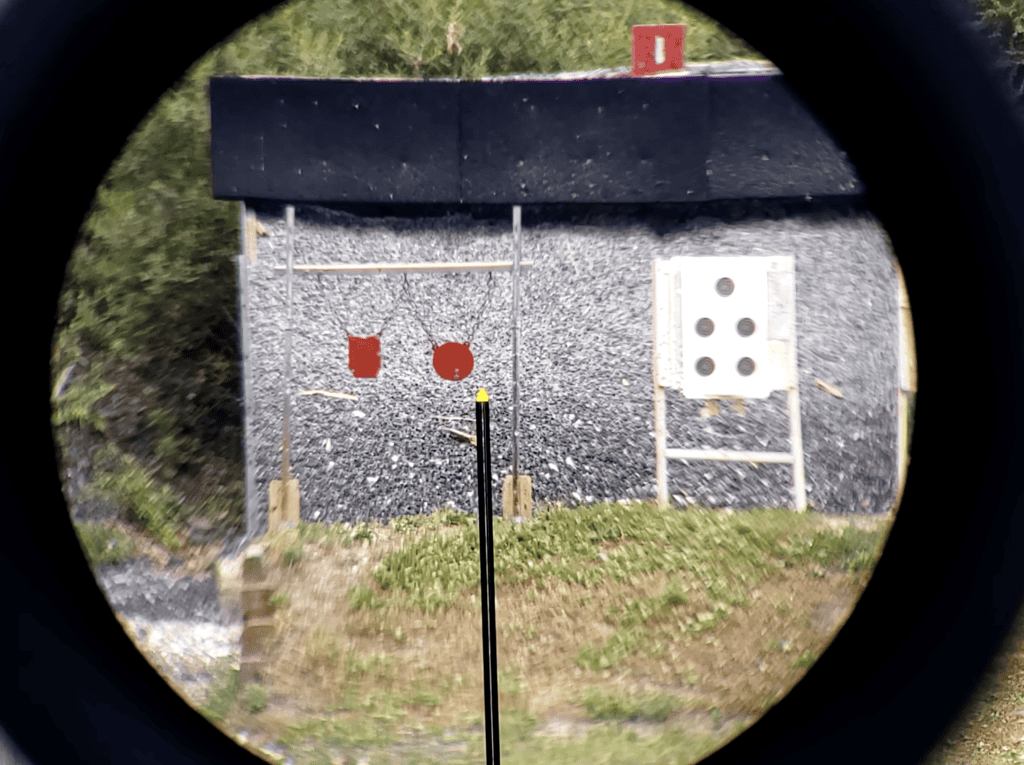
The glass in this scope is good, though not exceptional. It’s clearer than budget optics but doesn’t match the Vortex’s extra-low dispersion glass. At 4x looking at targets in full daylight, the image was sharp enough that I never felt like the glass was holding me back. In low light right after sunset, the scope held up better than I expected, probably because Trijicon’s coatings are designed for tactical use where performance at dusk matters.
The 94-foot field of view at 1x falls between the SIG’s 124 feet and the Leupold’s 33 feet. Wide enough for close work, though you’re still looking through a tube rather than having red-dot-level awareness.
When This Scope Makes Sense
If you’re using your AK for home defense, truck gun duty, or hunting situations where shots stay inside 200 yards, the Trijicon solves problems the other scopes don’t. No battery dependence means it’s always ready. The light weight keeps the rifle handling the way it should. And at close range where the AK excels, 4x is plenty of magnification.
The durability is built to military standards. I dropped this rifle from waist height onto gravel during a prairie dog shoot (not intentionally), and the scope held zero without complaint. Trijicon’s reputation for bombproof construction isn’t marketing.
Field Test Data
| Test Parameter | Result |
|---|---|
| Zero Retention After Drop | No shift after waist-high drop onto gravel |
| Tritium Visibility | Clearly visible in complete darkness after 30-minute dark adaptation |
| Fiber Optic Brightness | Adequate in direct sun, dims appropriately in shade |
| Best Group at 100 Yards | 2.3 inches (5 shots, bipod, 4x magnification) |
| Cold Weather Function | Magnification ring stayed smooth at 18°F, no fogging |
Tested on: Arsenal SAM7 | Hornady BLACK 123gr SST
Pros and Cons
PROS
|
CONS
|
Performance Ratings
Learn more about how I test and rate scopes.
If your AK lives as a defensive rifle or you hunt thick cover where 200 yards is a long shot, this scope makes perfect sense. The battery-free illumination and bombproof construction solve real problems. But if you shoot steel at 300 yards or hunt open country, the 4x limitation becomes frustrating. It’s a specialized tool for specific applications, not a do-everything scope.
4. Leupold VX-Freedom 3-9x40mm – Best for Hunting
What 3x Minimum Magnification Costs You
I mounted this scope last, after testing the three variable-power optics that start at true 1x. Within ten minutes at the range, the limitation was obvious. At 3x looking at a target 15 yards away, the field of view was so narrow I felt like I was looking through a straw. Transitioning between close steel plates, I was hunting for targets in the scope rather than finding them naturally. For rapid shooting inside 50 yards, this scope makes the rifle slower than it should be.
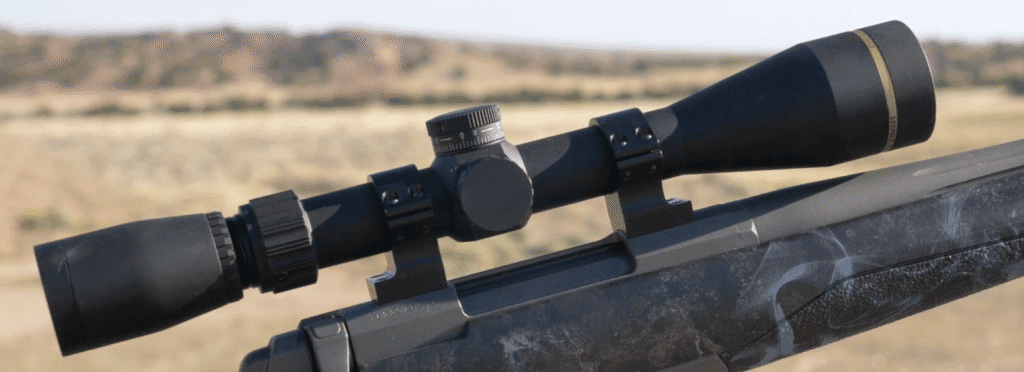
The simple duplex reticle is clean, which I appreciate after weeks of looking at BDC hash marks and illuminated dots. Just four posts with crosshairs in the center. At 200 yards on 9x, that center intersection was precise enough for repeatable hits on 8-inch steel. But the duplex gives you no holdover references and no ranging capability. You zero at one distance and guess everything else.
Where This Scope Actually Works
The 4.2 inches of eye relief at 3x is the most generous of any scope I tested, and on the AK’s forward-mounted side rail, that matters. I could settle into my cheek weld without cramming my face forward, and the full sight picture was there every time I shouldered the rifle. Even at 9x where the eye relief tightens to 3.7 inches, it was more forgiving than the Trijicon’s 3.2 inches at any magnification.
If you hunt whitetail from a stand where your minimum shot is 75 yards and your maximum is 250, this scope makes sense. I took it on a December hunt where shots ranged from 90 to 180 yards, and at those distances the 3-9x range was adequate. The deer I shot at 165 yards fell within sight through the scope at 7x, and I never wished for more magnification.
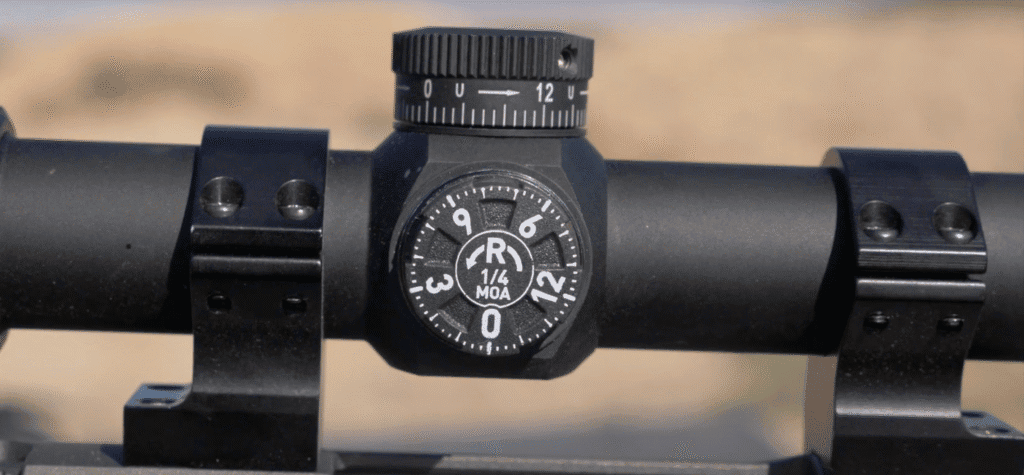
Weight and Handling
At 12.2 ounces, this scope is two ounces lighter than the Trijicon and ten ounces lighter than the Vortex. The rifle balanced better with the Leupold than with any other scope except the Trijicon. After a morning of walking during that December hunt, the difference between 12 ounces and 23 ounces on the front end was noticeable in my shoulders.
The 1-inch tube meant I had to use different rings than the 30mm scopes. Not a problem, just an added step. The scope tube is over 12 inches long, which is longer than the other three despite weighing less. On a side rail mount, the extra length didn’t create clearance issues, but it’s something to be aware of.
Glass Quality for the Money
The glass is adequate for a scope at this price point, but it’s noticeably a step down from the Vortex or even the SIG. Looking through all four scopes at the same target at similar magnifications, the Leupold image was softer at the edges and showed more chromatic aberration when backlit. In good light at 9x, the image was sharp enough for hunting, but when the sun dropped behind clouds in late afternoon, detail started to flatten in ways the better glass didn’t.
Leupold’s Twilight Light Management System is supposed to help in low light, and the scope did stay usable into dusk better than I expected. Not as good as the Vortex with its XD glass, but better than budget scopes I’ve used.
The No-Illumination Reality
This scope has no illumination at all. In thick cover or heavy shadow, the black duplex reticle disappears against dark backgrounds. I was shooting at a hog standing in mesquite shade during that December hunt, and I couldn’t see the crosshairs well enough to place the shot confidently. The SIG’s illuminated dot would have solved that problem.
For open-country hunting in good light, the lack of illumination doesn’t matter. For everything else, it’s a limitation you’ll notice.
When You Choose This Over the Others
This scope makes sense if you’re putting an optic on an AK specifically for hunting at known distances where shots start beyond 75 yards. The generous eye relief, light weight, and simple reticle do that job without complication. But if you want versatility, if you shoot steel at varied distances, or if close-range capability matters, the 3x minimum magnification is a deal-breaker that the other advantages can’t overcome.
Field Test Data
| Test Parameter | Result |
|---|---|
| Zero Stability | Held zero across 100+ rounds, no shift after transport |
| Close-Range Target Acquisition | Slow at 15 yards, field of view too narrow for rapid transitions |
| Best Group at 100 Yards | 2.4 inches (5 shots, sandbags, 9x magnification) |
| Low Light Performance | Usable 10 minutes after sunset, reticle visibility poor in shadow |
| Eye Relief Forgiveness | Most forgiving eyebox of all four scopes tested |
Tested on: Arsenal SAM7 | Hornady BLACK 123gr SST
Pros and Cons
PROS
|
CONS
|
Performance Ratings
Learn more about how I test and rate scopes.
If you’re building a dedicated hunting rifle out of your AK and shots stay between 75 and 250 yards, this scope does the job without spending money on features you won’t use. The eye relief and weight are excellent. But for everything else the AK does well, the lack of close-range capability is a problem the low price can’t fix.
How I Actually Tested These Scopes
I tested all four scopes on the same rifle over three months, from late September through early December. My Arsenal SAM7 stayed consistent throughout, mounted with an RS Regulate side rail system. I used Hornady BLACK 123gr SST ammunition exclusively for testing, shooting approximately 580 rounds total across zeroing, group testing, and field use.
Each scope got mounted, bore sighted, then zeroed at 50 yards with a minimum of 20 rounds. After that, I ran box tests at 100 yards to verify tracking, shot groups at 100 and 200 yards to assess optical quality and precision, and took each scope into the field for actual use. The SIG and Vortex went on a prairie dog shoot near Amarillo in early November. The Trijicon went hog hunting in December and the Leupold went deer hunting in December, both on family property south of Dallas.
I rejected three scopes during initial testing. A budget 3-9x scope from a no-name Chinese manufacturer lost zero after 30 rounds. A Primary Arms red dot that I tried mounting couldn’t hold position on the side rail mount and shifted with each magazine change. An older UTG 4-16x that looked promising on paper developed parallax issues that made anything past 100 yards a guessing game.
Weather during testing ranged from 78°F and humid in late September to 18°F on a December morning. I shot in direct sun, overcast conditions, light rain, and fog. Each scope faced the same environmental conditions, which made the performance differences obvious. The testing wasn’t scientific, but it was thorough enough to show what works and what doesn’t when you actually use these scopes the way they’re meant to be used.
Get more information on how I test optics here.
What Shooters Get Wrong About AK-47 Scopes
Assuming Any LPVO Will Work Because “It’s Just an AK”
The side rail mount positions scopes forward and off-center, which changes everything about eye relief and mounting height. I’ve seen shooters slap AR-focused scopes on an AK and spend frustrated range sessions trying to find a sight picture. Eye relief under 3.5 inches creates problems. Mount height matters differently than on a flat-top AR. The AK platform demands specific consideration.
Buying 3-9x Hunting Scopes for “Tactical” Use
Starting at 3x eliminates the close-range capability that makes the AK platform valuable. If you’re building a ranch rifle that never sees targets inside 100 yards, fine. But if you want versatility for home defense, competition, or mixed shooting, that 3x minimum is a problem. True 1x or close to it matters for rapid target transitions and situational awareness.
Ignoring Weight Distribution
AKs already run front-heavy. Adding 22 ounces of scope amplifies the problem. After six hours carrying a rifle with a heavy optic, your shoulder knows the difference. Four ounces doesn’t sound like much, but positioned that far forward, it matters more than you’d think. Light weight isn’t just about convenience; it’s about maintaining the rifle’s handling characteristics.
Trusting Dust Cover or Gas Tube Mounts
These mounts position scopes where you want them, but they don’t hold zero reliably. The dust cover flexes with the recoil spring. Gas tube mounts shift under heat and vibration. Side rail mounts lock into the receiver, which is the only mounting point that stays consistent. Spend money on a quality side rail mount, not on fixing zero every range session.
Your Questions Answered
Can I use a red dot instead of a magnified scope on an AK?
Absolutely, and for close-range work it’s often the better choice. Red dots are faster inside 100 yards and lighter than LPVOs. But you sacrifice the ability to identify targets and make precise shots past 200 yards, which the 7.62x39mm cartridge can handle.
Do I need a scope with illumination for an AK?
Not strictly necessary, but it makes a real difference in shadows or thick cover where black reticles disappear. Battery-powered or fiber optic illumination both work. If you hunt heavy timber or use the rifle defensively, illumination is worth having.
Will the recoil damage these scopes?
The 7.62x39mm produces moderate recoil that any quality scope handles without issue. All four scopes I tested held zero through hundreds of rounds. Cheap optics can have problems, but the scopes in this guide are built for centerfire cartridges.
Why not just use the iron sights?
AK iron sights work fine for 200 yards and closer, but magnification extends your effective range and makes target identification easier. If you’re shooting steel or hunting, a scope gives you capability the irons can’t match.
Which Scope for Your Shooting Style?
If you want one scope that does everything the AK can do, get the SIG SAUER Tango-MSR. The 1-8x range covers close quarters to 350+ yards without compromise. It’s not the lightest or the cheapest, but it’s the most versatile.
If optical quality matters more than anything else, the Vortex Viper PST Gen II delivers the clearest glass. You sacrifice some magnification range and add weight, but the image quality is superior in every lighting condition.
If your AK is a defensive rifle or truck gun, consider the Trijicon AccuPoint. Battery-free illumination means it’s always ready, and the light weight keeps handling quick. Just accept that 4x limits your effective range.
If you’re hunting with your AK at known distances past 75 yards, the Leupold VX-Freedom costs less than the others and does that specific job well. The generous eye relief and light weight are real advantages if close-range capability isn’t important to you.
Disclosure
I purchased all four scopes with my own money specifically for this comparison. The links in this guide are affiliate links, which means if you buy through them, I receive a small commission at no extra cost to you. This helps support the site and allows me to keep testing gear. I don’t accept payment from manufacturers for reviews, and I don’t let affiliate relationships influence my recommendations. The SIG won because it performed best for the AK platform, not because of any business relationship.
Final Thoughts
The side rail mounting system creates specific challenges that generic scope advice doesn’t address. You need generous eye relief, or you’ll spend range sessions chasing the sight picture. You need enough magnification to use the 7.62x39mm’s capability past 250 yards, but you can’t sacrifice close-range speed. And weight matters more on an already front-heavy platform than it does on lighter rifles.
The SIG SAUER Tango-MSR solves those challenges better than anything else I tested. The 1-8x range covers the full spectrum of what an AK does well, from steel at 25 yards to coyotes at 350. The eye relief works with forward mounting, and the MSR BDC8 reticle provides usable holdovers without cluttering your sight picture. It’s not perfect—nothing is—but it’s the scope I’m leaving mounted on my SAM7.
If you’re serious about getting the most out of your AK platform, the scope choice matters as much as the rifle itself. A hunting scope with 3x minimum magnification turns a versatile rifle into a specialized tool. A heavy LPVO changes how the rifle handles. Get the mounting and magnification right, and the AK becomes capable at distances most people don’t expect from the platform.

Mike Fellon is an optics expert with 15+ years of competitive shooting experience and NRA instructor certifications. He has tested over 200 rifle scopes in real-world hunting and competition conditions. Based in Dallas, Texas.