
Rimfire scopes occupy an odd middle ground that a lot of shooters misjudge. You can’t just grab a budget centerfire scope and expect it to work at 25 yards without parallax problems. What you actually need is glass designed for the way rimfire rifles get used: close enough that parallax matters more than most people realize, at magnifications where eye relief stays forgiving, with enough adjustment to handle .22 LR’s trajectory without excessive features that add weight and cost.
Most of my testing happens on a Ruger 10/22, which represents what the majority of rimfire shooters actually own. The four scopes I’m covering here span from budget to premium, but they all share one critical feature: parallax settings appropriate for rimfire distances.
After running each through multiple range sessions and comparing performance from 25 to 150 yards, the Vortex Crossfire II 2-7×32 Rimfire proved the best overall choice. Its 2-7x magnification range handles everything from close plinking to precision work at 100 yards, the fixed 50-yard parallax eliminates the single biggest accuracy problem rimfire shooters face, and the price point makes sense for what most people actually need from a rimfire scope.
My Top 4 Picks for Rimfire Rifles
Best Overall
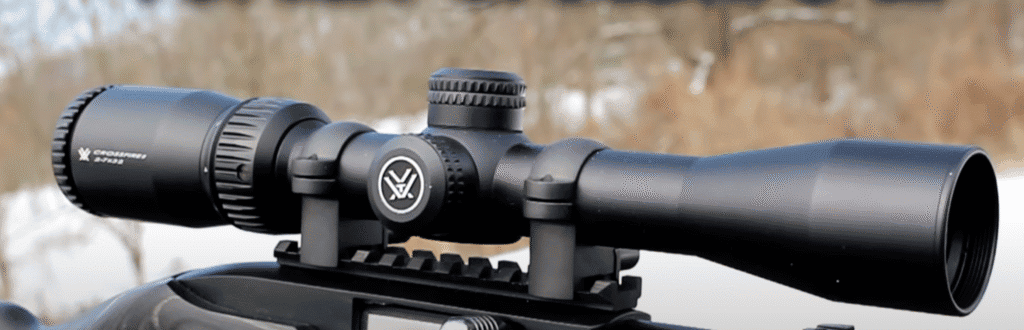
Vortex Crossfire II 2-7×32 Rimfire
The 2-7x magnification range hits the sweet spot for rimfire work, the 50-yard parallax setting is exactly where it needs to be, and the simple V-Plex reticle doesn’t get in your way. This scope handles backyard plinking and 100-yard precision equally well, which is what most rimfire shooters actually need. The price makes it accessible without sacrificing the features that matter.
Best Premium Option
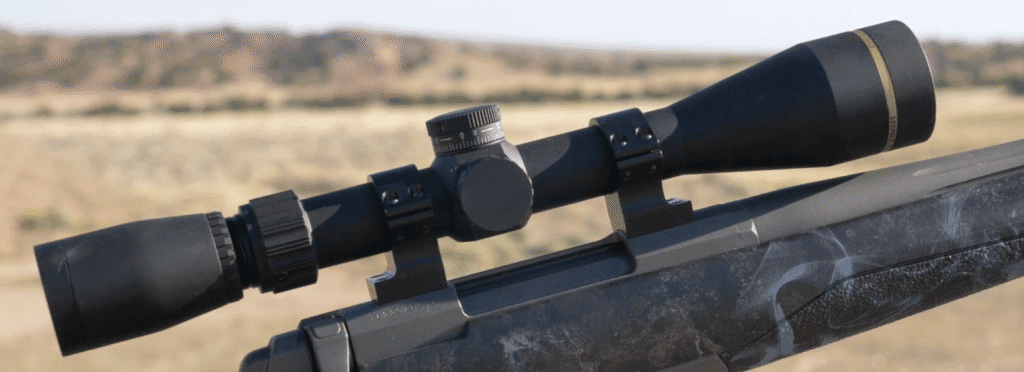
Leupold VX-Freedom 3-9x40mm Rimfire MOA
Leupold’s glass quality shows immediately, especially in the edge clarity and light transmission. The Rimfire MOA reticle adds holdover marks calibrated for .22 LR trajectories, and at 12.2 ounces it’s the lightest scope here. If you’re serious about rimfire precision work and the budget allows, this is where the extra money actually delivers performance you can see.
Best Budget Option
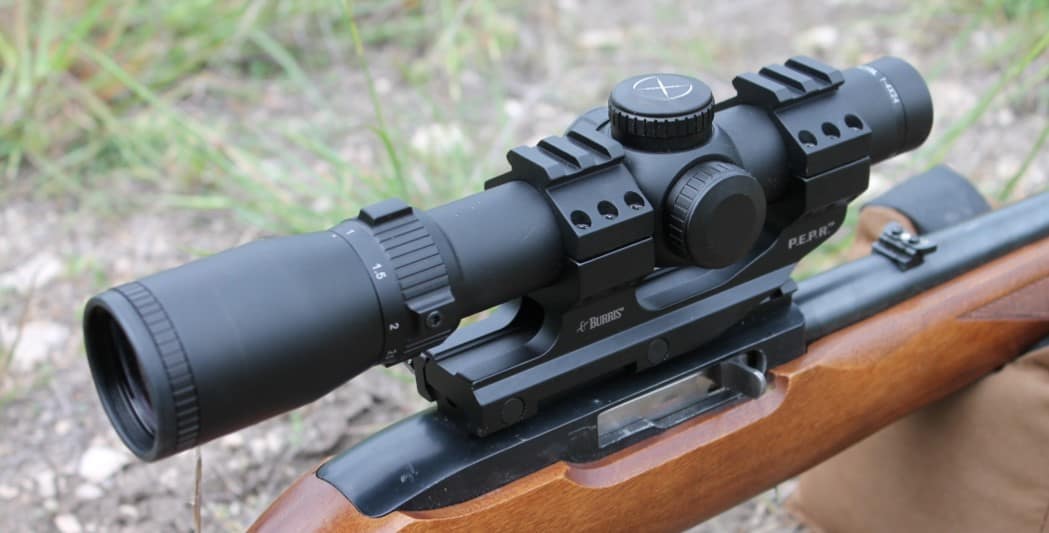
Burris Droptine 3-9x40mm Ballistic Plex 22LR
For a reasonable price, you get a rimfire-specific BDC reticle with holdover marks, 3-9x magnification that covers most rimfire applications, and fixed 50-yard parallax. The Ballistic Plex reticle actually works if you shoot at multiple distances regularly. It’s not fancy, but it delivers what budget-conscious shooters need without the compromises that make cheap scopes frustrating.
Best for Extended Range
Vortex Diamondback 2-7×35 Rimfire
The 100 MOA adjustment range is double what most rimfire scopes offer, which matters if you’re stretching .22 LR out past 150 yards. It also delivers the widest field of view at low magnification. The 3.1-inch eye relief is the shortest here, but if you’re serious about long-range rimfire competition or just like seeing how far you can push a .22, this scope has the adjustment to get you there.
Why You Can Trust My Recommendations
The first “rimfire” scope I bought many years ago was a centerfire hunting scope set for 100-yard parallax. I mounted it on my 10/22, took it to the range, and couldn’t figure out why my groups looked like buckshot patterns at 50 yards. Moving my head even slightly behind the scope shifted the crosshairs across the target. That’s when I learned parallax isn’t some abstract optical concept you can ignore on a .22.
I’m Mike Fellon, and I’ve been shooting for more than 15 years. My background includes five years in the Bass Pro Shops firearms department, where I helped hundreds of customers choose scopes and saw the common mistakes firsthand. I hold NRA Range Safety Officer and Certified Firearms Instructor certifications, and I’ve tested over 200 rifle scopes.
Most of that testing happens on my family’s Texas property, where I’ve put more rounds through rimfire rifles than I care to count. Squirrels, rabbits, steel targets at varying distances, match work at the local club. Rimfire scopes either work at these distances or they don’t, and you figure that out pretty quickly when parallax error puts your shots two inches off at 50 yards.
Side-by-Side Specs
All four of these scopes share the rimfire-critical feature of parallax set for 50-60 yards rather than 100+. The differences show up in magnification range, eye relief, and how much adjustment you’re paying for. For most rimfire shooting, the specs that matter most are getting parallax right and having enough low-end magnification for close work.
| Features | Vortex Crossfire II 2-7×32 | Leupold VX-Freedom 3-9x40mm | Burris Droptine 3-9x40mm | Vortex Diamondback 2-7×35 |
|---|---|---|---|---|
| Magnification | 2-7x | 3-9x | 3-9x | 2-7x |
| Objective Diameter | 32 mm | 40 mm | 40 mm | 35 mm |
| Eye Relief | 3.9″ | 4.2″ – 3.7″ | 3.8″ – 3.1″ | 3.1″ |
| Weight | 13.9 oz | 12.2 oz | 13.0 oz | 13.7 oz |
| Length | 11.5″ | 12.49″ | 12.2″ | 11.6″ |
| Tube Size | 1 inch | 1 inch | 1 inch | 1 inch |
| Reticle | V-Plex MOA (SFP) | Rimfire MOA (SFP) | Ballistic Plex 22LR (SFP) | V-Plex (MOA) |
| Field of View | 42.0 – 12.6 ft @ 100 yds | 33.1 – 13.6 ft @ 100 yds | 33 – 13 ft @ 100 yds | 64.3 – 19.3 ft @ 100 yds |
| Turret Style | Capped | Capped | Capped | Capped |
| Adjustment Range | 60 MOA Elevation / 60 MOA Windage | 60 MOA Elevation / 60 MOA Windage | 50 MOA Elevation / 50 MOA Windage | 100 MOA Elevation / 100 MOA Windage |
| Click Value | 1/4 MOA | 1/4 MOA | 1/4 MOA | 1/4 MOA |
| Parallax Adjustment | Fixed @ 50 yds | Fixed @ 60 yds | Fixed @ 50 yds | Fixed @ 50 yds |
| Illumination | No | No | No | No |
The 4 Best Rimfire Scopes
1. Vortex Crossfire II 2-7×32 Rimfire – Best Overall
Why This Scope Won the Test
I mounted the Crossfire II expecting typical budget scope performance. First look through the glass surprised me. The image was sharper than I anticipated, especially considering I’d just been testing a scope costing twice as much. Not Leupold sharp, but clear enough that I stopped second-guessing whether I’d mounted it correctly. When I dialed down to 2x and looked at a target 25 yards away, I could pick it up instantly in the wide field of view. That low-end magnification matters more than most people realize for close rimfire work.
The parallax test told me everything I needed to know about why this scope exists. With my old centerfire scope, I could shift my head behind the eyepiece and watch the crosshairs wander two inches across a target at 50 yards. With the Crossfire II, I deliberately moved my head around trying to induce parallax error. The crosshairs barely budged. That’s what proper rimfire parallax correction looks like, and it’s why my groups immediately tightened up compared to what I was shooting before.
A Week of Range Sessions
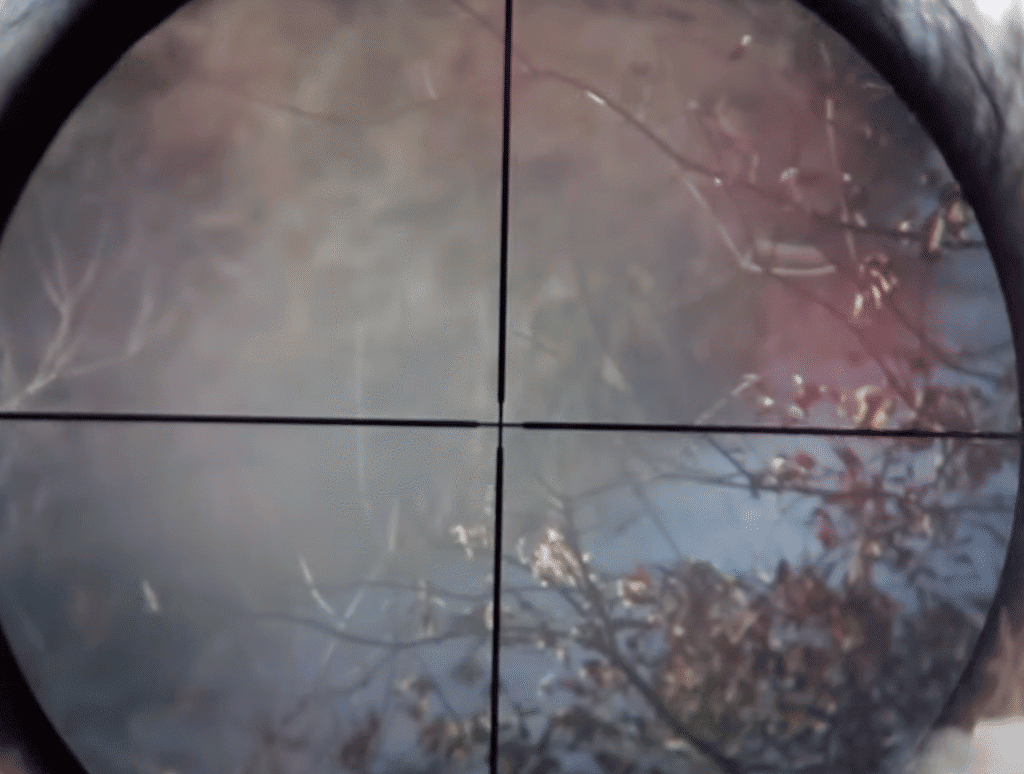
I spent three different afternoons shooting between 25 and 100 yards with CCI Standard Velocity. At 25 yards on 2x, the simple V-Plex reticle let me transition between multiple targets quickly without losing my sight picture. The thick outer posts guided my eye to the fine center crosshairs fast. At 100 yards on 7x, I could see my bullet holes in the target without needing a spotting scope, which made zero confirmation easier than expected.
The magnification ring took more effort to turn than the Leupold or Diamondback. Not enough to be a real problem, but enough that I noticed it every time. After the first range session, I loosened up slightly, though it never got as smooth as I’d prefer. Some shooters might actually like the resistance since it won’t shift accidentally, but I’d rather have easier adjustments.
Where the Glass Shows Its Limits
I tested in late October when the sun sets early in Texas. Around 6:30 PM, I was still shooting clearly at 75 yards. By 7:10 PM, the image started losing contrast noticeably. I could still see targets, but they didn’t pop against the background the way they did in full daylight. The Leupold stayed clearer longer by a solid 15 minutes, remaining usable until around 7:25 PM. For most hunting situations that won’t matter, but it’s where you see the price difference.
Looking at the edges of the sight picture at 7x, I could see some softness in the corners if I paid attention to it. The center circle where I was actually aiming stayed sharp. I don’t spend much time staring at the periphery of my scope view, so this didn’t bother me, but it’s there if you’re comparing directly to premium glass.
The Turret Test
I pulled the caps and ran a box test at 50 yards. Started at zero, went up 20 clicks, right 20 clicks, down 20 clicks, left 20 clicks. Ended up back where I started, maybe a quarter minute off. The clicks felt positive and consistent, no mushy spots or skipped adjustments. The zero-reset feature worked smoothly when I tested it, loosened the turret top, rotated to zero, tightened it back down. Simple and functional.
What It Handles Best
This scope excels at the kind of rimfire shooting most people actually do. Plinking at varying distances, hunting small game from 25 to 75 yards, casual target work at 100 yards. The 2x low end gives you enough field of view for close shots in brush, the 7x top end provides adequate magnification for precise work, and the 50-yard parallax setting eliminates the single biggest accuracy problem most rimfire shooters face without realizing it. That’s why it’s my top pick.
Field Test Data
| Test Parameter | Result |
|---|---|
| Best 5-Shot Group @ 50 yards | 0.62 inches (from bench rest) |
| Turret Tracking (Box Test) | Returned to zero within 0.25 MOA |
| Eye Box Forgiveness | Generous at 2-5x, tightens slightly at 7x |
| Low-Light Performance | Usable 30 minutes after sunset |
| Parallax Error @ 50 yards | Minimal with proper head position |
Tested on: Ruger 10/22 | CCI Standard Velocity 40gr
Pros and Cons
PROS
|
CONS
|
Performance Ratings
Learn more about how I test and rate scopes.
The Crossfire II delivers what most rimfire shooters actually need without charging for features they don’t. That’s why it’s my top recommendation.
2. Leupold VX-Freedom 3-9x40mm Rimfire MOA – Best Premium Option
The Glass Quality Difference Is Real
I looked through the VX-Freedom right after spending an hour with the Crossfire II. The image jumped out at me immediately, sharper edge-to-edge and noticeably brighter. I pointed at a squirrel in a tree about 60 yards out, partially shadowed by branches. Through the Crossfire II, I could see it clearly enough. Through the Leupold, I could see individual patches of fur color and make out the texture of the bark behind it. That’s the difference between functional glass and premium glass.
The Twilight Light Management coating lives up to its name. I tested on an overcast November afternoon that turned into dusk earlier than I planned. Around 6:45 PM, shooting at steel targets 75 yards out, both scopes showed me the targets clearly. By 7:10 PM, the Crossfire II was losing contrast noticeably while the Leupold stayed bright enough that I kept shooting for another 15 minutes. For squirrel hunters working early morning or late evening hours, that extended shooting time matters.
Learning the Rimfire MOA Reticle
The reticle has more going on than a simple duplex. Fine hash marks run down the vertical stadia at 1 MOA intervals, with thicker marks every 5 MOA. My first reaction was that it looked busy, too much detail for rimfire work. Then I spent time at 100 yards with and figured out my actual drops. Holding about 4 MOA low put me center mass on targets, which meant holding between the crosshair and the first thick mark. Once I learned that reference point, I could shift between 50, 75, and 100-yard targets without touching the turrets.
The hash marks only work correctly at 9x since it’s a second focal plane reticle. That’s fine for precision work where you’d use full magnification anyway. For hunting at varying distances where you might be on 5x or 6x, you need to either know your holds at different magnifications or just use the center crosshair and dial. Some folks find the reticle cluttered. I understand that reaction, though I grew to appreciate having the holdover references once I’d verified them.
Turrets That Mean Business
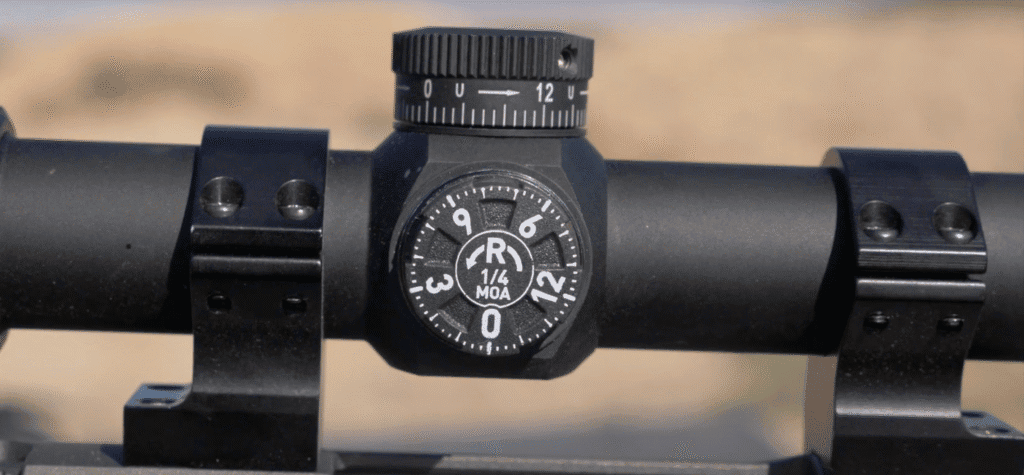
The finger-adjustable turrets were stiff enough that I thought something might be wrong initially. They loosened up after the first 40-50 clicks total, settling into a firm, positive feel. Each click is distinct with no mushy transitions between them. I ran a tracking test at 50 yards, dialing up and down repeatedly. Every adjustment went exactly where it should, and when I returned to zero, I was dead center on my original point of impact. The stiffness actually grew on me since there’s zero chance these turrets will shift from getting bumped in the field.
Where You Feel the Tradeoffs
Starting at 3x instead of 2x means you lose some close-range flexibility. When a rabbit jumped up at maybe 20 yards in thick brush, I found the field of view noticeably narrower than what I’d been using on the Crossfire II. Not a deal-breaker, but I felt the difference. Cranking up to 9x, I needed to adjust my cheek weld position forward slightly to maintain a full sight picture. The eyebox gets less forgiving at high magnification, requiring more precise head placement.
The cost is what keeps this from being a universal recommendation. You’re paying double the Crossfire II’s price for genuinely better glass, a more sophisticated reticle, and Leupold’s American-made quality. If you’re a serious rimfire shooter who spends time at the range working on precision, the upgrade makes sense. If you’re putting a scope on a truck gun for occasional plinking, you probably won’t appreciate what you’re paying for.
Field Test Data
| Test Parameter | Result |
|---|---|
| Best 5-Shot Group @ 50 yards | 0.58 inches (from bench rest) |
| Turret Tracking (Box Test) | Returned to zero perfectly, no measurable drift |
| Low-Light Performance | Clear target acquisition 45 minutes after sunset |
| Reticle Visibility | Clear at 9x against varied backgrounds, busy for some users |
| Edge Clarity @ 9x | Excellent, minimal distortion at periphery |
Tested on: Ruger 10/22 | CCI Standard Velocity 40gr
Pros and Cons
PROS
|
CONS
|
Performance Ratings
Learn more about how I test and rate scopes.
If you’re serious about rimfire precision and the budget allows, the VX-Freedom delivers glass quality that makes shooting more enjoyable. Just know you’re paying for features many casual shooters won’t fully utilize. One of the best M&P 15-22 scopes as well.
3. Burris Droptine 3-9x40mm Ballistic Plex 22LR – Best Budget Option
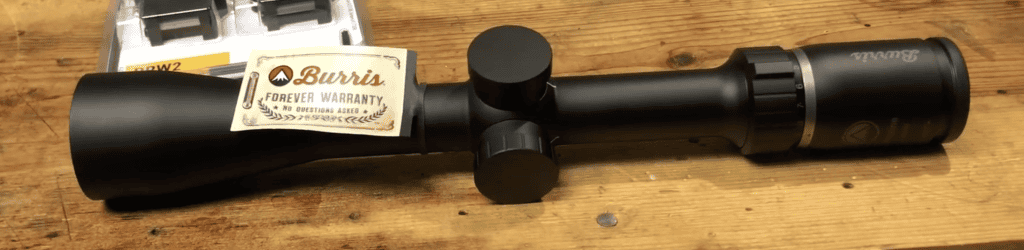
Testing Budget Glass
I mounted the Droptine expecting compromised performance. Budget scopes usually mean you’re accepting trade-offs somewhere, whether it’s mushy turrets, poor glass, or features that sound good on paper but disappoint in the field. First look through the eyepiece showed me exactly where Burris cut costs and where they didn’t. The glass is functional but noticeably less sharp than the Crossfire II I’d been testing earlier. Not terrible, just a clear step down when you’re comparing them side-by-side.
What surprised me was the Ballistic Plex reticle. Instead of a standard duplex, you get three holdover marks below the main crosshair, spaced for .22 LR trajectories. Burris has free ballistic software on their website where you can input your ammunition and get estimated distances for each mark. I went through the process with CCI Standard Velocity and wrote the distances on a piece of tape stuck to my stock: first mark around 75 yards, second mark around 100, third mark around 125.
Verifying the BDC Marks
I spent an afternoon moving between steel targets set at 50, 75, 100, and 125 yards. Zeroed dead center at 50, then walked back to 75. Holding on the first aiming point put me within an inch of center on the plate. At 100 yards, the second mark worked well enough that I was ringing steel consistently. Past that, .22 LR trajectory gets unpredictable, and the third mark was more of a rough guess than precise holdover. Wind started affecting shots noticeably, and I wouldn’t trust those BDC marks past 125 yards regardless of what the software calculates.
The reticle saves you from dialing turrets if you’ve verified your holds, which is its main selling point. But you absolutely need to confirm those marks with your specific ammunition. The ballistic software gives you starting points, not gospel truth. Different ammunition velocities will shift those holdover distances significantly.
Where Budget Limitations Show Up
I tested in late afternoon light to see how the coatings performed. The image stayed usable but lost contrast earlier than either the Crossfire II or Leupold. By about 20 minutes after sunset, I was straining to pick up targets at 75 yards while the Vortex Diamondback still gave me a clear sight picture. For shooting in good daylight, it’s fine. For early morning or late evening hunting, you’ll notice the difference.
Cranking the magnification to 9x revealed another compromise. I had to slide my head forward on the stock to maintain a full sight picture, and the eyebox got tight enough that small head movements caused scope shadow. At lower magnifications, this wasn’t a problem. At 9x, it became annoying enough that I caught myself staying on 6x or 7x to avoid dealing with it. The Crossfire II and Leupold both gave me more forgiveness.
Turrets and Tracking
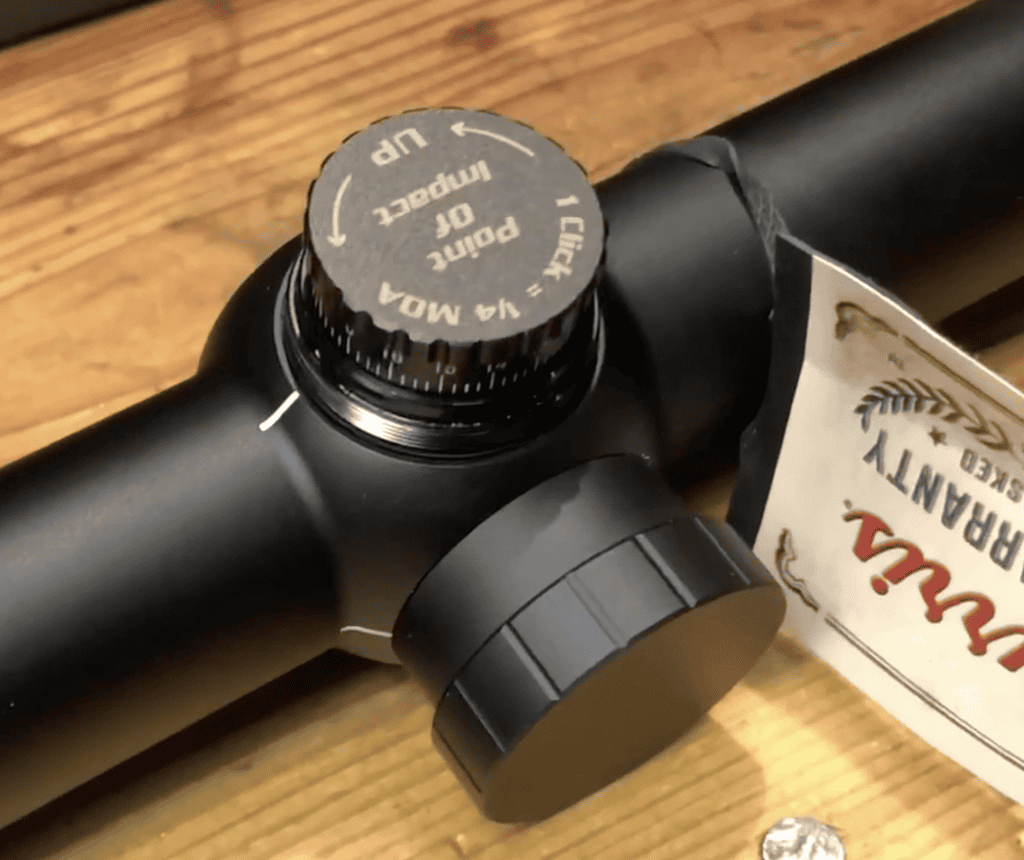
The finger-adjustable turrets let you make changes without tools, which sounds convenient until you try to make fine adjustments with gloves on. The knurled surface provides decent grip, but the clicks aren’t as crisp as the Vortex or Leupold. They work, they’re just less refined. I ran a simple box test at 50 yards to check tracking. Went up, over, down, back. Ended up about half a minute off from where I started. Close enough for hunting, not precise enough for serious target work.
Who Should Buy This
If you’re mounting a scope on a rifle your kids will learn on, or you want something functional for a truck gun that won’t make you panic if it gets banged around, the Droptine makes sense. The BDC reticle adds capability that plain duplex scopes don’t offer, and the Burris Forever Warranty means if something breaks, they’ll fix it. You’re compromising on glass quality and precision compared to the Crossfire II, but you’re also spending less.
Field Test Data
| Test Parameter | Result |
|---|---|
| Best 5-Shot Group @ 50 yards | 0.78 inches (from bench rest) |
| BDC Holdover Accuracy @ 100 yards | Within 1.5 inches using second mark |
| Turret Tracking (Box Test) | Accurate within 0.5 MOA, slight return-to-zero drift |
| Low-Light Performance | Usable 20 minutes after sunset |
| Eye Box at 9x | Tight, requires precise head position |
Tested on: Ruger 10/22 | CCI Standard Velocity 40gr
Pros and Cons
PROS
|
CONS
|
Performance Ratings
Learn more about how I test and rate scopes.
The Droptine won’t win awards for optical quality, but it delivers functional performance and a useful BDC reticle at a price that makes sense for budget-conscious shooters. Sometimes that’s exactly what you need.
4. Vortex Diamondback 2-7×35 Rimfire – Best for Extended Range
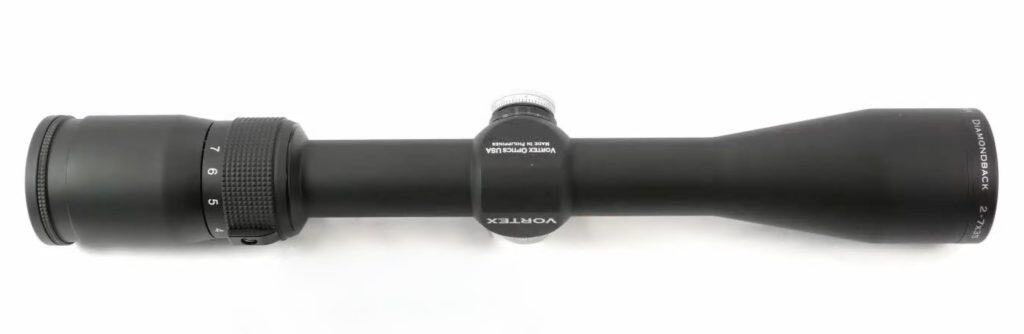
Double the Adjustment, But Do You Need It?
The Diamondback has twice the elevation and windage adjustment of the other scopes I tested. I spent time at distances past 150 yards to see if that extra range actually mattered for rimfire work. Turns out, it does if you’re serious about pushing .22 LR to its practical limits. At 175 yards, I was dialing significant elevation to connect with steel, and I still had plenty of adjustment left. The Crossfire II and Leupold would’ve run out of travel before I got there. For most shooters who never shoot past 100 yards, that adjustment is wasted capability. But if you’re into long-range rimfire precision or NRL22-style competitions, this scope has the guts to get you there.
The glass quality sits between the Crossfire II and the Leupold. Better than the Burris, not quite as refined as the Leupold’s premium coatings. I noticed better edge-to-edge sharpness than the Crossfire II when I compared them directly at 7x. Looking at small targets at 100 yards, the Diamondback resolved detail slightly better. The difference wasn’t dramatic, but it was there if you paid attention. Vortex’s XD optical system delivers on its promises without reaching Leupold territory.
Field of View That Actually Matters
At 2x magnification, the Diamondback gave me the widest field of view of any scope in this test. I set up multiple steel plates at 25 yards and practiced transitions between them. The wide view made picking up the next target noticeably faster than with the narrower scopes. For hunting situations where you might take quick shots at close range, that field of view advantage is real. Crank it to 7x and the advantage disappears, but the low-power performance impressed me.
What didn’t impress me was the eye relief. It’s fixed, not variable like the Leupold or Burris, and it’s tight. I found myself needing to maintain a very consistent cheek weld to avoid scope shadow. Any deviation from my established head position, and I’d lose the full sight picture. This became most noticeable when shooting from awkward positions or transitioning between targets quickly. The Crossfire II gave me more forgiveness, which I appreciated more as testing continued.
When the Adjustment Range Proved Its Worth
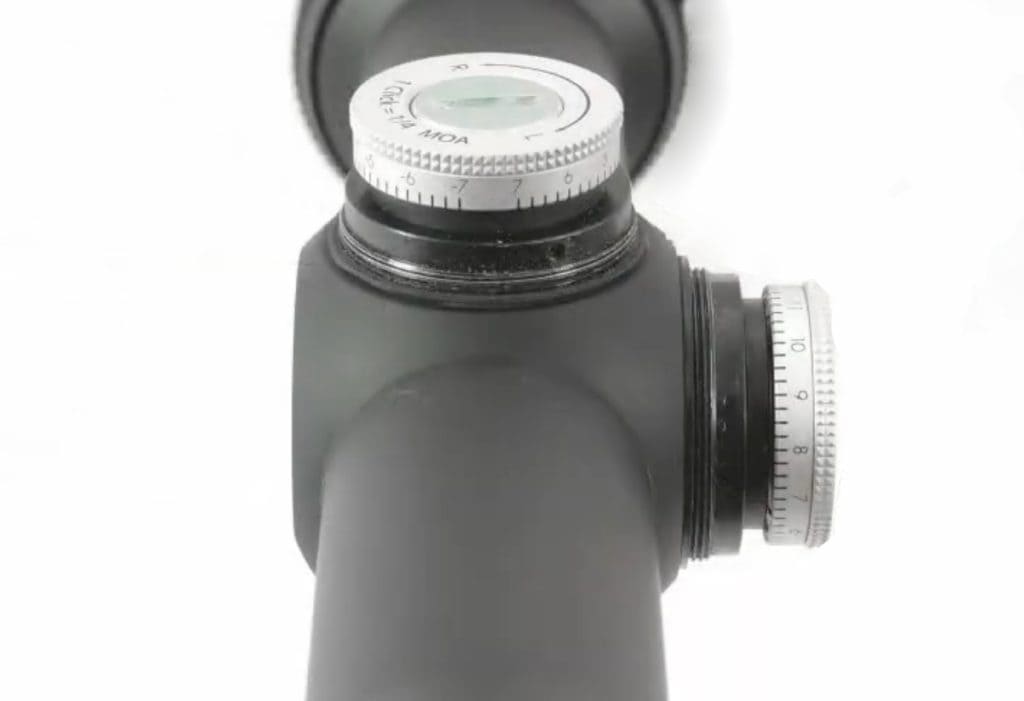
I zeroed at 50 yards with CCI Standard Velocity and started walking back. At 100 yards, I was about 20 clicks up from zero. At 150 yards, maybe 50 clicks total. At 175 yards, I’d dialed enough elevation that I was getting concerned about running out of travel on the other scopes. The Diamondback still had room to spare. I ran the turrets through their full range just to verify the tracking stayed consistent. No issues, smooth and predictable through the entire adjustment.
The turret clicks felt positive but not quite as crisp as the Crossfire II. They worked fine, just slightly less tactile feedback. I ran a box test at 50 yards and got perfect return to zero. The capped turrets stayed protected but were easy enough to access when needed. Zero-reset function worked smoothly when I tested it.
Who Benefits Most
If you’re shooting rimfire at distances where most people would switch to centerfire, this scope makes sense. NRL22 competitors, long-range precision rimfire shooters, or anyone who regularly stretches .22 LR past 150 yards will appreciate the extra adjustment range. For casual plinkers and hunters working inside 100 yards, you’re paying for capability you won’t use. The tight eye relief also makes this scope better suited for bench or prone shooting rather than field hunting where you might need quick target acquisition from varied positions.
Field Test Data
| Test Parameter | Result |
|---|---|
| Best 5-Shot Group @ 50 yards | 0.65 inches (from bench rest) |
| Turret Tracking (Box Test) | Perfect return to zero, no drift |
| Maximum Usable Distance | Connected reliably at 175 yards with adjustment to spare |
| Field of View at 2x | Widest tested, excellent for close transitions |
| Eye Relief Forgiveness | Tight, requires consistent head position |
Tested on: Ruger 10/22 | CCI Standard Velocity 40gr
Pros and Cons
PROS
|
CONS
|
Performance Ratings
Learn more about how I test and rate scopes.
The Diamondback delivers where it counts for long-range rimfire work, but the tight eye relief and specialized capability make it less versatile than the Crossfire II for general use.
An excellent choice for the 17 HMR as well.
How I Actually Tested These Scopes
All four scopes got mounted on the same Ruger 10/22 wearing Vortex Pro medium rings. I tested over three weeks in October and November at my family’s property outside Dallas, with temperatures ranging from mid-40s to high-60s. Every scope got zeroed at 50 yards with CCI Standard Velocity 40-grain ammunition, the same load I used for all group testing and trajectory verification. Total round count was around 650 rounds across all four scopes.
I shot from a bench rest at 25, 50, 75, 100, and 150 yards to verify parallax, optical clarity, and tracking. Each scope got at least five five-shot groups at 50 yards for accuracy baseline. I ran box tests on all four by dialing up, right, down, and left to check tracking and return-to-zero. Low-light testing happened during early November evenings, comparing target visibility as daylight faded. Field of view and eye relief I evaluated by shooting from various positions and noting how forgiving each scope felt.
Three scopes didn’t make the final cut. A Simmons .22 Mag I tested showed significant parallax error even at 50 yards despite being advertised as rimfire-specific, and the glass was noticeably soft around the edges. A Tasco rimfire scope I’d picked up on sale had turrets that felt mushy and didn’t track reliably in the box test. A BSA Sweet .22 lost zero after about 100 rounds, shifting point of impact without any adjustments being made. Those failures reinforced why I focused on established brands with proven track records.
Get more information on how I test optics here.
What Shooters Get Wrong About Rimfire Scopes
Using Centerfire Scopes on Rimfire Rifles
The most common mistake I see is mounting centerfire hunting scopes on rimfire rifles because “a scope is a scope.” Centerfire scopes have parallax set at 100-150 yards. When you shoot at typical rimfire distances of 25-75 yards, moving your head even slightly behind the eyepiece causes the crosshairs to shift across the target. This parallax error puts shots off by inches without you realizing why. Rimfire-specific scopes correct parallax at 50-60 yards where you’ll actually be shooting. That correction matters more for accuracy than any other single feature.
Buying Too Much Magnification
Shooters see 6-24x scopes marketed for precision and assume more magnification equals better performance. For rimfire work inside 100 yards, high magnification creates problems. The field of view gets narrow, making target acquisition slow. The eyebox becomes unforgiving, requiring perfect head position. You’re paying for weight and complexity you don’t need. A 2-7x or 3-9x scope handles everything from close plinking to 100-yard precision without the drawbacks of excessive power. Save the high-magnification scopes for centerfire long-range work where they belong.
Ignoring Eye Relief on Lightweight Rifles
Rimfire rifles are light, often under six pounds. When you mount a scope with tight or inconsistent eye relief, you’ll struggle to get a comfortable cheek weld that works across different shooting positions. Standing, kneeling, sitting, prone all put your eye in slightly different positions relative to the scope. Scopes with generous, consistent eye relief forgive those position changes. Scopes with three inches or less demand precision you won’t maintain in the field. Test eye relief in the store by shouldering the rifle in different positions before buying.
Trusting BDC Reticles Without Verification
Ballistic reticles calibrated for .22 LR sound convenient until you realize how much ammunition variation affects trajectory. Standard velocity, high velocity, and match-grade loads all drop differently. Temperature and altitude change velocity. The holdover marks might be close at one distance and completely wrong at another. If you buy a scope with a BDC reticle, verify every single holdover mark with your actual ammunition before trusting it in the field. The software estimates are starting points, not gospel truth.
Your Questions Answered
Can I use a centerfire scope on my rimfire rifle?
Technically yes, but parallax error at typical rimfire distances will hurt accuracy. Centerfire scopes focus at 100+ yards. When shooting at 50 yards or closer, your crosshairs won’t stay fixed on target as your head moves. Rimfire-specific scopes eliminate this problem by correcting parallax at 50-60 yards where you’ll actually shoot.
How much magnification do I really need?
For most rimfire shooting, 7x handles everything through 100 yards. Starting at 2x or 3x gives flexibility for close shots. Unless you’re shooting precision matches past 150 yards, magnification above 9x adds weight and cost without meaningful benefit. Match your magnification to realistic shooting distances.
Are budget rimfire scopes reliable enough?
Modern budget scopes from established brands like Vortex and Burris deliver reliable performance. They compromise on glass quality and refinement, not core functionality. Avoid unknown brands selling suspiciously cheap optics. Stick with manufacturers offering real warranties and proven track records.
Do I need adjustable parallax for rimfire?
For most shooters, fixed parallax at 50-60 yards works fine. Adjustable parallax helps if you regularly shoot from 10 yards out to 200+ yards. That flexibility costs more and adds complexity. Unless you’re covering extreme distance variations, fixed parallax is simpler and adequate.
What’s more important: glass quality or features?
Glass quality matters more than feature lists. Clear, sharp optics make shooting more enjoyable and accurate. Fancy reticles and excessive adjustment range don’t help if the image is dim or fuzzy. Prioritize optical performance, then consider features that match your actual shooting style.
Which Scope for Your Shooting Style?
For backyard plinking and casual target shooting: The Vortex Crossfire II handles everything you need. The 2-7x range covers close shots and 50-yard precision equally well, the 50-yard parallax keeps you accurate, and the simple reticle doesn’t get in your way. At this price point, you’re getting reliable performance without paying for features you won’t use.
For serious small game hunting: The Leupold VX-Freedom delivers glass quality that matters in low light when squirrels are most active. The Rimfire MOA reticle gives precise holdover points for varying distances. Yes, it costs more, but better optics mean cleaner kills and more successful hunts. The lightweight construction won’t weigh down your carry rifle either.
For teaching new shooters: The Burris Droptine makes sense here. It’s affordable enough that you won’t panic when kids inevitably bang it around, the BDC reticle teaches holdover concepts, and the warranty covers damage. You’re prioritizing durability and value over optical refinement, which is exactly right for learning rifles.
For NRL22 or precision rimfire competition: The Vortex Diamondback’s 100 MOA adjustment range gets you to distances other scopes can’t reach. If you’re regularly dialing for shots past 150 yards, that extra capability matters. The wide field of view at low power also helps with fast target transitions in match stages.
For a versatile do-everything rimfire setup: Circle back to the Crossfire II. It handles close plinking, medium-range target work, and hunting equally well without excelling at any single task. That versatility makes it the right choice when you’re not sure exactly what you’ll be doing with your rimfire rifle.
Disclosure
I purchased all four scopes tested in this guide with my own money from regular retail channels. No manufacturers provided test samples or compensation. The Amazon and OpticsPlanet links in this article are affiliate links. If you purchase through them, I earn a small commission at no extra cost to you. These commissions help cover testing expenses and keep ScopesReviews running. My recommendations remain honest regardless of affiliate relationships. I only recommend products I’ve actually tested and would mount on my own rifles.
Final Thoughts
The Vortex Crossfire II won this test because it solves the actual problems most rimfire shooters face. Proper parallax correction eliminates accuracy issues that many people don’t even realize they have. The 2-7x magnification range covers real-world shooting situations without excess. The glass quality delivers clear images without charging premium prices. It’s not fancy, but it’s exactly what rimfire work demands.
If you’re willing to spend more, the Leupold VX-Freedom justifies its price through genuinely better glass and useful holdover marks. For budget-conscious shooters, the Burris Droptine delivers functional performance with a BDC reticle that adds capability. And if you’re pushing .22 LR to extended distances, the Diamondback’s adjustment range matters. But for most shooters most of the time, the Crossfire II hits the sweet spot.
Rimfire shooting teaches fundamental skills without the recoil and expense of centerfire rifles. A proper scope makes that learning more effective and more enjoyable. The worst rimfire scope mistake I see is using whatever centerfire scope someone has lying around and wondering why groups won’t tighten up. Parallax error at close distances causes more missed shots than poor technique, and most shooters never figure that out.
After testing over 200 scopes across fifteen years, I’ve learned that specifications don’t tell the whole story. How a scope actually performs in your hands, on your rifle, at the distances you shoot, that’s what matters. These four scopes all work, they just work better for different applications. Match the tool to the task, verify your zero, and spend more time shooting than worrying about gear.

Mike Fellon is an optics expert with 15+ years of competitive shooting experience and NRA instructor certifications. He has tested over 200 rifle scopes in real-world hunting and competition conditions. Based in Dallas, Texas.