
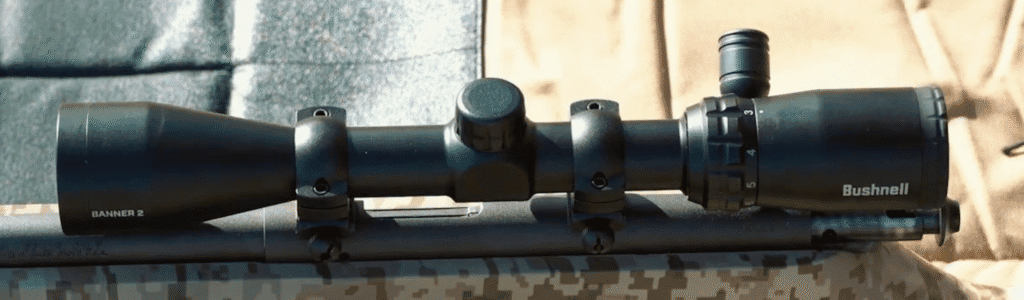
Most budget hunting scopes try to be passable at everything and end up forgettable at all of it. The Banner 2 takes the opposite bet. Bushnell built it around a single promise, usable light in the last and first minutes of legal shooting, and let the rest of the scope be merely adequate. The Dusk and Dawn coatings are the whole identity, the DOA Quick Ballistic reticle is along for the ride, and the price sits at the very bottom of the centerfire market.
I kept fielding the same question from people putting together a first deer rig: is the cheap Bushnell still worth buying when every forum pushes them toward something dearer? So I mounted one on a whitetail rifle and hunted it through a season to find out whether the low-light claim was real or just decades-old marketing with a new sticker. The answer interested me less than how sharply it splits. In the window it’s built for, it punches genuinely above expectations. Step outside that window and it’s an ordinary inexpensive scope. Whether that’s a bargain or a disappointment depends entirely on the kind of hunter you are.
Bushnell Banner 2 3-9×40 Review
The last twenty minutes of light are the entire pitch
Low-light marketing is some of the most abused language in optics, so I went in skeptical. Credit where it’s due, though. Sitting a field edge watching the gray come down, I had a real stretch of usable image after my naked eye had started giving up. Nothing miraculous, no night-vision trickery, but enough that I could still read a deer’s body and judge it when the bargain glass I’ve looked through in the same light had already turned to mud. The second-generation optical design seems to have picked up contrast over the original Banner I remember, especially in that flat, colorless light at the very end of shooting hours. For a scope at this price, that single quality is the reason the whole thing exists, and it does it honestly.
Daylight is where it turns back into an ordinary cheap scope
This is the part the marketing won’t tell you, and it’s the heart of why this scope is a specialist rather than an all-rounder. In flat midday light the Banner 2 is unremarkable. The center is clear enough, the edges soften, and you’ll find color fringing on a high-contrast line at 9x if you go looking. It’s fine. It’s also nothing you couldn’t get from a dozen other scopes in the bracket. The Banner doesn’t beat them at noon; it ties them. Everything that makes it worth seeking out is concentrated in that narrow band of failing light at either end of the day. Buy it for the middle of the day and you’ve bought an average scope. Buy it for the edges and you’ve bought something that genuinely outperforms its price.
The DOA reticle only speaks at 9x
The DOA Quick Ballistic gives you a main crosshair plus a column of holdover points with wind references. It’s clean and uncluttered, and the holds are genuinely useful for a hunter who’s confirmed where they hit. The trap, and I watched it confuse people firsthand, is the focal plane. This reticle lives in the second plane, so the holdover spacing is only correct at one magnification, which on this scope means topped out at 9x. Dial back to 5x or 6x and those drop points stop meaning what the ballistic app told you. That isn’t a defect, it’s how every SFP reticle behaves, but the marketing makes it sound like you can hold at any power, and new shooters believe it. You can’t. Confirm at full magnification, leave it there when you intend to use the holds, and the reticle does its job. For the close ranges this scope mostly works, the center crosshair and a little hold by eye covers the majority of shots anyway.
Long eye relief that earns its place on a kicker
The 5.11 inches of relief on the extended model deserves specific mention, because it’s the second thing this scope does better than its price suggests. On a .270 that comes back with some authority, that buffer is exactly what keeps a budget optic from clipping you above the brow. I’ve cleaned up enough crescent cuts on hunters who ran short-relief glass on hard-kicking rifles to value real margin when a maker builds it in. The eyebox snugs up at 9x and wants a consistent cheek weld for a full picture, but drop to the lower powers where most woods and field-edge shots happen and it opens right up, with fast target pickup.
Capped, simple, and a quick word on the rings
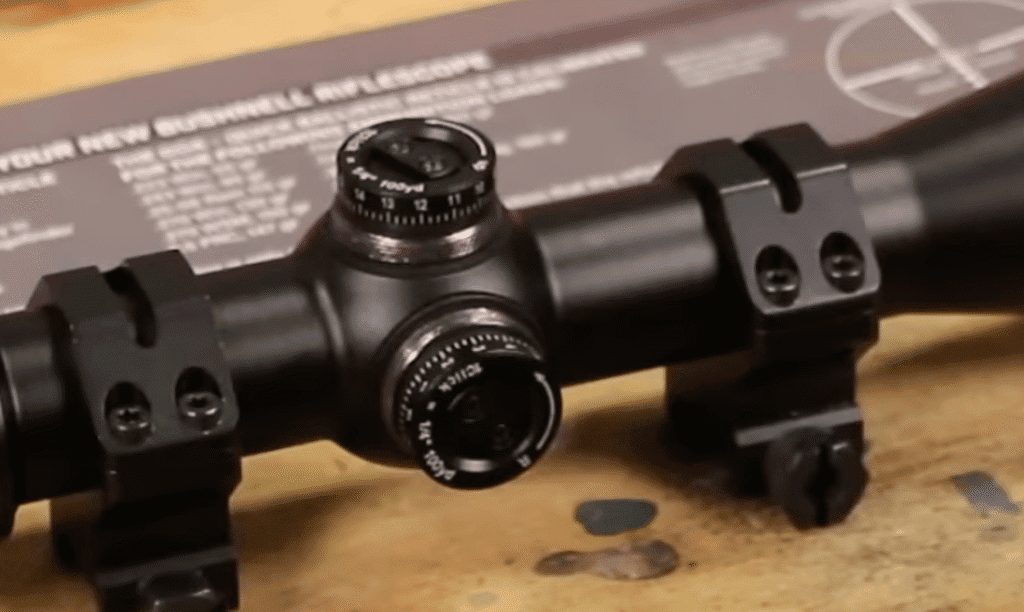
The turrets are capped, the right call here. You set zero, thread the caps down, and stop thinking about them. I confirmed zero and the scope held it through the season, including the usual truck-bounce and the odd knock against a stand ladder. The clicks are mushy, felt more than heard, but they tracked true enough for a zero-and-forget setup, and a basic box check came back clean. One caution worth flagging: the rings some packages include are soft pot-metal, and I’ve seen enough strip or gall during mounting that I swapped to a decent set off the bench before trusting it. Budget for real rings if yours ships with the cheap ones. It also stayed fog-free moving from cold morning air into a warm cab repeatedly, the kind of swing that exposes bad seals. This one held.
Hunting a Whitetail Season With This on a .270 in Mixed Timber
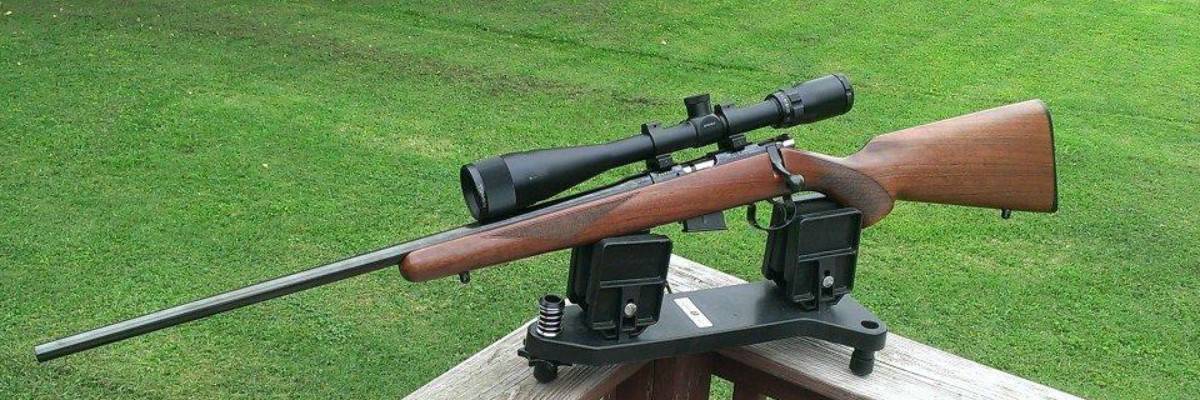
I put the Banner 2 on a Remington 700 in .270 Winchester, because that pairing is who actually buys this scope: a hunter who wants a capable, affordable deer rig without overthinking it. I fed it Winchester Super-X 130-grain Power-Point start to finish, a workhorse whitetail load that’s cheap enough to shoot plenty and proven enough to trust on game. Match ammo would have told you nothing useful about how this performs for the people actually shopping for it.
The season played out in mixed hardwood timber and field-edge country, the kind of ground where shots come early and late in flat light and rarely stretch far. That handed me repeated mornings and evenings in exactly the low-light window the Dusk and Dawn coatings exist for, which was the one thing I most wanted to verify. Roughly 110 rounds of the Winchester load went through across range work and field time. I confirmed zero at 100 yards, ran a box check on the turrets, and then let it ride through the cold, the damp, and the routine abuse of getting in and out of a stand. My chief worry going in was the reticle confusion I’d watched trip first-time buyers, so I deliberately tested the DOA holds at both full and reduced power to pin down what really happens. The whole rundown of how I put scopes through their paces lives in my full testing methodology.
Performance Ratings
Field Test Data
Tested with: Remington 700 | .270 Winchester | Winchester Super-X 130gr Power-Point
| Test Parameter | Result |
|---|---|
| Zero retention over season | No measurable shift after ~110 rounds and repeated field handling |
| Box check tracking (1/4 MOA clicks) | Returned to zero acceptably; minor deviation typical of the tier |
| Usable low-light window (vs naked eye) | Noticeable extra minutes of target ID at dawn and dusk |
| Daylight clarity vs tier rivals | Comparable, not superior; ordinary for the bracket |
| Eye relief on .270 recoil | Comfortable, zero scope contact across the session |
| DOA reticle hold validity | Correct only at 9x (SFP); off-power holds do not track |
Pros and Cons
PROS
|
CONS
|
Who Should Live With a Specialist Like This
This scope makes sense for one hunter above all: the low-light woods or field-edge hunter who does most of their killing in the first and last gray of the day. If you’re after whitetail or hogs at sensible ranges, you sit mornings and evenings, and you want a scope that holds zero and lets you judge an animal when it steps out at dusk, the Banner 2 is a smart, narrow buy. First-time centerfire owners and anyone setting up a backup or loaner rifle that lives for those windows should look hard at it. It’s also a strong pick on a rifle that kicks, since that long eye relief is real protection on a .270 or a .30-06.
Pass on it if you want a do-everything scope, because outside the low-light window it’s just average and your money buys average elsewhere too. Skip it if you intend to dial turrets for distance, since the capped, mushy turrets and fixed parallax aren’t built for that, or if you need to hold over at varying magnifications, which the SFP reticle won’t allow. And if illumination matters to you, note this variant doesn’t have it. This is a tool for a specific job. Match it to that job and it’s a bargain; ask it to be a generalist and you’ll be let down.
Common Questions About the Bushnell Banner 2 3-9×40
Is the Banner 2 actually better than the original Banner?
Yes, in the ways that matter for hunting. The second-gen optical design improves contrast and clarity over the original, especially in low light, and the DOA Quick Ballistic reticle is more practical than the old Multi-X for holdovers. The core Dusk and Dawn identity carries over.
Will it hold up to a .270 or larger calibers?
For a .270 like I tested, yes. The body handled the recoil and held zero all season, and the long eye relief protects you. Just replace soft included rings with quality ones, since bad mounting is where most so-called scope failures actually start.
Why don’t my DOA holdover points match my drops?
Almost always because you’re not at maximum magnification. This is a second focal plane scope, so the holds are only calibrated at 9x. Set it to 9x, confirm with the Bushnell Ballistics app, and the spacing works.
Does this version have an illuminated reticle?
This particular variant does not. Bushnell sells an illuminated DOA version separately, so check the model number before buying if illumination matters. Listings sometimes mix them up.
Is the fixed parallax a problem?
Not for normal hunting ranges. It’s set at the factory for typical distances and I never noticed an issue afield. You’d only see minor parallax error pushing it hard at high magnification on distant targets, which isn’t this scope’s job.
If a Specialist Isn’t What You Need
If you’d rather have a true all-rounder than a low-light specialist, the Vortex Crossfire II 3-9×40 sits a step up and trades the Banner’s edge-of-day advantage for more even, fully multi-coated performance across the whole day, plus Vortex’s transferable lifetime warranty, which is worth real money on a scope you keep for years.
If dialing for distance matters more than zero-and-forget hunting, neither the Banner nor a base Crossfire II answers it; step up to a Vortex Diamondback, which gives you a more capable turret system and crisper adjustments for the hunter who actually wants to make elevation corrections afield.
And if you want the low-light edge but with better build quality and a tougher all-around feature set in roughly the same neighborhood, the Leupold VX-Freedom brings Leupold’s durability and clarity, trading away some of the Banner’s standout low-light value for a more refined package.
Disclosure
This review may contain affiliate links, which means I could earn a small commission if you purchase through them at no extra cost to you. Affiliate relationships do not influence my evaluation. The assessment here reflects my honest findings from testing this scope, period.
A One-Window Scope, and a Good One If That’s Your Window
The Bushnell Banner 2 3-9×40 does one thing and does it well: it hands you genuinely usable light at the edges of the day for money almost anyone can swing. That low-light glass is the reason to own it, the long eye relief is a real bonus on a hard-kicking rifle, and it held zero through a full season on my .270 without complaint. None of that makes it a generalist, and trying to use it as one is how you end up disappointed.
It’s an easy recommendation for the hunter who shoots at sensible ranges, sits the gray hours, and isn’t trying to dial turrets or hold over at varying power. Go in with two facts straight: the DOA reticle only works at 9x, and you may need to swap the rings. Get those right and this scope will outshoot its price every dim morning you carry it. For the specialist it’s built for, that’s a deal worth taking; for everyone else, keep looking.
Mike Fellon is the founder of ScopesReviews and an optics specialist with 15+ years in precision shooting. A former Bass Pro Shops firearms advisor and NRA-certified instructor, he’s hands-tested 200+ rifle scopes across hunting and competition. Based in Dallas, Texas.