
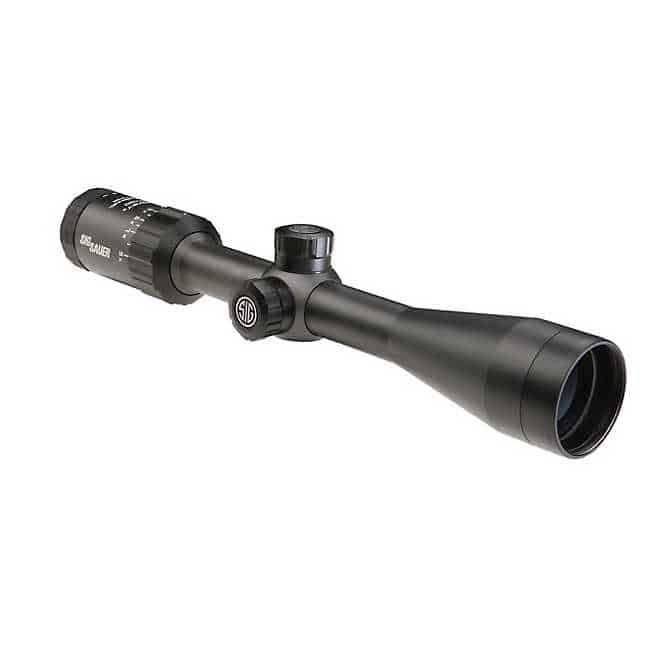
Sig Sauer scopes are made in the Philippines, Japan, and the United States — the specific country depends on the model, not just the product line name. The short answer breaks down like this: Sierra scopes are most likely made in the Philippines, Whiskey3 scopes are made in the Philippines, Whiskey5 scopes are made in Japan, and the Tango6T (the military-contract variant) is assembled in the USA. Sig Sauer Electro-Optics is based in Wilsonville, Oregon, where R&D, design, QC, and assembly of premium models happen.
The Three Lines — What’s Made Where
Sig Sauer organizes its riflescopes into three named families: Sierra, Whiskey, and Tango. The country of origin is more granular than the simple three-country split you’ll see on most sites — it varies by specific model within each line.
Sierra — Most Likely the Philippines
The Sierra line covers Sig’s entry-level hunting optics. Key models include the Sierra3BDX and Sierra6BDX, both built around Sig’s BDX (Ballistic Data Xchange) system — a Bluetooth integration with compatible Kilo rangefinders that automatically adjusts your holdover reticle based on real-time ballistic data. It’s a genuinely useful feature if you’re already in Sig’s ecosystem.
Multiple sources indicate the Sierra line is made in the Philippines, though some cite China — Sig Sauer does not officially publish country-of-origin data for the Sierra on their product pages. If you need certainty, check the box when you receive it or contact Sig directly. What is clear: Sig’s Electro-Optics team in Wilsonville handles QC regardless of where the unit originates.
Whiskey3 — Philippines / Whiskey5 — Japan
This is where the simple “Whiskey = Philippines” summary breaks down. The Whiskey3 is assembled in the Philippines. The Whiskey5 — including the Whiskey5 HD — is manufactured in Japan, machined from a single piece of aluminum. Japan-made glass at this price point ($400–$700) is a different proposition than Philippine-assembled optics: tighter machining tolerances, better glass coatings, and more consistent edge-to-edge clarity.
If you’re choosing between the Whiskey3 and Whiskey5, the country of origin is one real factor in the price difference — you’re not just paying for the extra magnification range.
Tango6 — Japan / Tango6T — Assembled in Oregon, USA
Another split within a line. The commercial Tango6 (3-18×44, 5-30×56) is manufactured in Japan, designed by Sig’s Oregon team. The Tango6T (1-6×24) — the military-contract variant selected by the U.S. Army — is assembled at Sig Sauer’s ISO-certified Electro-Optics facility in Wilsonville, Oregon. Sig is transparent that some internal components may be sourced internationally even for the Tango6T, but the assembly and QC are domestic.
The Tango6T earned Sig real credibility in the precision and tactical market. It won a $77 million U.S. Army contract for M4 carbine optics, was selected for SOCOM’s Squad-Variable Powered Scope program, and is used by multiple law enforcement agencies. It competes directly with Nightforce ATACR and Steiner P4Xi at comparable magnification and price.
Quick Reference: Sig Sauer Scopes by Country
| Model | Made In | Price Range | Best For |
|---|---|---|---|
| Sierra3BDX, Sierra6BDX | Philippines (likely) | $250–$500 | Budget hunting, BDX users |
| Whiskey3 | Philippines | $300–$450 | Entry-level hunting |
| Whiskey5, Whiskey5 HD | Japan | $400–$700 | Mid-range hunting, deer/elk |
| Tango6 (3-18x, 5-30x) | Japan | $800–$1,400 | Precision, long range |
| Tango6T (1-6×24) | USA (Wilsonville, OR) | $1,200–$2,000+ | Tactical, military, competition |
Does Country of Origin Actually Matter?
For most hunters and recreational shooters, not as much as you’d expect. The Sierra and Whiskey3 scopes hold zero reliably for typical hunting distances and track reasonably well. The real gap shows up in low light, at extended range, and under hard recoil over thousands of rounds.
If you’re shooting whitetail in Texas at 200 yards at first light, a Sierra3BDX paired with a Kilo rangefinder will do everything you need. If you’re making shots on elk at 400+ yards in flat light, the Whiskey5 HD’s Japanese glass makes a noticeable difference. And if you’re running a precision rifle at extended range or need a combat-ready optic, the Tango6T’s US assembly and military pedigree matter beyond the marketing.
My Take After Running Them
I’ve had Sig scopes across all three lines on the range and in the field. The Sierras are honest budget glass — the BDX system is genuinely useful, not a gimmick, especially if you’re solo hunting and ranging and shooting without a spotter. The Whiskey5 HD surprised me; the Japanese glass at that price point is better than I expected coming from a brand that also makes budget optics. The Tango6T is in a different class — clean glass, repeatable turrets, rock-solid return to zero. From handling them at the counter and putting rounds downrange, I haven’t had a consistency problem with any of the three lines. Sig’s QC hold up.
How Sig Compares to Rivals at the Same Price
At the Sierra price point ($250–$500), competition includes the Vortex Crossfire II, Diamondback, Leupold VX-Freedom, and Bushnell Engage. Sig’s edge is the BDX ecosystem. Outside of that ecosystem, the Vortex Diamondback HP is a stronger pure-glass buy at comparable money.
At the Whiskey5 tier ($400–$700), you’re up against the Vortex Viper, Leupold VX-3HD, and Burris Fullfield IV. The Whiskey5 HD is competitive; the Leupold VX-3HD has the edge on tracking feel and build quality for hard field use, but the Sig’s glass holds its own. At the Tango6T tier ($1,200+), you’re comparing against Nightforce ATACR 1-8x and Steiner P4Xi — serious company for a serious optic.
A Note on Sig Sauer’s Background
Sig Sauer’s roots go back to 1853, when a Swiss company — SIG (Schweizerische Industrie-Gesellschaft) — began making firearms after starting as a railway carriage manufacturer. The “Sauer” in the name comes from J.P. Sauer & Sohn, a German gunmaker with roots to 1751, which partnered with SIG in 1976 to form the combined brand. Sig Sauer Inc. established its U.S. presence in the mid-1980s. Today the firearm side operates out of Newington, New Hampshire; the Electro-Optics division — design, engineering, QC, and assembly — is based in Wilsonville, Oregon.
Verdict
Where a Sig Sauer scope is made tells you more than most buyers realize — and it’s more nuanced than the three-line breakdown suggests. The Sierras are solid budget buys, especially in the BDX ecosystem. The Whiskey5 HD’s Japanese glass is the value sweet spot in the lineup. The Tango6T is the real deal — US-assembled, military-vetted, and it earns its price. Don’t pick or skip a Sig based on where it’s made; pick based on whether the glass and features match what you’re actually shooting.
Mike Fellon is the founder of ScopesReviews and an optics specialist with 15+ years in precision shooting. A former Bass Pro Shops firearms advisor and NRA-certified instructor, he’s hands-tested 200+ rifle scopes across hunting and competition. Based in Dallas, Texas.