
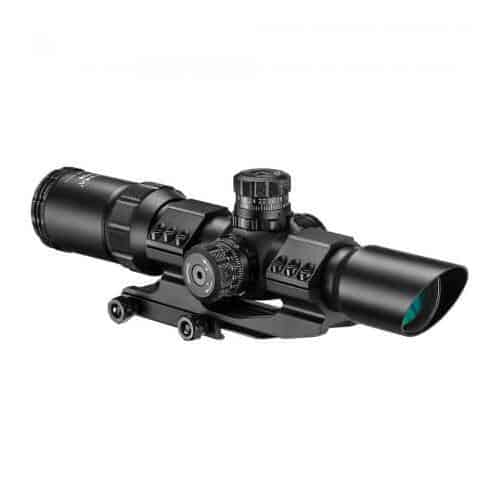
Barska scopes are made in China. The company designs its products in the United States, at its headquarters in Pomona, California, then contracts manufacturing to Chinese factories. That’s the short answer. Here’s what actually matters for a buyer.
Where Are Barska Scopes Made?
All Barska rifle scopes are manufactured in China. The company was founded in 1994 and remains headquartered in Pomona, California, where it handles product design, warehousing, and U.S. distribution. But production happens overseas: China is where the glass is ground, the tubes are machined, and the scopes are assembled.
That’s a common setup for budget optics brands. Barska keeps prices low by leveraging China’s established optical manufacturing infrastructure, while claiming to enforce its own quality specifications on each production run. There is no publicly disclosed OEM partner; Barska does not name the specific factory or factories it works with.
The Pomona facility is not a manufacturing plant. It’s a U.S. base for the business side: design, distribution, and customer service. When your scope ships from Barska, it was made in China and warehoused in California.
About Barska
Barska was founded in 1994 and has grown into a broad-spectrum optics company. Rifle scopes are a core part of the lineup, but the brand also makes spotting scopes, binoculars, red dot sights, rangefinders, and even biometric gun safes. They distribute to retailers in over 40 countries and are listed among the top 100 sporting goods brands in multiple international markets.
The brand’s position is clear: they are targeting budget-conscious buyers. Barska is not trying to compete with Leupold or Vortex on glass quality. They are competing on price accessibility: get a working optic on a rimfire or entry-level centerfire rifle without spending $200+.
Barska Scope Lineup: Models and Price Tiers
Barska offers several scope series aimed at different use cases. Here’s a practical breakdown:
- Plinker-22 Series: Built specifically for .22 LR rimfire. Parallax-free at 50 yards, 30/30 reticle, fully coated optics, often includes rings. Typically $30–$60. Best for backyard plinking or a kid’s first rifle.
- Huntmaster Series: General-purpose hunting scopes in the 3-9x40mm range. Quick-targeting reticle, 1/4 MOA adjustments, fog and waterproof. Usually $60–$120. Adequate for deer hunting at moderate ranges.
- Colorado Series: Similar general-hunting spec at a slightly different price/feature mix. Often bundled with mounts.
- Varmint / AO Series: Higher magnification options (6.5-20×50, 6-24×50) with adjustable objective. Marketed for long-range varmint shooting. $80–$150 range.
- AR-X Pro / Electro Sights: Tactical-style and illuminated reticle options for AR platforms.
Does Country of Origin Affect Quality?
Yes and no. China produces optics across the full quality spectrum, from garbage to genuinely good. Where a scope is made matters less than who is specifying the build and what QC is in place. Barska’s Chinese manufacturing does not automatically make it bad, but their price points reflect real constraints on what glass quality and mechanical tolerances are achievable.
Honestly: Barska scopes are serviceable for their price class. For rimfire and casual use, a $40 Plinker-22 does what it says. For hunting inside 200 yards in decent light, the Huntmaster line will hold zero and give you a clear enough image. Where Barska struggles is edge-to-edge clarity, low-light performance, and long-term mechanical durability under heavy recoil, areas where spending more buys you real improvement.
At a similar price, the Vortex Crossfire II and Primary Arms SFP both offer better glass and more reliable adjustments, and both are also made in China or the Philippines. The difference is specification and quality control, not the country itself. If your budget stretches to $150+, that’s where I’d look first over Barska.
Quick Comparison: Barska vs. Budget Competitors
| Brand | Made In | Price Tier | Best Use |
|---|---|---|---|
| Barska | China | $30–$150 | Rimfire, casual centerfire, beginners |
| Vortex Crossfire II | China/Philippines | $150–$250 | Hunting, general purpose |
| Primary Arms SFP | China/Philippines | $100–$200 | Tactical, hunting |
| Simmons / Tasco | China | $25–$80 | Rimfire, entry-level |
My Take on Barska Scopes
I’ve handled and mounted a fair number of Barska scopes over the years, behind the counter and on the range. They’re not impressive optics, but they’re not fraudulent either. A Plinker-22 on a .22 LR bolt gun for a new shooter is a completely reasonable setup. The Huntmaster models I’ve looked through have acceptable clarity in full daylight at ranges where most deer hunting happens. What I’ve noticed is that the low-light performance drops off early; past golden hour, you’re squinting. Reticle tracking under heavy centerfire recoil is where I’d be more skeptical; I wouldn’t put one on a hard-kicking magnum and expect it to hold zero long-term.
For more detailed breakdowns of individual models, see my Barska scope reviews; I’ve tested several and called out both the good and the weak points.
Who Are Barska Scopes Best For?
Barska makes sense in specific situations:
- A rimfire or air rifle that doesn’t justify a $200 optic
- A first-time shooter learning fundamentals before investing in quality glass
- A dedicated range or “beater” rifle you don’t want to put real money on
- Budget hunters taking shots inside 150 yards in daylight conditions
Barska is not the right pick for precision shooting, hard-use hunting in tough conditions, or any application where glass clarity and mechanical reliability matter at the margin. Once you’re looking at centerfire deer rifles with serious range expectations, the extra $100–150 for a Vortex Crossfire II or a Leupold VX-Freedom is money well spent.
Mike Fellon is the founder of ScopesReviews and an optics specialist with 15+ years in precision shooting. A former Bass Pro Shops firearms advisor and NRA-certified instructor, he’s hands-tested 200+ rifle scopes across hunting and competition. Based in Dallas, Texas.